
Will Your Divorce Destroy the Image of Christ and the Church?
John Piper’s Counsel to Christians Whose Friends Are Divorcing
In a widely circulated “Ask Pastor John” video episode, John Piper answers a question about how Christian friends should respond when a couple chooses divorce. His answer is strong and unambiguous. Friends, he says, should pursue them and “plead with them not to shatter the image of Christ and his church.” That language is arresting. It raises an important question: Does the Bible actually teach that a Christian’s divorce destroys Christ’s image? And if not, what happens when pastors frame divorce that way — especially in cases involving abuse, addiction, or betrayal?
Primary sources:
• John Piper, “Divorce & Remarriage: A Position Paper” (1986, updated 1989)
• “How to Respond to Christian Friends Who Choose Divorce,” Ask Pastor John (YouTube)
Piper notes that his position paper reflects his own understanding and is not the official position of his church, though he drafted its original statement. He asks for humility and openness to correction. That is commendable.
But in the video, his pastoral prescription relies on maximum-pressure language — “shatter the image of Christ and his church” — that can function as intense spiritual leverage. Elsewhere, he argues that divorce is not permitted even in cases of adultery.
He goes further: “Frankly I think in our culture we need to make it (divorce) harder not easier.” When a pastor who rejects even adultery as grounds urges friends to “make it harder,” abuse survivors hear something chilling: if adultery doesn’t qualify, what possibly could?
Harder for whom? And at what cost?
This video was sent to me by an abuse survivor. She was not looking for a theological debate. She was shocked and deeply hurt. As she listened to a pastor urge Christians to “pursue” and “plead with tears” so that someone would not “shatter the image of Christ,” she did not hear shepherding. She heard pressure. She heard judgment. She heard that her attempt to escape harm could make her an enemy of God.
Abuse victims often sit quietly in our churches. Their voices are rarely centered when divorce is discussed. But they are listening. And pastors need to understand how their words land on people whose marriages are not merely unhappy — but unsafe.
1. “Pursue Them and Plead”: Confrontation or Care?
Piper says friends should “pursue them and plead with them not to shatter the image of Christ and his church.” In other words, do not stay neutral. Go to them. Insert yourself. Apply moral weight to the decision.
Notice what is not mentioned first: careful listening, safety assessment, or curiosity about what is happening inside the marriage. When a spouse is facing infidelity, coercive control, severe addiction, criminal behavior, or physical violence, the immediate pastoral question is not, “How do we preserve appearances?” It is, “Is this person safe?”
There is a significant difference between rescuing a struggling marriage and pressuring a person to remain in harm’s way. Christians are called to weep with those who weep.
The Good Samaritan did not begin with a lecture about public witness; he began by binding wounds. If you are going through a life-saving divorce and someone confronts you with this rhetoric, you are not morally obligated to accept their pressure. Friends are not the Holy Spirit. They do not carry responsibility for your safety, sanity, or daily reality. God does not deputize acquaintances to control your conscience.
2. Does Scripture Say Divorce “Shatters” Christ’s Image?
The claim that divorce destroys Christ’s image rests primarily on Ephesians 5, where marriage reflects Christ and the Church. But Ephesians 5 is a metaphor describing covenant faithfulness — not a command to preserve appearances at the expense of the vulnerable. Scripture complicates the “shattering” claim in several ways:
- In Jeremiah 3, God uses divorce imagery of himself having been betrayed by spiritual adultery.
- In Matthew 19, Jesus explains that divorce was permitted because of hardness of heart.
- In 1 Corinthians 7, Paul acknowledges abandonment and says the believer is “not bound.”
- Throughout Scripture, God repeatedly prioritizes protection of the oppressed.
If divorce automatically shattered Christ’s image, these passages would be impossible to reconcile. More importantly: Is Christ’s glory truly so fragile that a wounded believer’s legal action can damage him?
Jesus is more powerful than death, disease, betrayal, and sin. Your divorce cannot destroy him.
What does distort Christ’s image is ongoing cruelty, violence, deceit, and covenant treachery. When we treat divorce as the central scandal, we risk ignoring the behaviors that destroyed the marriage in the first place.
3. What’s Missing: Safety Screening
Piper encourages friends to offer help — counseling, financial assistance, rebuke if needed. Offering support is good. But responsible pastoral care must begin with assessment of safety. Have there been threats? Violence? Coercive control? Sexual immorality? Addiction patterns that endanger children? Criminal behavior? People in crisis often do not disclose the worst details publicly.
Churches are not entitled to a full evidentiary hearing before someone seeks safety. Nor should victims be required to prove they “tried hard enough.” Without safety screening, pressure to “make divorce harder” can unintentionally trap victims in dangerous situations.
4. Church Discipline and Divorce
Piper references situations where church discipline was enacted when someone refused counsel and pursued divorce. Church discipline has biblical warrant when someone persists in unrepentant, destructive sin. But discipline aimed at punishing a spouse for seeking safety is an abuse of spiritual authority.
Jesus, Paul, and the Law of Moses all acknowledge circumstances in which divorce occurs. Treating every divorcing spouse as the moral aggressor ignores biblical nuance.
5. “Make It Harder Not Easier”: Harder for Whom?
Piper laments that some scholars have made divorce “easier.” He says, “Frankly I think in our culture we need to make it harder not easier.” But historically, making divorce harder has rarely constrained powerful abusers. It has constrained the vulnerable from getting to safety.
When a life-saving divorce is made culturally, legally, or spiritually impossible, the person with less power — often the abused spouse — bears the cost. Marriage is sacred. So is human life. And divorce has been shown to reduce women’s suicide, homicide, and domestic violence rates.
Piper Applauded When Divorced Son Remarried
In his 1986 paper, Piper argues that remarriage after divorce is prohibited while both spouses live. Yet when his own son, Barnabas Piper, divorced and later remarried in 2020, it has been reported that John Piper attended the wedding, sat in the front row, applauded, and celebrated the union.
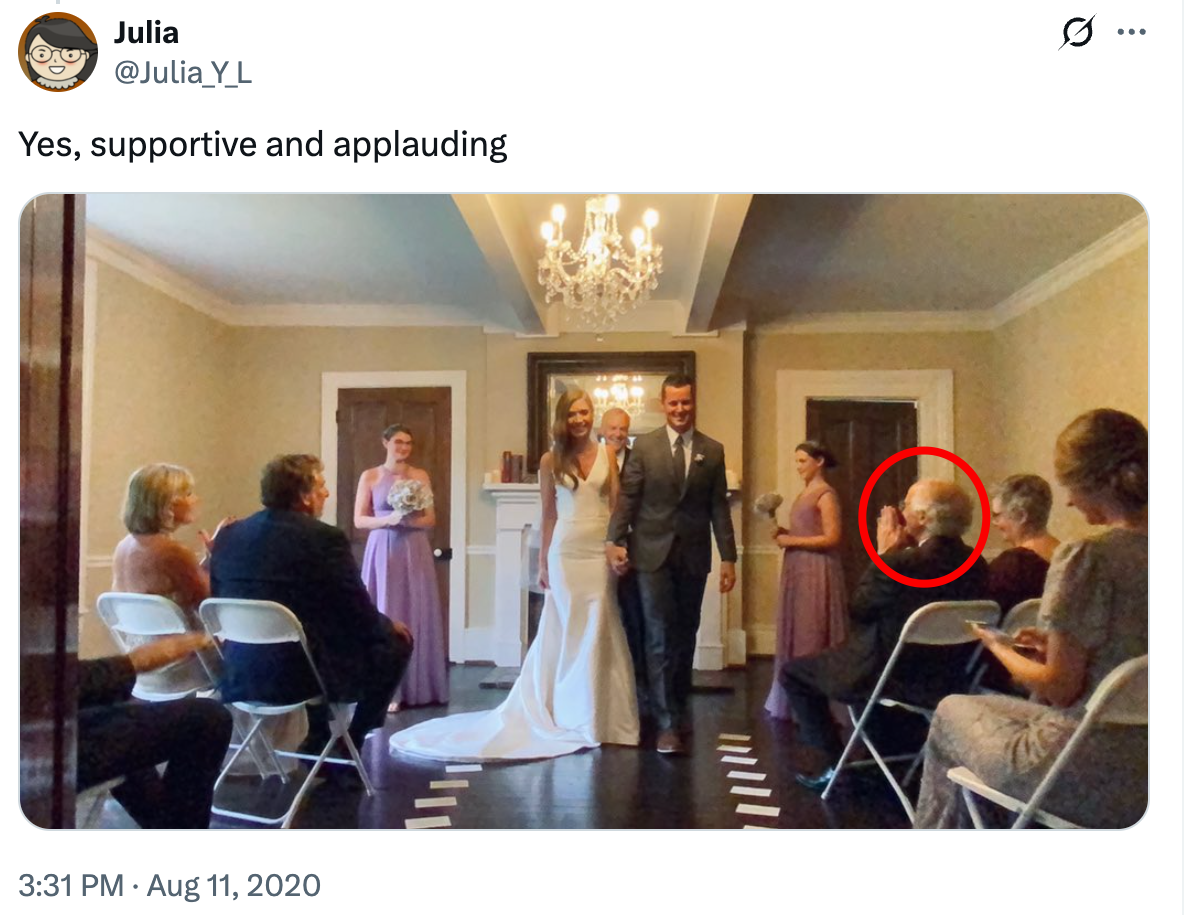
Click to enlarge
I am glad he did. Parents should love their children. Presence is better than estrangement.
That moment reveals something important: when divorce hits close to home, a father’s own pastoral instincts often turn more relational than punitive. The real question is whether that same kindness and support are offered to everyone—or only to a small circle of well-regarded insiders. Since Piper has not publicly revised his documented position, the evidence points to the latter. Double standards are worth noticing, especially when it involves Christian leaders who publicly shame those who choose divorce, like Greg Smalley, a VP at Focus on the Family.
No One Enters Marriage Hoping It Will Fail
Most Christians marry prayerfully, sincerely, and with hope. Divorce is almost always the last chapter of a long story of fracture. Sometimes it is the tragic result of hardness of heart. Sometimes it is the necessary result of ongoing danger.
We have a choice: protect the symbol, or protect the person. Jesus consistently moved toward the wounded, not away from them. He did not preserve public optics at the expense of suffering individuals.
The Bible allows divorce in cases of sexual immorality, abandonment, and patterns of destructive, covenant-breaking behavior that endanger the innocent.
For a fuller biblical treatment, see Adultery, Abuse, and Abandonment are Biblical Grounds for Divorce or Chapter 6 of The Life-Saving Divorce.
Divorce does not threaten Christ’s glory. His covenant faithfulness is not fragile. He conquers sin; he exposes injustice; he sets captives free. And at times, divorce is the boundary he uses to end covenant-breaking abuse and release his people from captivity.
A Last Thought
In this John Piper tweet on marriage, it’s important to remember a wedding certificate records a promise that each person made — it doesn’t record the fulfillment of the promise or guarantee safety, faithfulness, or lifelong covenant integrity.
A story in the Bible gives us an example:
In the Old Testament, King Saul was:
- the RIGHT king,
- the HAND-SELECTED king,
- the GOD-ORDAINED king.
But King Saul’s own lies and deceit caused God to reject and replace him. The same goes for a spouse who sin, betrays, and cheats.

Desiring God tweet (May 13, 2020) quoting John Piper: “Put out of your mind every thought that you may be married to the wrong person… look at the name on your wedding certificate.”
Your spouse may have been a person who behaved with integrity at the beginning of your marriage. Your decision to marry them was likely bathed with prayer and blessed by your church. But having their name on a wedding certificate does not prevent them from taking the wrong path and sinning repeatedly and deliberately.
Recommended Reading
To explore these issues further, the following resources examine the biblical texts, theological arguments, and practical concerns.
- John Piper Part 1: Does Divorce Destroy the Image of Christ and the Church?
Piper warns that divorce can “shatter” the picture of Christ and the church. I examine whether Scripture places that burden on an injured spouse—and why ongoing cruelty and covenant-breaking behavior are the real distortion of Christ’s love. - John Piper Part 2: This Momentary Marriage—When “Staying Married” Becomes the Goal
My review looks at wife Noël Piper’s candid description of profound conflict and unhappiness in their own marriage. It also discusses Piper’s unusually strict position on divorce and remarriage, the book’s emphasis on permanence. - John Piper Part 3: Did He Retract His “Smacked One Night” Advice?
This article traces Piper’s wife-abuse statements from 2009 through 2020 and asks whether his later comments amounted to a genuine retraction, correction, or apology.
Related Biblical Resources
- 1 Corinthians 7:10 Explained: What Paul Meant About Separation and Remarriage
A closer look at Paul’s instructions to married Christians, including what the passage does—and does not—say about separation, abandonment, and remarriage. - Romans 7 Does Not Teach “Marriage Ends Only at Death”
- Can the Innocent Spouse Remarry? Biblical Scholar Dr. David Instone-Brewer Says Yes
- Marriage Is a Conditional Covenant, Not an Unbreakable Promise
Biblical covenants contain responsibilities. A marriage certificate records promises, but it does not prove that both spouses have faithfully kept them. - Wayne Grudem Supports Divorce and Remarriage After Abuse, Adultery, and Abandonment
Grudem explains why serious abuse can function like abandonment and why the innocent spouse may be free to divorce and remarry. - Can Christians Divorce for Abuse?
- The Bible Teaches Us to Get Away from Abusers
Scripture repeatedly shows faithful people escaping violent, deceptive, and destructive individuals rather than remaining available for further harm. - Safety-First vs. Marriage-First Counseling
Marriage-first counseling asks how to preserve the relationship. Safety-first counseling begins by asking whether the spouse and children are safe.
Additional Reading and Context
 :
:
 :
: Buy PDF