
Official Christian Denominational Divorce Rules: Abuse, Adultery, and Remarriage
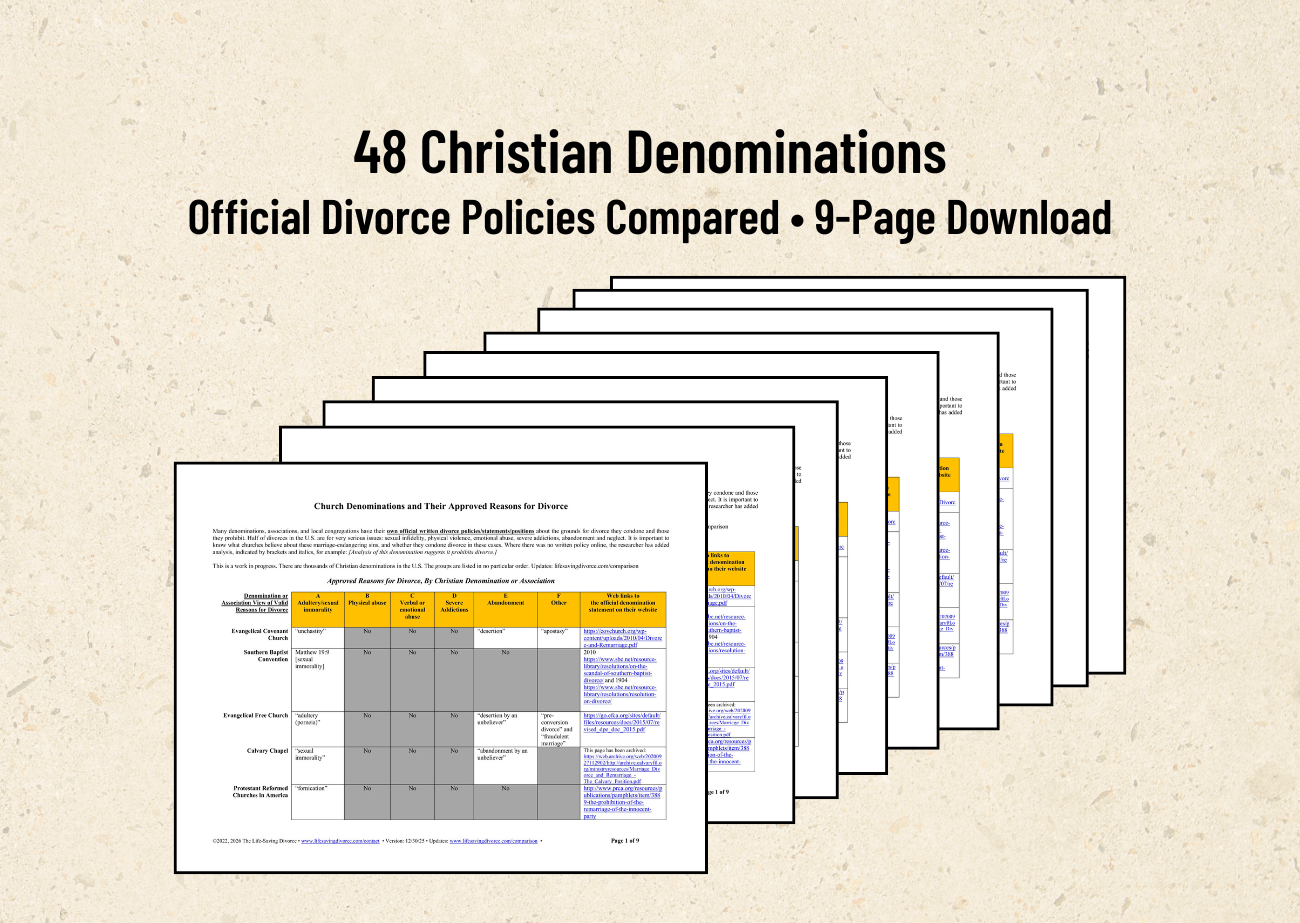
Side-by-side comparison chart of more than 45 church denominations’ public policies
▶️ Watch the short 2.5-minute video overview here
This 9-page comparison chart shows more than 40 Christian churches, denominations, and associations using their own publicly available official divorce policies. The link is below.
My motivation is simple: abused and betrayed spouses deserve to know whether they will find support to leave a destructive marriage—or whether they will be pressured to stay. This comparison includes only what each organization states explicitly, because vague wording can leave survivors dangerously uncertain. Where no written policy was available online, I have added brief bracketed analysis in italics.
Church policies frequently specify which divorces they recognize as biblically permissible—such as those involving adultery, abandonment, or abuse—and whether remarriage is allowed. But many policies are unclear or silent about emotional abuse and coercive control, leaving victims unsure whether they will be supported—or disciplined. For that reason, this chart is designed as a practical reference tool, not a commentary: it documents only official statements and provides updated links so readers can verify each source directly.
Summary: This resource compares over 45 Christian denominations using their official divorce policies, especially regarding abuse, adultery, addictions, abandonment, and remarriage. This resource is educational and informational, not legal or pastoral counseling advice.
Key topics covered: abuse, adultery, abandonment, remarriage, and church discipline.
How to Download the Most Recent Version
- This document is updated regularly with corrections, additions, and policy changes. For that reason, it is hosted on Dropbox:
Click HERE to Download the Chart
- When you arrive at Dropbox, click the PDF icon to download the most current version.
8 Common Questions about This Chart
1. Where did you find this information?
I went to the official website of each organization and reviewed their written policy statements directly. I’ve posted the links to each official site in the chart itself.
This review is intentionally narrow. I am not evaluating whether a group cares about abuse victims, provides domestic violence resources, or has compassionate pastors. I am asking one question: What does the official written divorce policy publicly say? When I say I reviewed their “policies,” I mean “statements,” “affirmations,” “guidelines,” “codes,” “values,” or whatever else a normal person, making a good faith effort to determine the church’s stance would readily find in a 5-minute best-effort search.
If a policy names approved grounds such as adultery or abandonment—but does not explicitly name abuse, coercive control, severe addiction, or neglect—I do not assume they are included. In safety matters, silence is not clarity.
This matters because unclear policies create two chilling effects.
First, they chill victims. Abuse victims often read church policies while frightened, isolated, financially vulnerable, and worried about church discipline, custody, reputation, and their children’s safety. If abuse is not clearly named as valid grounds for divorce, many victims will conclude they do not have permission to leave—or that they must prove a more “acceptable” form of betrayal before their church will support them.
Second, unclear policies can chill pastors and make victims feel betrayed. The divorce question is often part of hiring, credentialing, ordination, or ministry review, so pastors may know that openly supporting divorce for abuse could be viewed as violating denominational doctrine. Some may speak compassionately in private while the victim is trying to survive, but when the victim finally chooses divorce, the pastor may withdraw support, attack the victim, or defer to the official policy. That leaves victims confused, isolated, and doubly wounded—first by the abusive spouse, then by church leadership.
Official policy matters because it sets the boundaries for both victims and pastors. Clear public wording protects the vulnerable and gives good pastors permission to do the right thing openly.
2. Do you have evidence that half of divorces in the U.S. are for very serious issues, not frivolous at all?
Yes. According to multiple major studies, about half of divorces involve serious issues such as adultery, sexual immorality, physical abuse, emotional abuse/control, addictions, abandonment, or severe neglect.
For a deeper discussion of how churches sometimes misunderstand abuse dynamics, see my article on pastor education on domestic violence and biblical response.
3. Are there Bible verses that indicate that abuse is biblical grounds for divorce?
Yes. Both physical abuse (including intimidation, striking, restraining, and throwing objects) and emotional abuse (threats, deceit, concealment, coercion) constitute covenant-breaking behaviors. See Bible verses addressing abuse as grounds for divorce.
For additional theological support from respected pastors and scholars, see What Do Top Bible Scholars and Pastors Say About Abuse and Divorce?.
4. I’ve heard divorce will destroy me and my kids. Is that true?
No. Research consistently shows most children and adults recover well after divorce, especially when leaving destructive marriages.
Churches sometimes repeat common divorce myths suggesting that you will never be happy again or that your children will be permanently damaged. Those claims are not supported by long-term research.
See 10 Facts Evangelical Pastors Must Know About Kids and Divorce for documented findings.
For a newer study, see New Study Shows Kids of Divorce Rarely Face Teen Pregnancy, Jail, or Early Death.
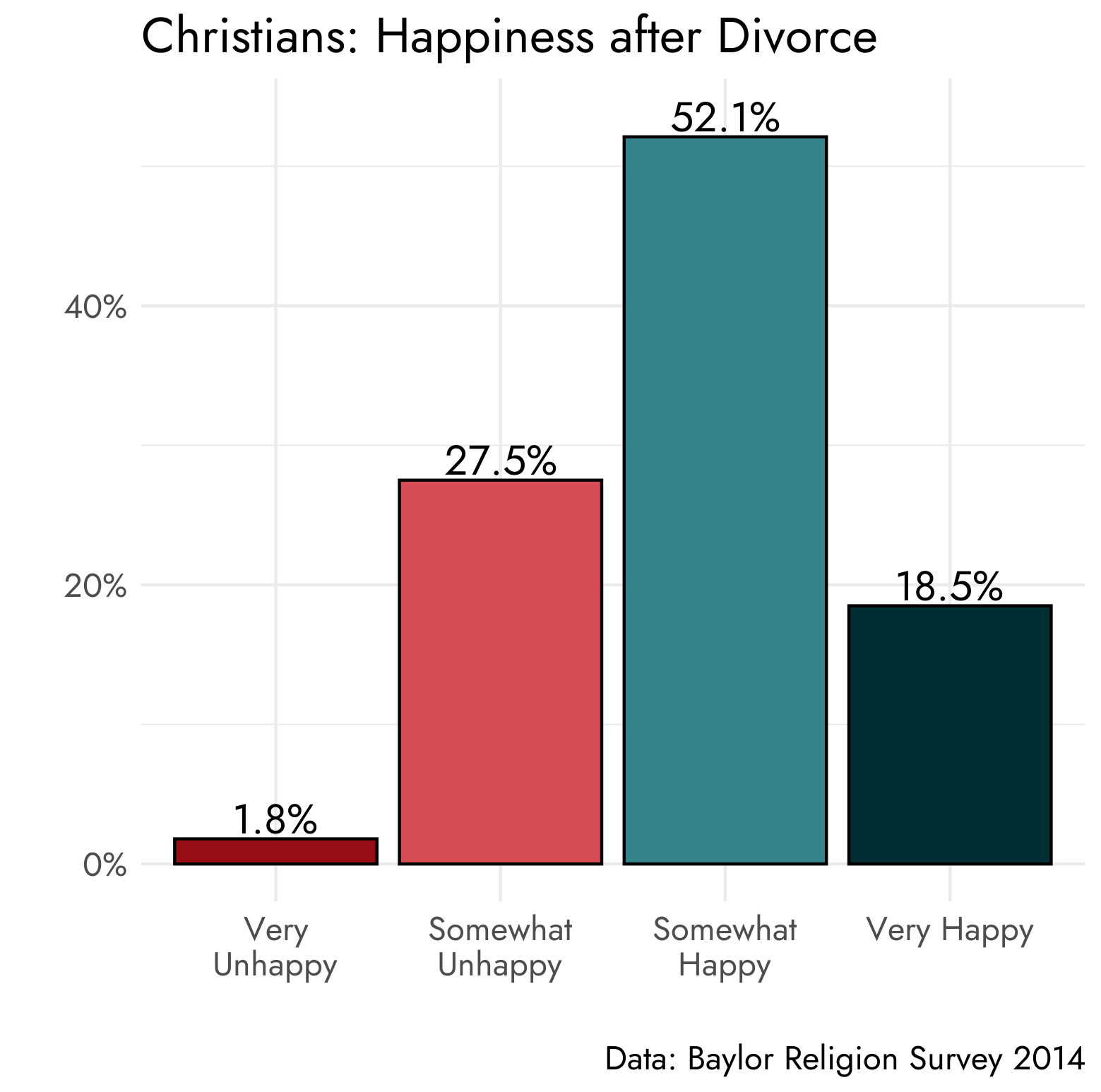
Research using Baylor University data shows that 7 in 10 Christians report being happy after divorce. See the graph below.
5. Can a Church Legally Prohibit My Divorce or Remarriage?
No. Divorce and remarriage are civil legal matters in the United States. Churches may decline to officiate a ceremony, but they cannot legally block your divorce.
Many churches will recommend professional, licensed counseling with a “safety-first” ethic that prioritizes protection and stabilization. In other settings, a person may experience strong pressure to stay married, sometimes through spiritual arguments or guilt. If you want to recognize these patterns and respond with biblical clarity, see: 27 Ways Some Churches Gaslight Abuse and Betrayal Victims (And the Biblical Truth).
The Roman Catholic Church requires an annulment before remarriage in the church. Here is a list of 21 grounds for annulment offered by the Roman Catholic Church. For those seeking a Catholic annulment in the U.S., a civil divorce is required first.
Some people are disabled, destitute, and alone, and have no family or government support other than their church, which does not condone divorce. In that situation, a legal separation might be preferable to divorce, despite its lower level of legal protection. See Legal Separation vs. Divorce for Abused Christians.
6. Can a Church Excommunicate or Discipline Me if I Divorce for Abuse?
Yes, a minority of churches do attempt to discipline or excommunicate wives (primarily) for leaving abusive or chronically unfaithful spouses.
If you are being threatened with church discipline, see Church Discipline and Divorce for guidance, legal considerations, and sample resignation strategies. If you reside in the United States, your First Amendment rights allow you to resign from your church at any time, regardless of what you’ve signed. See sample resignation letter.
Research suggests that, in some communities, this hard-handed approach has contributed to large numbers of Evangelical divorcees leaving church participation.
7. I Love the Lord. I Love God’s Word. Can I Find a Better Church?
Yes. There are healthy churches and pastors who understand abuse dynamics and biblical grounds for divorce. See Pastors Who Accept Abuse as Biblical Grounds for Divorce.
One practical way to vet a church is to listen to its marriage sermons (often available on the church website or a video platform). Here are key topics to note as you evaluate a church’s teaching and tone.
We know from Luke 13 and Jesus’ rescue of the captive woman that Christ prioritized freeing those in bondage, even when religious leaders objected.
And in the Good Samaritan parable, Jesus exposed leaders who walked past suffering rather than offering mercy.
According to LifeWay Research, about 6 in 10 Protestant divorcees switch churches after divorce.
8. How Do I Find Another Church? I Don’t Want to Make a Mistake
When I help people vet churches, I recommend listening carefully to marriage sermons online. Do leaders name abuse as unacceptable? Do they acknowledge justified divorce? Do they repeat common divorce myths?
If you sense rigidity without compassion—or a lack of clarity about safety and abuse—it may be wise to keep looking until you find a church that communicates both truth and mercy.
Here is one woman’s story of trying to find a church that would not condemn her or shame her children.
And here is a broader list of pastors who teach biblical grounds for divorce in abuse cases.
Bonus: What would Jesus say about convoluted theological wordsmithing?
We know from Luke 13 that Jesus confronted rigid religious leaders and prioritized freeing those in bondage.
We are called to imitate Christ—siding with mercy, protection, and setting captives free.
Errors, Corrections, and Updates
If you have an update or find an error in this chart, please report it with exact quotes, page numbers, and official URLs at lifesavingdivorce.com/contact.
Recommended Reading
 :
:
 :
: Buy PDF