
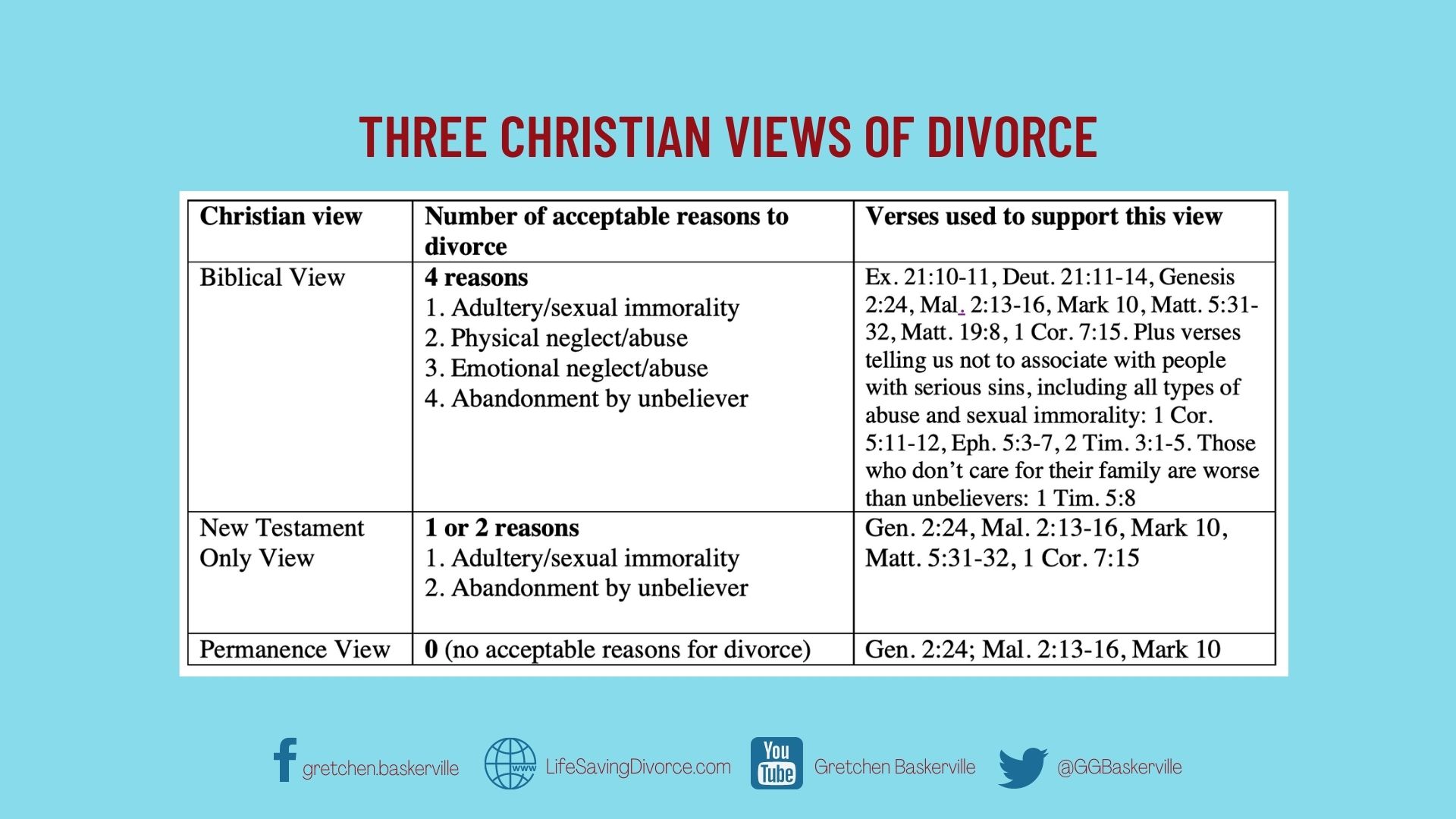
Abuse, Abandonment, and Adultery Are Biblical Grounds for Divorce
MYTH: God Forbids All Divorce Except for Adultery
TRUTH: Scripture permits divorce in more than one situation.
Yes. The Bible condones divorce for more than one reason. The clearest biblical grounds include sexual immorality, abandonment, and severe neglect or abuse. Family-crushing addictions can also become a form of neglect, abandonment, or abuse.
This article explains the main passages often cited in discussions about divorce and the Bible—Matthew 19:9, 1 Corinthians 7:15, Exodus 21:10–11, and Malachi 2:16.
In my interviews with Christian divorcees, I’ve often heard that they stayed in unfaithful or abusive marriages for decades because they were taught that divorce was a sin. Some even believed it was an unpardonable sin, given the way it was described in their church.
Let’s look at the key Bible verses.
Biblical Ground #1: Sexual Immorality (Matthew 19:9)
Jesus specifically allowed divorce for infidelity
Matthew 19:9 (ESV): “And I say to you: whoever divorces his wife, except for sexual immorality, and marries another, commits adultery.”

Matthew 19:9 ESV
Notice that Jesus does not say this is the only reason for divorce. We find other reasons for divorce in Scripture. See Dr. David Instone-Brewer’s 7-min video on the 4 biblical reasons for divorce.
Biblical Ground #2: Abandonment or Neglect (1 Corinthians 7:15)
The Apostle Paul allowed divorce for abandonment
1 Corinthians 7:14-15 (NIV) – Yet if the unbeliever leaves, let it be so. The brother or the sister is not bound in such circumstances; God has called us to live in peace.

1 Corinthians 7:14-15
Do Paul’s words in 1 Corinthians 7 represent a new view of marriage? No, as we see in Biblical Ground #3, Paul is simply echoing Exodus 21 by requiring both spouses to provide affection, material care, and mutual marital rights. Paul’s message includes the caution that if you marry, you must please your spouse. Both spouses matter.
What about 1 Corinthians 7:10–11, where Paul tells believers not to divorce and says that if separation happens, the spouse should remain unmarried or be reconciled? I address that passage and its context here: 1 Corinthians 7:10 explained.
Biblical Ground #3: Neglect and Abuse (Exodus 21:10–11)
The Bible commanded divorce for neglect and it’s most extreme form, abuse
Example 1: The Bible commanded divorce for breaking any of the three marriage vows in Exodus 21:10-11: food, clothing, and “marital rights,” which can be defined as love (as we read in the New Testament passages earlier).
Exodus 21:10-11 (ESV)
If he takes another wife to himself, he shall not diminish [the first wife’s] food, her clothing, or her marital rights. And if he does not do these three things for her, she shall go out for nothing, without payment of money.

Exodus 21:10-11 (ESV)
In the Book of Exodus, if a man took a second wife, it was against God’s command to reduce the first wife’s food, clothing, or marital rights (love). He was not allowed to reduce her care. He was not allowed to treat her as a slave. If he was unwilling to treat her as a wife, he had to let her go so she could marry someone who would treat her properly. This is the first time that the Bible commands divorce.
Example 2: The same was true for a prisoner-of-war wife who was captured during battle. If a man took a captive as his wife, he had to do her the honor of letting her mourn before sleeping with her. As his wife, she had to be treated properly. But later, if he no longer loved her and tried to reduce her to slave status or sell her, he was required to let her go free, presumably so that she could marry someone who would care for her. The husband could not treat her any way he wanted. She was either a wife with rights, or she had to be set free. This is the second time the Bible commands divorce.
“…if you notice among the captives a beautiful woman and are attracted to her, you may take her as your wife. Bring her into your home and have her shave her head, trim her nails and put aside the clothes she was wearing when captured. After she has lived in your house and mourned her father and mother for a full month, then you may go to her and be her husband and she shall be your wife. If you are not pleased with her, let her go wherever she wishes. You must not sell her or treat her as a slave, since you have dishonored her.” -Deuteronomy 21:11-14 (NIV)

Deut 21:11-14 NIV
This sounds like abusive marriages today where a woman has no voice and no power. She started as a wife with an honorable marriage, but she is being reduced to slave-status. Read more about this in Chapter 6 of the Life-Saving Divorce.
“When a man chooses to be abusive, he breaks the covenant.
An abusive man forfeits the right to remain married…”
– Justin and Lindsey A. Holcomb[1]
Example 3: The third time the Bible commands divorce is in Ezra 9-10. This is where God commands the men to divorce their foreign wives due to spiritual betrayal. And they recognized this as the right thing to do, and followed the command.

So we’ve learned that there are multiple places in the Old Testament where divorce is commanded. Notice that the Bible protects neglected or abused spouses from their oppressors by setting them free. There are things more important than the “institution of marriage.” You and your children are more precious to Jesus than your marital status.
God is Divorced
In fact, God in the Book of Jeremiah (Jeremiah 3:8), says he’s the victim of serial adultery. The leaders of Israel were so destructive that God divorced them. What was the result? The 10 northern tribes — which were called “Israel” (as opposed to the two southern tribes, called “Judah,”) — were wiped out by the Assyrian Empire in 722 BC, and never returned. God himself is a divorcee.

Jeremiah 3:8 NIV
Does the Bible Say “God Hates Divorce”? Malachi 2:16 in Modern Translations
The Hebrew doesn’t say, “I hate divorce” or “God hates divorce.” The translation of this verse from the ancient Hebrew language to English is incorrect. The earliest English Bibles (Wycliffe, Geneva, Bishops, and the Great Bible) didn’t interpret it as “I hate divorce” or “God hates divorce.” And the three most recent English Bibles don’t either.
-
For over 2,100 years (500 BC–AD 1611), Malachi 2:16 was not interpreted as “God hates divorce.”
-
Neither Martin Luther nor the translators of the Geneva Bible in John Calvin’s Geneva rendered the verse that way.
-
The Septuagint, Jerome’s Vulgate, Wycliffe, Coverdale, Luther, the Bishop’s Bible, and the Geneva Bible did not translate it as “God hates divorce.”
-
The phrase reflects a later English translation tradition that began in 1611.
-
Dead Sea Scrolls scholarship has influenced modern versions—including the ESV, CSB, and NIV (2011 update)—to adjust the wording.
This verse is not about God’s anger at divorce, but his anger at hypocritical, unfaithful, violent husbands who dump their wives without just cause.
Malachi 2:15-16 can be translated from Hebrew to English like this in the New International Version of the Holy Bible.
So be on your guard, and do not be unfaithful to the wife of your youth. “The man who hates and divorces his wife,” says the Lord, the God of Israel,”does violence to the one he should protect,” says the Lord Almighty. So be on your guard, and do not be unfaithful. —Malachi 2:15b-16 (New International Version, NIV, emphasis mine)
The same verses in the English Standard Version read like this:
…let none of you be faithless to the wife of your youth. “For the man who does not love his wife but divorces her,” says the Lord, the God of Israel, “covers his garment with violence,” says the Lord of hosts. So guard yourselves in your spirit, and do not be faithless.-Malachi 2:15b-16 (ESV, emphasis mine)
The Holman Christian Standard Bible published by Lifeway (Southern Baptist Convention), translated it like this. (And the revision of the HCSB, the Christian Standard Bible, treats that phrase the same way):
So watch yourselves carefully, and do not act treacherously against the wife of your youth. “If he hates and divorces his wife,” says the LORD God of Israel, “he covers his garment with injustice,” says the LORD of Hosts. Therefore, watch yourselves carefully, and do not act treacherously. —Malachi 2:15b-16 (HCSB, emphasis mine)
God is not against all divorce. God is against treacherous divorce, divorce where the vow breaker abandons the faithful spouse.
And God is also against treacherous treatment of spouses, such as abuse, abandonment, neglect, and exploitation, as we’ve already seen.

Click to read clearly: Modern Bible translations (NIV, ESV, CSB) do not translate Malachi 2:16 as “God hates divorce,” but as a warning against violent, faithless husbands.
In this Bible passage—the first three chapters of the book of Malachi—God says he is fed up with his people’s disrespect toward him and their disregard of his covenant with them. God threatens to cut off the covenant with Judah.
God rebukes and warns them due to their many betrayals, including the following:
- Judah disrespects God by violating the covenant. The priests cheat God by not offering the appropriate sacrifices (1:6-8).
- Judah profanes God by marrying foreign women who serve foreign gods, leading to spiritual adultery (2:11).
- Judah has been unfaithful by dealing treacherously with the wife of his youth, even though she has been his companion all these years (2:14).
This entire passage is about breaking promises. And God’s hatred toward divorce is focused on those who break the marital contract by doing wrong and acting treacherously.
First, we see the Lord is angry with the people and no longer accepts their offerings with favor.
Malachi 2:13 (NASB)
“This is another thing you do: you cover the altar of the Lord with tears, with weeping and with groaning, because He no longer regards the offering or accepts it with favor from your hand.”
Why won’t God accept their offerings? Because of treachery and marrying the daughter of a foreign god (possibly meaning worshiping other gods).
Malachi 2:11 (NASB, emphasis mine)
“Judah has dealt treacherously, and an abomination has been committed in Israel and in Jerusalem; for Judah has profaned the sanctuary of the LORD which He loves and has married the daughter of a foreign god.”
What kind of treachery does God condemn? Betraying the wife of your youth, who has been your companion and is legally your wife by the marriage covenant. Why?
Malachi 2:14 (NASB)
“Yet you say, ‘For what reason?’ Because the Lord has been a witness between you and the wife of your youth, against whom you have dealt treacherously, though she is your companion and your wife by covenant.”
The treachery behind this makes God angry. He hates divorce by those who get rid of their wives wrongly.
Malachi 2:16 (ESV, emphasis mine)
“For the man who does not love his wife but divorces her,” says the Lord, the God of Israel, “covers his garment with violence,” says the Lord of hosts. So guard yourselves in your spirit, and do not be faithless.
Notice God’s summary statement: “So guard yourselves in your spirit, and do not be faithless.” God doesn’t say, “Don’t divorce for any reason.” In fact, we see Israelites returning from exile taking vows before God to divorce their foreign wives who draw them away from their faith (Ezra 9-10).
It is treachery that God hates. God permits divorce, as long as it is justified.
And it’s not just the translators of the New International Version, the English Standard Version, the Holman Christian Standard Bible, and the Christian Standard Bible that know this verse has been translated incorrectly. Many Bible scholars have pointed this out, but to no avail. Our churches and Christian marriage authors and radio broadcasters either don’t know, or they don’t want to know. Despite our proclamations that we Christians “handle the Word of God rightly,” I suspect that our leaders would prefer to ignore this rather than tell people the truth, that God does not hate all divorce. I suspect they fear opening the floodgates to divorce. I understand that. As a committed Christian myself, I don’t want to open the floodgates to frivolous divorce either. Surely there is a sensible option where we can approve of life-saving divorces without approving of immature sinful divorces. For more on the Bible and divorce, see Chapter 6, of the Life-Saving Divorce.
Since God hates treachery toward wives, we can conclude this:
Divorce is not evidence of moral decay in society.
Tolerating abusive marriages is.
If you’re supporting someone in a situation like this and don’t know what to say without pressuring her, I wrote a practical guide here: How to Help a Friend in an Abusive or Destructive Marriage.
Addictions Can Become a Form of Neglect or Abandonment (1 Corinthians 5:11)
How can we be so sure that abuse and substance abuse are serious in God’s eyes?
Substance abuse can become a serious form of neglect, abandonment, or harm within a marriage and family. The apostle Paul told the Christians in Corinth not to continue close fellowship with someone who claims to be a believer yet persists in destructive behavior such as sexual immorality, greed, slander, drunkenness, or swindling. Here are some Bible passages that speak to that concern.
1. We should not associate closely with people who claim to be Christians but persist in serious, unrepentant sin. Not even to eat with them.
1 Cor 5:11-12 (NIV) But now I am writing to you that you must not associate with anyone who claims to be a brother or sister but is sexually immoral or greedy, an idolater or slanderer, a drunkard or swindler. Do not even eat with such people.

2. Although we are called to love others, we are not to be partners with Christians who have even a hint of sexual immorality, impurity, or greed. The Bible calls such Christians deceivers and even says they aren’t going to inherit the Kingdom of God. We hear the verse about not being “unequally yoked,” referring to unbelievers, but this verse actually says we shouldn’t be partners with Christians who do such things.
Eph 5:3-7 NIV “But among you there must not be even a hint of sexual immorality, or of any kind of impurity, or of greed, because these are improper for God’s holy people. Nor should there be obscenity, foolish talk or coarse joking, which are out of place, but rather thanksgiving. For of this you can be sure: No immoral, impure or greedy person—such a person is an idolater-has any inheritance in the kingdom of Christ and of God. Let no one deceive you with empty words, for because of such things God’s wrath comes on those who are disobedient. Therefore do not be partners with them.”
3. We can and must talk about our spouse’s bad behavior. It is not slander. This passage said that we must expose it and why.
Eph 5:11-13 NIV Have nothing to do with the fruitless deeds of darkness, but rather expose them. It is shameful even to mention what the disobedient do in secret. But everything exposed by the light becomes visible-and everything that is illuminated becomes a light.
4. We can call a spade a spade. We can call bad behavior out, just the way Jesus does. We are to have nothing to do with such selfish destructive people. I know people will say this doesn’t apply to marriage, but why wouldn’t it? Does marriage give license to spouses who deliberately commit adultery, abuse, or betray? Is Christian marriage the one place that cheaters and betrayers can get away with it, scot-free?
2 Tim 3:1-5 NIV But mark this: There will be terrible times in the last days. People will be lovers of themselves, lovers of money, boastful, proud, abusive, disobedient to their parents, ungrateful, unholy, without love, unforgiving, slanderous, without self-control, brutal, not lovers of the good, treacherous, rash, conceited, lovers of pleasure rather than lovers of God- having a form of godliness but denying its power. Have nothing to do with such people.
5. Those who do not provide for their own family are the same as those who reject the faith.
But if anyone does not provide for his own, and especially for those of his household, he has denied the faith and is worse than an unbeliever. -1 Timothy 5:8
We can love them, forgive them, and still follow the biblical commands to get away from them. We are not called to hate them. We can divorce (or separate) and walk away. Perhaps they will learn their lesson when they lose a spouse.
Of course there are people who will say, “These verses don’t apply to marriage and divorce.” Why not? How can a pastor say these verses apply to everything except marriage?
- This behavior is so bad that Christians are to be thrown out of the church according to 1 Cor 5:11-12 and Eph 5:3-7. If God wants the church to reject them, how can you ask a spouse to tolerate more than God does?
- If in God’s eyes, this person does not inherit the Kingdom of God, then they are an unbeliever. If they abandon their duty, Christians are given permission to divorce in 1 Corinthians 7:15.
- Jesus taught that marriage doesn’t exist in heaven. So one day we all stand before the Lord singly as individuals.
- Those who have abandoned their obligations to their spouse are also considered to have denied their faith, and are even worse than unbelievers. That situation falls into 1 Corinthians 7:15: abandonment by an unbeliever.
- In Exodus 21:9-11, a husband who reduced-or didn’t provide-food, clothing, and marital rights to his wife was required to let her go free (presumably to marry someone who cared for her better). Wives couldn’t be demoted to concubine status or slave status. The husband only had two choices: care for her properly, or let her go.
Related:
- Marriage is a conditional covenant (not an unconditional one)
- What 1 Corinthians 7:10 means about separation, divorce, and remarriage,
- What “let no one separate” does and does not mean, and
- Why the innocent spouse may remarry.
Footnotes:
1 Justin Holcomb and Lindsay Holcomb, “Does the Bible Say Women Should Suffer Abuse and Violence?” JBC 28, no. 2 (2014), accessed 12/13/19, http://justinholcomb.com/wp-content/uploads/2014/09/Does-the-Bible-Say-Women-Should-Suffer-Abuse-and-Violence-Holcomb.pdf Justin is a frequent contributor to The Gospel Coalition blog.
2 Link to Hebrew-English interlinear online for Malachi 2:16. Link to side-by-side chart comparing 18 English Bible translations of Malachi 2:16 shows that “God hates divorce” is just one of three translations published in the past 500 years.
Other noteworthy pastors and theologians say emotional and physical abuse are biblical grounds for divorce.
- Sermons from pastors who believe abuse is grounds for divorce.
- List of theologians and pastors who believe abuse is grounds for divorce.
- Training video for pastors who want to train their staff the basics of domestic violence and abuse awareness.
- Nearly 3 in 4 Protestant Pastors accept divorce for abuse, and say it is not a sin.
Read more! Go deeper!
Scholarly books on biblical reasons for divorce:
1) Divorce and Remarriage in the Church, by Dr. David Instone-Brewer (Tyndale House, Cambridge).
2) Divorce and Remarriage in the Bible, by Dr. David Instone-Brewer (Tyndale House, Cambridge).
This page includes Amazon affiliate links.
 :
:
 :
: Buy PDF