

Will I Ever Be Happy Again After Divorce?
Question: I’ve heard divorce will destroy me and my kids forever. Is that true?
TRUTH: 7 in 10 Christians who divorce state they are happy or somewhat happy after divorce. And 8 in 10 children turn out fine after divorce with no long-term serious problems. Often churches have been given misinformation about the effects of divorce on divorcees and children. They will tell you that you will never be happy again; your next marriage will end tragically too because “you’ll bring your problems into the next marriage”; and that your kids will be destroyed, have drug/alcohol/behavior problems and their marriages will fail too. But all of this is incorrect for more than just a handful of cases. (See research findings here: https://lifesavingdivorce.com/wallerstein/) If you’re sorting truth from fear-based messaging, see Divorce Myth #1: Most Divorces Are NOT About Falling Out of Love
RESEARCH GIVES US HOPE
Life-Satisfaction Increased After Divorce
Divorce does not doom women to lifelong unhappiness. In a 2025 study of Australian middle-aged women, life satisfaction dropped around the time of separation or divorce but gradually increased afterward. On average, women returned to their previous baseline level of life satisfaction within about 3–4 years. The biggest factors linked to better recovery were strong social support, a sense of control over life, and enough income to manage. Remarriage did not significantly change their life-satisfaction trajectory one way or the other.
Another Study Also Found Higher Life Satisfaction Several Years Later
When you are in the middle of divorce, it can feel like your life is over. But research gives us hope. A British longitudinal study that followed thousands of people over many years found that life satisfaction often declines during the years leading up to divorce. After divorce, however, well-being generally returned to baseline. The researchers concluded that “habituation to divorce would appear to be both fairly rapid and complete.” They also noted that “there is even mild evidence that women are more satisfied with their lives after a number of years of divorce.” This doesn’t mean divorce is easy. It means the misery you feel right now is not necessarily your future.
MOST PEOPLE OF FAITH REGAIN THEIR HAPPINESS AFTER DIVORCE
Bradford Wilcox, the senior fellow for the Institute for Family Studies, wrote that two years after the divorce, 50% of parents turn out fine, and 20% turn out much happier after a divorce. —Institute for Family Studies
This graph based on the Baylor Religion Survey confirms Wilcox’s claim. About 7 in 10 Christians say they are happy after divorce. About half are “somewhat happy” and 2 in 10 are “very happy.” Perhaps faith and prayer and the community of loving believers make a difference in their recovery. (By the way, Baylor is the largest Baptist university in the world.) 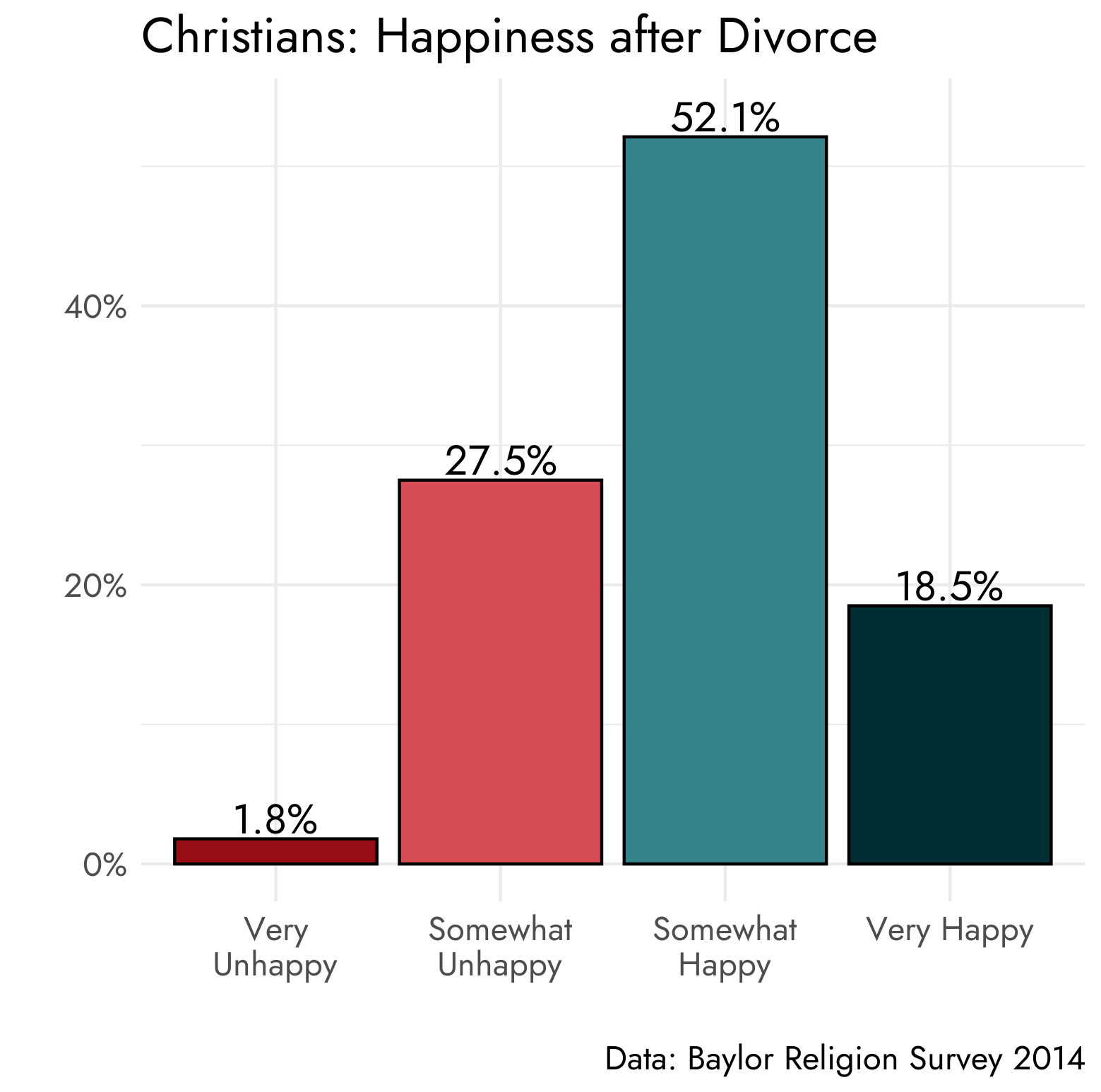 Baylor is not the only organization to find that people of faith do generally well after divorce. A large nationwide study of divorcees over age 40 found something surprising. Believe it or not, they discovered that Baptists had the highest post-divorce happiness levels in the survey, consistently saying they were at a 9 on a 10-point scale of happiness (The Ladder of Life). I believe this is due to the warm community of prayer and support that many good churches offer. If you aren’t in one of these warm and kind churches, feel free to switch. Here’s why so many do: Nearly 6 in 10 Christians Leave Their Church After Divorce (Lifeway Data) (Sources: 2004 The Divorce Experience; LifeWay 2015 study “Marriage Ministry and the Cost of Divorce for Churches”)
 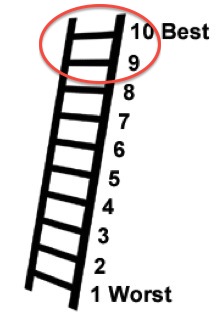 Ladder of Life: Divorced Baptists Reported a 9 out of 10 points on the Happiness Scale
EVEN THE ABANDONED SPOUSE USUALLY RECOVERS
Even if you were the abandoned spouse, the one who got left behind when your spouse filed, this applies to you too. You’re not alone—many have been there: Turning Point 10: I had no Choice Because My Spouse Divorced or Abandoned Me One of the leading researchers on divorce, Dr. Mavis Hetherington, wrote,
“In the early period, the ‘left’ spouses were the most unhappy and resentful, but by the end of the second year, there were few differences between those left and the ‘leavers’… [In] the second year there was an upsurge in emotional wellbeing as people began to adapt to their new life situation.” -Hetherington and Kelly, For Better or For Worse, p. 150-151
BETTER HEALTH AFTER DIVORCE THAT ENDS A LONG DESTRUCTIVE MARRIAGE
FOR THOSE WHO REMARRY AND THOSE WHO DO NOT: As for remarriage? It turns out that if you had a chronically miserable marriage and chose to divorce, there’s a good chance you will be happier. Dr. Linda Waite, the noted researcher who found that 2 in 3 unhappy marriages became happier within 5 years, ALSO found that 8 in 10 of the people in her study who divorced and remarried were happier too. Is that a guarantee? No, but odds are that if you stayed a long time in an unhappy marriage, the problem isn’t you. The same good news about happier remarriages after a long miserable marriage was found in a larger, more comprehensive study by Drs Hawkins and Booth:
“Remaining unhappily married is associated with significantly lower levels of overall happiness, life satisfaction, self-esteem and overall health along with elevated levels of psychological distress compared to remaining otherwise continuously married. There is also some evidence that staying unhappily married is more detrimental than divorcing, as people in low-quality marriages are less happy than individuals who divorce and remarry. They also have lower levels of life satisfaction, self-esteem and overall health than individuals who divorce and remain unmarried. Unhappily married people may have greater odds of improving their well-being by dissolving their low-quality unions as there is no evidence that they are better off in any aspect of overall well-being than those who divorce.” -Daniel N. Hawkins and Alan Booth, Unhappily Ever After: Effects of Long-Term, Low-Quality Marriages on Well-Being, Social Forces, Vol. 84, No. 1 (Sep., 2005), pp. 451-471, from the abstract
So basically they found that people in 12-year-long (or longer) marriages that had been miserable, were happier after divorce (on average), whether they remarried or stayed single. According to decades of research, none of the fear-bombing is true for the vast majority of people who need to escape from long destructive or unfaithful marriages. There is research showing that you are likely to be happier if you leave a long destructive marriage.
WHAT ABOUT THE KIDS?
Despite what you’ve been told about divorce universally destroying kids, research has shown that nearly 8 in 10 kids turn out fine after divorce, with no serious long-term psychological, emotional, or social problems. And in fact, researchers have also found that the worse the marriage, the better divorce is for kids (and conversely, if your marriage is kind and loving, divorce is horrible for kids). 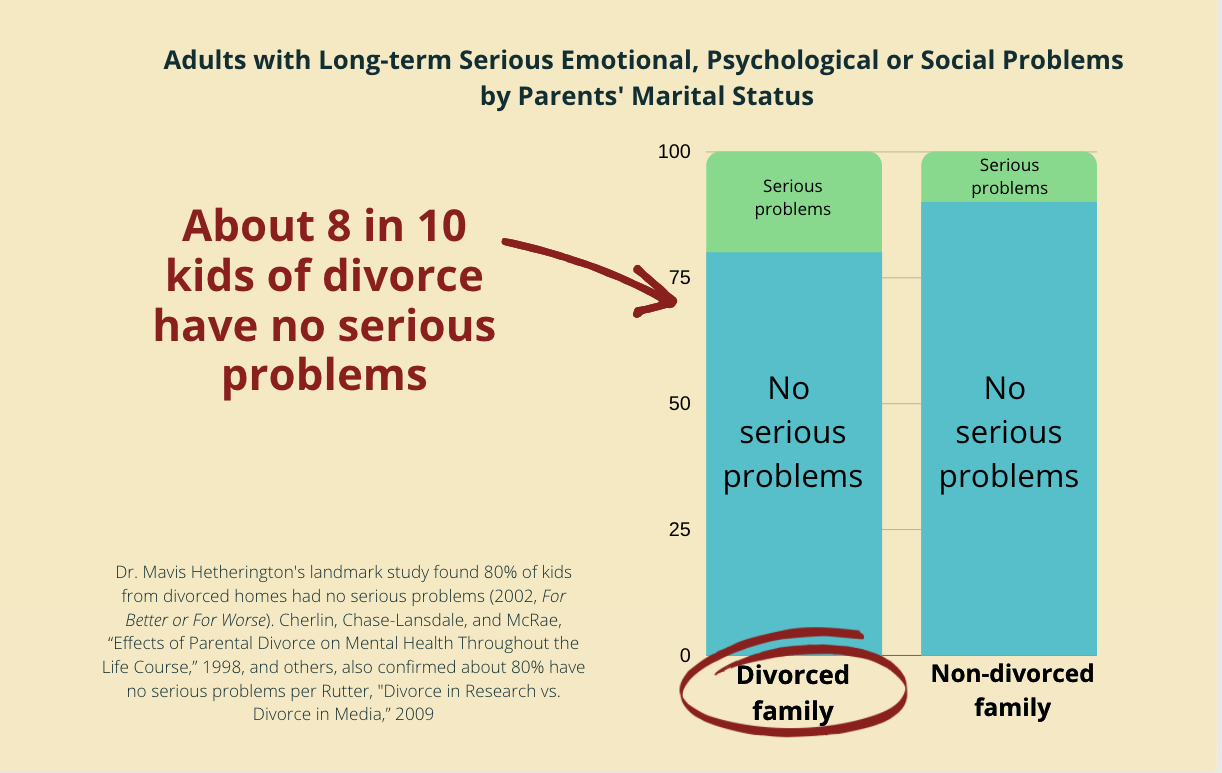
BUT WAIT! I DIVORCED LONG AGO, AND I STILL FEEL AWFUL
This is true sometimes, especially if your ex-spouse is still harassing you, turning the kids against you, dragging you into court, and generally making life miserable. If ongoing conflict is draining you, this can help: What is J.A.D.E. and Gray Rock? As one abuse victim wrote:
“I’ve been divorced from my ex for over 5 years. (My case is not the norm. I was severely abused, beaten, and locked in a room). I asked my therapist why I’m not “further ahead”… more where I think I should be. She asked me how long it has been since I’ve really been out of the trauma. Really, only one year, as he continued his abuse through insane litigation and mind games. So while I might say “But it’s been five years!”, really I have been “out” of the trauma for much less. That plays a huge part.”
Give God time. The more abuse you experienced in your marriage or in childhood, the longer it takes to process the trauma. Get to safety first. If your marriage involved coercion or danger, this may clarify why recovery takes longer: Am I Being Abused? 5 Free Self-Tests. Find a good counselor, a loving online support group, and group therapy if possible. Find safe places to share your story among fellow survivors who have a positive outlook.
Sources
Arcangeli, O. J., & Ejova, A. (2025). Does Time Heal All Wounds? Life Satisfaction Trajectories in Australian Middle-Aged Women Before and After Relationship Dissolution. Journal of Happiness Studies, 26, 41. https://doi.org/10.1007/s10902-024-00853-5 Clark, A. E., & Georgellis, Y. (2013). Back to Baseline in Britain: Adaptation in the British Household Panel Survey. Economica, 80(319), 496–512. https://doi.org/10.1111/ecca.12007
 :
:
 :
: Buy PDF