
Marriage Is a Conditional Covenant (Not an Unbreakable Promise)
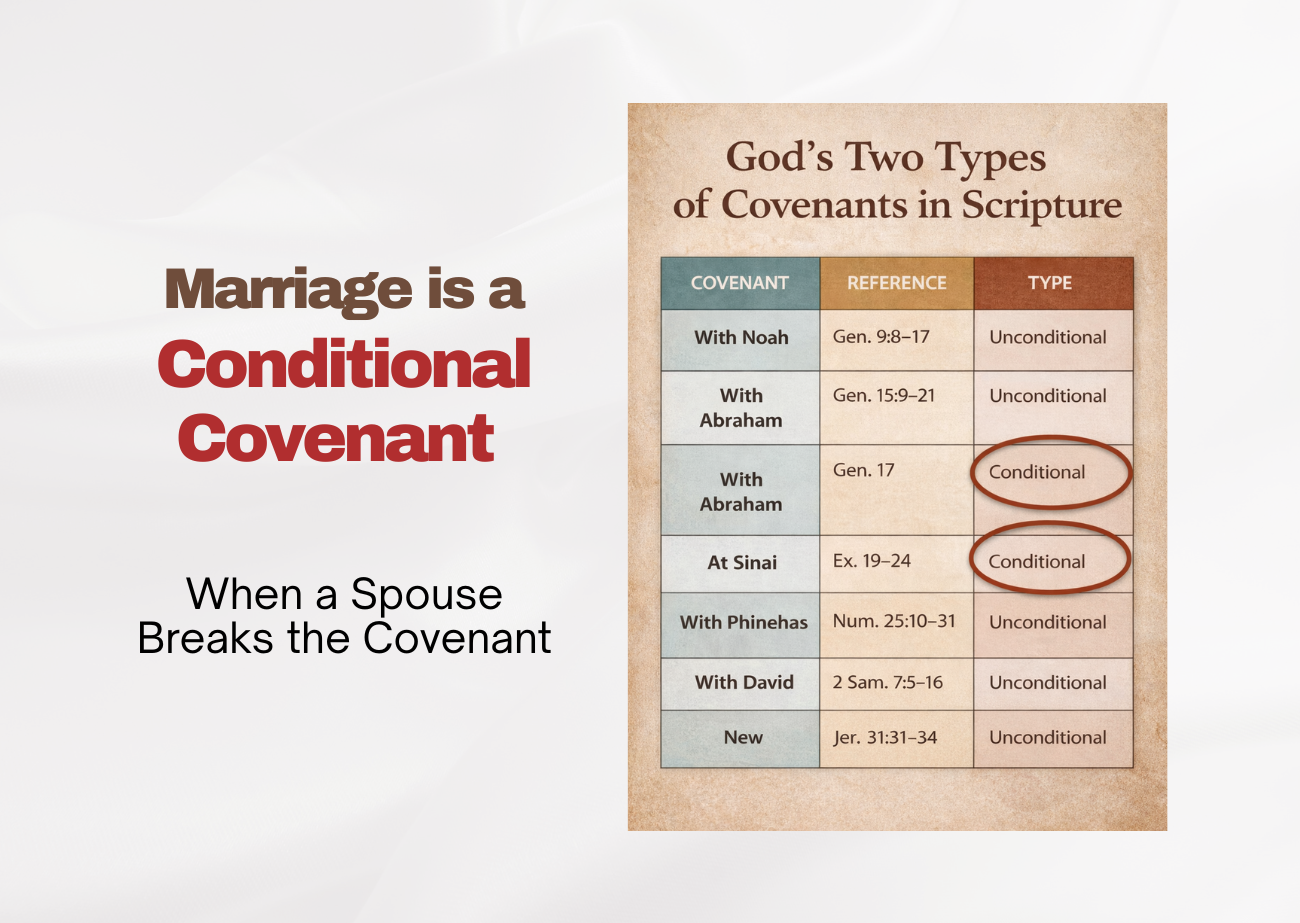
Biblically, marriage is a conditional covenant—not an unconditional one.
Marriage includes mutual vows, and persistent covenant-breaking through adultery, abuse, abandonment, or severe neglect violates the covenant.
For a short audio summary, listen here:
Many Christians have been taught that marriage is an “unbreakable covenant.”
And usually, what they mean is this:
Marriage must be unconditional—because God’s promises are unconditional.
So if God never breaks His promises, and you promised to love, honor, and be faithful, does that mean you may never leave… no matter how completely your spouse breaks their vows?
Does it mean you must stay despite your spouse’s:
- adultery
- abandonment
- domestic violence
- chronic emotional abuse
- severe addiction
- neglect
So we need to ask honestly:
Is marriage biblically an unconditional covenant?
Or is it something else?
Two Types of Covenants in the Bible
Old Testament scholar Dr. David Instone-Brewer explains that Scripture contains two categories of covenants:
Unconditional Covenants
These are one-sided promises God makes that He will fulfill no matter what.
Only God can truly make unconditional covenants, because only God cannot sin, fail, or abandon His promises.
Conditional Covenants
These are agreements with mutual obligations.
If one party persistently breaks the terms, the covenant is violated.
Conditional covenants are more like binding vows:
“If you do this, I will do that.”
Even God Made Conditional Covenants
This surprises many Christians, but Scripture shows that God Himself made different kinds of covenants—some unconditional, and some conditional.
Here are two clear conditional covenants:
In Genesis 17, God made a covenant with Abram: God promised him land and descendants, and Abram was required to keep the covenant sign of circumcision.
Another conditional covenant appears in Exodus 19–24, where God promised to make Israel His treasured people, but only if they obeyed fully and kept the covenant.
Tragically, Israel repeatedly broke that covenant through unfaithfulness. That’s why Jeremiah 3:8 describes God as divorcing Israel because she would not keep her side of the covenant and chased after false gods.
Can any of us blame God?
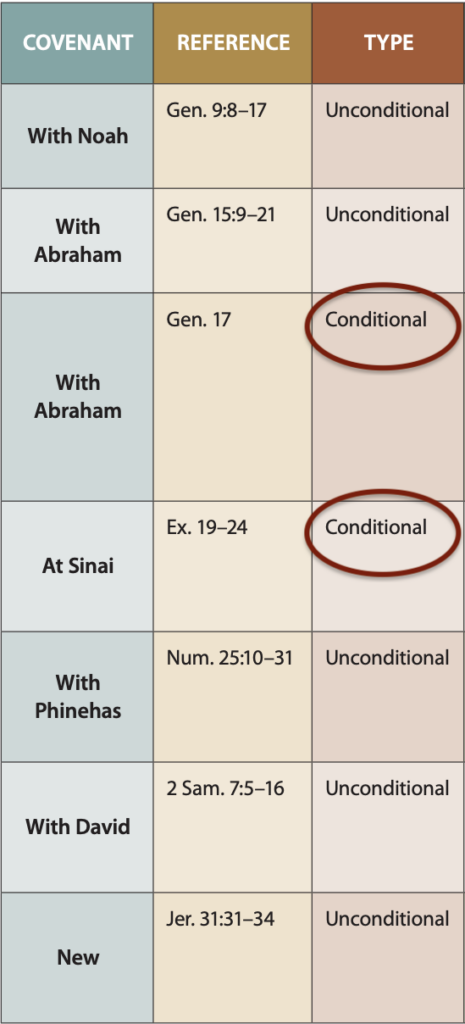
©2017. God’s Conditional and Unconditional Covenants. Used with permission from Rose Publishing.
So What About Marriage?
Marriage is indeed a covenant.
But biblically, it is a conditional covenant, not an unconditional one.
Scripture describes the basic marital duties as food (provision), clothing (protection), and love and care (Exodus 21; echoed in Ephesians 5:28–29).
And far from being a weird, isolated Old Testament idea, these duties show up in ancient marriage and divorce documents too. They are the bedrock of Jewish marriage law today.
Dr. David Instone-Brewer argues that Jewish marriage certificates preserved vows like food, clothing, and bed, showing that these were concrete, enforceable obligations in the ancient world—not pious fluff (Divorce and Remarriage in the Church, p. 129; Divorce and Remarriage in the Bible, pp. 227–228).
Jesus also reinforced sexual faithfulness: “forsaking all others.”
Marriage requires mutual covenant faithfulness.
A Covenant Is Not the Same as Endless Tolerance
Let’s talk about a biblical covenant that went wrong. We’ll use the story of the Exodus where God rescued the Israelites from slavery in Egypt and Pharaoh resisted letting them go. Joseph J. Pote offers a helpful biblical picture of conditional covenants in two articles, which I summarize here. Pote argues that Israel’s covenant with Egypt began as provision and protection through Joseph (Genesis 41:39-45), but later became bondage when Pharaoh violated the covenant relationship by enslaving Joseph’s descendants. In Exodus 6:6, God promises not only to deliver Israel from bondage, but also to redeem them. That distinction matters: deliverance is rescue from danger, while redemption is release from the covenant obligation itself. In other words, God did not merely help Israel escape; He ended Egypt’s claim over them. This gives us a powerful biblical category for understanding abusive marriages: a covenant may begin validly, but if one spouse turns it into oppression, terror, or bondage, God may redeem His child from that shattered covenant. In that sense, divorce may be not covenant-breaking by the victim, but God’s mercy in ending a covenant of bondage.
Here is the crucial point:
God allows sacred covenants to end if one party oppresses the other.
If a spouse establishes a pattern of adultery, violence, cruelty, abandonment, or severe neglect, they have already broken the marriage covenant.
Divorce is not “breaking a covenant.”
It is often recognizing that the covenant has been shattered.
What if the Covenant-Destroyer Repents? Must You Take Them Back?
What if the covenant-breaking spouse later says they repent? Repentance matters, but repentance — even genuine repentance — does not automatically restore a covenant that they destroyed or require the harmed spouse to resume the marriage. The victim is not obligated to rebuild trust, restore access, or remain married. If the covenant has been destroyed through violence, emotional or sexual abuse, sexual infidelity, abandonment, addiction, or severe neglect, the innocent spouse may still choose divorce without shame.
Even if the offender appears to have truly changed, Scripture does not support forced reconciliation. In the book of Philemon, the apostle Paul believed Onesimus had changed. Paul loved Onesimus and clearly hoped Philemon would receive him back. But Paul did not force the issue. He wrote, “I did not want to do anything without your consent, so that any favor you do would not seem forced but would be voluntary” (Philemon 14, NIV). That is a remarkable example of respecting the harmed party’s agency, even when reconciliation may be hoped for.
The reformer Martin Luther also recognized this. In his Commentary on the Sermon on the Mount, Luther urged forgiveness where the guilty spouse was truly “humbled and reformed” for an single “misstep,” but he warned against a guilty person who “presumed upon mercy and forgiveness” by repeated marriage-destroying sin.
Luther wrote:
“For to make a misstep once is still to be forgiven, but to sin presuming upon mercy and forgiveness is not to be endured.”
He also said “it is not right to compel one to take back again” an adulterer if the innocent spouse is unwilling or unable to do so.
In other words, forgiveness is not a weapon that can be used to force the victim back into a shattered covenant. If you are unwilling or unable to take them back, or you cannot trust them, you are not obligated to reconcile.
Answering the Opposing View
Some Christians argue:
“Marriage is a covenant, not a contract. Covenants are unconditional, so divorce is never an option.”
But biblically, that confuses categories.
Yes, marriage is more sacred than a business contract.
But Scripture does not treat marriage as an unconditional covenant. It is a conditional covenant.
Marriage contains vows with conditions—and God Himself acknowledges covenant-breaking as real.
Calling marriage “unconditional” may sound spiritual, but it can become a weapon that traps victims in lifelong harm.
God does not ask you to submit to desecration in His name.
You Can Love God and Still Leave
If you are in a marriage marked by serious, ongoing covenant-breaking, you are not abandoning holiness by seeking safety.
You are not “mocking marriage.”
Your spouse has already violated the covenant.
And you are free to choose:
- to keep trying
- or to leave
- without shame
- without condemnation
You can love God and get a divorce.
And God will still love you. Really.
If you’re wondering whether these are biblical grounds for divorce, see:
Abuse is Biblical Grounds for Divorce and
“But He Never Hit Me”: Divorce for Neglect, Emotional, and Financial Abuse.
 :
:
 :
: Buy PDF