
Best Children’s Books on Divorce
When parents or grandparents go looking for a children’s book on divorce, they are not just shopping for a cute story. They are trying to find words that will steady a child, lower fear, and help that child make sense of a painful family change without loading adult burdens onto small shoulders.
That is why I spent the money to buy these books and evaluate them carefully. I did not just look at the cover copy or star ratings. I looked at what each book actually communicates to a child: whether it reminds children they are not to blame, whether it reassures them they are loved by both parents, whether it gives a hopeful future, whether it explains why divorce happens, whether it puts children in the middle, whether it models nurturing parents, whether it offers self-care ideas, and whether it creates comfort or anxiety. I also ran them through age-grading software to be sure the vocabulary is suitable.
Some books are clearly better when both parents are safe, loving, and cooperative. Some are more useful in high-conflict situations. Some work best for toddlers, while others are much better for preteens and teens. Some use Christian language and discuss God’s care. And a few books that are often recommended are, in my opinion, far less comforting than people assume.
This master list is the full overview. Click on the title to go directly to Amazon. #Ad
Below that, I have added category lists so you can quickly find the best books for a child’s age, family situation, and emotional needs.
Jump to:
- Top-Ranked Books
- Not Recommended
- 1. Best by age level
- 2. Best when both parents are safe, loving, and stable
- 3. Best for high-conflict divorce where one parent is abusive, addicted, deceitful, etc.
- 4. Best for dads
- 5. Best for kids who blame themselves
- 6. Specifically Christian content
- 7. Worst book(s)
- Final Thoughts
Top-Ranked Books
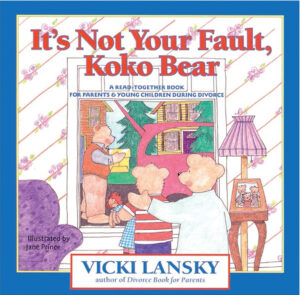
It’s Not Your Fault, Koko Bear by Vicki Lansky
Best for: Ages 6–10
This is one of the strongest all-around divorce books in the group. It directly tells children they are not to blame, acknowledges that they may feel confused, scared, sad, or mad, and reassures them that they are still loved by both parents. It also gives children a positive future without pretending the sadness is not real.
What especially sets this one apart is the way both parents are portrayed. PapaBear and MotherBear are cooperative, nurturing, and emotionally responsible. They repeat loving bedtime rituals, tell Koko that the other parent still loves them, and model the kind of post-divorce behavior children actually need to see. Many books say the child is loved. This one shows it in action.
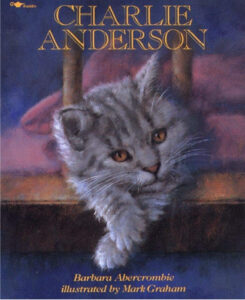
Charlie Anderson by Barbara Abercrombie
Best for: Ages 3–7
This is a gentle, quiet picture book for very young children. Divorce is never directly named, which may be helpful for children who do not need a big explanation yet but do need reassurance that life in two homes can still feel safe and loving.
The metaphor is simple and memorable: Charlie the cat belongs at two homes, and the sisters do too. I like the sweetness of the book and the calm tone. My main caution is that the question, “Who do you love the best?” could plant in some children the idea that they need to choose. Even so, it remains one of the gentler books in the group.
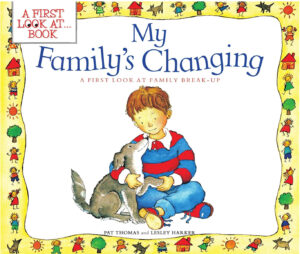
My Family’s Changing Right Now by Pat Thomas
Best for: Ages 4–8
This is one of the few books on the list that is actually useful for high-conflict divorce. It helps children know what to expect, reminds them they are loved, and addresses some of the painful realities children face when parents badmouth each other, pressure the child, or create emotional confusion. (If the other parent doesn’t love the child, you can skip that line.)
It is not perfect. I do have concerns that in some spots it expects a lot of self-awareness and maturity from children. But for high-conflict cases, it fills an important gap. It gives children language for boundaries and helps them ask for what they need, which many gentler divorce books never do.
Divorce Feels Yucky by Madison and Lucas Lovato
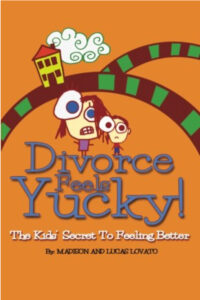
Best for: Ages 3–7
This is a short, non-blaming explanation of divorce that does a good job naming the child’s pain without drowning the child in adult complications. The scraped-knee metaphor is useful: the child learns that divorce hurts, healing takes time, and sharing feelings helps.
I also appreciate that this book gives children some practical emotional guidance. It acknowledges sad, scared, afraid, and “yucky” feelings, encourages children to talk to someone they trust, and includes some simple activities. It is not the deepest book on the list, but it is clear, kind, and emotionally manageable for young children.
Why Can’t We Live Together? by Madison and Lucas Lovato
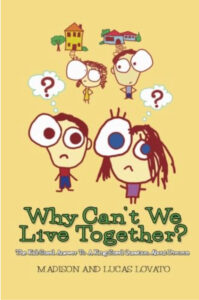
Best for: Ages 5–8
This book emphasizes a very important idea: the child is still a family and is still loved by both parents no matter where they live. That simple reassurance matters, especially for children who fear that divorce means their family has disappeared.
The pizza-and-ice-cream metaphor helps children understand that two good things can both be loved, even if they do not go together. I like this one best for lower-conflict situations where the main goal is reassurance, not heavy boundary-setting or detailed emotional processing.
When Mom and Dad Separate by Marge Heegaard
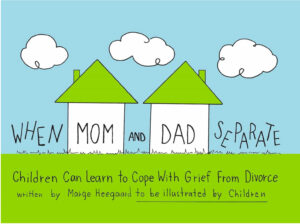
Best for: Ages 6–12
This is not a standard storybook. It is an art-based workbook, and that is exactly why it is valuable. Some children do not need another adult voice explaining divorce to them. They need room to express grief, anger, confusion, fear, and love in their own words and drawings.
This book is especially strong in the categories many books skip: identifying feelings, encouraging self-expression, helping children see that divorce is a grown-up problem rather than something children cause or fix, and drawing attention to the safe adults who care for them. It is one of the best tools on this list for emotional processing.
Meet Max by Jennifer Leister
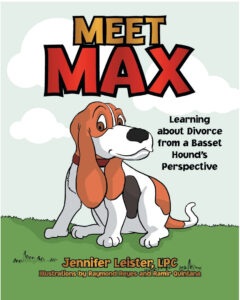
Best for: Ages 4–8
This is a sweet and compassionate book told through the eyes of Max the Dog. Using the pet’s viewpoint gives the child enough emotional distance to absorb painful change without feeling overwhelmed. The sadness is real, but the story keeps moving toward steadiness and hope.
I also appreciate how well this book portrays the father. Dad is shown as competent and involved: getting Sam to school, making lunch, helping with homework, and taking him to practice. Mom affirms Dad’s competence. That is a healthier and rarer detail than people might think.
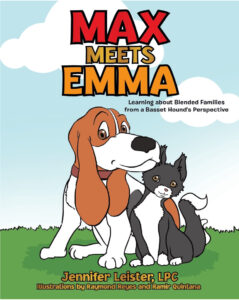
Max Meets Emma by Jennifer Leister
Best for: Ages 4–8
This is a strong follow-up choice for children dealing with remarriage and stepfamily change. The book recognizes that blending families can feel awkward, territorial, and emotionally complicated. It does not force instant harmony.
What I especially like is that it makes clear a stepparent does not replace a parent. That is a very important message for children who fear losing their original bond with Mom or Dad. New loving adults can add to a child’s life without erasing anyone.
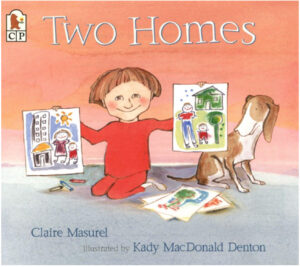
Two Homes by Claire Masurel
Best for: Ages 2–5
This is one of the best books on the list for toddlers and preschoolers. The repetition is simple and soothing. The concepts are concrete: two homes, two bedrooms, two kitchens, two routines. For very young children, that kind of steady parallel structure works beautifully.
This book does not spend much time on negative feelings or conflict, which is part of its strength for the youngest age group. It quietly normalizes life in two homes and shows both parents as loving and involved. It is especially good when the goal is to calm rather than explain.
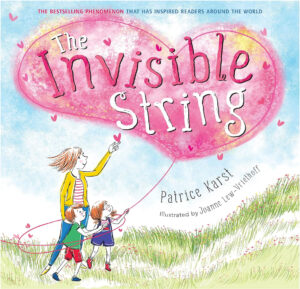
The Invisible String by Patrice Karst
Best for: Ages 4–9
This is not specifically a divorce book, but it belongs on this list because it is so useful for children who go back and forth between parents. The core message is that love still connects us even when we are apart.
For children with separation anxiety, this can be more comforting than a direct divorce book. It does not mention blame or custody issues, but it offers emotional reassurance and a memorable metaphor children can actually use when they miss someone. It is one of the strongest companion books on this list.
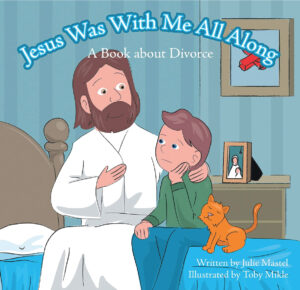
Jesus Was With Me All Along: A Book About Divorce by Julie Mastel
Best for: Ages 3–8
This is one of the few explicitly Christian children’s books on divorce. Its main message is that Jesus is with the child even when the parents are fighting, the child feels sad, and life feels confusing. The book reminds children they are not to blame and points them to God’s presence as their deepest comfort.
Told from the child’s viewpoint, it shows both parents in nurturing moments. The father is shown talking with his son, putting a hand on the child’s shoulder, and relaxing with him over popcorn and TV. The mother is shown smiling and playing a board game with her son. The only hints about the cause of divorce are a few pictures of the parents fighting, the father yelling, and the mother driving away from the home.
What makes this book especially distinct is its direct biblical reassurance. Children are told through the illustrations and the closing verse, Deuteronomy 31:8, that the Lord will never leave them or forsake them, so they do not need to be afraid. For Christian families who want a divorce book that openly names Jesus as the child’s companion and comforter, this fills a gap that most mainstream books do not address.
Why Do Families Change? by Jillian Roberts
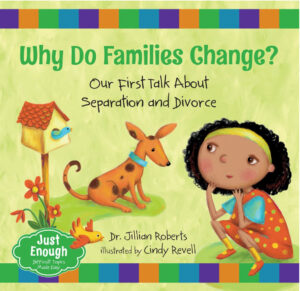
Best for: Ages 4–9
This is one of the strongest general-purpose divorce picture books here. It directly tells children they are not to blame, that they are still loved, and that their family can still become happier and healthier after change. It hits the major themes well without becoming too abstract or too heavy.
I also appreciate that it shows a wider support system. Grandparents are present and involved, and the families portrayed are more varied than in many older divorce books. This book fills the need for a multi-ethnic book for kids whose parents were married, common law partners, or lived together. That makes it useful not only for parents, but for grandparents who are trying to support a child through the transition.
Divorce Is Not the End of the World by Zoe and Evan Stern, with Ellen Sue Stern
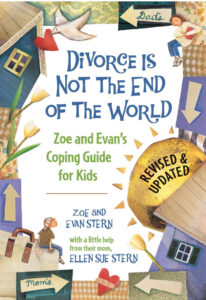
Best for: Ages 11–17
This is my top recommendation for teens. It treats older children as thinkers, not just comfort-seekers. It addresses self-blame, divided loyalties, anger, boundary-setting, and the practical realities of moving between homes. It also gives teens a voice.
Because it is written from the perspective of siblings who lived through divorce, it feels less preachy than many adult-authored books for adolescents. It offers honesty, problem-solving, and realistic hope. For teens in complicated or high-conflict situations, this is one of the best books in the whole group.
I Am Fine by Daniela Owen
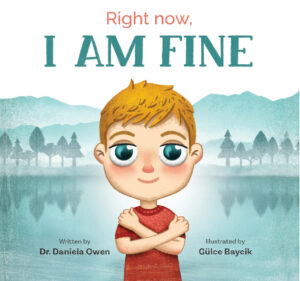
Best for: Ages 3–8
This is not specifically a divorce book, but it is excellent for anxious children who feel physically overwhelmed by stress. If a child’s main issue is worry, panic, or that knotted-up feeling in the body, this can be a very useful companion book during divorce.
It teaches grounding, breathing, self-soothing, and calming strategies in child-friendly language. I would especially pair it with a divorce-specific book when the child is not just sad, but highly dysregulated by the family upheaval.
Mama and Daddy Bear’s Divorce by Cornelia Maude Spelman
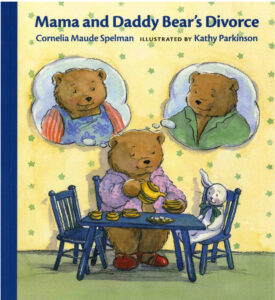
Best for: Ages 2–6
This is a very soothing choice for sad young children. The emotional tone is low and tender. It reassures the child that although Daddy now lives somewhere else, Mama will always be Mama, Daddy will always be Daddy, and many beloved things in life will stay the same.
That stability matters so much for preschoolers. The book also portrays both parents as gentle and nurturing, which makes it useful when a child needs comfort more than explanation. For a very young child whose world feels shaky, this one can help lower fear.
Not Recommended
Dinosaurs Divorce by Laurie Krasny Brown and Marc Brown
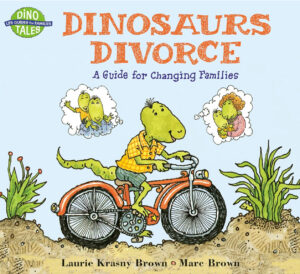
Best for: I do not recommend this one for most children.
This book is by well-known and well-loved authors, but in my judgment it is one of the weakest on the list. It tries to cover nearly every upsetting topic connected to divorce in a very short space: fighting, addiction, custody schedules, stepfamilies, financial loss, losing friends, judges and court, parents dating and remarrying, and more. Instead of comforting children, it risks overwhelming them.
I also object to the emotional tone and the illustrations. The book tends to catastrophize life after divorce and place too much adult responsibility on children. It’s overwhelming for children to discuss what they need to give up, how much they will lose (money, friends, etc.) and how they need to be patient and understanding toward their parents. The illustrations show the mother in a negative light multiple times, but never the father (except where both parents as equally angry). There are only a handful of sentences in this book that suggest that life will be okay after divorce. Finally, the authors often tell kids to behave with maturity and pick up the slack where their parents don’t or cannot. Putting adult responsibility on kids may/may not be helpful.
1. Best by age level
Ages 2–5
Best overall: Two Homes
Younger children do best with concrete repetition, and this book does that beautifully. It normalizes two homes without flooding a toddler or preschooler with too much explanation.
Best soothing choice: Mama and Daddy Bear’s Divorce
This is especially helpful for a sad young child who needs comfort, tenderness, and the reassurance that the people they love are still theirs.
Best companion book: The Invisible String
Not specifically about divorce, but excellent for separation anxiety and for children moving back and forth between homes.
Ages 3–7
Best gentle story: Charlie Anderson
Best short explanation of divorce: Divorce Feels Yucky
Best Christian book: Jesus Was With Me All Along: A Book About Divorce.
Ages 3–8
Best for high-conflict divorce: My Family’s Changing Right Now
Best companion book for anxiety during family change: I Am Fine
Ages 4–8
Best for grief and adjustment: Meet Max
Best for stepfamilies: Max Meets Emma
Best for high-conflict divorce: My Family’s Changing Right Now
Best companion book for anxiety during family change: I Am Fine
Ages 4–9
Best mainstream divorce picture book: Why Do Families Change?
Best emotional reassurance book: The Invisible String
Ages 5–8
Best for affirming two homes without panic: Why Can’t We Live Together?
Ages 6–10
Best all-around divorce read-aloud: It’s Not Your Fault, Koko Bear
Ages 6–12
Best workbook for processing feelings: When Mom and Dad Separate
Best companion book for anxiety during family change: I Am Fine
Ages 11–17
Best for teens: Divorce Is Not the End of the World
2. Best when both parents are safe, loving, and stable
When both parents are emotionally safe and trying to do right by the child, the best books are the ones that reassure without dragging the child into adult conflict.
- It’s Not Your Fault, Koko Bear — Best all-around choice for cooperation, reassurance, and family continuity.
- Two Homes — Excellent for very young children adjusting to two stable homes.
- Why Can’t We Live Together? — Strong on “you are still a family” and loving both parents.
- Meet Max — Good for children who need gentle emotional processing and a positive picture of both parents.
- Why Do Families Change? — Helpful, balanced, and reassuring, with grandparents included.
3. Best for high-conflict divorce where one parent is abusive, addicted, deceitful, etc.
High-conflict divorces need different books. Children in these situations often need boundaries, realism, and help understanding what to do with mixed feelings.
- My Family’s Changing Right Now — Best overall for high conflict. It helps children know what to expect and gives language for asking for what they need. There is a line about the child being loved by their parents (plural). If this isn’t the case—due to abandonment or DV—you can just explain that sometime this is not the case.
- Divorce Is Not the End of the World — Best for older kids and teens dealing with divided loyalties, pressure, and boundary-setting.
- When Mom and Dad Separate — Best for processing grief, anger, confusion, and hard feelings in a healthy way.
- The Invisible String — Best companion book when the child feels pulled between homes and needs emotional reassurance.
4. Best for dads
Some books portray fathers better than others. These are the ones I think are especially helpful for dads who want to reassure their children and stay emotionally connected.
- It’s Not Your Fault, Koko Bear — PapaBear is warm, responsible, and cooperative.
- Meet Max — Dad is clearly shown as competent, involved, and nurturing.
- Two Homes — Good for normalizing Dad’s home as a real, stable home for little ones.
- Mama and Daddy Bear’s Divorce — A tender choice for dads of very young children.
- Divorce Is Not the End of the World — Good for dads of teens who want a book that respects older kids’ intelligence and emotions.
5. Best for kids who blame themselves
Some children quietly assume they caused the divorce or could have prevented it. These books do the clearest job correcting that false belief.
- It’s Not Your Fault, Koko Bear — Best overall. The message is direct and repeated.
- Why Do Families Change? — Clear and age-appropriate reassurance that separation is not the child’s fault.
- Divorce Is Not the End of the World — Best for older kids and teens struggling with self-blame.
- When Mom and Dad Separate — Strong workbook support for the truth that divorce is a grown-up problem.
- My Family’s Changing Right Now— Especially useful where self-blame gets tangled with high-conflict loyalty binds.
6. Specifically Christian content
Most of the books in this list are not specifically Christian. That is not necessarily a weakness. Many are still warm, moral, and deeply helpful. But if you are looking for books with language that will feel especially resonant to Christian families, these are the closest fits.
- Jesus Was With Me All Along: A Book About Divorce— This is one of the few explicitly Christian children’s books on divorce. Its main message is that Jesus is with the child even when the parents are fighting, the child feels sad, and life feels confusing. The book reminds children they are not to blame and points them to Jesus’ presence as their deepest comfort.
- Divorce Is Not the End of the World — Includes a small amount of explicit God-language and discussion of forgiveness. Written by a Christian divorced family with teens.
- The Invisible String — Not a Christian book, but very reminiscent of Romans 8:38-39: “Who can separate us from the love of God?”
I would not call this a strongly Christian category overall. The real strength of this list is emotional safety, realism, and kindness.
7. Worst book(s)
Worst choice for most kids: Dinosaurs Divorce
This is the one I would avoid for most children. It is too crowded with upsetting topics, too anxious in tone, and too likely to burden children instead of calming them. In my view, it catastrophizes life after divorce and asks children to carry too much adult emotional weight.
Final Thoughts
No single divorce book is right for every child. Some children need a gentle introduction to two homes. Some need help naming emotions. Some need reassurance that they are not to blame. Some need boundary language for high-conflict situations. And some need a companion book that lowers anxiety more than it explains divorce.
The best children’s books on divorce do not merely mention divorce. They help children feel safer, more loved, less confused, and less alone. That is the standard I used here, and it is why some popular books rank lower than people might expect.
 :
:
 :
: Buy PDF