
Why Couples Counseling When There’s Abuse Isn’t Just Unhelpful—It Can Be Dangerous
Many well-meaning therapists don’t understand: couples counseling is clinically contraindicated—and therefore unethical—when there is abuse.
Most marriage counselors and pastors genuinely want to help. But when abuse is present, good intentions are not enough. Abuse is not a communication issue or a mutual conflict—it is a power and control dynamic. And when that reality goes unrecognized, couples counseling can unintentionally side with the abuser.
A Peer-Reviewed Warning: “Unwitting Coercion”
In clinical ethics, a treatment that places a client at risk is considered contraindicated. This is exactly how leading clinical literature describes couples counseling when intimate partner violence is present. One of the clearest explanations comes from a core graduate-level textbook, the Clinical Handbook of Couple Therapy. In a section on ethical risk, the authors explain:
“Couple therapists see themselves as helpers and healers, who intend to hurt no one and certainly do not view themselves as coercive agents. Unfortunately, there are circumstances in which clients may be coerced into therapy without the practitioner’s knowledge… one of the greatest dangers may arise in cases of undisclosed IPV.” (p. 706)
The chapter describes a couple, Ann and Jeff, who present for therapy with complaints of “chronic conflict.” The therapist works on communication, unaware that Jeff is physically abusing Ann. Only later does the abuse come to light.
The authors conclude:
“This is a vexing situation in which the therapist may have unwittingly supported Jeff’s coercion and abetted his abuse.” (p. 706)
The ethical takeaway is unmistakable:
“Where there is abuse, couples therapy is not recommended. Individual therapy is recommended.” (p. 706)
So What Should I Do Instead?
When abuse is present, the recommended next step is individual counseling, not couples counseling. Individual counseling provides a confidential, safer setting where a person can speak honestly without fear of retaliation, manipulation, or punishment at home. A trained individual counselor can help assess whether abuse is occurring, support safety planning, address trauma, and help the client regain clarity and agency. This is not about “giving up on the marriage.” It is about prioritizing safety and truth, which are prerequisites for any kind of genuine healing.
Why Abuse So Often Goes Undisclosed in Counseling
The textbook explains what happens. Leslie Vernick explains why.
Leslie Vernick, MCSW—therapist, author, and a widely respected voice in Christian counseling—warns that many abused spouses cannot tell the truth in joint sessions without paying a price.
She puts it this way:
“If you can’t be totally, 100% honest with what’s going on at home, without a price to pay, don’t go to marriage counseling.”
She then gives a concrete example of how abuse gets hidden in counseling. A woman named Carol knew she could not speak honestly in sessions because:
-
if she contradicted her husband, the car ride home could be terrifying
-
when she once corrected a lie in session, her husband immediately contradicted her
-
the counselor responded by saying, “Well, you both have very different versions of reality, so I’m not sure who to believe.”
Vernick explains that Carol knew, in that moment, she would never be safe telling the truth in counseling—and that the process itself had become dangerous.
Her conclusion is direct:
“When there’s no safety, marriage counseling is contraindicated and even dangerous.”
This is the lived reality behind what the textbook calls “unwitting coercion.”
The Broader Professional Consensus
The Clinical Handbook and Vernick’s clinical experience align with major professional and safety organizations:
Gottman Institute
“When battery is present, couples therapy is inappropriate.”
Beginning couples therapy in these cases is “irresponsible, unethical, and likely even illegal.”
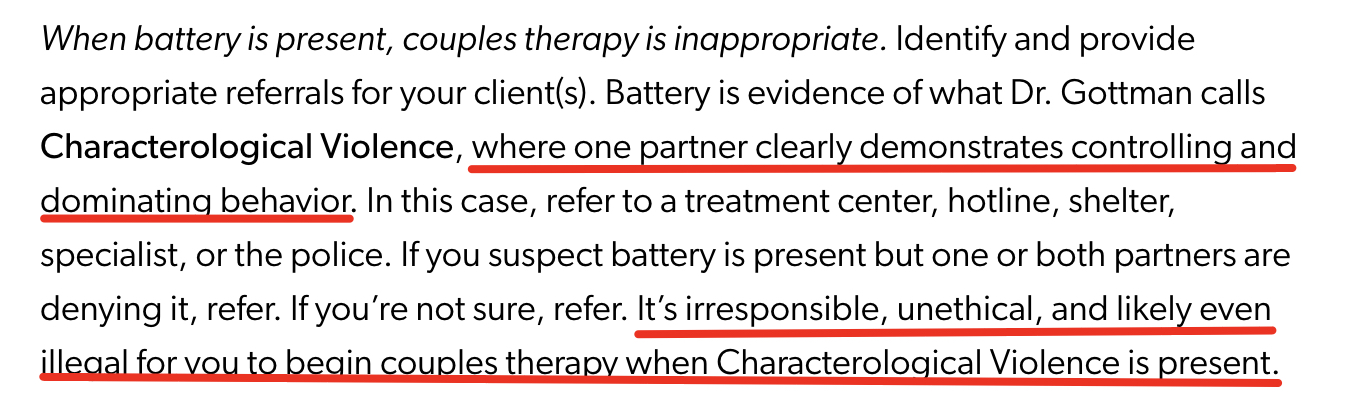
A portion of the Gottman article “V is for Violence”
National Domestic Violence Hotline
“We do not encourage anyone in an abusive relationship to seek counseling with their partner.”
Abuse is not a relationship problem; it is a safety problem.
American Counseling Association (ACA)
“Conjoint couple therapy is not advised when IPV is present… due to the safety risks that may arise.”
Government DV Guidance
Official DV resources warn that couples counseling can:
-
shift responsibility onto the victim
-
miss coercive control
-
escalate danger after sessions
The Bottom Line
When abuse is present:
-
victims often cannot speak honestly
-
therapists may unknowingly validate the abuser’s narrative
-
counseling can increase risk at home
-
“working on the marriage” can mean working around the abuse
From peer-reviewed clinical literature to respected Christian counselors like Leslie Vernick, the message is consistent:
Couples counseling is not appropriate when there is abuse. Safety and individual support must come first.
Endnotes
1. Gurman, Alan S., ed. Clinical Handbook of Couple Therapy, 4th ed. New York: Guilford Press, 2008, p. 706.
This graduate-level clinical textbook describes the ethical risk of “unwitting coercion” in cases of undisclosed intimate partner violence (IPV), concluding that therapists may “unwittingly support coercion and abet abuse” and that “where there is abuse, couples therapy is not recommended; individual therapy is recommended.”
2. Gottman Institute. “V Is for Violence.”
The Gottman Institute states: “When battery is present, couples therapy is inappropriate,” and warns that beginning couples therapy in cases of characterological violence is “irresponsible, unethical, and likely even illegal.” The Institute emphasizes referral to specialized domestic violence resources rather than conjoint therapy.
3. National Domestic Violence Hotline. “Why We Don’t Recommend Couples Counseling for Abusive Relationships.”
The Hotline explicitly advises against joint counseling, explaining that abuse is not a relationship problem but a power and control issue, and that couples counseling may increase danger, silence victims, or enable manipulation by the abusive partner.
4. American Counseling Association (ACA). Counseling Victims of Intimate Partner Violence.
The ACA advises that “conjoint couple therapy is not advised when IPV is present,” citing safety risks and the likelihood that joint treatment may obscure accountability and endanger victims.
5. Washington County, Oregon. 12 Reasons Why Couples Counseling Is Not Recommended When Domestic Violence Is Present.
This government domestic-violence guidance document explains how couples counseling can misattribute responsibility, overlook coercive control, escalate post-session abuse, and unintentionally place victims at greater risk.
6. Vernick, Leslie, MCSW. Clinical teaching and counseling examples as cited in Marriage Counseling in Abusive Situations Is Unethical.
Vernick warns that when an abused spouse cannot speak “100% honestly… without a price to pay,” marriage counseling is unsafe. She provides real-world examples of women concealing abuse during counseling due to fear of retaliation, concluding that when there is no safety, marriage counseling is “contraindicated and even dangerous.”
 :
:
 :
: Buy PDF