
When Pro-Marriage Organizations Ignore Abuse: How Christian and Traditional Voices Fail Christian Wives and Mothers
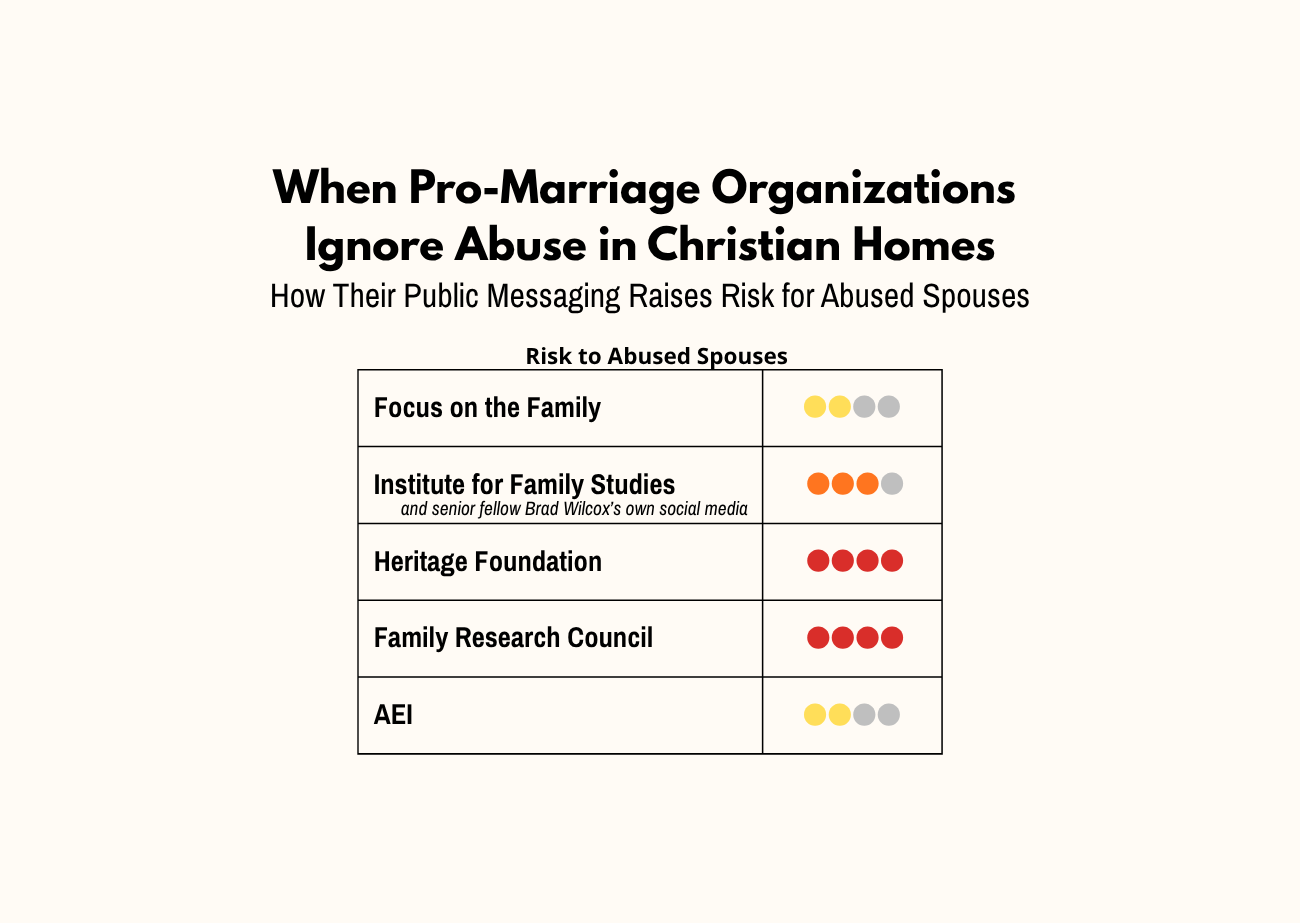
How Focus on the Family, Institute for Family Studies, Heritage Foundation, Family Research Council, Brad Wilcox, and American Enterprise Institute Messaging Endangers Lives
As Christians, we value the sanctity of marriage. We believe in marriage vows. We believe God meant marriage to be loving, undefiled, and faithful. But what if it is not? What if that marriage has become dangerous?
Too many pro-marriage voices praise marriage, motherhood, and “family stability” without saying clearly enough that safety comes first. Good wives and husbands matter. Wives (or husbands) living with cruelty, coercion, intimidation, betrayal, or abuse matter. When they turn to a trusted organization and do not hear clear exceptions for abuse, domestic violence, child exploitation, or betrayal, they may feel spiritually and morally pressured to stay in danger.
Today I looked at the past 1,000 tweets from these 5 organizations, and reviewed them for marriage messages only (4/2/2026 at 4pm ET). Sadly the pattern was consistent: idealizing marriage, stigmatizing divorce, urging women toward self-erasure, and offering little or no safety-aware counterbalance. Not every post was equally severe. But the overall message still leaned toward preserving the marital status rather than protecting the person.
That is dangerous.
What I Am Not Saying
I am not saying that encouraging marriage is bad. I am not saying that encouraging motherhood is bad. I am not saying every post about marriage needs to mention abuse.
I am saying this: when influential Christian and traditional organizations repeatedly praise marriage, lifelong family structure, motherhood, and staying committed—but rarely, if ever, clearly say “leave abuse,” “protect the children,” “coercive control is not a marriage problem,” or “divorce may be necessary for safety”—the overall message becomes unsafe for people in destructive homes.
That imbalance matters. A single post may be defensible in isolation. A pattern of posts with no safety-aware counterbalance is the problem.
Why This Becomes Moral Injury
This is also a kind of moral injury. When trusted conservative Christian organizations praise marriage, stigmatize divorce, or flatten abuse into ordinary marital struggle, they do not just give bad advice. They wound the consciences of abused Christian wives and mothers who expected truth, protection, and justice from their own side. See also “Church Betrayal After Abuse: Christian Divorce When the Church Sides with Your Abuser”.
A woman in harm’s way does not need romanticized slogans about thriving, lifelong marriage, or “biblical womanhood.” She needs moral clarity: abuse is not a marital inconvenience, caution is not rebellion, and leaving danger is not sin.
Let’s look at problematic tweets from these 5 Christian or traditional nonprofits. In each case is an exact quote and date, the category of problem, explanation of why it is a red flag, and a rating of severity.
How I Rated the Severity
I rated each message based on how likely it is to pressure an abuse victim, betrayed spouse, or endangered parent to ignore danger, minimize harm, stay silent, reconcile prematurely, or remain trapped.
- Severity 1: Mild concern. The message may be fine in healthy relationships but lacks safety nuance.
- Severity 2: Moderate concern. The message could reasonably increase pressure on someone in a harmful or coercive marriage.
- Severity 3: High concern. The message is likely to stigmatize divorce, minimize abuse, promote unsafe reconciliation, or increase moral pressure to stay.
The concern is not only the wording of one post. The bigger concern is the pattern: repeated marriage idealization with little or no clear safety exception.
Focus on the Family’s Tweets on X: Marriage, Abuse, Forgiveness, and Divorce
Overall account rating: Moderate concern.
Summary with Samples Below
Focus on the Family’s messaging can present meaningful risks for abuse victims, divorcees, and women contemplating marriage. The recurring concerns are forgiveness-and-reconciliation pressure, marriage permanence language, submission teaching, and appeals to keep families together without adequate safety qualifications.
Much of the advice assumes that marital problems are rooted in hurt feelings, resentment, selfishness, poor communication, or emotional distance. These are genuine problems in many marriages. But they are not the same as abuse, serial infidelity, coercive control, repeated betrayal, or serious substance addictions.
The danger arises when advice intended for ordinary marital conflict is applied to situations involving unilateral wrongdoing. Victims can be pressured to forgive quickly, examine their own contributions, remain emotionally available, reconcile, or stay married for their children when they actually need protection, boundaries, separation, or legal assistance.
How these examples were selected: I began collecting concerning Focus on the Family tweets in earlier reviews and have intentionally retained the strongest historical examples, including posts from 2025 and early 2026. In October 2026, I examined an additional export of 160 tweets covering several periods between February and October 2026. An initial screening identified 50 potential red flags, including seven provisionally classified as severity 3. The new examples below were selected for their relevance to abuse victims.
This is a curated collection, not an exhaustive record of everything Focus on the Family has published. The examples are arranged to show recurring themes rather than their frequency in the complete account. Severity ratings reflect potential risks when messages are applied to abusive relationships, not the intentions of their authors. Positive counterexamples appear at the end.
Potential Red Flags
Newer Examples: Forgiveness, Reconciliation, and Staying for the Children
- 2026-10-08
Exact quoted line: “But the Lord says, ‘Forgive, forgive, forgive.’”
Category: Rushed forgiveness / spiritual pressure
Why it is a red flag: The surrounding message describes someone exhausted by repeated criticism, then turns toward forgiveness as the spiritual response. In abusive relationships, repeatedly exhorting victims to forgive without first addressing the offender’s behavior can shift the moral burden onto the person being harmed. Forgiveness does not require restored trust, reconciliation, or continued exposure to mistreatment. See “Forgiveness Takes Time Where There’s Marital Abuse or Betrayal” and “Unconditional Love in Marriage Does Not Mean Enduring Abuse”.
Severity: 3
- 2026-04-11
Exact quoted line: “Kids don’t need perfect parents – they need parents who stay.”
Category: Stay-for-the-kids pressure
Why it is a red flag: Children do not merely need parents who stay. They need parents who protect, nurture, and care for them. Sometimes a parent protects children by separating from an abusive spouse. This message makes parental presence sound more important than safety and can burden protective parents with guilt. See “Is it Always Best to ‘Stay for the Kids’? No, Not If the Home is Toxic”. And What 50 Years of Kids-and-Divorce Research Have Found
Severity: 3
- 2026-04-06
Exact quoted line: “A culture that abandons marriage will also abandon children.”
Category: Divorce stigma / stay-for-the-kids pressure
Why it is a red flag: This conflates leaving a marriage with abandoning children. Yet a mother or father who divorces an abusive spouse may be doing precisely the opposite: protecting the children from further harm. Marriage preservation and child protection are not always the same goal. See “Is it Always Best to ‘Stay for the Kids’? No, Not If the Home is Toxic” and “12 Positive Outcomes of Divorce that Nobody Told Us”.
Severity: 3
Earlier Examples Retained: 2025–2026
- 2026-03-24
Exact quoted line: “Forgiveness is a change in your own attitude. It’s being willing to still show love, gentleness, and kindness to the other person.”
Category: Rushed forgiveness
Why it is a red flag: This frames forgiveness in a way that can pressure hurting spouses to stay warm and accessible to someone harming them, without any safety qualifier. See also “Forgiveness Takes Time Where There’s Marital Abuse or Betrayal”.
Severity: 2
- 2026-02-23
Exact quoted line: “Be willing to make the first move toward reconciliation, even if it feels unfair or vulnerable.”
Category: Pressured reconciliation
Why it is a red flag: Telling someone in a marriage crisis to reconcile even when it feels “unfair or vulnerable” can be dangerous in coercive or abusive dynamics. See also “Safety-First vs. Marriage-First Counseling” and “Marriage Counseling in Abusive Situations is Unethical”.
Severity: 3
- 2026-02-23
Exact quoted line: “Stay present. Listen first.”
Category: Pressured reconciliation
Why it is a red flag: In an abusive context, “stay present” can function as pressure to remain emotionally available rather than prioritize safety and distance. See also “Safety-First vs. Marriage-First Counseling” and “Marriage Counseling in Abusive Situations is Unethical”.
Severity: 2
- 2026-02-23
Exact quoted line: “Even in deep dysfunction, every spouse longs to feel chosen, valued, and emotionally safe.”
Category: Minimizing abuse
Why it is a red flag: “Deep dysfunction” can blur the line between ordinary conflict and abuse, redirecting attention toward the hurting spouse’s duty to soothe the relationship rather than flee to safety. See also “130 Examples of Abuse: Physical, Emotional, Sexual, Spiritual, Financial and Neglect” and “Can I Divorce for Abuse? Can Christians Divorce for Abuse?”.
Severity: 2
- 2026-02-07
Exact quoted line: “Til death do us part”
Category: Divorce stigma / church-spiritual pressure
Why it is a red flag: This elevates permanence as the ideal in a way that can intensify shame and spiritual pressure on women considering leaving a harmful marriage. See also “Are ‘Traditional Marriage Vows’ Biblical? How Focus on the Family Misuses Them” and “Marriage Is a Conditional Covenant (Not an Unbreakable Promise)”.
Severity: 2
- 2026-02-07
Exact quoted line: “you’re promising a close marital bond that can’t be broken”
Category: Divorce stigma
Why it is a red flag: This presents marriage as unbreakable, which can trap women morally and emotionally when serious harm is present. See also “Marriage Is a Conditional Covenant (Not an Unbreakable Promise)” and “27 Myths about Divorce That Probably Don’t Apply to Committed Christians”.
Severity: 3
- 2025-08-20
Exact quoted line: “If you don’t move swiftly at the first feelings of resentment or unforgiveness toward your spouse”
Category: Rushed forgiveness
Why it is a red flag: This treats resentment as the urgent problem, which can discourage protective anger and clear-eyed recognition of mistreatment. See also “Forgiveness Takes Time Where There’s Marital Abuse or Betrayal”. And The Bible Requires Abusers to Repent and Change.
Severity: 2
- 2026-03-16
Exact quoted line: “Love is, in fact, a choice we have to make each day. We have to choose to forgive”
Category: Rushed forgiveness
Why it is a red flag: This makes forgiveness sound like a daily marital duty, without distinguishing normal conflict from repeated harm. See also “Forgiveness Takes Time Where There’s Marital Abuse or Betrayal”.
Severity: 2
- 2026-03-16
Exact quoted line: “love covers over a multitude of sins”
Category: Sin-leveling
Why it is a red flag: This biblical phrase comes from 1 Peter 4:8. When applied indiscriminately to marital wrongdoing, it can encourage victims to overlook repeated abuse or betrayal. Yet 1 Corinthians 13 also teaches that love “does not rejoice at wrongdoing” and “always protects.” Biblical love should never require someone to conceal or endure abuse. See also “130 Examples of Abuse: Physical, Emotional, Sexual, Spiritual, Financial and Neglect” and “Can I Divorce for Abuse? Can Christians Divorce for Abuse?”.
Severity: 3
- 2026-02-23
Exact quoted line: “If your marriage is in crisis, first surrender to God. Lean into Him with everything you have – there is no better source of help.”
Category: Church/spiritual pressure
Why it is a red flag: Spiritual counsel can help, but phrased this way it can steer people toward endurance and inward spiritual work before practical safety steps. See also “The Bible Teaches Us to Get Away from Abusers” and “Adultery, Abuse, Abandonment are Biblical Grounds for Divorce”.
Severity: 2
Counterbalancing Safety-Aware Messages
Focus on the Family does sometimes speak responsibly about abuse, safety, and the dignity of victims. These examples deserve recognition.
- 2026-03-07: “You do not have to stay silent about what’s hurting you. God gave you a voice and dignity. Pray, reach out, and let someone safe hear your heart.”
- 2025-05-15: “If you are in an abusive relationship, go to a safe place and call the National Domestic Violence Hotline.”
- 2026-01-25: “God’s design for marriage never included abuse, violence or coercive control.”
- 2026-10-02: “Your wife isn’t yours to control—she’s God’s daughter, entrusted to your care.” This directly rejects the idea that a husband has the right to dominate or manipulate his wife. (This is sharing a pastor’s comment.)
What These Contradictions Reveal
The concern is not simply whether Focus condemns abuse somewhere. It is whether its advice helps people recognize abuse, identify who is responsible, establish boundaries, and reach safety when necessary.
General statements that abuse is wrong are important. They are not a substitute for making sure abuse victims aren’t pressured to reconcile, forgive quickly, submit, or remain in harmful marriages.
For ordinary disagreements, advice to listen, forgive, and persevere may be helpful. For coercive control, sexual abuse, violence, chronic betrayal, or serious neglect, that same advice can be dangerous when offered without safety qualifications.
Victims should never be made responsible for maintaining a relationship that another person’s abusive behavior has made unsafe.

Heritage Foundation’s last 1,000 Tweets from X.com
Overall account rating. High concern.
Summary with Samples Below
The pattern is heavy on marriage idealization, motherhood idealization, and religious framing with little sign of safety exceptions. The strongest concerns are posts that present marriage as broadly superior, lifelong, and child-centered in ways that can stigmatize divorce and make women feel morally obligated to endure harmful situations. The account does not usually blame victims directly, but it repeatedly promotes a framework that can minimize relational danger and undermine boundaries. For abuse victims, divorcees, or women realistically assessing marriage risk, this is unsafe-leaning messaging.
Potential red flags
Date: 2026-03-22
Exact quoted line: “Heritage Policy Analyst @emlwaters new book, Lead Like Jael, aims to teach college students and young adults how to recover biblical womanhood, and is an essential how-to guide to create a world after feminism.”
Category: church/spiritual pressure
Why it is a red flag: It frames “biblical womanhood” as the corrective and feminism as the problem, which can pressure women toward religious-role expectations without any safety exceptions for sexually immoral, coercive, or abusive marriages. See also “The Bible Teaches Us to Get Away from Abusers” and “Adultery, Abuse, Abandonment are Biblical Grounds for Divorce”.
Severity: 2
Date: 2026-03-18
Exact quoted line: “You can’t do it all at one time, but I would say put first things first. And getting the family worked out first and then figuring out the career after that.”
Category: boundary-undermining
Why it is a red flag: This tells women to prioritize family formation before career stability, which can make women more vulnerable if a relationship becomes controlling, unsafe, or financially entrapping. See also “But He Never Hit Me: Divorce for Neglect, Emotional, and Financial Abuse” and “Turning Point 1: Fear, I Escaped and Never Went Back”.
Severity: 2
Date: 2026-03-18
Exact quoted line: “Serving in Congress has paled to the most important job I’ve ever had, which is to be a wife, a mother, a [grandma], and soon to be great-grandma.”
Category: submission or male entitlement
Why it is a red flag: It idealizes women’s relational roles as their highest calling. In real-world harmful marriages, messaging like this can normalize self-erasure and make it harder to treat safety and autonomy as priorities. See also “The Bible Teaches Us to Get Away from Abusers”.
Severity: 1
Date: 2026-03-06
Exact quoted line: “Giving into the lie that marriage and motherhood will ruin your life could actually be the thing holding you back from the greatest adventure you’ve ever embarked on.”
Category: minimizing abuse
Why it is a red flag: Calling fears about marriage and motherhood “the lie” can flatten legitimate caution from women who have seen abuse, coercion, betrayal, or abandonment up close. See also “But He Never Hit Me: Divorce for Neglect, Emotional, and Financial Abuse” and “Turning Point 1: Fear, I Escaped and Never Went Back”.
Severity: 3
Date: 2026-02-13
Exact quoted line: “Resotre marriage, restore the family, restore America.”
Category: divorce stigma
Why it is a red flag: It treats marriage restoration as a social cure-all, which can stigmatize divorce or separation even when those choices are protective and necessary. See also “Marriage Is a Conditional Covenant (Not an Unbreakable Promise)” and “27 Myths about Divorce That Probably Don’t Apply to Committed Christians”.
Severity: 2
Date: 2026-02-12
Exact quoted line: “The family is the most fundamental unit of self-government, undergirded by marriage.”
Category: divorce stigma
Why it is a red flag: It centers marriage as the proper foundation of family life, which can marginalize women and children whose safety depends on leaving a destructive marriage. See also “Marriage Is a Conditional Covenant (Not an Unbreakable Promise)” and “27 Myths about Divorce That Probably Don’t Apply to Committed Christians”.
Severity: 2
Date: 2026-02-12
Exact quoted line: “We seek an America where a husband, his wife, and their children are protected by law, encouraged by government, and supported by societal institutions so that they may prosper in peace and security, and pass on our heritage to subsequent generations.”
Category: boundary-undermining
Why it is a red flag: It presents one idealized family form as the model to be reinforced by law and institutions, with no acknowledgment that some wives and children need distance, not preservation of the unit. See also “But He Never Hit Me: Divorce for Neglect, Emotional, and Financial Abuse” and “Turning Point 1: Fear, I Escaped and Never Went Back”.
Severity: 2
Date: 2026-01-28
Exact quoted line: “Yes. Children need a mom and a dad, as God designed, committed to each other in marriage for life.”
Category: stay-for-the-kids pressure
Why it is a red flag: “Marriage for life” plus a mom-and-dad ideal can pressure women to remain in damaging marriages for the children rather than prioritize safety. See also “Is it Always Best to ‘Stay for the Kids’? No, Not If the Home is Toxic”.
Severity: 3
Date: 2026-01-28
Exact quoted line: “Proud to be a part of this coalition. God designed marriage as the union of one man and one woman. Social science clearly shows that children (and adults) thrive best in this family structure.
Moms & dads are not optional. The needs of children are greater than adult “equality.””
Category: stay-for-the-kids pressure
Why it is a red flag: It treats one family structure as the unquestioned best and explicitly subordinates adult concerns, which can be used to pressure women to stay despite serious harm. See also “Is it Always Best to ‘Stay for the Kids’? No, Not If the Home is Toxic” Also, note that this tweet is talking about the #GreaterThan campaign coalition, headed by Katy Faust; and it’s important to debunk the messages she espouses in her book Them Before Us.
Severity: 3
Counterbalancing safety-aware tweets
I did not find clear marriage/family tweets in this file subset that explicitly affirmed leaving abuse, prioritizing safety, respecting boundaries, or resisting pressured reconciliation.

American Enterprise Institute (AEI) Tweets on Marriage, Divorce, and Women’s Safety
Overall account rating: Moderate concern
Summary with Samples Below
The American Enterprise Institute (AEI) publishes research and commentary on many subjects, including marriage, family structure, economics, and social policy. Its social media feed is generally more research-oriented than the explicitly religious marriage messaging found in some other organizations.
The strongest concerns in the tweets reviewed are divorce stigma, romanticizing marriage and motherhood, and comparisons that portray unmarried or childless women as less happy or less successful. The account has also promoted the idea that divorce is socially contagious, language that can make divorced people seem like a threat to other families.
These messages deserve scrutiny because population averages about marriage do not establish that an individual woman would be safer, happier, or better off staying married. Some women remain single or leave marriages because of abuse, coercive control, infidelity, serious neglect, or other harmful circumstances. Divorce can be a necessary and beneficial response to those conditions.
How these tweets were selected: This review preserves five concerning examples collected during November and December 2025. In October 2026, I also examined an additional export containing 158 unique posts dated September 2 through October 16, 2026. Of those, 104 were identified as AEI-authored posts and 54 as posts from other authors appearing in the export.
The newer batch was considerably less focused on marriage and divorce. An initial screening identified seven posts requiring additional context, but no confirmed moderate or severe abuse-safety red flags from the tweet text alone. The newer examples below are included to show the themes AEI continues to promote, not because they establish direct pressure on abuse victims.
This is a curated collection, not an exhaustive audit of everything AEI has published. The earlier examples are retained because they illustrate potential concerns even though the newer sample is less concerning. Severity scores are editorial judgments about possible implications for abuse victims, not statements about the authors’ intentions. Selected quotations and their surrounding research should be checked before making broader claims about AEI’s institutional position.
Potential Red Flags: Historical Examples
Date: 2025-11-06
Exact quoted line: “Divorce is contagious. If a high % of your close friends are divorced, you are more likely to get/be divorced.”
Category: Divorce stigma
Why it is a red flag: “Divorce is contagious” is particularly stigmatizing language. It can encourage readers to view divorced friends as a threat to their own marriages rather than recognizing that some people divorce because of abuse, betrayal, addiction, abandonment, or other serious wrongdoing. An association between friends’ divorces and one’s own divorce does not establish that divorced friends caused the marital breakup. Shared social circumstances, relationship difficulties, and other factors may contribute. See “When ‘Divorce is Contagious’ Misses the Real Story”.
Severity: 3
Date: 2025-12-10
Exact quoted line: “Today, there is no group of women in America who are less happy than prime-aged women with no immediate family”
Category: Romanticizing marriage / stigmatizing singleness
Why it is a red flag: This sweeping comparison can portray women without spouses or children as uniquely unhappy. But group averages cannot establish why individual women are unhappy, whether marriage would improve their well-being, or whether remaining single might be the healthier choice. For women escaping abusive relationships, independence and singleness may represent safety, freedom, and recovery rather than failure. See “Will I Find Happiness Again? Remarry or Stay Single After Divorce!” and Study Shows Divorced Women Thrive Years Later And 75% of Divorced People Are Happy Today (2024 GSS)
Severity: 3
Date: 2025-11-17
Exact quoted line: “When divorce becomes common in a friend group, it can influence how people view commitment, conflict, and the purpose of marriage itself.”
Category: Divorce stigma
Why it is a red flag: Although social networks can influence attitudes toward marriage, this framing can encourage suspicion toward divorced friends. It overlooks the possibility that hearing another person’s experience of abuse or betrayal may help someone recognize serious wrongdoing in their own marriage. Learning that divorce is sometimes necessary is not the same as becoming less committed to healthy marriage. See “Marriage Is a Conditional Covenant (Not an Unbreakable Promise)” and “27 Myths about Divorce That Probably Don’t Apply to Committed Christians”.
Severity: 2
Date: 2025-12-04 (later deleted)
Exact quoted line: “Elizabeth Gilbert’s ‘Eat, Pray, Love’ empowered women to leave their husbands and travel the world to find themselves”
Category: Divorce stigma
Why it is a red flag: This quotation invokes a familiar cultural narrative about women leaving marriages in pursuit of personal fulfillment. Its meaning depends on the surrounding post, including whether AEI presented that narrative approvingly or critically. The concern arises when discussion of voluntary divorce for self-discovery is generalized to women whose marriages involve abuse, betrayal, or serious neglect. Their reasons for leaving may be very different. See “Marriage Is a Conditional Covenant (Not an Unbreakable Promise)” and “27 Myths about Divorce That Probably Don’t Apply to Committed Christians”.
Severity: 2 (provisional; context needed)
Date: 2025-12-15
Exact quoted line: “The narrative has taken hold that marriage is a riskier proposition than perhaps it once was, particularly for young women who have professional ambitions.”
Category: Minimizing relational risk / women’s autonomy
Why it is a red flag: Describing women’s concerns about marriage as a “narrative” may suggest their caution is driven primarily by cultural messaging. Yet women may have legitimate concerns about financial dependence, unequal domestic labor, coercion, career sacrifices, or mistreatment. The quoted statement does not explicitly dismiss those risks, but any argument challenging women’s caution should take them seriously. See “130 Examples of Abuse: Physical, Emotional, Sexual, Spiritual, Financial and Neglect” and “Can I Divorce for Abuse? Can Christians Divorce for Abuse?”.
Severity: 1
Counterbalancing Safety-Aware Tweets
In the reviewed exports, I did not identify a clear AEI institutional tweet explicitly affirming divorce as a legitimate response to abuse, encouraging victims to leave dangerous marriages, or warning against coercive reconciliation.
However, the newer September–October 2026 sample also contained no confirmed moderate or severe red flags based on the tweet text alone. Most posts dealt with unrelated policy topics, and several marriage-related posts were descriptive reports of research rather than instructions directed at women.
One September 2026 post emphasized individualized consideration of children’s foster-care placements rather than assuming that placement with relatives is always best. That reflects attention to children’s circumstances, although it is not directly about domestic violence or divorce.
Important qualification: Not finding explicit divorce-for-abuse guidance in these limited exports does not establish that AEI or its scholars have never published such guidance elsewhere.
Bottom Line
The older AEI tweets contain language that can stigmatize divorce, portray marriage and motherhood as standards for women’s happiness, and cast divorced friends as socially influential in potentially negative ways.
But the newer institutional feed is much less focused on these subjects. The available evidence does not justify portraying all AEI marriage research as hostile to abuse victims, nor does it establish that AEI directly urges people to remain in abusive marriages.
The essential distinction is between describing average outcomes associated with marriage and telling an individual what they should do in a harmful relationship. Research about marriage, happiness, and family stability must not be used to erase the experiences of people whose marriages have become unsafe.
That is particularly important when AEI promotes research by scholars who also advocate policies affecting divorce, marriage incentives, or family structure. Their specific proposals should be evaluated on their own evidence, including whether they adequately account for domestic violence and necessary divorce.
Institute for Family Studies’ Tweets on X: Marriage, Divorce, and Women’s Safety
Overall account rating: Orange / concerning for abuse victims.
Summary with Samples Below
The Institute for Family Studies (IFS) frequently promotes marriage, motherhood, religious participation, and traditional family structures. The concern is not that IFS values marriage. It is that much of its messaging romanticizes marriage without adequately distinguishing healthy marriages from those marked by abuse, betrayal, coercive control, or severe neglect.
The pattern is generally less openly hostile toward women than the personal account of IFS senior fellow Brad Wilcox (below). Instead, IFS repeatedly presents marriage as a path to happiness, financial security, and social stability. Some posts encourage women to reconsider career priorities or portray declining marriage rates as a social crisis. These messages may sound harmless to happily married people, but they can have very different implications for someone trapped in a destructive marriage.
Marriage can be wonderful. But marriage is not automatically safe, and divorce is not automatically harmful. A responsible discussion of marriage must recognize that leaving an abusive or chronically destructive spouse can be necessary and beneficial.
How these tweets were selected: This is a curated collection of potential red flags from several batches of IFS tweets reviewed during 2026. I have intentionally retained the strongest historical examples rather than replacing them with newer material. In October 2026, I examined another export containing 160 unique posts and selected additional examples that illustrate recurring themes. The examples below are not an exhaustive record of everything IFS has published, nor are they intended to represent a random sample.
The collection includes posts authored by IFS and material the account amplified through reposting. Where relevant, that distinction is identified. Severity scores are my editorial assessment of potential risk for abuse victims, not a judgment about the authors’ intentions. I also include positive counterexamples at the end.
Potential Red Flags
Newer Examples: September–October 2026
Date: 2026-10-13
Exact quoted line: “Stunning, almost never discussed truth about young men today: ‘Young men who grew up in a non-intact family are more likely to go to prison than graduate college.’”
Category: stay-for-the-kids pressure / divorce stigma
Why it is a red flag: IFS reposted this statement from Brad Wilcox. It presents an alarming comparison without distinguishing children whose parents divorced because of abuse, coercive control, addiction, or other dangerous circumstances. The underlying statistic also requires scrutiny before it can be applied broadly. Such claims can frighten parents into believing that leaving a harmful marriage will destroy their children’s futures. See “Is it Always Best to ‘Stay for the Kids’? No, Not If the Home is Toxic” and “New Study Shows Kids of Divorce Rarely Face Teen Pregnancy, Jail, or Early Death”.
Severity: 3
Source: View reposted tweet
Date: 2026-10-14
Exact quoted line: “Marriage, children, extended family, and stable community should not be viewed as a mere personal preference or a luxury by young adults, but as a necessary facet of life.”
Category: romanticizing marriage / boundary-undermining
Why it is a red flag: Marriage and parenthood are presented as necessities rather than personal choices. But not everyone should marry, and not every marriage should continue. Some women wisely remain single rather than enter unsafe relationships. Others must leave destructive marriages to protect themselves and their children. Some follow the words of Jesus that singleness is a valid option. Presenting marriage as something everyone needs can undermine careful discernment and increase pressure to conform to a preferred family structure. See “Will I Find Happiness Again? Remarry or Stay Single After Divorce!”.
Severity: 2
Source: View tweet
Date: 2026-10-14
Exact quoted line: “The decline of marriage is the single biggest cause of demographic collapse in the west, argues @BradWilcoxIFS…”
Category: romanticizing marriage / divorce stigma
Why it is a red flag: IFS amplifies Brad Wilcox’s sweeping claim that declining marriage is the greatest cause of demographic decline. This frames marriage rates as a societal crisis without considering why some people avoid marriage or leave destructive relationships. It also places considerable weight on individual marriage decisions as solutions to society’s problems. People should not feel obligated to marry or remain married to satisfy demographic goals. See “12 Positive Outcomes of Divorce that Nobody Told Us”.
Severity: 2
Source: View tweet
Date: 2026-10-10
Exact quoted line: “Which Americans are happiest today? According to a 2026 Institute for Family Studies survey, it’s married adults.”
Category: romanticizing marriage
Why it is a red flag: IFS reports that married adults are more likely than unmarried adults to describe themselves as happy. But population averages do not tell us whether marriage causes happiness, whether people in unsafe marriages are happy, or whether divorce improves well-being after abuse. For someone living with cruelty or coercive control, leaving a marriage may be a path toward greater safety and happiness. See “12 Positive Outcomes of Divorce that Nobody Told Us” and “5 Christians Who Divorced and Are Thriving Now”.
Severity: 2
Source: View tweet
Earlier Examples Retained: January–March 2026
These examples appeared in the earlier review. They are retained because they illustrate recurring concerns, not because they were necessarily the most recent or most frequent kinds of posts.
Date: 2026-03-23
Exact quoted line: “I realized the career-first, put-off children script I’d followed had quietly postponed the very desire for motherhood it had told me to ignore.”
Category: boundary-undermining
Why it is a red flag: It frames caution and delayed childbearing as a harmful script, which can pressure women to downplay legitimate concerns about safety, readiness, or relational risk. See also “But He Never Hit Me: Divorce for Neglect, Emotional, and Financial Abuse” and “Turning Point 1: Fear, I Escaped and Never Went Back”.
Severity: 2
Date: 2026-02-17
Exact quoted line: “For both men and women, the primary predictor of marital happiness is clear: high commitment to your spouse.”
Category: minimizing abuse
Why it is a red flag: In unsafe marriages, “high commitment” language can blur the line between healthy perseverance and staying bound to harmful treatment. See also “130 Examples of Abuse: Physical, Emotional, Sexual, Spiritual, Financial and Neglect” and “Can I Divorce for Abuse? Can Christians Divorce for Abuse?”.
Severity: 2
Date: 2026-01-15
Exact quoted line: “There is at least one step young couples can take to strengthen their marriages, and it’s pretty simple: Go to church.”
Category: church/spiritual pressure
Why it is a red flag: It presents church involvement as a marital fix without any safety caveat for coercion, abuse, or dangerous dynamics. See also “The Bible Teaches Us to Get Away from Abusers” and “Adultery, Abuse, Abandonment are Biblical Grounds for Divorce”.
Severity: 2
Date: 2026-02-13
Exact quoted line: “A recent study by @FamStudies shows regular church attendance leads to stronger marriages. | National Marriage Week”
Category: church/spiritual pressure
Why it is a red flag: It ties marital strength to church participation, which can feed the idea that spiritual compliance is the answer even when a marriage is unsafe. See also “The Bible Teaches Us to Get Away from Abusers” and “Adultery, Abuse, Abandonment are Biblical Grounds for Divorce”.
Severity: 2
Date: 2026-02-12
Exact quoted line: “.@Gallup survey finds married couples more likely to be ‘thriving.’ | National Marriage Week”
Category: divorce stigma
Why it is a red flag: It promotes marriage as the thriving path without acknowledging that some women thrive only after separation or divorce from harmful spouses. See also “Will I Find Happiness Again? Remarry or Stay Single After Divorce!” and “12 Positive Outcomes of Divorce that Nobody Told Us”.
Severity: 2
Counterbalancing Safety-Aware Tweets
Not every IFS tweet ignores women’s safety. The October 2026 export contains several examples acknowledging sexual exploitation and the responsibility of men not to harm women.
October 7, 2026 — Sexual coercion and nonconsensual choking. IFS warned about violent pornography, coercive sex, and men choking women during sex without asking for consent. The post concluded that women want men who respect and protect them rather than hurt them. This is a meaningful acknowledgment of serious sexual misconduct. View tweet.
October 7, 2026 — Exploitation of intoxicated women. IFS published commentary questioning why educated young men saw nothing wrong with taking sexual advantage of an intoxicated woman. This places moral scrutiny on the men’s behavior rather than simply blaming the woman. View tweet.
October 7, 2026 — Teaching men not to exploit women. IFS asked why the men involved had not learned the principle that a gentleman does not take advantage of a woman who is drunk. This explicitly identifies male responsibility. View tweet.
What remains unclear: These posts condemn forms of sexual exploitation and coercion, but in the reviewed October export I did not identify a similarly explicit endorsement of divorce as a legitimate response to domestic violence, or clear guidance for victims facing ongoing abuse within marriage. That does not establish that IFS has never published such guidance elsewhere.
Bottom Line
IFS can recognize when men behave abusively or exploitatively. The important question is whether it applies that same moral clarity when promoting marriage and discouraging divorce.
Research showing that many married people are happy does not mean that every marriage is beneficial. Research showing that children often benefit from stable families does not mean children benefit from living with abuse. And research showing that religious couples have lower divorce rates does not establish that remaining married is always the safest or healthiest outcome.
For abuse victims, these distinctions are essential. A genuinely pro-family message must recognize that sometimes protecting a family means helping someone leave a destructive marriage.

Brad Wilcox’s Tweets on X: Abuse, Divorce, and Women’s Safety
Brad Wilcox is associated with the Institute for Family Studies. This review examines his personal X account, including selected posts through October 17, 2026. It is a review of available exports and previously collected examples, not an exhaustive audit of his account.
Overall account rating: Orange-Red / unsafe.
Brad Wilcox’s Tweets on X: Abuse, Divorce, and Women’s Safety
Brad Wilcox is a senior fellow at the Institute for Family Studies. This review examines his personal X account, with particular attention to how his messages may affect women experiencing domestic violence, betrayal, or other serious marital harm.
Overall account rating: Orange-Red / unsafe.
Summary with Samples Below
The recurring concern in Wilcox’s posts is not that he values marriage. It is that he often presents marriage as the preferred outcome without adequately distinguishing healthy marriages from marriages marked by domestic violence, coercion, or betrayal.
His tweets include rhetoric disparaging “female victimhood,” stigmatizing divorce, blaming feminism for social problems, and romanticizing marriage and motherhood as the superior path for women. Such messaging can make it harder for abuse victims to be believed and can intensify pressure to remain in unsafe relationships.
Perhaps the clearest recent example is his September 27, 2026, description of a marriage involving court-substantiated domestic violence as a “failed influencer marriage.” He used the story to promote marriage statistics without acknowledging the domestic violence that had occurred.
To be fair, Wilcox has also criticized men who sexually exploit vulnerable women. Those examples appear in the counterbalancing section below. The central concern is the contrast between recognizing some forms of male wrongdoing and repeatedly promoting marriage without making adequate exceptions for seriously harmful marriages.
How these tweets were selected: This is a curated collection of potential red flags, not a chronological list of every tweet. I began documenting Wilcox’s messaging earlier in 2026 and have deliberately retained the strongest examples from those earlier reviews. In October 2026, I reviewed two additional exports containing 266 unique tweet IDs after duplicates were removed. I added particularly concerning recent examples while preserving the older ones that best illustrate recurring themes.
The exports include original posts, replies, quotations, and reposts, and do not represent everything Wilcox has published. The examples are arranged to highlight the most significant concerns rather than simply the newest posts. The severity ratings are editorial assessments of potential risk to abuse victims, not judgments about Wilcox’s intentions.
Related: Wilcox on single motherhood and juvenile delinquency risks.
Potential red flags
Date: 2026-09-27
Exact quoted line: “Failed influencer marriages make NYT headlines. Ordinary faithful marriages don’t. But out in ordinary America, churchgoers are markedly less likely to divorce.”
Category: abuse minimization / marriage idealization
Why it is a red flag: Wilcox presented Bernadine Bluntly as an example of a failed influencer marriage, although the case was publicly described as involving domestic violence and a Missouri court finding that the woman had proved allegations of domestic violence. Leah Libresco Sargeant objected publicly that the case should not be minimized as influencer drama. Describing it this way to make a point about religious marriages overlooks the serious abuse allegation and court finding, potentially teaching audiences to see a safety crisis as merely a failed marriage. The tweet itself does not explicitly deny that abuse occurred; the concern is what it omits.
Severity: 3
Source: September 27 tweet
Date: 2026-10-13
Exact quoted line: “What the apostles of the ‘drifting apart’ model of divorce don’t reckon with is how it can affect their kids. Doubt ‘Dom’ knows that boys from divorced homes are more likely to spend some time in prison or jail than they are to graduate from college.”
Category: stay-for-the-kids pressure / divorce stigma
Why it is a red flag: Although he specifies that this is about divorces for “drifting apart,” warnings like this need a clear exception for children living with abuse, coercive control, and other dangerous conditions. See “Is it Always Best to ‘Stay for the Kids’? No, Not If the Home is Toxic”.
Severity: 3
Source: October 13 tweet
Date: 2026-10-14
Exact quoted line: “Bloomberg could not be more wrong. Data (on hhld income) says: ✔️Married moms: $133K ✔️Childless single women: $79K That’s a $54K gap. Marriage is not a path to poverty. It’s a path to prosperity.”
Category: romanticizing marriage / financial dependence blind spot
Why it is a red flag: Comparing household income (income from 2 adults) for married mothers and single women is not the same as showing that marrying causes an individual woman to become financially secure. Household income may count another adult’s earnings and may conceal unequal access to or control over money. For women facing financial abuse, household wealth is not proof of personal safety. See “How to Afford Divorce When Your Spouse Controls the Money”.
Severity: 2
Source: October 14 tweet
Date: 2026-10-12
Exact quoted line: “Academics often avoid –> ‘mentioning one of the most robust findings in happiness research: “Married people are happier. Period.”’ It’s true even for young women.”
Category: romanticizing marriage
Why it is a red flag: This presentation of an average group difference can sound like a promise to individual women. It does not tell readers whether being married causes greater happiness or what happens to women in chronically harmful marriages. The qualifier that matters for abuse victims is whether the relationship is safe, not merely whether the person is married. See “12 Positive Outcomes of Divorce that Nobody Told Us”.
Severity: 2
Source: October 12 tweet
Date: 2026-03-23
Exact quoted line: “For years, pushing back against the cult of female victimhood has been one of my core messages.”
Category: victim-blaming
Why it is a red flag: This is open contempt for women describing harm. In Christian settings, women already struggle to be believed when they describe coercion, betrayal, sexual selfishness, intimidation, or abuse. Messaging like this trains readers to treat women’s pain as exaggeration or ideology instead of something that may need moral clarity and protection. See also “27 Ways Churches Gaslight Abuse and Betrayal Victims (And the Biblical Truth)” and “When Your Friend Doesn’t Believe You’re Being Abused”.
Severity: 3
Date: 2026-03-23
Exact quoted line: “Women were lied to. We were taught to put off love for more ‘important’ things like self, status and stuff, and family would come easily later in life.”
Category: boundary-undermining
Why it is a red flag: This judges women’s caution and life planning. In the real world, some women delay marriage because they are trying to finish school, become financially stable, heal from trauma, or avoid becoming trapped with an unsafe man. Framing that caution as a lie can push women to distrust their own prudence. See also “Why You Did Not See the Red Flags And Why It Is Not Your Fault” and “Book Review: Before You Say ‘I Do’ Christian Premarital Workbook”.
Severity: 2
Date: 2026-03-23
Exact quoted line: “countless women have become victims of something—the seductive lies peddled by ‘girl boss’ feminism.”
Category: victim-blaming
Why it is a red flag: Instead of showing concern for women harmed by actual men, this shifts sympathy toward a culture-war story in which feminism is the real villain. That can make readers less willing to take women’s reports of mistreatment seriously. See also “27 Ways Churches Gaslight Abuse and Betrayal Victims (And the Biblical Truth)” and “Unconditional Love in Marriage Does Not Mean Enduring Abuse”.
Severity: 3
Date: 2026-04-02
Exact quoted line: “These conservative students view the divorce revolution, 2nd/4th waves of feminism, and the devaluation of masculinity as driving today’s societal malaise.”
Category: divorce stigma
Why it is a red flag: This casts divorce itself as a driver of social decline. That can shame women for even contemplating divorce, even when divorce may be the safer and more truthful response to coercion, infidelity, abuse, or chronic deception. See also “No-Fault Divorce Myths and How to Refute Them” and “Marriage Is a Conditional Covenant (Not an Unbreakable Promise)”.
Severity: 3
Date: 2026-02-11
Exact quoted line: “If you are worried about the risk of divorce, the risks can be minimized, “by focusing on finding a mate who is a good friend, as well as by embracing a common faith and avoiding cohabitation.””
Category: church/spiritual pressure
Why it is a red flag: Shared faith and friendship can matter, but this makes divorce risk sound manageable through premarital virtue and religiosity. That can hide the reality that some harmful spouses deceive well, perform faith well, and still become coercive or abusive. See also “Adultery, Abuse, Abandonment are Biblical Grounds for Divorce” and “But I Thought It Was God’s Will for Me to Marry This Person!”.
Severity: 2
Date: 2026-03-31
Exact quoted line: “Married mothers are the happiest among young women.”
Category: divorce stigma
Why it is a red flag: This creates a hierarchy where married motherhood is the happiest and therefore most desirable status. That can shame single women, childless women, and divorcees, and can push women to preserve a marriage at too high a cost. See also “Will I Find Happiness Again? Remarry or Stay Single After Divorce!” and “12 Positive Outcomes of Divorce that Nobody Told Us”.
Severity: 2
Date: 2026-03-31
Exact quoted line: “Get married and be open to the gift of life.”
Category: church/spiritual pressure
Why it is a red flag: This is direct marriage-and-childbearing pressure. It leaves no room for the woman who needs to slow down, vet a man carefully, remain single, or leave a relationship that has already become unsafe. See also “Unconditional Love in Marriage Does Not Mean Enduring Abuse” and “Afraid You’ll Never Find a Healthy Relationship After Abuse?”.
Severity: 3
Date: 2026-02-27
Exact quoted line: “Single, childless young women are markedly less happy than their peers who are married mothers.”
Category: divorce stigma
Why it is a red flag: This stigmatizes women outside marriage and motherhood. That kind of messaging can make women fear singleness more than they fear a destructive marriage. See also “Will I Find Happiness Again? Remarry or Stay Single After Divorce!” and “5 Christians Who Divorced and Are Thriving Now”.
Severity: 2
Date: 2026-02-27
Exact quoted line: “women who marry in their 20s & start having kids are clearly happier than their single, childless peers today”
Category: boundary-undermining
Why it is a red flag: This pressures women toward earlier marriage and motherhood as the superior path. It can weaken careful discernment and feed the idea that waiting, screening, or choosing singleness is failure. See also “Book Review: Before You Say ‘I Do’ Christian Premarital Workbook” and “Why You Did Not See the Red Flags And Why It Is Not Your Fault”.
Severity: 2
Date: 2026-03-03
Exact quoted line: “Parents’ divorce => adult children’s lower fertility”
Category: stay-for-the-kids pressure
Why it is a red flag: This frames divorce as something that harms children’s later life outcomes, which can pressure mothers to stay in marriages that are dangerous, cruel, or degrading. See also “Is it Always Best to ‘Stay for the Kids’? No, Not If the Home is Toxic” and “New Study Shows Kids of Divorce Rarely Face Teen Pregnancy, Jail, or Early Death”.
Severity: 2
Date: 2026-04-02
Exact quoted line: “Children in the West grow up seeing their own working mothers tired, worn out, & burdened by the second shift.”
Category: boundary-undermining
Why it is a red flag: This shames women’s paid work and can push women toward dependency or traditional-role pressure rather than emphasizing informed choice, safety, and the ability to support oneself if a marriage becomes harmful. See also “But He Never Hit Me: Divorce for Neglect, Emotional, and Financial Abuse” and “How to Afford Divorce When Your Spouse Controls the Money”.
Severity: 1
Date: 2026-02-12
Exact quoted line: “Too many women aren’t prioritizing family”
Category: boundary-undermining
Why it is a red flag: This blames women for not centering family enough, which can pressure them to subordinate safety, discernment, and autonomy to a preferred family script. See also “Unconditional Love in Marriage Does Not Mean Enduring Abuse” and “God Hates Abuse”.
Severity: 2
Counterbalancing safety-aware tweets
October 7, 2026: Wilcox shared criticism of men who sexually exploit intoxicated women, asking how men could see nothing wrong in taking sexual advantage of a woman who was drunk. In a follow-up, he quoted approvingly: “teaching our boys that a good man does not take advantage of a woman when she is drunk or vulnerable.” These are meaningful statements that place responsibility on men for sexual misconduct. Original post | Follow-up.
September 27, 2026: In a discussion of religious marriages, Wilcox acknowledged that some Catholic spouses worried their marriage would not last and that pornography was a problem among churchgoing husbands. View tweet.
October 17, 2026: His account reposted commentary stating that women are right to object to husbands’ pornography use. View reposted commentary.
Limits: These posts acknowledge sexual exploitation and some marital problems, but the reviewed exports did not reveal an explicit statement from Wilcox affirming divorce as a legitimate safety response to domestic violence or urging victims to leave dangerous marriages. Absence from this limited dataset does not establish that he has never made such a statement elsewhere.
Family Research Council’s Last 1,000 Tweets on X.com
Overall account rating: High concern.
Summary with Samples Below
The pattern is heavy on marriage idealization, motherhood idealization, and religious framing with little sign of safety exceptions. The strongest concerns are posts that present marriage as broadly superior, lifelong, and child-centered in ways that can stigmatize divorce and make women feel morally obligated to endure harmful situations. The account does not usually blame victims directly, but it repeatedly promotes a framework that can minimize relational danger and undermine boundaries. For abuse victims, divorcees, or women realistically assessing marriage risk, this is unsafe-leaning messaging.
Potential red flags
Date: 2026-04-01
Exact quoted line: “A great story with a great message. Thank you, @howertonjosh, for affirming biblical marriage to the next generation 👏”
Category: church/spiritual pressure
Why it is a red flag: It presents “biblical marriage” as the norm to affirm without any safety carve-out for women facing coercion, abuse, or destructive marriages. See also “The Bible Teaches Us to Get Away from Abusers” and “Adultery, Abuse, Abandonment are Biblical Grounds for Divorce”.
Severity: 2
Date: 2026-03-24
Exact quoted line: “Q. What would you say to people in this generation who have a perfectionist mindset on marriage?
A. “Marriage [is] the uniting of two sinners into a relationship that will bless you and test you and shape you and fashion you.” –The late Dr. Voddie Baucham https://t.co/9svvKeBcu0”
Category: minimizing abuse
Why it is a red flag: It frames marital hardship as part of growth and testing, which can blur the line between normal imperfection and genuinely harmful behavior. See also “130 Examples of Abuse: Physical, Emotional, Sexual, Spiritual, Financial and Neglect” and “Can I Divorce for Abuse? Can Christians Divorce for Abuse?”.
Severity: 2
Date: 2026-03-19
Exact quoted line: “”Being their momma is who I’m meant to be.” Love this testimony from @AmericanIdol’s Hannah Harper!
Motherhood isn’t easy, but it is one of life’s greatest rewards. https://t.co/somtml3l0s”
Category: boundary-undermining
Why it is a red flag: It idealizes motherhood as core female purpose in a way that can pressure women to discount risk, loss of safety, or the need for independence before marriage. See also “But He Never Hit Me: Divorce for Neglect, Emotional, and Financial Abuse” and “Turning Point 1: Fear, I Escaped and Never Went Back”.
Severity: 2
Date: 2026-02-13
Exact quoted line: “A recent study by @FamStudies shows regular church attendance leads to stronger marriages.
| National Marriage Week”
Category: church/spiritual pressure
Why it is a red flag: It ties marital strength to church participation, which can feed the idea that spiritual compliance is the answer even when a marriage is unsafe. See also “The Bible Teaches Us to Get Away from Abusers” and “Adultery, Abuse, Abandonment are Biblical Grounds for Divorce”.
Severity: 2
Date: 2026-02-12
Exact quoted line: “.@Gallup survey finds married couples more likely to be ‘thriving.’
| National Marriage Week”
Category: divorce stigma
Why it is a red flag: It promotes marriage as the thriving path without acknowledging that some women thrive only after separation or divorce from harmful spouses. See also “Will I Find Happiness Again? Remarry or Stay Single After Divorce!” and “12 Positive Outcomes of Divorce that Nobody Told Us”.
Severity: 2
Date: 2026-02-10
Exact quoted line: “Recent studies show that, compared to single peers, married couples experience…
- Less than half the rate of suicide and alcohol abuse
- Less than a quarter of the rate of drug deaths
- Over twice the average financial assets
- Almost twice the rate of happiness (for women)
- Almost twice the rate of meaning in life (for men)
- 13% greater trust in their partner’s faithfulness
- 16% greater belief in their partner’s trustworthiness
- 16% greater trust in their partner’s financial management
| National Marriage Week”
Category: divorce stigma
Why it is a red flag: It strongly markets marriage as safer, happier, and more stable than singleness, which can shame divorcees and push women to undervalue prudent caution. See also “Marriage Is a Conditional Covenant (Not an Unbreakable Promise)” and “27 Myths about Divorce That Probably Don’t Apply to Committed Christians”.
Severity: 3
Date: 2026-01-28
Exact quoted line: “Yes. Children need a mom and a dad, as God designed, committed to each other in marriage for life.”
Category: stay-for-the-kids pressure
Why it is a red flag: “Marriage for life” plus a mom-and-dad ideal can pressure women to remain in damaging marriages for the children rather than prioritize safety. See also “Is it Always Best to ‘Stay for the Kids’? No, Not If the Home is Toxic”.
Severity: 3
Date: 2026-01-28
Exact quoted line: “Proud to be a part of this coalition. God designed marriage as the union of one man and one woman. Social science clearly shows that children (and adults) thrive best in this family structure.
Moms & dads are not optional. The needs of children are greater than adult “equality.””
Category: stay-for-the-kids pressure
Why it is a red flag: It treats one family structure as the unquestioned best and explicitly subordinates adult concerns, which can be used to pressure women to stay despite serious harm. See also “Is it Always Best to ‘Stay for the Kids’? No, Not If the Home is Toxic”.
Severity: 3
Counterbalancing safety-aware tweets
I did not find clear marriage/family tweets in this file subset that explicitly affirmed leaving abuse, prioritizing safety, respecting boundaries, or resisting pressured reconciliation.
How often do conservative Christians find themselves in dangerous or destructive marriages? More often than many pastors and churchgoers realize. See also “What the LifeWay Study of 1,000 Churchgoing Divorcees Reveals — And Why Focus on the Family Isn’t Talking About It”.
 :

 :
 Buy PDF