
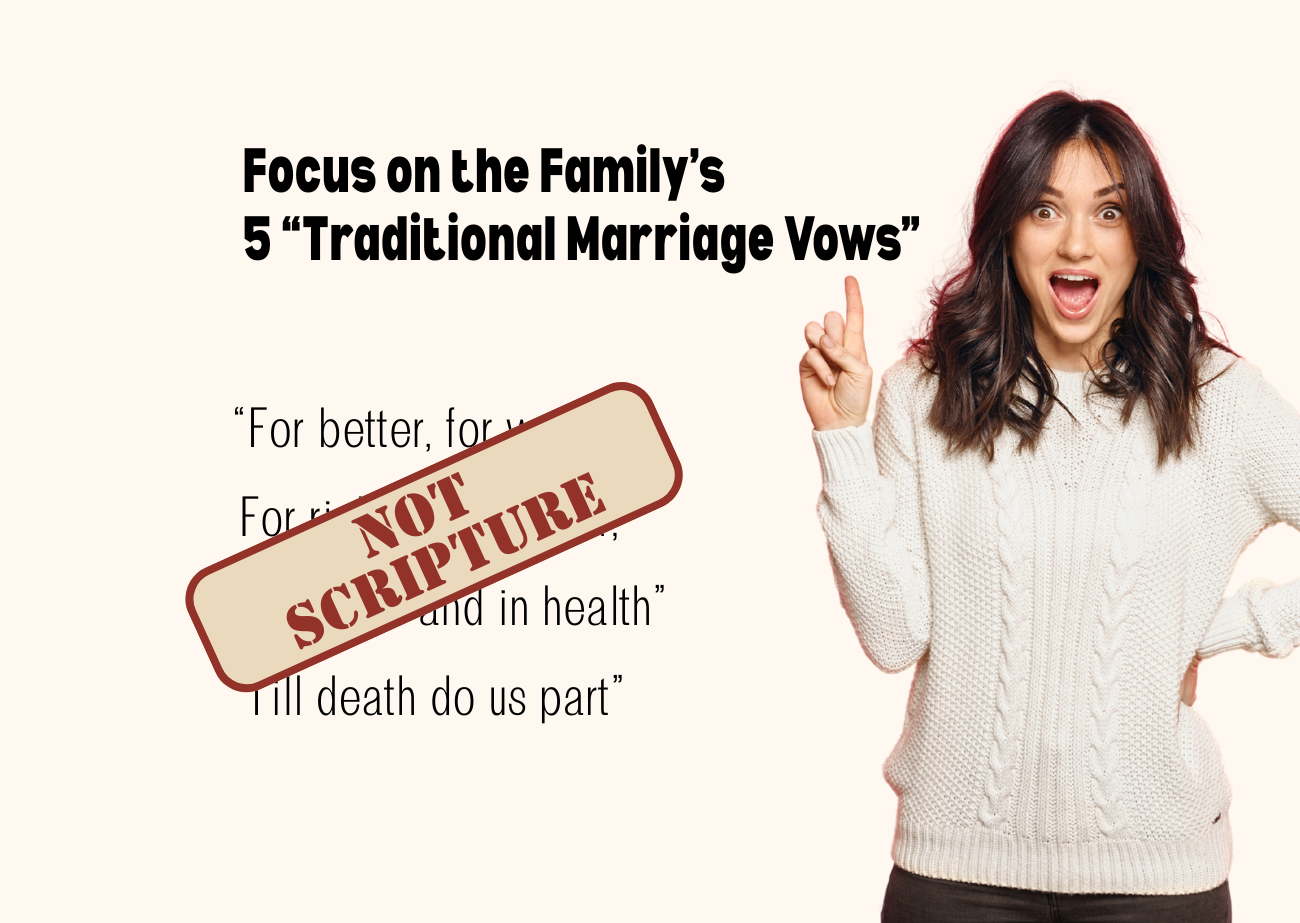
Focus on the Family’s “5 Traditional Marriage Vows”:
Are These Even Biblical — and How Are They Misused?
Recent Focus on the Family social media and article present five phrases from “traditional marriage vows” as if they are the oldest and most biblically authoritative.
But these phrases come largely from the Anglican Church’s Book of Common Prayer, not from Scripture itself. Jesus did not grow up with “for richer, for poorer” or “till death do us part.” Those lines entered English wedding liturgy roughly 1,500 years after Christ.
What happens here is a subtle swap: biblical covenant obligations are replaced with later wedding liturgy — and then backstopped with Scripture. Instead of asking, What does the Bible require of spouses? the method becomes: Here are our vows… now let’s find verses to support them.
When these phrases are treated as unbreakable commands, they become dangerously easy to weaponize.
This matters for more than historical reasons. Jesus confronted religious leaders who used Scripture and tradition to burden the vulnerable while protecting the powerful (Matthew 23:4; Mark 7:8–13).
Of course marriage vows call both spouses to faithfulness. But in abusive dynamics, vows rarely restrain the covenant-breaker — while victims are spiritually pressured to endure “no matter what.”
Let’s take Focus on the Family’s vows one at a time.
1. “I take thee to be my wedded wife (husband)”
Is this biblical?
No. This is Anglican church liturgy.
How is it misused?
Author Greg Smalley reframes it as “personal responsibility for your choice,” implying:
You chose them, so you owe them permanence.
That’s “you made your bed, now lie in it” theology — and it shifts moral responsibility onto the harmed spouse, not the betrayer.
2. “To have and to hold”
Is this biblical?
No. It comes from the Book of Common Prayer.
How is it misused?
Greg Smalley teaches that “to have” includes enjoying a sexual relationship. That interpretation shifts the phrase away from loyalty and belonging and reframes it as sexual access.
Like many people, I always heard “to have and to hold” as a promise of commitment and mutual belonging. Recasting it as sexual access changes the meaning in ways that are especially dangerous in abusive marriages. In those contexts, it becomes obligation-sex theology — the idea that one spouse owes sex regardless of consent or safety.
You vowed your body.
Consent is not a vow. Sex is never owed.
Sheila Gregoire documents the harm of this teaching here:
👉 https://baremarriage.com/2023/09/10-things-obligation-sex/
3. “For better, for worse… in sickness and in health”
Is this biblical?
This exact phrase does not appear in the Bible. Marriage does include going through hardship together. Love “bears all things” (1 Cor. 13:7) in the sense of enduring life’s losses, stresses, and ordinary suffering together.
But this phrase is not a Bible verse, and it’s not one of the specific marriage vows Scripture spells out.
How is it misused?
Hardship becomes absolutism:
“Stay no matter what.”
Taken as a license, this framing effectively gives the other spouse a free pass: no matter what they choose to do, you are obligated to stay.
As one woman put it:
For better or worse means “no matter what life throws at us” — not “no matter what you do to me.”
Abuse is not “for worse.”
Adultery is not “sickness.”
Violence is not a season.
This is how covenant language becomes captivity.
4. “To love and to cherish”
Is this biblical?
Yes.
How is it misused?
Focus on the Family rightly emphasizes sacrificial love. But in the context of “no matter what” permanence teaching, love can easily be reframed as endless endurance — even when the marriage covenant has been shattered by serious sin or harm.
That creates pressure on the faithful spouse to prove love by staying, rather than holding the covenant-breaker accountable.
Scripture never defines love as tolerating ongoing harm. Love includes truth, justice, protection, and repentance.
5. “Till death do us part”
Is this biblical?
No. This is a 16th-century English wedding phrase, not a quote from Scripture.
How is it misused?
In the Focus on the Family article, Greg Smalley teaches that this vow means “death should be the only thing that dissolves the marriage bond” and describes marriage as “a close marital bond that can’t be broken.” This contradicts the message he gave to his daughter, when she got divorced. He hoped she would remarry.
That framing lands painfully in real lives. Many Christians internalize it this way:
“I made a vow before God to stay until death.”
But that understanding erases what biblical scholars like Dr. David Instone-Brewer have shown: in Scripture, marriage covenants were based on concrete obligations (Exodus 21:10–11). When those obligations are persistently violated through abuse, betrayal, or abandonment, the covenant has already been broken.
Preached without accountability, “till death” stops sounding like devotion and starts functioning like a sentence. It binds the faithful spouse to harm while asking very little of the covenant-breaker.
A vow before God is not a vow to be harmed. It is a vow to love well — and love does not require staying where repentance and safety are absent.
Many Christians internalize it this way:
“I made a vow before God to stay until death.”
But marriage vows are not one-sided promises that bind only the victim.
Biblically, marriage is a mutual covenant between two people, made in the presence of God. God is the witness. Your spouse is the covenant partner. The vows are reciprocal.
You did not vow, “I will remain even if you destroy me.”
You vowed to live in a marriage defined by faithful love, protection, and care.
When one spouse persistently violates those vows through abuse, betrayal, or abandonment, the covenant is not being “kept” by forcing the faithful spouse to endure.
A vow before God is not a vow to be harmed.
Some people bring up Romans 7, but that is not teaching that marriage can only be ended by death.
But What About Love, Honor, and Fidelity?
Many Christians immediately think:
Wait — aren’t the real vows love, honor, faithfulness, and lifelong commitment?
Yes — those are biblical values.
But notice something important: they are not the five “traditional vows” Focus mentions.
The emphasis falls instead on permanence, not accountability.
That’s why these “traditional vows” so easily become shackles. And it’s why so many people choose trauma-informed wedding vows when they remarry after abuse or betray.
The Bottom Line: The Real Biblical Vows
Those familiar “5 traditional marriage vows” are not Scripture.
They are not the vows Jesus knew.
In the biblical world, marriage vows were not sentimental phrases like “for better or worse.” They were concrete, enforceable promises—basic duties a husband owed his wife.
That is why Exodus 21:10–11 — still the foundation of Jewish marriage today — is so important, even though it addresses low-status wives. Scripture deliberately sets the bar at the lowest place: if even she was entitled to certain marital vows, then those vows defined marriage itself.
God names three core obligations: food, clothing, and marital rights—what we would call today “love, honor, and cherish”:
“He shall not diminish her food, her clothing, or her marital rights…” (Exodus 21:10)
And here is the stunning part: if a husband refused those vows, the Law required that she be released:
“If he does not do these three things for her, she shall go out…” (Ex. 21:11)
This is the first place in Scripture where divorce is commanded—not as a moral failure, but as God’s protection for a vulnerable wife.
The same principle appears again with captive wives (Deut. 21:11–14): a woman could not be treated as property or reduced to slavery. She was either honored as a wife, or she had to be set free.
Faithfulness is the 4th vow.
Both husband and wife vowed to each other that they would:
* be faithful to each other – ie not commit adultery
* provide food – ie the man would provide the money and the woman cooked
* provide clothing – ie the man paid and the woman sewed or went shopping
* provide love – ie they would share a physical relationship in marriage
(Abuse was also a ground for divorce because this was worse than neglect)—Rev. Dr. David Instone-Brewer, Retired Senior Research Fellow in Rabbinics and the New Testament,
Tyndale House, Cambridge UK
Biblical marriage vows were meant to protect the vulnerable—not trap them. And after a valid biblical divorce, the innocent party could remarry.
Biblical marriage vows were meant to protect the vulnerable — not trap them.
Divorce and Remarriage in the Bible by Dr. David Instone-Brewer. The author has a free website with excerpts of key parts of his book. Look at the topics in Chapter 8 (index on left side of the page): https://www.instonebrewer.com/DivorceRemarriage/DRC/IndexBook.htm. He also has a free Q&A web page.
 :
:
 :
: Buy PDF