
Pros and Cons of No-Fault Divorce for Christians
Background: As a young conservative Christian, I was taught that divorce was always sinful and that no-fault divorce undermined biblical marriage. But after nearly 30 years leading Christian divorce recovery, I see the issue more clearly. No-fault divorce has both dangers and life-saving benefits.
What Is No-Fault Divorce?
No-fault divorce means neither spouse must prove wrongdoing in court. Instead, the marriage is ended under terms like “irreconcilable differences” or “marital breakdown,” with no further specifics. The term “unilateral” means that an abuse victim can leave without their abuser’s consent.
This approach avoids public courtroom battles over fault, evidence, and blame. It also offers safety to those who need it.
Then-Governor Ronald Reagan said this in 1969 when he signed no-fault divorce into law in California: “I believe it is a step towards removing the acrimony and bitterness between a couple that is harmful not only to their children but also to society as a whole.” (Source)
Now let’s look at the pros and cons.
Cons: Reasons No-Fault Divorce Can Be Harmful
1. It can allow one spouse to end a marriage for trivial or selfish reasons
No-fault divorce makes it possible to walk away from a marriage without proving serious grounds. That troubles many Christians who believe divorce should only occur for grave covenant-breaking sins such as adultery or abandonment.
Believers often point to the familiar trope of a husband leaving his faithful wife “for his secretary” or running off simply because he wants a new life. No-fault laws can make that kind of selfish abandonment easier, because the court does not require evidence of wrongdoing.
This is why some Christians fear that no-fault divorce can weaken the seriousness of marriage vows and normalize walking away instead of fighting for reconciliation when reconciliation is possible.
2. Divorce can devastate financially dependent spouses and children
The first year after divorce often includes shock, anger, and financial instability. Household income frequently drops, especially for the lower-earning spouse. While emotional adjustment may improve within a couple of years, financial stability can take much longer to rebuild.
Single parents may need new employment, childcare arrangements, housing, and budgeting strategies. The disruption is real, even when the divorce was necessary.
It is also important to note that some states consider marital misconduct when dividing assets or awarding spousal support. In those states, the court may award a larger share of property to the spouse deemed the “innocent” party. A no-fault filing may not eliminate that possibility, but fault-based proceedings can sometimes influence financial outcomes.
When asked how long it takes for the rejected spouse to return to their normal level of wellbeing, Dr. Mavis Hetherington said:
“By the end of the second year… there was an upsurge in emotional wellbeing as people began to adapt.” —Hetherington & Kelly, For Better or For Worse (New York: WW Norton & Company, 2002), 50-51.
3. Some churches won’t support you unless the court names an innocent party
Rev. Dr. David Instone-Brewer notes that a no-fault filing can still represent real biblical grounds—such as abuse, neglect, abandonment, or infidelity—even if those are not stated legally in court records. Instone-Brewer’s discussion here
Sadly, churches often focus on legal labels instead of covenant reality. Privacy can come at a spiritual cost.
Pros: Reasons No-Fault Divorce Can Save Lives
1. It lowers wife suicide, wife homicide, and domestic violence rates
Research shows unilateral no-fault divorce laws are associated with significant reductions in domestic violence, wife suicide, and wife homicide by her partner.
No-fault divorce reduced suicide, domestic violence, and murder rates.
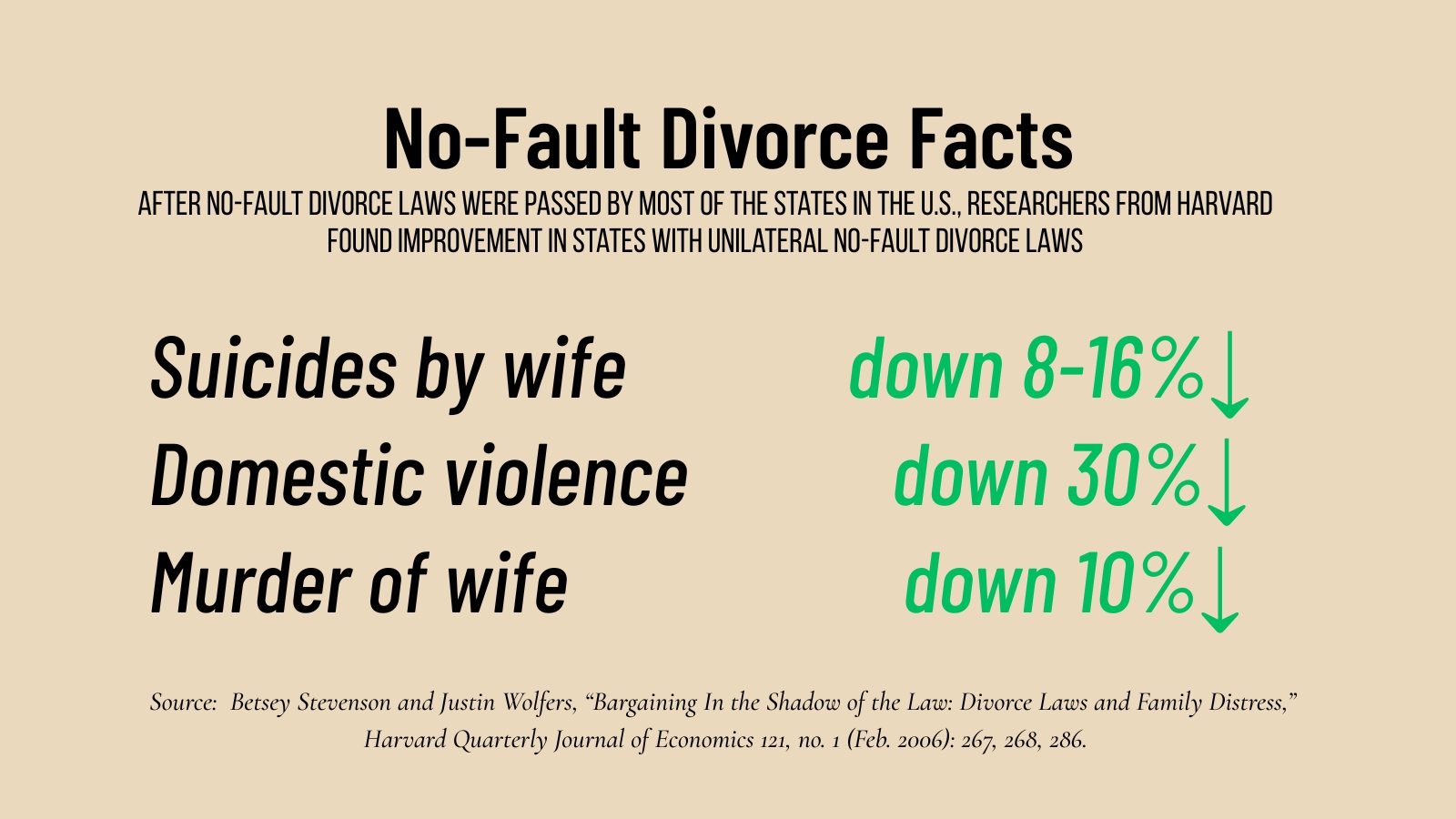
Research found that unilateral no-fault divorce laws were associated with lower rates of suicide, domestic violence, and intimate-partner homicide.
2. It allows victims to leave without an abuser’s consent
Abusive spouses rarely agree to divorce. No-fault laws allow victims to escape without their spouse’s consent or a judge’s permission (as long as they fill out the paperwork correctly and in a timely fashion). They don’t need courtroom proof of every harm.
3. It makes safety possible even for low-income spouses
Fault-based divorce often requires expensive evidence gathering, private investigators, attorneys, or relocation. No-fault divorce opened the door for poorer families to seek freedom from abuse and betrayal too.
4. It reduces public humiliation
Many abused or betrayed spouses prefer privacy. No-fault divorce allows them to exit without publicly exposing traumatic details or disclosing their spouse’s misconduct in open court.
Sometimes the innocent spouse makes a strategic choice to remain silent—not out of revenge—but out of practicality. Public accusations could jeopardize the other spouse’s employment, which in turn could reduce the ability to pay child support or spousal support. In those situations, protecting financial stability for the children may outweigh the desire to clear one’s name.
No-fault divorce can allow families to move forward without amplifying damage that would ultimately hurt the children.
5. It prevents courts from being overwhelmed
At-fault litigation increases legal conflict, cost, and court burden. No-fault systems reduce unnecessary courtroom warfare.
6. It has not increased divorce long-term
After a spike in the 1970s and early 1980s, divorce rates declined over the next decades. Today, the divorce-rate-per-married-person is lower than it was 55 years ago.
Chart: Divorce Rate from 1970 to 2024[7]
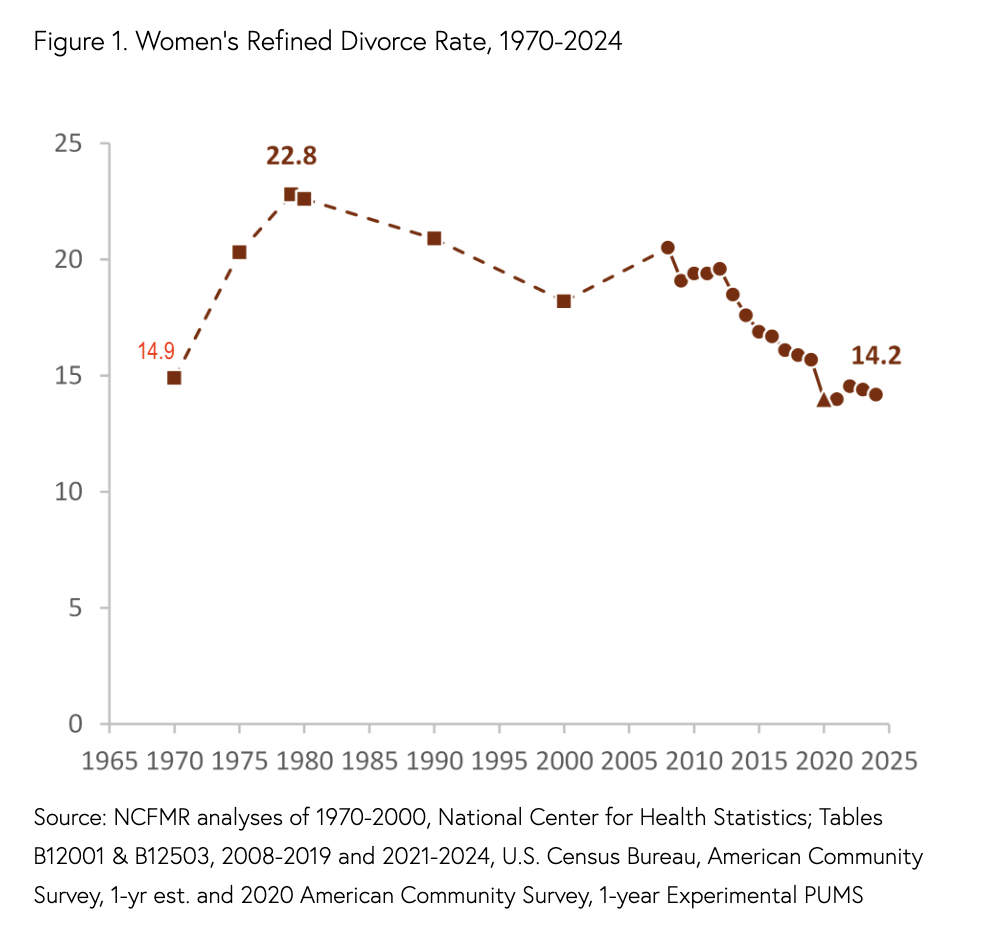
Women’s refined divorce rate in the U.S., 1970–2024. The rate peaked around 1980 at 22.8 and declined to 14.2 by 2024. Source: NCFMR analyses using National Center for Health Statistics and U.S. Census Bureau American Community Survey data.
Divorce Rate Has Declined Since the High in the Early 1980s
Contrary to what you may have heard from news media, family organizations, and conservative think tanks, the divorce rate is lower than it was 55 years ago. And it appears to be continuing downward according to both demographers and pro-family, pro-marriage researchers.
I often have to clarify this because there are common misconceptions. Some assume the decline is only because fewer people are marrying or because more couples are cohabiting. But the divorce rate in these studies is calculated among married (and recently divorced) adults—not the entire population—so it remains a valid comparison over time.
In other words, young people are not divorcing less simply because they are marrying less. Among those who do marry, divorce rates are lower than they were in prior generations.
This also gently challenges the claim that no-fault divorce caused long-term moral collapse. If that were the case, we would expect divorce rates to keep climbing. Instead, after an initial spike in the 1970s and early 1980s due to pent-up demand, the rate steadily declined.
The good news is that fewer young people are divorcing, which is pulling the rate down. Baby boomers still have comparatively high divorce rates, but that will matter less over time. Millennials, by contrast, have lower divorce rates.
One reason is that millennials are marrying later, often with more education and life experience, and they are being more selective about whom they marry. Because of this caution and maturity at marriage, researchers expect divorce rates to continue to decline.[8]
Final Takeaway
No-fault divorce is not automatically “unbiblical.” It can be misused—but it has also saved countless lives by allowing oppressed spouses to escape danger without impossible legal burdens.
In the end, God is not fooled by court paperwork. He sees covenant-breaking sin clearly, even when the legal system uses neutral language.
Related
- Paper written by an analyst and an economist at the Federal Reserve about no-fault divorce.
- Click to see which states may be changing their no-fault divorce laws.
- Side-by-side comparison chart of At-Fault and No-Fault divorce laws
- VIDEO: True stories of Life Before No-Fault Divorce
[1] E. Mavis Hetherington and John Kelly, For Better or For Worse (New York: WW Norton & Company, 2002), 50-51.
[2] Betsey Stevenson and Justin Wolfers, “Bargaining In the Shadow of the Law: Divorce Laws and Family Distress,” The Quarterly Journal of Economics 121, no. 1 (Feb. 2006): 267, 268, 286.
[3] Nelson Blake, Road to Reno (New York: Macmillan, 1962), 119.
[4] Philip Cohen, “Hell in a Handbasket, or the Democratization of Divorce?” Family Inequality (11/27/2003), accessed 10/1/19, https://familyinequality.wordpress.com/2013/11/27/handbasket-democratization/. Although I’ve read a lot about the plight of poor spouses who could not afford a divorce, and even seen it in my own family tree, this article clarified it as an issue of fairness.
[5] By the way, The United States is one of the few countries that has unilateral no-fault divorce (meaning a person can divorce without the consent of their spouse). In 2022, after a long hard fight, the United Kingdom got the right to no-fault divorce.
[6] Beverly Bird, “Which States Are No-Fault States,” Legalzoom.com, accessed 10/16/19, https://info.legalzoom.com/states-nofault-divorce-states-20400.html.
[7] Loo, J. (2023). Divorce rate in the U.S.: Geographic variation, 2022. Family Profiles, FP-23-24. Bowling Green, OH: National Center for Family & Marriage Research. https://doi.org/10.25035/ncfmr/fp-23-24 accessed 10/26/2024. Method of calculation: The divorce rate = [(number of women divorced in the past 12 months) / (number of women divorced in the past 12 months + number of currently married women)] x 1000. The 2023 figures are also now available and they show even a greater drop in divorce rates. https://www.bgsu.edu/ncfmr/resources/data/family-profiles/FP-24-26.html
[8] Cohen, The Coming Divorce Decline.
 :
:
 :
: Buy PDF