
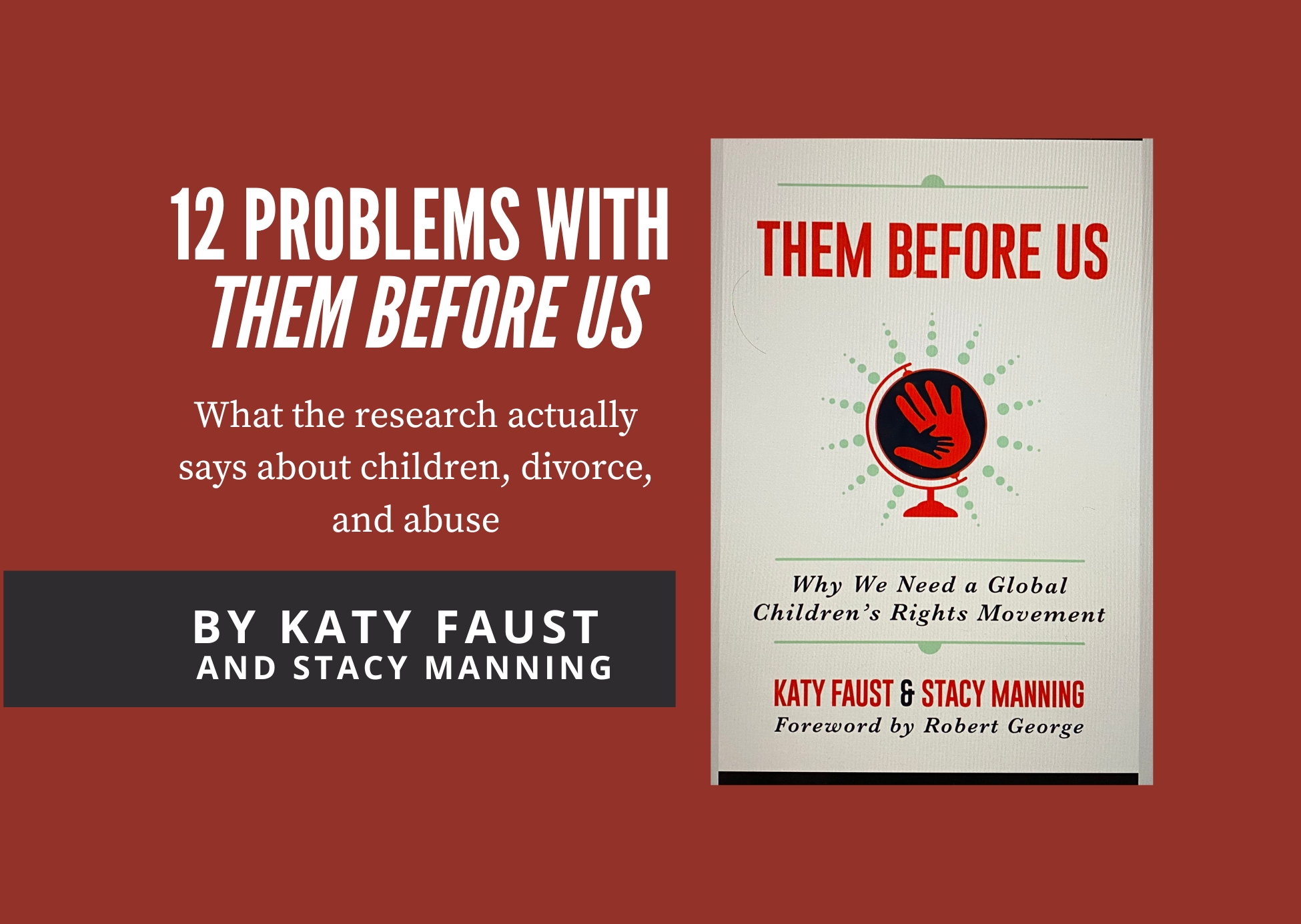
12 Serious Problems with Them Before Us by Katy Faust and Stacy Manning
Update (May 2026): Faust’s #GreaterThan campaign emphasizes that “divorce hurts kids,” but it largely avoids the harder truth: many children are harmed most inside high-distress, coercive, or abusive homes—long before divorce ever happens. Read more: Divorce Hurts Kids—But Abuse Hurts Them More.
As a Christian, I really wanted to like the book Them Before Us.
The title is fantastic…“Them before us” is a great motto, and it sounds so promising. Of course parents and society should put children first. But that’s not what this book actually teaches. Katy Faust and Stacy Manning go much further, implying that only two married biological parents can be trusted to raise children, while single parents, divorcees, and stepparents are portrayed as universally risky. For example, in the first 100 pages, divorce is described as something only self-centered people do, with no exceptions for serious reasons such as pedophilia, physical violence, coercive control, family-crushing addictions, or criminal behavior. To sell this message, the authors routinely misuse research—downplaying abuse in “intact” homes, exaggerating the danger of stepfamilies, and ignoring solid evidence that divorce can be life-saving in violent or destructive marriages. This review walks through twelve serious problems in their argument, showing how key studies are distorted, important findings are omitted, and fear-based messages replace sound pastoral care.
Here are 12 half-truths, distorted claims, and misuse of academic studies in this book
First, here is a quick list of 12 problems in the book. Below this section is a longer explanation of each one, including all citations and verified quotes. All page numbers refer to the Kindle version of the book Them Before Us, ©2021.- Katy Faust acknowledges that married biological parents can be abusive, but she offers no concrete anecdotes of abuse or neglect by biological parents—only by single parents, stepparents, and romantic partners—creating the impression that her model is naturally safer. Yet even the Institute for Family Studies, whose researchers she often quotes favorably, reports that about 1 in 4 highly religious marriages have experienced abuse with their current partner.
- She calls divorcees selfish, yet nearly 6 in 10 of U.S. divorces happen for serious reasons like abuse, infidelity, or addictions, according to the same researchers she often quotes in the book, such as Dr. Scott Stanley. See one of his studies below, and another one here: study #3.
- She misinterprets the famous Dr. Judith Wallerstein, who believed divorce was the best choice for children in abusive homes and showed that 7 in 10 kids of divorce turned out fine. See quotes from Dr. Wallerstein below, or a longer analysis of Wallerstein’s 5 books written during or about her 25-year study.
- Faust claims you can win any argument about divorce by quoting two different studies (p. 121–122), but she misrepresents the 2002 Institute for American Values study, which found that while 2 in 3 unhappy marriages became happy in 5 years, the remaining 1 in 3 marriages (often those involving abuse, addictions, or adultery) did not. In fact, 4 in 5 people in the study who divorced and remarried were happy.
- Faust suggests that researcher Dr. Alan Hawkins agreed that the “top reason for divorce” was “lack of commitment” (p. 111, Kindle). But in his 2012 study, Dr. Alan Hawkins found different figures. He found that roughly 37% to 72% of divorces were for serious problems such as adultery, addiction, or violence alone.
- Faust paints a frightening picture of stepparents by relying on the Cinderella Effect theory (p. 54, Kindle) to describe stepfathers and boyfriends as highly dangerous and extremely homicidal toward the children of single mothers. The actual figures are sobering, but much lower—and less scary—than she cites.
- Faust exaggerates differences between family types, promoting a doom-and-gloom narrative for divorcees and their children. For example, the way the graph on child abuse is portrayed is misleading (p. 59, Kindle). See explanation below. This continues today; for example, in 2025, her organization used relative numbers rather than absolute numbers to describe this recent 5-million person study.
- Although she quotes Dr. Paul Amato and mentions his conclusion that in 1 in 3 divorces where children are involved, divorce is the lesser evil, Faust fails to mention Amato’s key insight that children’s well-being improves by a factor of up to 10 times when parents leave toxic marriages.
- On page 51 (Kindle), Faust mentions an “alarming” study on children age 9 who are found to have cellular damage (shortened telomeres), suggesting it is exclusively or predominantly due to fatherlessness. But the researchers themselves list a wide range of other factors such as stress, obesity, and poverty on page 2 of their study.
- Faust leaves out two ACEs from the original 1998 ACE Study (and far more than that if we consider later ACE studies). She fails to mention the significant harm experienced by children who witness the abuse of their mother. It is not just abuse directed at the child.
- Faust also distorts the effects no-fault divorce, failing to acknowledge that prior to 1970, judges and juries often forced victims to stay with their abusers, resulting in higher suicide, violence, and homicide rates. The reduction in those outcomes has been documented in a Harvard study of effects of the unilateral no-fault divorce laws.
- Faust wrongly suggests that marital abuse is easy to fix through counseling—ignoring that the abuser is unlikely to change and that couples counseling is unethical and contraindicated in abusive relationships.
Here are the details to support and explain the 12 points above
1. KATY FAUST ADMITS THERE CAN BE ABUSIVE MARRIED PARENTS—BUT SWEEPS IT UNDER THE CARPET
Faust admits that a biological parent can be abusive (p. 52, Kindle), yet throughout the rest of the book she offers not one single anecdote in which the abuser is a married biological parent. Instead, the “bad actors” in her stories are always single parents, stepparents, or romantic partners. The effect is subtle but powerful: it makes her thesis feel self-evident, because the reader never sees the category of “married biological parent” associated with real harm.
But that’s not realistic. A wedding ring doesn’t instantly transform people into emotionally healthy, safe, protective adults. Even the pro-Christian research organization IFS reports that about 1 in 4 highly religious couples have experienced physical, sexual, or financial abuse in their current relationship. And as someone who has worked in Christian divorce recovery since 1998, I can tell you: some of the most abusive people in the world look “godly” in public and terrifying behind closed doors.
Faust engages in double-speak: she says the majority of stepparents and romantic partners are not abusive or neglectful (p. 54), yet in the following pages she tells horror stories—an “evil stepmother,” then the claim that stepparents secretly hate their stepchildren (p. 55). Later she uses a murder study to reinforce the impression that step-parents are universally risky. The argument isn’t simply “some family structures are statistically higher risk.” It becomes a moral narrative: married biological parents are the safest, and everyone else is suspect.
2. FAUST DESCRIBES DIVORCEES AS SELFISH—BUT MANY DIVORCES ARE FOR SERIOUS REASONS
Faust tells her story right up front (p. 20, Kindle). Her mother and father divorced (though she is silent about why). Later her mother fell in love with a woman, and the two have been partners ever since. Faust describes her mother’s home with her partner as “stable and conflict-free.” She says she loves her mother’s partner, considers her a friend, and describes her childhood there as peaceful. She also describes divorce as a difficult rollercoaster of losses and transitions.
Yet throughout the book, Faust portrays divorcees as self-centered and uncommitted—people who choose “self” over family, influenced by Hollywood and moral decay, lacking grit and faithfulness. The overall suggestion is that divorce is mainly a character flaw.
But research from the very scholars she quotes tells a very different story. In a peer-reviewed study by Shelby Scott, Galena Rhoades, and Scott Stanley, divorced participants reported serious contributing factors at striking rates: infidelity (59.6%), substance abuse (34.6%), and domestic violence (23.5%). And when asked for the final straw—the decisive reason the marriage ended—nearly 6 in 10 cited infidelity, domestic violence, or substance abuse (Reasons for Divorce and Recollections of Premarital Intervention, 2003). In other words, many divorces are not about selfishness—they are about escaping betrayal, addiction, and violence.

The truth is that a large portion of divorces occur for serious reasons: adultery, sexual immorality, violence, emotional abuse, crushing addictions, criminality, child abuse, neglect, or abandonment.
So Faust’s repeated implication that divorce is mostly frivolous or immature simply does not match the evidence.
Faust may view her own parents’ divorce as selfish (she does not say), but even if she did, that does not mean most divorces are. And by her own life story, Faust seems to have turned out well: she is happily married, raising children, and has built a meaningful public career. She is a successful child of divorce—and she is not rare.
Most family researchers over the past 30 years have found that roughly 8 in 10 children of divorce grow up “average,” “very well,” or “outstanding,” with no lifelong serious impairment. Yet Faust devotes an entire chapter to ending no-fault divorce—an approach that would make it harder for victims of abuse and betrayal to escape and find safety.
Although she accepts divorce for direct child abuse as morally permissible, she does not acknowledge until page 111 that some homes are so toxic that 1 in 3 divorces involving children is emotionally and physically beneficial—life-saving. But by page 111, it is too little, too late: she has already spent most of the first half of the book shaming and stigmatizing those who divorce.
3. FAUST IS WRONG: MOST MAJOR RESEARCHERS SHE QUOTES AGREE DIVORCE CAN HELP CHILDREN IN ABUSIVE OR HIGH-CONFLICT HOMES
Faust presents a stack of studies as though they prove divorce is always a disaster. But she frequently omits the conclusions that don’t serve her message. Many of the researchers she cites—Amato, McLanahan, Waite, Felitti, and Wallerstein—do warn that divorce can harm children. But they also emphasize that divorce is often better for children in violent, hostile, or high-conflict homes, and that staying “for the kids” can be worse.
Faust frequently cites Dr. Judith Wallerstein—whom she calls “the queen of divorce”—as if Wallerstein supports her argument that divorce is uniquely harmful and should be avoided whenever possible. But that’s only true if you quote Wallerstein selectively. Wallerstein repeatedly said divorce is often the only rational solution to a bad marriage, and that children exposed to violence and ongoing conflict often do worse in intact homes than in divorced families. Faust quotes Wallerstein’s warnings but ignores her repeated endorsements of divorce in conflict-ridden homes where children observe abuse.
Dr. Judith Wallerstein wrote:
“Children raised in extremely unhappy or violent intact homes face misery in childhood and tragic challenges in adulthood.” (Unexpected Legacy of Divorce, p. 300)
Wallerstein also stated:
More quotes from Dr. Judith Wallerstein:“Indeed divorce is often the only rational solution to a bad marriage. When people ask if they should stay for the sake of the children, I have to say, “Of course not.” All our evidence shows that children turn out less well-adjusted when exposed to open conflict, where parents terrorize or strike one another, than do children from divorced families.” —Dr. Judith Wallerstein, Second Chances: Men, Women and Children, A Decade after Divorce, p. 321-322 (Originally published 1989. Referenced Kindle edition, 2018)
Judith Wallerstein quote showing that 7 in 10 children of divorce turned out fine: “At the twenty-five-year follow-up we found that 30 percent of the participants in our study were doing poorly, with functioning significantly impaired and below average. Thirty-four percent were in the average range, and 36 percent were doing very well to outstanding in all areas of their life tasks.” -Judith S. Wallerstein, The Unexpected Legacy of Divorce (New York: Hyperion, 2000), p. 333
Judith Wallerstein quote denying that divorce is universally destructive to children: “And I am, of course, aware of the many voices on the radio, on television, and in certain… religious circles that say divorce is sinful… But I don’t know of any research, mine included, that says divorce is universally detrimental to children.” -Judith S. Wallerstein, The Unexpected Legacy of Divorce (New York: Hyperion, 2000), p. xxxix
Judith Wallerstein quote pointing out the damage that observing abuse does to children: “Many judges who deal with such families do not understand that merely witnessing violence is harmful to children; the images are forever etched into their brains. Even a single episode of violence is long remembered in detail. In fact there is accumulating scientific evidence that witnessing violence or being abused physically or verbally literally alters brain development resulting in a hyperactive emotional system.” -Judith S. Wallerstein, The Unexpected Legacy of Divorce (New York: Hyperion, 2000), p. 90
Optional Reading: Judith Wallerstein’s five books and how often she says that divorce can be good for children, and even recommends it in some cases. And how Christians often ignore, misread, or misinterpret Wallerstein’s writings.
Dr. Paul Amato likewise concluded:
“Our results show that if conflict between parents is relatively high, offspring are better off… if their parents divorced than if they remained married.” (Amato et al., 1995, p. 895)
And here’s what matters: even Bradford Wilcox, one of Faust’s most frequently cited favorites, contradicts the idea that divorce is usually selfish or unjustified. Wilcox has explicitly said:
“In some cases, divorce may be the best option… Domestic violence, drug and alcohol abuse, and infidelity… are certainly legitimate grounds…” (Wilcox, “Three Reasons Not to Make This January Your Divorce Month.”)
Wilcox also wrote:
“In cases where children are exposed to high levels of conflict… they do seem to do better if their parents part.” (Institute for Family Studies, “The Evolution of Divorce.”)
So even within the pro-marriage world Faust relies on, there is clear agreement that divorce can be protective—and sometimes necessary.
4. FAUST MISREPRESENTS THE 2002 INSTITUTE FOR AMERICAN VALUES REPORT
Faust practically crows that these two studies are the ultimate “big-kid-pants” trump card for winning anti-divorce arguments (pp. 121–122, Kindle). But in reality, neither one does: the first study is far more nuanced than she admits, and the other is a pseudo-scholarly working paper masquerading as social science.
A. Faust references the 2002 Institute for American Values report (p. 122) and claims it found unhappy couples who divorced were “no happier” than those who stayed together. But that is not what the report says.

The 2002 Institute for American Values report also found:
-
-
“Eighty-one percent of those second marriages were happy.” (p. 12)
-
“Marriages with high conflict and domestic violence were less likely to become happy five years later.” (p. 11–12)
-
“If the problem is marital violence, divorce appears to offer significant relief.” (p. 12)
-
In other words, the report includes exactly the kind of nuance Faust downplays: some marriages improve, but violent and high-conflict marriages often do not—and divorce can bring relief.
B. Faust also pairs that higher-quality report with a much weaker UK Marriage Foundation working paper, “Couples on the Brink” (Harry Benson & Steve McKay, Feb. 2017). Faust may suggest this is valid social science, but it isn’t. This is pseudo-scholarly work—a low-quality paper with big claims from tiny, cherry-picked subgroups, with no meaningful comparisons to divorce or separation. What is confounding is that McKay is a legitimate academic (University of Lincoln), which makes the paper’s thinness even more striking—this is nowhere near Dr. McKay’s usual scholarly standard, nor his usual publication topics.
5. FAUST IS WRONG ABOUT REASONS FOR DIVORCE: MANY ARE NOT FRIVOLOUS—THEY ARE SERIOUS
On page 111, Faust cites Dr. Alan J. Hawkins, a family-life researcher at Brigham Young University (BYU), and claims that his work shows “a whopping 73 percent of people cited lack of commitment as their reason for divorce.” But this is misleading. Hawkins was not endorsing that statistic at all. He was merely referencing an older national survey from 2005—someone else’s work—not presenting it as the definitive truth about why people divorce.
In fact, Hawkins conducted his own research that paints a very different picture. He distinguished between “soft” reasons for divorce (such as growing apart, leisure preferences, or issues with in-laws) and “hard” reasons—serious problems such as adultery, addiction, and violence. He asked divorced participants, “What were the important factors in your divorce?” and gave them twenty options. Participants could select more than one reason.
Hawkins found that 37% to 72% of participants reported at least one “hard” reason for divorce. The most frequently reported serious reasons included:
-
Infidelity: 37% (women reported this 39%)
-
Alcohol or drug problems: 22% (women: 27%)
-
Physical violence: 13% (women: 18%)
Notably, emotional abuse, verbal abuse, and criminal behavior were not listed as response options, which makes these figures even more striking. And because participants could select multiple reasons, overlap is unknown—meaning some divorces likely involved clusters of serious problems: infidelity plus addiction plus abuse.
So Faust’s repeated implication that divorce is usually frivolous, immature, or caused by selfish lack of commitment is simply incorrect. Even the research she leans on undermines her moral narrative. Her statement on p. 109 (Kindle) ignores serious harm in married homes: “Divorce” is another term for the death of a family. The end of a marriage is often the death of a child’s feelings of safety and security; it’s the end of one home, the end of love shared by the two people a child loves most,…” Where there’s a pattern of abuse and infidelity there is no “love shared by the two [parents],” it’s just one person treating the other contemptuously.
Citation: Hawkins, A. J., Willoughby, B. J., & Doherty, W. J. (2012). Reasons for divorce and openness to marital reconciliation. Journal of Divorce & Remarriage, 53(6), 453–463. https://doi.org/10.1080/10502556.2012.6828986. Faust Uses Fear of Boyfriends and Stepfathers to Pressure Parents to Stay
Faust and Manning repeatedly present stepfathers and romantic partners as a “chilling” threat to children, implying that mothers keep children safest by staying with the biological father. Faust even repeats the claim that children are 120 times more likely to be beaten to death by a stepfather or live-in boyfriend than by a biological father.
But that claim is not correct. Later reanalyses of that study still found elevated risk, but not 100–120 times higher. One newer analysis placed it closer to six times higher, depending on the dataset and comparison used. That is still serious. It is not the horror-story statistic Faust relies on.
The nuance matters. Yes, uncommitted romantic partners—especially immature or unstable boyfriends—can pose a real risk. Parents should date carefully, screen wisely, and leave at the first sign of danger.
But Faust turns caution into fear.
Even her own chart (p. 59 Kindle) based on the Fourth National Incidence Study shows physical abuse in single-parent homes with an unmarried partner occurs in fewer than 2 in 100 households, and about 1 in 100 in stepfamilies. Every harmed child matters. But those numbers do not justify the implied message: “If you leave, your children will probably be in greater danger.”
That message is pastorally reckless.
It tells abused parents, “Your spouse may be dangerous, but leaving could be worse.” That is not wisdom. That is paralysis.
No one should stay with someone who is definitely abusive because a future partner might be abusive. Sometimes the safest choice is divorce and remaining single.
And anyone who works with abuse survivors knows Faust’s framing is backwards. Many married biological fathers are not protectors. They are the danger. In my 6,000-member Christian divorce group, countless parents stayed “for the kids” while the kids were being harmed. The father in the home did not shield them from abuse. He was the source of it.
Faust’s fear-based framing risks trapping abused mothers—and abused fathers—in harmful marriages. It amplifies anxiety, downplays present danger, and pressures vulnerable parents to stay while their children are already paying the price.
7. Faust Exaggerates Differences Between Family Types
Faust’s book frequently relies on vague phrases like “more likely to…” without providing real numbers, which leads readers to assume the differences are enormous. But when she does show numbers, they are often small.
For example, the physical abuse graph (p. 59) is visually misleading—magnified so dramatically that the differences look huge when they are all under 1%: married parents (0.19%), single parents (0.59%), and stepfamilies (0.98%). These differences matter, but they are not the catastrophe the book implies. They are certainly not enough to shame divorce survivors or to treat widows, single parents, or loving stepparents as permanent risks.
To see how Them Before Us misrepresents data, see their May 2025 tweet summarizing a large study on children of divorce. Their post lists “60% higher risk” outcomes, but the study’s absolute numbers show that teen birth, incarceration, and early mortality remain rare in both groups (less than 2 in 100 divorced families). When critics pointed this out, she responded by attacking them personally rather than addressing the statistics.8. Faust Misses Paul Amato’s Most Important Finding
To Faust’s credit, she cites Paul Amato (p. 110) and acknowledges that in 1 in 3 divorces involving children, divorce is “the lesser evil” in high-conflict marriages. But she fails to highlight what Amato’s work actually shows: when conflict is high, children can be dramatically better off (on average 10 times better wellbeing) if parents divorce rather than stay together.

What makes this omission more troubling is that Faust herself includes stories from adults whose parents were so abusive that they wished their parents had divorced sooner—or that they had been raised in a loving single-parent home, or even a loving same-sex home. Yet she dismisses these testimonies with barely a sentence because they don’t fit her ideological framework that children must always have married biological parents (p. 48). Ironically, that framework can encourage people to endure harmful marriages even when the children are watching abuse, betrayal, and terror unfold in their own homes.
Side note: Faust frequently cites Dr. Sara McLanahan to support her emphasis on two-parent biological homes. But McLanahan—like Amato—explicitly acknowledges that divorce can improve outcomes in high-conflict families, and that children may be better off without violent or antisocial fathers:
“We have long known that while the average effect of divorce is negative, for some families it may actually improve family functioning and child well-being. Work by Amato (1993), for example, shows that in families with high levels of conflict, divorce improves child outcomes. More recently, Jaffee et al. (2003) have found that children are better off not seeing their fathers in cases where these men are violent or antisocial.”
— Sara McLanahan & Elizabeth Thomson, Social Forces (2012)
Finally, Faust also cites studies comparing heterosexual and homosexual parenting, but she does not disclose the methodological weaknesses and limitations that critics have raised about those studies. A fact-checking review of that research is available for readers who want to evaluate those claims more carefully.
9. Telomere Damage
Faust cites a study about shortened telomeres and presents fatherlessness as though it were the primary driver of cellular damage in children. But the researchers never claimed that. On page 2 of their study, they listed many other causes—”smoking, mental illness, obesity, caregiving stress, poor sleep, and poverty.”
Yes, losing a good father can be devastating. But Faust’s use of the study functions like a rhetorical trump card: father absence equals physical damage. That oversimplifies the science, and it implicitly shames families where a father is absent for reasons beyond the child’s control—abuse, abandonment, incarceration, or death.
Other meta-analyses on telomeres show that some of these factors do more damage than father absence.10. FAUST LEAVES OUT 2 ACEs from the ACE STUDY
Faust finally mentions the massive ACE Study that measured the number of adverse childhood experiences from childhood (p. 112) and suggests divorce is acceptable if ACEs are present—but she leaves out two of the most relevant ones from the original 1998 study:
-
witnessing violence against a parent, and
-
living with a mentally ill household member.
This omission is not minor. Faust repeatedly frames abuse as grounds for divorce only when the child is directly abused, not when a parent is abused. But children are harmed by witnessing violence, intimidation, and terror in the home. When Faust omits these two ACEs, she reinforces the harmful idea that a child can thrive while watching one parent destroys the other.
“Many judges who deal with such families do not understand that merely witnessing violence is harmful to children; the images are forever etched into their brains. Even a single episode of violence is long remembered in detail. In fact there is accumulating scientific evidence that witnessing violence or being abused physically or verbally literally alters brain development resulting in a hyperactive emotional system.” The Unexpected Legacy of Divorce, (New York: Hyperion) 2000, p. 90″
- Psychological abuse
- Physical abuse
- Sexual abuse
- Violence against mother (later, all intimate partner violence was added)
- or living with household members who were substance abusers,
- or mentally ill or suicidal,
- ever imprisoned (had criminal behavior)
11. Faust Misrepresents No-Fault Divorce (and Ignores Why It Exists)
Faust treats no-fault divorce as though it were invented to help selfish people break vows. That framing ignores history—and it ignores the people no-fault divorce was designed to protect. She also fails to acknowledge a basic fact: the U.S. divorce rate today is lower than it was decades ago, even after no-fault reforms. In other words, no-fault divorce did not unleash an endless divorce spiral; it gave people a way out of marriages that were already broken, dangerous, or unlivable.
Faust implies that at-fault divorce protects innocent spouses. But the old at-fault system often did the opposite: it trapped innocent spouses—especially the poor, women, and abuse victims—because the legal burden was so high. Before the reforms beginning in 1969, divorce was often slow, humiliating, expensive, and filled with obstacles. It was a court trial: victims had to prove “fault,” often with witnesses, documentation, and courtroom interrogation. Their own testimony didn’t count; neither did a private confession from the spouse. Wealthy people could afford it; many others could not. And in some states, certain kinds of abuse weren’t even considered legitimate grounds for divorce.
That reality matters, because at-fault systems give the advantage to abusers and cheaters. They raise the cost and burden of proof so high that the innocent spouse may be forced to stay, or to settle, or to delay leaving for years. Meanwhile, the children remain stuck inside the chaos—absorbing trauma through direct abuse or by witnessing the abuse of a parent.
When no-fault laws were adopted state-by-state (starting with California in 1969), Harvard researchers examined what changed. The evidence is sobering and life-saving. In states that passed unilateral no-fault divorce, economists found:
-
wife suicide rates dropped by 8–16%
-
domestic violence dropped by 30%
-
homicide of wives dropped by 10%
Source: Stevenson & Wolfers, “Bargaining in the Shadow of the Law: Divorce Laws and Family Distress,” Harvard Quarterly Journal of Economics (2006), 267, 286.
Those are not “lifestyle choices.” Those are bodies. Those are lives.
Faust also seems to accept a common myth: that abusers and cheaters are the ones who want divorce. But anyone who has worked with domestic violence survivors knows abusive spouses often want to stay married. They want the benefits of marriage while continuing the harm. They want a spouse who turns a blind eye, endures mistreatment, is silenced by threats, and keeps paying the bills and caring for the children while they indulge their addictions, violence, pornography, affairs, or control. In other words, they want to have their cake and eat it too. Repealing no-fault divorce would serve that kind of person.
And that matters because about half of divorces today are for serious issues: infidelity, physical violence, emotional/sexual abuse, addictions, criminal behavior, severe neglect, or abandonment. If lawmakers repeal no-fault divorce laws and return to pre-1970 wording, it is reasonable to expect we’ll see domestic violence, suicide, and homicide rise again. No-fault divorce empowers victims to leave before the harm escalates. And we have proof that it saves lives.
Faust also repeatedly relies on “X percent more likely” language without giving absolute numbers—especially when citing older data about children of divorce. This is a classic way to frighten readers. She uses this phrase more than 30 times in the book. Whenever you see “X percent more likely,” it’s a cue to ask: more likely than what? and how big is the actual difference? What are the absolute numbers?
For example, Faust’s claim that if you divorce, your children are “much more likely” to divorce looks different when you look at the actual numbers. Scholar Nicholas Wolfinger has reported that most children of divorce who marry still have lasting marriages; his figures show divorce rates around 47% for children of divorce compared to 40% for those from intact homes—higher, yes, but not the doom-and-gloom story Faust implies on page 121.

Dr. Nicolas Wolfinger 2019 on the Likelihood of Children of divorce experiencing a divorce
Finally, Faust uses anecdotes about adults whose parents’ divorce damaged them for life. My heart goes out to those people. But the best scholarship shows that most children of divorce turn out fine—and when they don’t, the harm often comes not from divorce itself, but from what surrounded it: the dysfunction in the home before the divorce, conflict during and after, poverty, repeated moves, and long-term parental warfare. Sociologist Andrew Cherlin and others have repeatedly documented this: what hurts children most is not “legal divorce,” but chronic family instability, hostility, and untreated trauma.
 Faust’s chapter on ending no-fault divorce ignores all of this history and evidence. It romanticizes a legal system that often forced victims to stay with their abusers—and it risks pulling the ladder up behind the very people no-fault divorce was designed to protect.
12. Faust Suggests Abuse is Easy to Fix
Faust implies that an abused spouse can simply tell a chronically abusive, neglectful, or addicted partner to snap out of it and start behaving “for the sake of the kids.” Really? A little “professional help and accountability” (p. 111) is all it takes? Voilá! Why didn’t anyone tell the millions of domestic violence and infidelity survivors who have begged, pleaded, prayed, counseled, confronted, fasted, forgiven, and tried every “biblical marriage restoration plan” known to man?
Here’s another naive take: “I’ve witnessed many couples rescue their marriages from the brink of certain death. I’ve seen almost all the dysfunction there is to see in marriage, and I can assure you that in nearly every situation, no matter how deeply the couple is divided, it is possible to resuscitate a moribund marriage.” (p. 111, Kindle)This isn’t wisdom. It’s wishful thinking. A person in church ministry ought to be a realist—especially when lives are at stake. It is nearly delusional and profoundly irresponsible to imply that entrenched patterns of abuse, betrayal, and addiction can be fixed with a bit of counseling and some accountability. That kind of messaging doesn’t protect victims; it sets them up to stay longer, endure more, and blame themselves when the abuser doesn’t change.
Couples counseling is often contraindicated in abusive relationships because abusers weaponize therapy, manipulate counselors, and punish victims afterward. This isn’t just an opinion; it is widely taught in counseling programs and affirmed by abuse experts.
And here’s the heartbreaking irony: Faust repeatedly uses research that acknowledges the widespread reality of abuse—including among religious couples—yet she promotes a vision of marriage permanence that can keep victims stuck.
FINALLY, FAUST TRIES TO CUT OFF MOST OPTIONS FOR ABUSE VICTIMS
By Faust’s logic, if you’re not married and you’re not the biological parent of the child, you’re not simply “less ideal”—you’re a risk. In her framework, safety and legitimacy belong almost exclusively to married biological parents, while everyone else is treated as a dangerous compromise.
So, apparently:
—Sorry, loving single grandparents.
—Sorry, emotionally healthy stepparents.
—Sorry, nurturing single mothers and single dads. (Notice how rarely she even mentions widows—why?)
—And sorry, solo adoptive parents—you don’t cut it either.
One reviewer rightly pointed out something I had missed: on page 206, Faust essentially equates a single mother raising her child alone with being a child abuser. That is an astonishing claim—and a cruel one.
And what about caring boyfriends and girlfriends who step into a child’s life with humility, sacrifice, and love, marrying the child’s parent? Faust’s messaging leaves little room for them either, even though studies show that children in stepparent families often do better in school. Real people live in complicated situations where the “ideal” is not available and never will be.
The reality is that most single parents do a fine job. Their main struggle is not moral deficiency—it’s overload. They’re doing the work of two adults with the time and energy of one. Instead of marginalizing and demonizing divorcees, churches and communities should be supporting them.
And rather than treating step-parents as a universal threat, we should focus on what truly matters: character. A child’s safety depends far more on the integrity and behavior of the adults in the home than on DNA or family labels. We don’t need fear-based rhetoric—we need wise discernment, accountability, and practical safeguards.
Bottom line
This book is not recommended for readers who care about careful scholarship, or for church groups that want to protect the vulnerable. Its overarching message can mislead abuse victims into staying longer by suggesting that divorce will harm children more than abuse does. And it relies on repeated misuse, selective quoting, and distortion of academic research to create a fear-driven narrative.
A Note About Faust’s Fulbright Credential
Some critics have questioned Katy Faust’s “Fulbright” claim. For the record: she did receive a Fulbright English Teaching Assistantship (ETA) under her maiden name. It is on the Fulbright website and her college (St. Olaf in Minnesota) confirms it. That matters because accuracy matters.
But it also matters to understand what a Fulbright ETA is—and what it isn’t. A Fulbright Scholar typically conducts research or university-level teaching abroad. A Fulbright ETA is a competitive cultural exchange and teaching program in which participants assist local English teachers and serve as cultural ambassadors. Both are valuable. They are simply different programs with different roles.
So yes, Faust had a legitimate Fulbright ETA. The deeper concern is not her résumé—it’s the way she handles research and the pastoral damage her message can cause when vulnerable people take it seriously.
Who Is Platforming Katy Faust?
Despite the serious problems in her scholarship and conclusions, Faust has been heavily platformed by influential Christian organizations, including Focus on the Family and the Colson Center. Yet that platforming does not appear to reflect broad book-market demand: her Amazon ranking does not appear especially significant, and Them Before Us does not appear to be carried by ChristianBook.com. She appeared in an invitation-only event as part of the #LighthouseVoices series on March 8, 2022. The event was held at The Family Central Bookstore in Grand Rapids, Michigan, described in the event introduction as a bookstore and event space founded by Elsa Prince Broekhuizen, and appeared to have a small audience; I counted 16 attendees. Elsa Broekhuizen keeps a very low profile but was mentioned multiple times at the event, including expressions of gratitude for providing the space, serving as a board member, and receiving sympathy after the loss of her husband. She is a known past Focus on the Family board member and the mother of Betsy DeVos and Erik Prince. Faust was described at the event as “an authority in academic circles,” despite having no graduate training in the social sciences most relevant to her claims and no peer-reviewed academic research.
As of May 11, 2026, the flagship #GreaterThan YouTube launch video had only 6,910 views after more than three months online, despite support from numerous large organizations with extensive built-in audiences of well over a million. Some reposted clips may have higher numbers, but the campaign’s central launch video never appears to have broken out beyond its existing circle.
 :
:
 :
: Buy PDF