
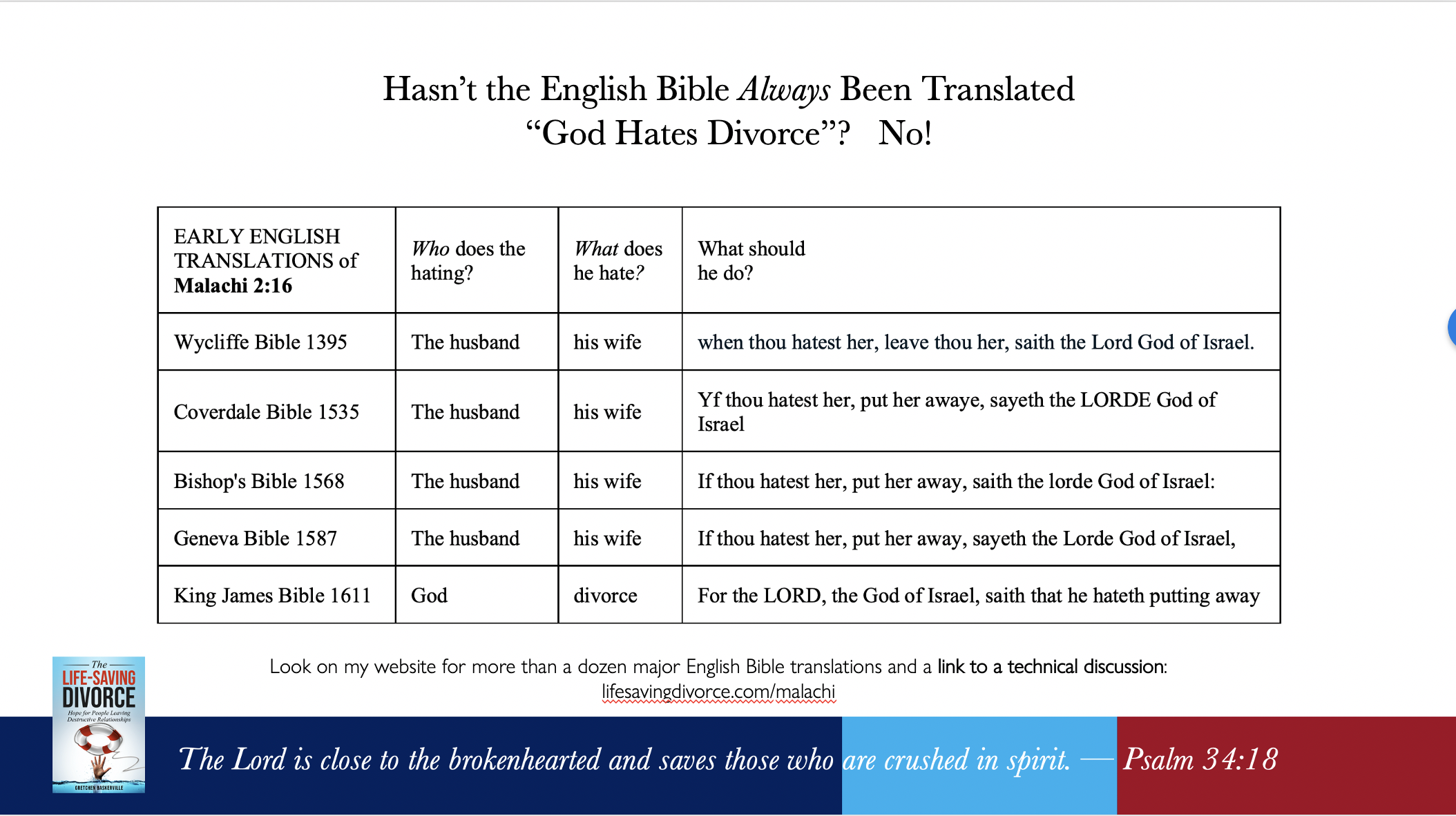
This page includes a timeline and side-by-side translation charts for visual learners. Or view 11-minute video [multiple language option]
Does God Hate Divorce? What Malachi 2:16 Really Means
Many Christians have heard that Malachi 2:16 says, “God hates divorce.” But that familiar wording is not the oldest or most consistent translation of the verse. For over 2,100 years, major Bible translations did not render it that way. Instead, Malachi 2:16 was often understood as condemning a man who hates his wife and deals with her treacherously. This matters today, especially for people who have been pressured to stay in destructive marriages. For more on that broader question, see Abuse is Biblical Grounds for Divorce and 5 Bible Verses that Say You Should Separate from an Abuser.
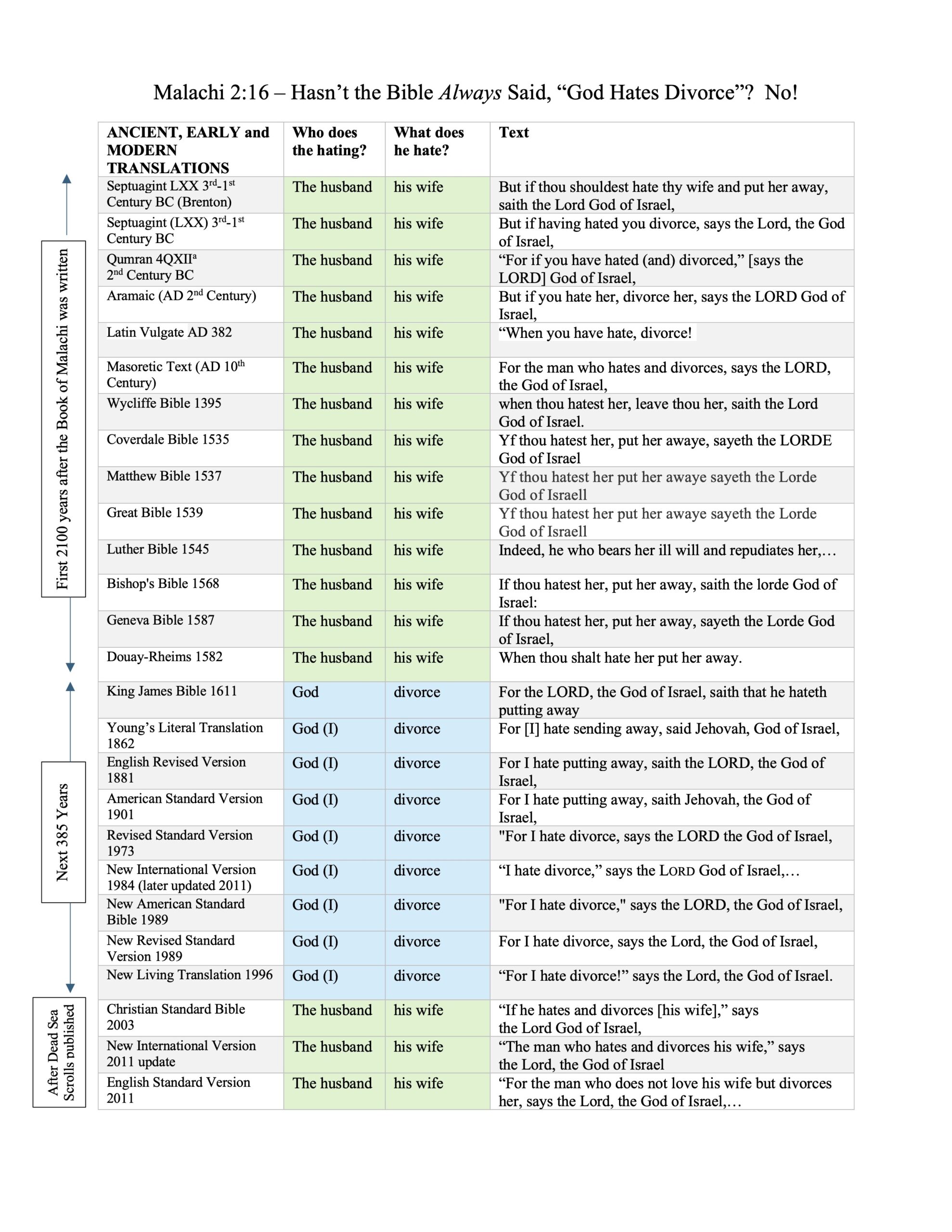
Chart: A side-by-side comparison of ancient, early, and modern translations of Malachi 2:16.
Summary
This article includes clear infographics and translation charts explaining why the familiar phrase “God hates divorce” is not the oldest rendering of Malachi 2:16. See also Myth: Divorce is the Unpardonable Sin and “God Hates Divorce”.
Here is the basic historical pattern:
- For over 2,100 years (500 BC–AD 1611), Malachi 2:16 was not translated as “God hates divorce.”
- Neither Martin Luther nor the translators of the Geneva Bible in John Calvin’s Geneva rendered the verse that way.
- The Septuagint, Jerome’s Vulgate, John Wycliffe’s Bible, Coverdale, Luther, the Bishop’s Bible, and the Geneva Bible did not translate Malachi 2:16 as “God hates divorce.”
- The phrase reflects a later English translation tradition, and Dead Sea Scrolls scholarship has influenced modern versions—including the ESV, CSB, and NIV (2011 update)—to adjust the wording.
Prefer video? Here’s the11-minute video [multiple language option].
Has Malachi 2:16 Always Meant “God Hates Divorce”?
Christians often hear the phrase “God hates divorce” stated as if it were a direct, timeless quotation from Scripture. It is frequently used to shut down questions, end conversations, and pressure people—especially abused spouses—to remain in marriages that are unsafe, unfaithful, or destructive. But has the Bible always said this?
The short answer is no.
How Malachi 2:16 Was Understood for the First 2,100 Years
The Book of Malachi was written about 500 years before Jesus’ day. For nearly 2,100 years, Malachi 2:16 was not understood to say “God hates divorce.” That modern phrasing stands in sharp contrast to how the verse was interpreted by many influential Bible translators and theologians in church history.
What Respected Biblical Scholarship Says About Malachi 2:16
Dr. C. Jack Collins, Old Testament professor at Covenant Theological Seminary, has carefully documented that the rendering “God hates divorce” represents a significant departure from the historic translation tradition. After comparing ancient Hebrew texts, the Septuagint, and later manuscript evidence, Collins concludes that Malachi 2:16 is best understood as condemning a man who hates his wife and divorces her, not as a statement about God’s hatred of divorce itself. His work shows that placing God as the subject of hatred in this verse is grammatically strained and contextually unlikely.
How the Great Bible Translators and Reformers Read This Verse
This scholarly conclusion aligns with how the verse was understood for centuries. Jerome, John Wycliffe, and the Reformers Martin Luther and John Calvin all interpreted Malachi 2:16 as an anti-treachery passage—one addressing covenant-breaking, violence, and faithlessness within marriage—not as a universal prohibition against divorce.
The King James Version and a Major Interpretive Shift
That understanding remained dominant until 1611, when the translators of the King James Version introduced wording that framed Malachi 2:16 as “God hates divorce.” That interpretation shaped English-speaking Christianity for the next 385 years, despite standing outside the earlier translation consensus.
What the First 2,100 Years of Bible Translations Actually Say
The Bibles of the first 2,000 years—including the Septuagint, Aramaic translations, Latin Vulgate, Masoretic Text, and early English Bibles such as Wycliffe, Coverdale, the Great Bible, the Bishop’s Bible, and the Geneva Bible—did not translate Malachi 2:16 as “God hates divorce.”
A 2,400-Year Translation Comparison of Malachi 2:16
This article examines 18 major Bible translations of Malachi 2:16, spanning more than 2,400 years, from the Septuagint to modern English Bibles published after the Dead Sea Scrolls were finally made available to scholars in 1996. New major Bible translations published after 1996 (the English Standard Version, Christian Standard Bible, and the 2011 update to the New International Version) do not interpret it as “God hates divorce.” When these translations are compared side by side, the historical pattern is clear: Malachi 2:16 condemns treachery, hatred, and violence in marriage, not divorce that protects the innocent.
2400 Years of Translating Malachi 2:16: How Ancient, Early and Modern English Bibles Interpret It
The chart above shows that the interpretation “God hates divorce” is not the traditional view. When you look at 2400 years of Bible translations, you see that it is a very odd wording.
In the Dead Sea Scrolls, the Hebrew in this passage says:
if he hates (verb) divorce (verb)
The word “divorce ” is a verb not a noun. No one is hating divorce (noun). And God is not speaking about himself, because the next phrase is that “he” (the person doing the hating) is covering his clothing with violence. So it cannot be talking about God. Plus God speaks in the first person in Malachi. He uses “I” when he speaks to the people, not “he,” followed by the phrase “says the Lord” (sixteen times) in Malachi. So “God hates divorce” is not the time-tested traditional translation even though people may claim it is.
1) “If you hate your wife, divorce her…” – Wycliffe, Coverdale, Matthew, The Great Bible, Bishop’s Bible, Geneva Bible, some Septuagint, etc.
2) “If he hates and divorces [his wife].” Septuagint, Masoretic, CSB, 2011 NIV, and ESV.
3) “God hates divorce…” KJV (AV), even though the word in Hebrew is he, not God. Also, despite the online Hebrew interlinear Bibles, the Hebrew language doesn’t have upper- and lowercase letters. So the capitalized “H” in he, does not really exist.
4) “I hate divorce”– Young’s, ERV, ASV, RSV, 1984 NIV, NASB, NRSV, NLT (even though the word “I” is not in the Hebrew; it’s the word “he”)
2 Scholars Discuss the Hebrew: Problems with the Interpretation “God Hates Divorce.”
- Dr. C. Jack Collins Compares Multiple Ancient Bible Texts, Including the Septuagint (LXX), the Masoretic. “Malachi 2:16 Again, by Jack Collins, Covenant Theological Seminary, Old Testament Faculty. https://www.academia.edu/5304267/Malachi_2_16_again_
From Collins’s abstract: “Most English Bibles, beginning with the AV , render Malachi 2:16 in such a way that God is saying that he hates divorce – either in the first person (“I hate divorce,” NASB, NIV, NRSV) or in the third person (“he [= the LORD] hates divorce,” AV). Most acknowledge that this is extremely difficult to get from the Masoretic Text, and offer some set of corrections (re-vocalizing, emending the consonants)”
From Collins’s conclusion:
I believe the discussion here shows the following:
1. The translation of this verse found in the AV (and most English Bibles since then), with God hating divorce, represents a departure from the translation tradition of the previous centuries.
2. The rendering of the ESV, which has a Judean man “hating” his wife and divorcing her, does the best job of handling the details of the Masoretic Text, with no corrections. It also enables us to see how this fits into the context of profaning the calling of the people of God .
3. This way of reading Malachi 2:16 allows us to see how the verse fits into the overall promotion of covenant fidelity as the ideal of marriage, an ideal for which the faithful among the people of God – whether in ancient Israel or in the Christian Church today – will seek all the resources of grace, of forgiveness, of fellowship with the saints, and of the Holy Spirit’s enabling power.
- Kyle Pope Compares the two Hebrew texts (the Masoretic and the Dead Sea 4QXIIa), “He Hates” or “God Hates” The Text of Malachi 2:16 see: https://focusmagazine.org/he-hates-or-god-hates-the-text-of-malachi-216.php.Kyle Pope notes, “Is Malachi quoting the Lord? If so, who is the “he” the Lord says “hates”? Is Malachi summarizing the declaration of the Lord? We do this all the time-“He says that he hates onions!”-rather than, “He says, ‘I hate onions!'” The next phrase raises further questions. The Hebrew speaks of “his clothing.” About whose clothing is this speaking? If God hates and God says, is this speaking of God’s clothing? If not, where is the shift?”
Scholar Discusses the Pastoral Aspects of Malachi 2:16
- Marg Mowscko: https://margmowczko.com/divorce-malachi-2/ “God on Divorce: Malachi 2:16”
Summary: “Divorce is hard, horrible, and heartbreaking, but we should stop saying that God hates divorce, as this is misquoting and misrepresenting scripture. Moreover, pronouncing that “God hates divorce” brings only hurt, confusion, and feelings of condemnation to Christians who are divorced or contemplating divorce. This pronouncement does nothing to help the church’s mission of bringing healing and hope through the gospel. Furthermore, we simply must stop using Malachi 2:16 to coerce or guilt a wronged or abused spouse to remain in a harmful marriage.”
Malachi 2:16 – Has the Bible Always Said, “God Hates Divorce”? No!
This chart shows that the interpretation “God hates divorce” is not the traditional view. When you look at 2100 years of Bible translations, you see that it is a very odd view.
ANCIENT, EARLY and MODERN TRANSLATIONS |
Who does the hating? |
What does he hate? |
What should he do? |
| Septuagint LXX 3rd-1st Century BC (Brenton) | The husband | his wife | But if thou shouldest hate thy wife and put her away, saith the Lord God of Israel, |
| Septuagint (LXX) 3rd-1st Century BC | The husband | his wife | But if having hated you divorce, says the Lord, the God of Israel, |
| Septuagint (LXX) 3rd-1st Century BC – alternate | The husband | his wife | If, having hated, divorce! says the Lord the God of Israel, |
| Aramaic (AD 2nd Century) | The husband | his wife | But if you hate her, divorce her, says the LORD God of Israel, |
| Latin Vulgate AD 382 | The husband | his wife | “When you have hate, divorce! |
| Wycliffe Bible 1395 | The husband | his wife | when thou hatest her, leave thou her, saith the Lord God of Israel. |
| Coverdale Bible 1535 | The husband | his wife | Yf thou hatest her, put her awaye, sayeth the LORDE God of Israel |
| Bishop’s Bible 1568 | The husband | his wife | If thou hatest her, put her away, saith the lorde God of Israel: |
| Geneva Bible 1587 | The husband | his wife | If thou hatest her, put her away, sayeth the Lorde God of Israel, |
| Roman Catholic Rheims-Douay 1582 | The husband | his wife | When thou shalt hate her put her away. |
| King James Bible 1611 | God | divorce | For the LORD, the God of Israel, saith that he hateth putting away |
| Young’s Literal Translation 1862 | God (I) | divorce | For [I] hate sending away, said Jehovah, God of Israel, |
| English Revised Version 1881 | God (I) | divorce | For I hate putting away, saith the LORD, the God of Israel, |
| American Standard Version 1901 | God (I) | divorce | For I hate putting away, saith Jehovah, the God of Israel, |
| Revised Standard Version 1973 | God (I) | divorce | “For I hate divorce, says the LORD the God of Israel, |
| New International Version 1984 (later updated 2011) | God (I) | divorce | “I hate divorce,” says the Lord God of Israel,… |
| New American Standard Version 1989 | God (I) | divorce | “For I hate divorce,” says the LORD, the God of Israel, |
| New Revised Standard Version 1989 | God (I) | divorce | For I hate divorce, says the Lord, the God of Israel, |
| New Living Translation 1996 | God (I) | divorce | “For I hate divorce!” says the Lord, the God of Israel. |
| Christian Standard Bible 2003 | The husband | his wife | “If he hates and divorces [his wife],” says the Lord God of Israel, |
| New International Version 2011 update | The husband | his wife | “The man who hates and divorces his wife,” says the Lord, the God of Israel |
| English Standard Version 2011 | The husband | His wife | “For the man who does not love his wife but divorces her, says the Lord, the God of Israel, |
And if someone you love is trapped in this theological confusion, here’s how to support them without pushing or pressuring: How to Help a Friend in an Abusive or Destructive Marriage.

 :
:
 :
: Buy PDF