
Afraid You’ll Never Find a Healthy Relationship After Abuse?
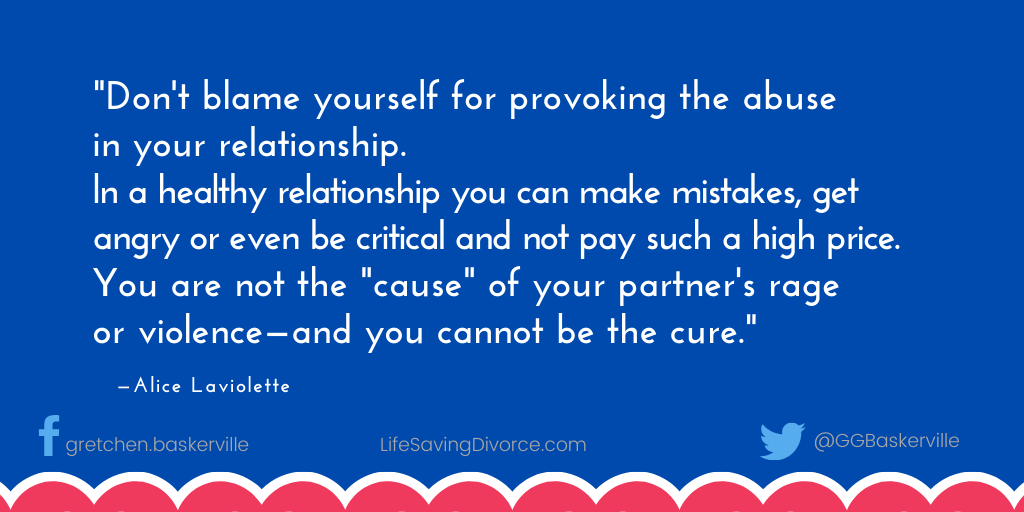
I recently posted an image on Facebook and heard back from a newly divorced man. He asked a heartbreaking question:
“Do you think I’ll ever be able to have a healthy relationship?”
He explained that for years, he blamed himself for his wife’s outbursts. He believed it was his job to keep her happy. And if she wasn’t happy, it must be his fault.
He said he felt stuck—still carrying the belief that his spouse’s emotions were his responsibility to manage.
My Response
First, let me say: I’m not a licensed therapist. I’m a Christian lay divorce recovery leader. But I do understand how deeply damaging certain marriage messages can be—especially in Christian culture.
Many of us were taught myths about marriage that simply aren’t true in abusive relationships. (See The 27 myths of divorce that aren’t likely true for godly Christians.)
When you combine…
-
the messages many of us heard from church
-
Christian marriage books and radio programs
-
and years of blame-shifting from an abusive spouse
…you end up believing something crushing:
That one spouse—the invested spouse—can single-handedly fix the marriage.
No wonder it feels impossible to think differently.
The Old Trope: “Your Next Relationship Will Fail Because You’ll Bring Your Problems With You”
Another message many abuse survivors hear—especially in Christian circles—is this warning:
“You’ll fail again because, ‘you’ll just bring your problems into your next marriage.’”
Sometimes that phrase is used to mean something healthy: don’t ignore your own healing.
But in abusive dynamics, it’s often used as a fear tactic that keeps the invested spouse trapped.
Here’s the difference:
-
In a healthy relationship, your “issues” show up as growth areas—communication, trust, boundaries, fear, or grief.
-
In an abusive relationship, the “problem” is often not your personality. It’s that one spouse feels entitled to dominate, punish, blame-shift, or erupt without consequences.
Abuse trains a person to overfunction:
- to manage another adult’s emotions,
to anticipate explosions,
to walk on eggshells,
to doubt their own judgment.
So yes—survivors may “bring” things with them:
hypervigilance, anxiety, self-doubt, people-pleasing, fear of conflict.
But those aren’t signs you’re unsafe for a future relationship.
They are injury responses to prolonged instability.
And the fact that you’re asking, “Could I have a healthy relationship?” is often evidence of the opposite of the trope:
you’re not entitled—you’re reflective.
You’re not dangerous—you’re conscientious.
You’re not doomed—you’re healing.
The goal isn’t to become “perfect” before you love again.
The goal is to learn what safety feels like—so you don’t confuse calm with boredom, or control with love.
The Truth About Abuse and Responsibility
An abusive spouse wants you to believe you are the cause of their anger, their misery, their problems.
That way, they feel entitled to treat you however they want.
They refuse to take responsibility for making the marriage safe, respectful, and loving. (If you’re unsure what qualifies as abuse, see List of 5 types of abuse.)
And when you finally lash out—as any normal person would under that pressure—they use it against you:
“See? You’re not perfect either.”
That’s part of the cycle of manipulation often called gaslighting. (For many examples, see 150 examples of abuse + gaslighting explained.)
What I Recommend
First: get to safety. When I say “get to safety,” the danger is often coming from people, systems, or dynamics that keep harm active—even if your ex-spouse is long gone.
Second: find therapy with someone who understands abuse dynamics quickly—someone who can see that you were the invested spouse, not the entitled one. If you prefer reading, I recommend Emotional Blackmail by Susan Forward.
And I also suggest reading pages 130–144 in The Life-Saving Divorce, where I talk about recognizing gaslighting phrases and developing automatic responses.
Years of confusion can make people almost deaf to manipulation. You need to learn how to hear it again.
That book offers polite-but-firm boundary phrases you can use with entitled people—at home, at church, at work, anywhere.
It helps rebuild self-worth and clarity.
Hopeful Research on Remarriage After a Long Miserable Marriage
And what about remarriage?
Many Christians fear that divorce—even life-saving divorce—means they’ve ruined their chances of ever having a healthy relationship again.
But the research tells a very different story.
Dr. Linda Waite: Most People Who Divorce and Remarry Are Happier
Dr. Linda Waite is well known for her finding that two-thirds of unhappy marriages became happier within five years.
But what many people don’t know is this:
She also found that among those who divorced and remarried after a chronically unhappy marriage, 8 out of 10 were happier.
Is that a guarantee? No.
But the odds strongly suggest that if you stayed for years in a miserable marriage, the problem wasn’t you.
Hawkins and Booth: Staying Unhappily Married Can Be Worse Than Divorce
Even more striking results came from a larger and more comprehensive study by Drs. Daniel Hawkins and Alan Booth:
“Remaining unhappily married is associated with significantly lower levels of overall happiness, life satisfaction, self-esteem and overall health… There is also some evidence that staying unhappily married is more detrimental than divorcing, as people in low-quality marriages are less happy than individuals who divorce and remarry…”
—Hawkins & Booth, Unhappily Ever After, Social Forces (2005)
In other words, people trapped in long-term low-quality marriages had worse well-being than those who divorced—whether they remarried or even stayed single.
This is not permission to rush into dating — it’s permission to stop fearing freedom.
The Bottom Line
These researchers found that people in marriages lasting 12 years or longer, when those marriages were chronically miserable, were often happier after divorce, on average:
-
happier remarried
-
happier single
-
healthier emotionally
-
stronger in self-esteem
According to decades of research, the fear-bombing simply isn’t true for most people escaping long destructive or unfaithful marriages.
There is real evidence that freedom can lead to peace.
You Can Have a Healthy Relationship
The fact that you cared so much…
The fact that you tried so hard…
The fact that you’re asking these questions…
…is evidence that you are capable of something far healthier.
You were never the problem.
You were the one carrying the marriage alone.
If you’re wondering whether Christians can remarry after a life-saving divorce, you might find hope here: Sure, An Innocent Spouse Can Remarry. But I’m at Fault Too!
And if you’re just beginning to date again with fear and uncertainty, see: How do I start dating again? I worry I’ll never find anyone.
(Concept of the “invested spouse” credited to Bob Hamp, MFT.)
 :
:
 :
: Buy PDF