
What Wayne Grudem Overstates in Judith Wallerstein
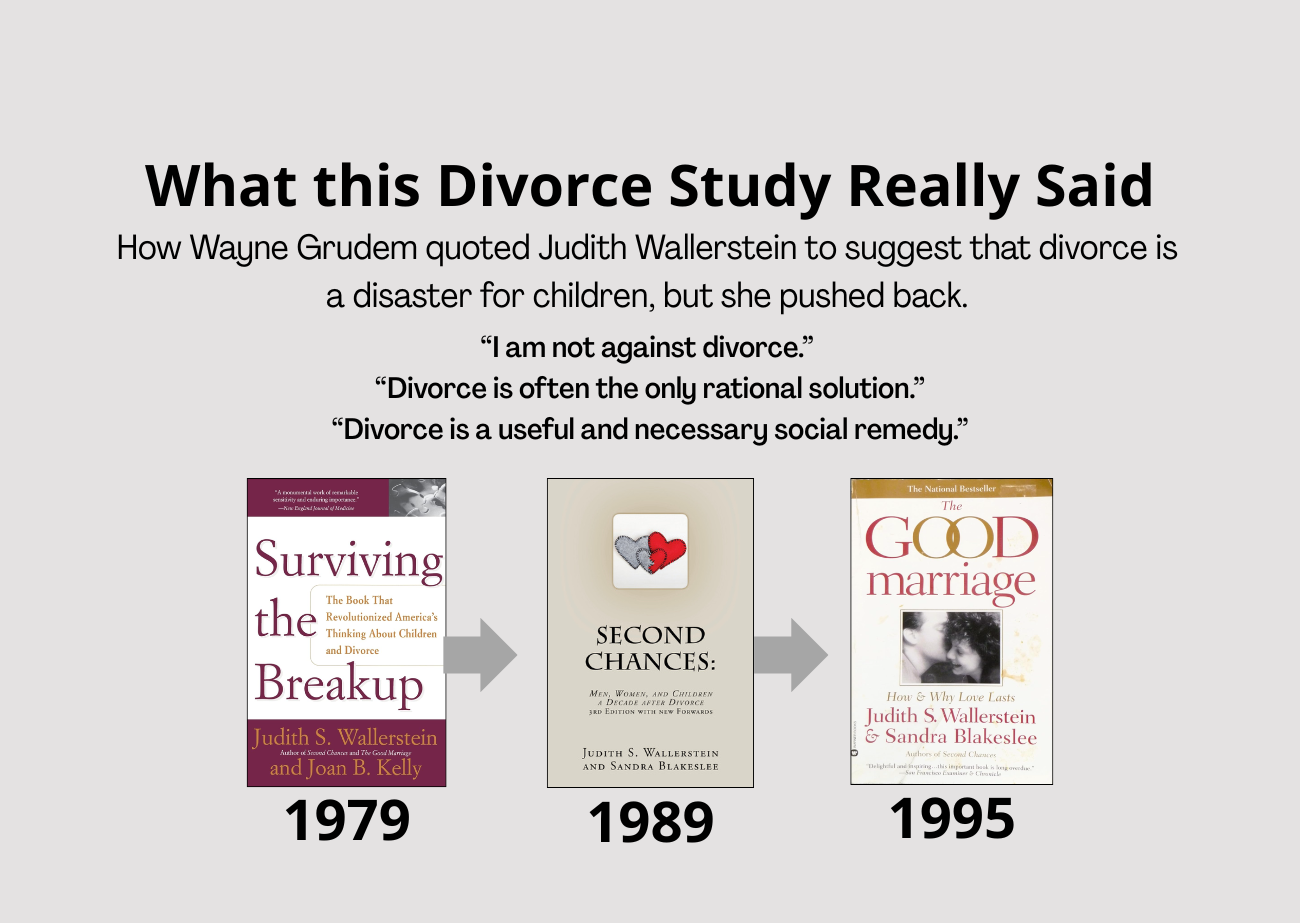
Thirty years ago, in 1996, Wayne Grudem did an analysis of Judith Wallerstein’s second book, Second Chances, one of three books she had already published that discussed her longitudinal 25-year study on divorce and children.
Although he accurately reported many of her negative findings about divorce and kids, Grudem did not quote Wallerstein’s many strong statements that divorce can be rational, necessary, and sometimes better for children than remaining in a cruel or conflict-ridden marriage.
He missed, or sharply downplayed, everything in Second Chances—for example, the following quotes—where Wallerstein clearly and boldly says that divorce can be the better choice than staying in some marriages.
Quote 1:
By 1989, Wallerstein was already saying that divorce was a rational solution to a bad marriage. And notice that she doesn’t limit it to physical abuse.
Although our overall findings are troubling and serious, we should not point the finger of blame at divorce per se. Indeed divorce is often the only rational solution to a bad marriage. When people ask if they should stay for the sake of the children, I have to say, “Of course not.” All our evidence shows that children turn out less well-adjusted when exposed to open conflict, where parents terrorize or strike one another, than do children from divorced families.” —Dr. Judith Wallerstein, Second Chances: Men, Women and Children, A Decade after Divorce, p. 322 (Originally published 1989. Referenced Kindle edition, 2018)
Quote 2:
Wallerstein told people “Don’t stay ‘for the sake of the children.’” Wallerstein didn’t want people to stay in a cruel, demeaning, or intensely lonely marriage “just for the kids”:
“But for many other people, divorce is the best solution, and staying married “for the sake of the children” (as it is so often stated) is not the wiser path. When a marriage is cruel, demeaning, or intensely lonely, divorce opens new opportunities to build a better life. The details of such unhappy marriages are often shocking. I met one couple who had not talked to each other in three years; they just passed notes back and forth. One man went to bed fully clothed every night for years, sending a not so subtle message to his wife beside him in the bed. Others brought lovers into the home when the spouse was away. In some marriages, in-laws invaded the home at all hours, leading one man to say, “She was never mine!” —Dr. Judith Wallerstein, Second Chances: Men, Women and Children, A Decade after Divorce, p. xxxiv (Originally published 1989. Referenced Kindle edition, 2018)
Quote 3:
Wallerstein was realistic about how bad marriages harm society, and says people in these bad marriages don’t consider it a mistake to divorce, even 10 years after the fact.
“Divorce is a useful and necessary social remedy…. And the fact is that most divorces with children are not impulsive. People may be wretched and lonely for years before summoning up the courage to separate, and most worry about the effects of divorce on their children. There is considerable evidence that a conflict-ridden marriage is not in the best interests of the children. There is evidence, too, that children benefit from dissolution of such marriages. Nor do most people consider that their divorce was a mistake a decade after the fact.” —Judith Wallerstein, Second Chances: Men, Women and Children, A Decade after Divorce, p. 16 (Originally published 1989. Referenced Kindle edition, 2018)
Quote 4:
In 1989, Wallerstein mentioned the lack of comparison studies between unhappy families and divorced families. She felt divorce was better for kids in these cases.
“And while we lack systematic studies comparing unhappily married families and divorced families, I do know that it is not useful to provide children with a model of adult behavior that avoids problem solving and that stresses martyrdom, violence, or apathy. A divorce undertaken thoughtfully and realistically can teach children how to confront serious life problems with compassion, wisdom, and appropriate action.” —Dr. Judith Wallerstein, Second Chances: Men, Women and Children, A Decade after Divorce, p. 322 (Originally published 1989. Referenced Kindle edition, 2018)
By the mid-1990s, studies had been conducted comparing unhappy vs. divorced families and the outcomes of children’s wellbeing in each. Dr. Paul Amato found that in highly troubled families, divorce was the better option for the child—as much as 10 times better.
How could Grudem dismiss or discard these powerful statements?
This certainly seems to point to selective reading of Second Chances on Grudem’s part. By 1996, Wallerstein had written three books, yet he selectively quoted from only one. To use that limited sample to summarize all her findings as anti-divorce is grossly inaccurate—unfair to Wallerstein and unfair to readers.
I know that researching Wallerstein can be frustrating. There is no single Wallerstein book that explains her entire study and conclusions, not even her later bestseller in 2000, The Unexpected Legacy of Divorce, or the 2003 follow-up, What About the Kids?
Most Parents in Wallerstein’s Study Were Mentally Troubled
It’s not surprising that many people, scholars included, don’t know about one of the major flaws in this study. It’s shocking, but only about one-third of the parents in the study were judged to have “generally adequate psychological functioning.” The rest were moderately or severely troubled, including chronic depression, suicidality, rage, assault, bizarre behavior, paranoid thinking, severe mental illness, sexual impulse-control problems, and chronic failure to cope with life, marriage, and family. But this is mentioned only in her first book, Surviving the Breakup (1979). She says nothing about it in Second Chances.
Reading all three pre-1996 books would have been necessary for Grudem to understand Wallerstein’s study, so while he did selectively quote her bleakest sentences in Second Chances accurately, he missed some very important facts:
For example:
- 7 in 10 parents in her study were moderately or severely troubled — Surviving the Breakup, 1979, p. 328.
- Some divorces were described as “a gift” and “a blessing” — The Good Marriage, 1995, pp. 283–284.
- She believed some marriages should end — Second Chances, 1989, p. xxxiv; pp. 322.
- She found divorce was better for kids that staying in a troubled home.“All our evidence shows that children turn out less well adjusted when exposed to open conflict, where parents terrorize or strike one another,
than do children from divorced families. — Second Chances, 1989, p. xxxiv; pp. 322. - Some second marriages after divorce were viewed positively — The Good Marriage, 1995 pp. 283–284.
In her 1995 book, The Good Marriage, she studied 50 happy couples, including 18 remarriages after divorce. She said:
“For all of these people, divorce was a gift, even a blessing.” The Good Marriage, p. 284.
We cannot hold Grudem responsible for omitting books that hadn’t been published, but 4 years later, Wallerstein continued to talk about the benefits of divorce in very troubled situations. She stated:
- Only 30% of the children were doing poorly. 7 in 10 were doing “average,” “very well,” or “outstanding.” —The Unexpected Legacy of Divorce, 2000, p. 333
- She wrote, “I am not against divorce. How could I be? I’ve seen more examples of wretched, demeaning, and abusive marriage than most of my colleagues.” (TULD, 2000, p. xxxix)
- She said, “I don’t know of any research, mine included, that says divorce is universally detrimental to children.” (TULD, 2000, p. xxxix)
- Many children of divorce do well: some become “successful,” “independent, resourceful, and flexible,” and some “manage to build good marriages in spite of their fears.” (TULD, 2000, p. xiii)
- And in her 2003 book, she was asked when someone should divorce if they have children. She replied: If there’s chronic violence at home, the answer is ‘the sooner the better,’ unrelated to the age of your child. By violence I mean physical attack-hitting, kicking, throwing objects-or chronic threats of physical violence.” —Judith Wallerstein and Sandra Blakeslee, What About the Kids? (New York: Hachette Books, 2003), pp. 127-128.
- “Exposure to violence has serious consequences for a child’s development that may last well into adulthood. They fear for your safety. They fear for themselves and their siblings. If there’s repeated high conflict in your marriage, accompanied by yelling, screaming, and pounding the table, then I’d also say the sooner the better… In some high-conflict homes, serious differences between the partners are a recurrent theme in everyday life.” —Judith Wallerstein and Sandra Blakeslee, What About the Kids? (New York: Hachette Books, 2003), pp. 127-128.
I think the most ethical action for Grudem is to remove his review or update it to reflect Wallerstein’s genuine conclusions.
Here is an overview of what Grudem gets wrong or ignores:
- He over-emphasizes divorce itself as the main cause of the damage Wallerstein describes, even though mentally ill parents have serious effects on children.
- He under-emphasizes how troubled the parent sample already was before divorce.
- He under-emphasizes Wallerstein’s repeated statement that she was not anti-divorce.
- He under-emphasizes her oft repeated view that some marriages should end.
- He under-emphasizes her positive view of some second marriages after divorce.
- He under-emphasizes her own mixed long-term results, which do not show universal devastation for children of divorce.
- He presents her warnings more absolutely than she presented them herself.
Wayne Grudem is not wrong to say that Judith Wallerstein saw divorce as painful, disruptive, and often damaging, especially for children. That theme runs through her work. She repeatedly writes about fear, loneliness, rejection, father-loss, anger, loyalty conflicts, and later problems with trust, intimacy, and commitment. In that sense, Grudem is drawing on something real. He is not inventing Wallerstein’s dark side.
But once you step back and read Second Chances and the rest of Wallerstein’s work as a whole, a more complicated picture emerges. As hard as divorce is on children, she found that staying in an abusive, violent, lonely, indifferent, or high-conflict home was even worse for them. Grudem takes one side of her message, the most alarming side, and makes it stand for the whole. He uses Wallerstein more like a witness against divorce in general than her full body of work really allows.
Related Articles
- Wayne Grudem Supports Divorce and Remarriage after Abuse, Adultery, Abandonment
- Pastors Who Accept Physical and Emotional Abuse as Grounds for Divorce
- More posts filed under Wayne Grudem
- 10 Quotes on Kids and Divorce From Dr. Judith Wallerstein
- The Unexpected Legacy of Divorce: What Counselors, Students, and Divorcing Parents Need to Know About Judith Wallerstein’s Key Books
 :
:
 :
: Buy PDF