
What Many Christians Were Never Told About the Large 1998 ACE Study
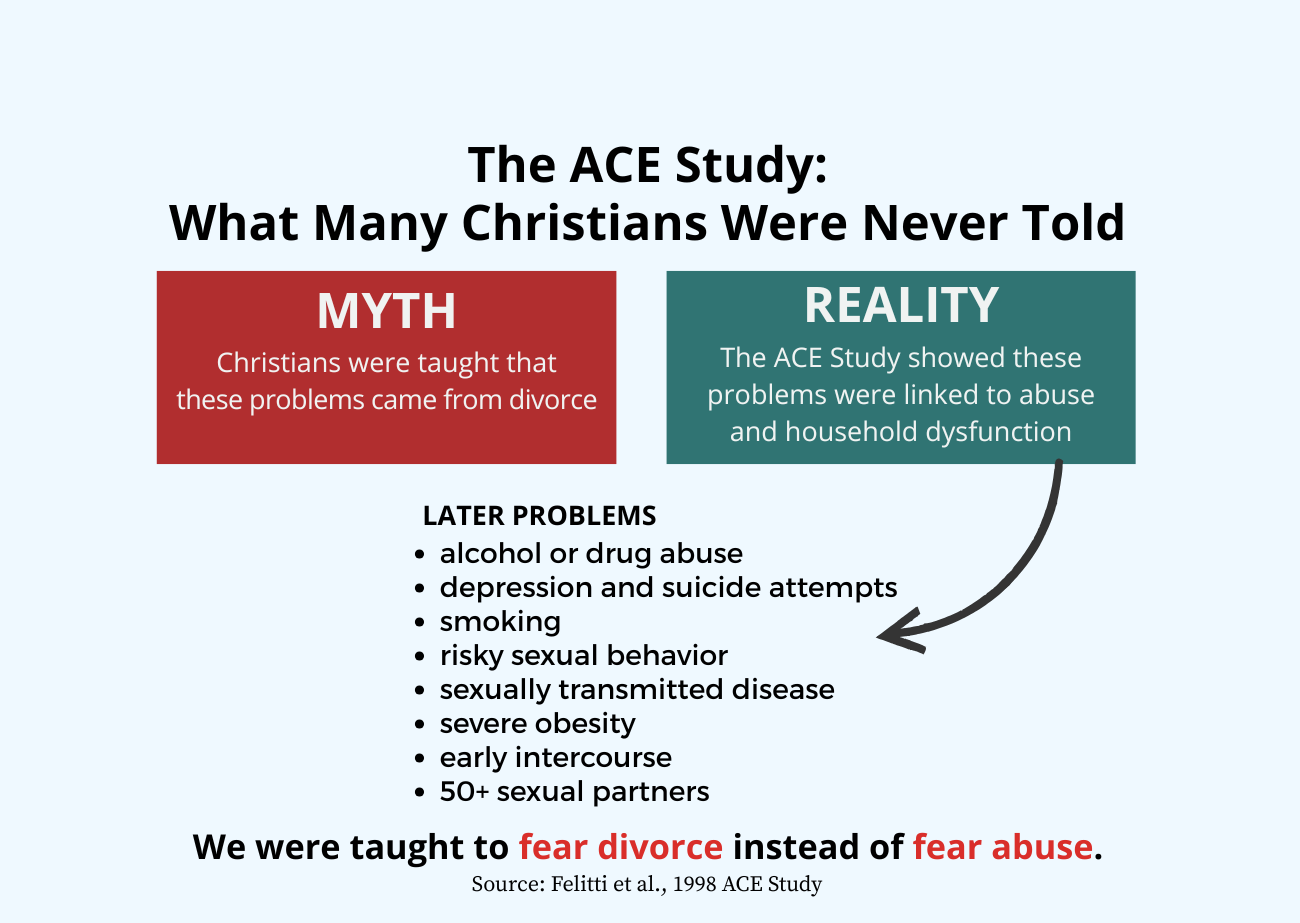
Many Christians have never even heard of the Adverse Childhood Experiences study published in 1998, much less the years of research that followed it. This was not some tiny study tucked away in a journal. It was a major study involving more than 18,000 adult respondents, and it was already pointing to something many of us were never taught to think about clearly: the long shadow cast by abuse and household dysfunction.
We were taught to fear divorce, but not taught to recognize what ongoing abuse, violence, terror, addiction, humiliation, or degradation can do to a child over time. The ACE study helped expose that reality.
Many Christians have never even heard of the Adverse Childhood Experiences study published in 1998, much less the research that followed it for years afterward. We were taught to fear divorce, but not taught to recognize what ongoing abuse, violence, terror, addiction, humiliation, or degradation can do to a child over time.
The ACE study helped expose that reality. It showed that childhood abuse and household dysfunction were not small hardships children simply “got over.” They were linked to serious problems later in life, including health problems, emotional suffering, and other adult fallout such as—
- alcohol abuse
- drug abuse
- depression, suicide attempts
- smoking
- risky sexual behavior
- sexually transmitted disease
- severe obesity
- early sexual intercourse
- having 50 or more sexual partners
In other words, what happens in a dangerous home does not necessarily stay in childhood. It can echo for decades.
Divorce Is Not Automatically the Trauma
People often speak as if divorce itself is what devastates children. But that is far too simplistic.
Many Christians have never even heard of the Adverse Childhood Experiences studies that began in 1995 and continue on for more than 20 years. Christians were taught to fear divorce, but not taught to recognize what ongoing abuse, violence, terror, addiction, humiliation, or degradation can do to a child over time. The ACE research helped expose that reality. It showed that childhood abuse and household dysfunction were not small hardships children simply “got over.” They were linked to serious problems later in life, including health problems, emotional suffering, and other adult fallout.
In other words, what happens in a dangerous home does not necessarily stay in childhood. It can echo for decades.
What the Church Often Missed
That matters, because many church discussions have focused almost entirely on preserving the marriage, while paying far less attention to the damage being done inside it. Too many Christian authors, church leaders, and marriage-permanence organizations spoke as if divorce was the great evil, while barely acknowledging the serious harms children were living with inside some “intact” homes.
What many of us were never told is that the ACE research connected abuse and household dysfunction to later problems.
Yet many Christians were taught to treat those outcomes as the effects of divorce rather than the effects of abuse, fear, chaos, and household dysfunction. We were warned about broken homes, but not nearly enough about the kind of home life that was already breaking a child long before any divorce papers were filed.
They warned people about broken families, but not nearly enough about broken people breaking everyone around them.
That is one reason I keep explaining what a life-saving divorce actually is. Not all divorces are the same, and not all intact homes are safe.
Am I Saying Divorce Causes No Trouble for Children?
No. Of course divorce can be painful, disruptive, and stressful for children. I am not denying that. What I am saying is that many Christians were taught to treat divorce as the explanation for later problems while ignoring abuse, fear, violence, addiction, and household dysfunction that were often harming the child long before the marriage legally ended.
In many families, the divorce was not the beginning of the child’s distress. It was the aftermath of it.
But Isn’t Divorce One of the ACEs?
Yes. In the later 10-ACE framework, parental separation or divorce was included as one of the adverse childhood experiences. But that does not mean divorce is always the main driver of harm, or that it outweighs abuse and severe dysfunction in the home. The ACE framework shows that these adversities are often interrelated and cumulative.
So if a child is living with abuse, addiction, violence, mental illness, sexual abuse, or chronic fear in the home, we cannot honestly blame all later problems on the divorce while minimizing the other ACEs that came before it or alongside it.
The ACE Studies Changed the Conversation
The ACE studies are often used to warn about childhood adversity, yet they also reveal something else: many children were growing up with sexual abuse, physical abuse, mental illness in the home, substance abuse, violence against their mother, and other serious harms.
If you need language for what that looks like, here are 130 examples of abuse. Many of these patterns are minimized in Christian spaces until the damage is already severe.
In that kind of home, the deepest wound is not necessarily that one parent left. Sometimes the deepest wound is that nobody got the child out sooner. Sometimes the tragedy is not the divorce. It is the years of pretending before it.
An Intact Home Is Not Always a Safe Home
That should change the way Christians think.
If a child is living with terror, coercion, cruelty, addiction, or violence, then keeping the family “intact” is not automatically a virtue. A child does not benefit from an intact home that is unsafe. A marriage certificate cannot sanctify abuse. Preserving appearances is not the same thing as protecting a child.
That is why I have written plainly about questions like Can Christians divorce for abuse? and Is it always best to stay for the kids? The answer is no—not when the home itself is toxic.
Sometimes Divorce Is the Rescue
Sometimes the healthiest person in the family is the one who finally refuses to keep pretending. Sometimes the bravest parent is the one who leaves. Sometimes divorce is not what broke the family. Sometimes divorce is what exposed that the family was already being broken by abuse.
That does not mean divorce is painless. Of course it can be sad, disorienting, and costly. But pain is not the same as harm. Surgery hurts too. So does escaping a fire.
When people automatically label divorce as the trauma, they can end up blaming the protective parent instead of the abusive one. They can pressure victims to stay longer. They can teach children that the real problem is not danger in the home, but the courage it took to leave it.
That gets the story backward.
Christians Need a Better Framework
We need a more truthful Christian framework—one that recognizes abuse, names danger clearly, and values the wellbeing of children as much as the preservation of a marriage. We also need pastors who understand this. I keep a running list of pastors who accept physical and emotional abuse as grounds for divorce because Christians deserve to know they are not alone.
And we must stop repeating the old slogans that shame people into staying. Many of those ideas belong in the pile of divorce myths that do not apply to committed Christians.
The Real Question
Divorce is not automatically the trauma. Sometimes it is the interruption of trauma. Sometimes it is the refusal to keep feeding a lie. Sometimes it is the doorway through which safety finally enters.
And for some children, that is not the tragedy.
That is the rescue.
We Were Told Divorce Caused the Damage. The ACE Studies Pointed to Abuse as Causing the Damage.
What many of us were never told is that the ACE research connected abuse and household dysfunction to later problems like alcohol abuse, drug abuse, depression, suicide attempts, smoking, sexual risk-taking, sexually transmitted disease, and severe obesity. The 1998 ACE paper also linked these childhood experiences to early intercourse and 50 or more sexual partners.
In other words, we were often told, “Divorce causes all these bad outcomes.” But the ACE studies pointed to something much darker inside many homes: abuse, addiction, violence, mental illness, and other serious dysfunction. About 52.1% of adults in the 1998 study reported at least one ACE, and the harms were described as strongly interrelated and cumulative.
That does not mean divorce is painless. It means we were too often blaming the visible breakup while ignoring the hidden horrors that may have come before it. Sometimes what people called “the harm of divorce” may actually have been the long shadow of abuse.
Other articles about family research and divorce
- Is it Always Best to “Stay for the Kids”? No, Not If the Home is Toxic
https://lifesavingdivorce.com/abuse-and-kids/ - 10 Quotes on Kids and Divorce From Dr. Judith Wallerstein
https://lifesavingdivorce.com/wallerstein/ - The Unexpected Legacy of Divorce: What Counselors, Students, and Divorcing Parents Need to Know
https://lifesavingdivorce.com/judith-wallerstein-unexpected-legacy-of-divorce-review/ - Bad Fathers Are Bad for Kids. Two-Parent Married Homes Aren’t Always Best per the Jaffee Study
https://lifesavingdivorce.com/jaffee-study-bad-fathers-are-bad-for-kids/ - The “40x Abuse” Myth: What Research Really Says About Single Moms and Stepfamilies
https://lifesavingdivorce.com/40x-child-abuse-myth-single-mothers-remarriage/ - “I Wish I’d Left Sooner”: What Parents Say About Timing Their Divorce When Kids Are Involved
https://lifesavingdivorce.com/whentoleave/ - 12 Tips for Talking with Alienated Kids
https://lifesavingdivorce.com/12-tips-kids/
Divorce, marriage, and family-outcome research
- What is a Life-Saving Divorce? What Are the Reasons for Divorce?
https://lifesavingdivorce.com/what-is-a-life-saving-divorce/ - Forbes Divorce Graph Misleads: Infidelity, Abuse, and Addiction Were Key
https://lifesavingdivorce.com/forbes-lack-of-commitment-divorce-study/ - Harvard Journal Shows Divorce Saves Lives
https://lifesavingdivorce.com/divorcesaveslives/ - Psychology Today Got the Waite Divorce Study Wrong —Here Is What the Data Really Show
https://lifesavingdivorce.com/psychologytoday1/ - Does the Waite and Gallagher Study Really Say Your Marriage Will Become Happy If You Stay 5 Years? No!
https://lifesavingdivorce.com/waite/ - Will the Kids and I Ever Be Happy Again After Divorce? Studies Say Most People Are!
https://lifesavingdivorce.com/happy/ - 75% of Divorced People Are Happy (GSS 2024)—So Why Does the Church Say the Opposite?
https://lifesavingdivorce.com/hope-after-divorce-gss-2024/ - Healing After Divorce: What a New 2025 Study Found
https://lifesavingdivorce.com/healing-after-divorce-2025-study/ - 12 Positive Outcomes of Divorce that Nobody Told Us
https://lifesavingdivorce.com/12facts/
 :
:
 :
: Buy PDF