
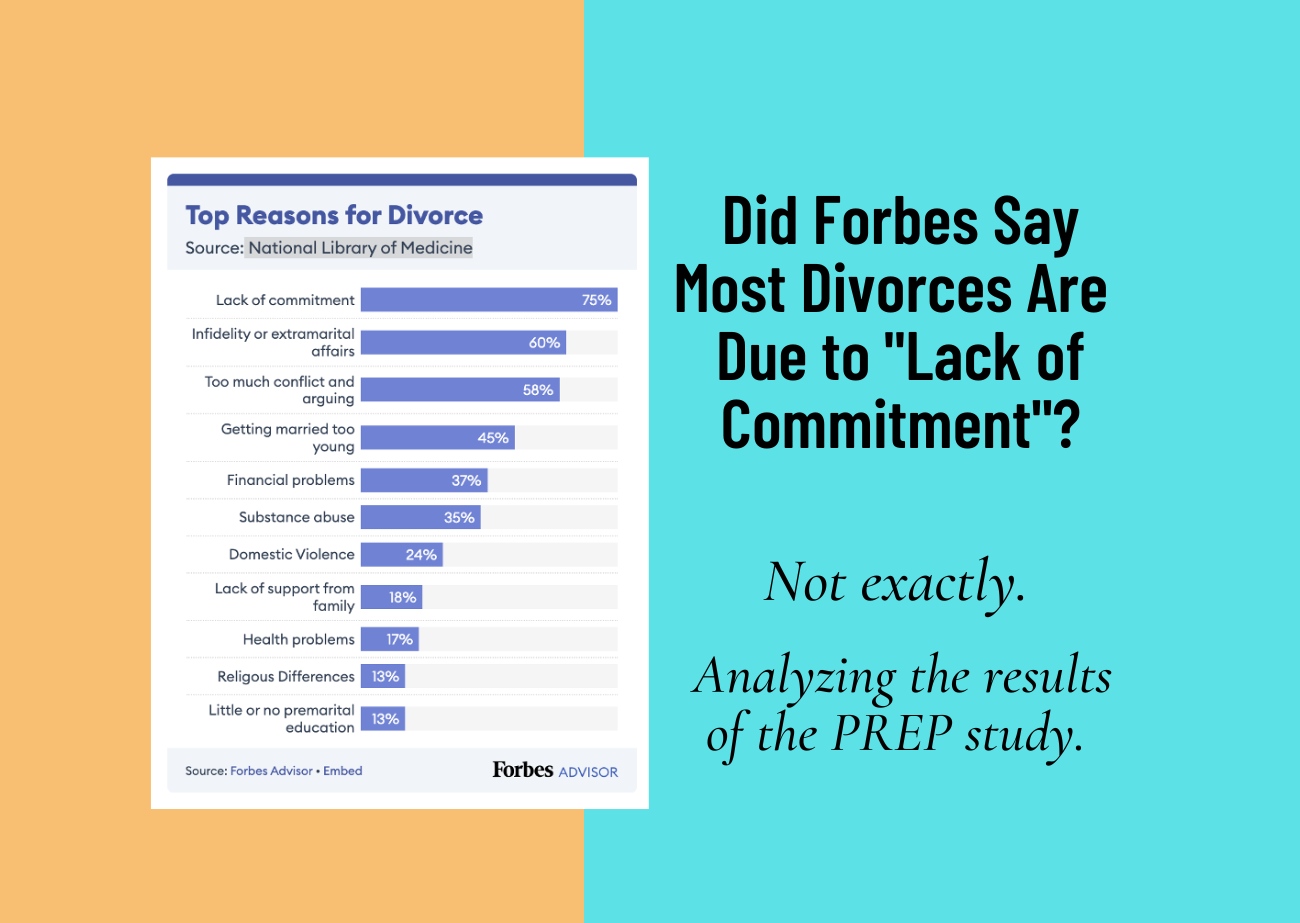
Did Forbes Really Say “Lack Of Commitment” Is the Top Reason For Divorce?
Watch the 2-minute video summary of this post.
The Forbes Graph and the Study Behind It
I saw this graph, “Top Reasons for Divorce,” on the Forbes Advisor website, and I looked up the study Forbes mentioned. It seems as though a marketing person wrote a misleading headline!
What the Study Actually Found
The study behind the headline draws a very different conclusion: It found that nearly 6 in 10 people in this study divorced for very serious reasons—in particular infidelity, substance abuse, and domestic violence. In fact, the marriages in this study were so troubled, that more than half of the participants indicated infidelity occurred in their marriage.
Background of the Study
The 52 participants in the survey had taken the 12-hour PREP premarital course in a church or religious organization in 1996. They took the followup survey between 2010-2012. Demographically they were white and were married in a church or Christian organization.
Why the Percentages Don’t Add Up to 100%
First, take a look at the graph in the image. The headline is off-base AND the figures don’t add up to 100% because participants could select more than one major contributor to their divorce, and they chose multiple factors—many of them serious.
This question wasn’t about the REASON for the divorce, but the MAJOR CONTRIBUTORS to the divorce.
Let me give an example: On a modern death certificate, it tells you the final cause of death, but it also notes several major contributing factors, the other health problems like heart disease, kidney disease, or diabetes. Likewise the reason for divorce might be infidelity, and a major contributor was the cheater’s “lack of commitment” to the marriage and family.
This study surveyed 52 individuals who had completed a rigorous PREP premarital program and later divorced. Participants were allowed to select multiple reasons (from a list of 11) as major contributors to their divorce, which is why the percentages add up to more than 100%. On average, each person selected about four major contributing reasons.
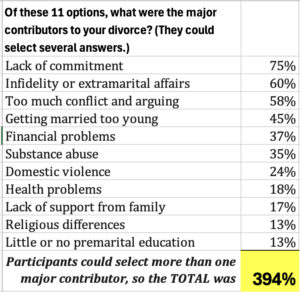
Here’s the link to the study: https://www.ncbi.nlm.nih.gov/pmc/articles/PMC4012696/
These Were Extremely Difficult Marriages
Most of these survey participants clearly faced extremely difficult marriages: on average, each person chose four different major contributing issues. Six in 10 selected infidelity as a major contributor, more than 2 in 10 selected domestic violence, and more than 3 in 10 selected substance abuse. In other words, some respondents were likely dealing multiple serious problem at once.
WHAT WAS THE “FINAL STRAW”
The participants were asked another question: was there was a “final straw”? They could pick only one answer. The vast majority reported a particular issue.
More than 7 in 10 participants said there was a “final straw.” (For some reason, the study doesn’t tell us what the 4th and 5th place issues were. But they report that 6 in 10 participants chose either infidelity, domestic violence, or substance abuse.)
The findings in this study do not support the idea that most divorces in this group were frivolous decisions, but rather responses to problems like betrayal, abuse, chronic fighting over bad behavior, substance issues, and growing apart—a much more complex picture than “just giving up.”
Results for the “final straw in the marriage” question: 6 in 10 identified one of these
-
Infidelity was reported by 24% (1 in 4) of participants
-
Domestic violence by 21.2% (about 1 in 5)
-
Substance abuse by 12.1% (about 1 in 9)
stance abuse by 12.1% (about 1 in 9)
These Were Extremely Difficult Marriages
Most of these survey participants clearly faced extremely difficult marriages: on average, each person chose four different major contributing issues. Six in 10 selected infidelity as a major contributor, more than 2 in 10 selected domestic violence, and more than 3 in 10 selected substance abuse. In other words, some respondents were likely dealing multiple serious problem at once.
WHAT WAS THE “FINAL STRAW”
The participants were asked another question: was there was a “final straw”? They could pick only one answer. The vast majority reported a particular issue.
More than 7 in 10 participants said there was a “final straw.” (For some reason, the study doesn’t tell us what the 4th and 5th place issues were. But they report that 6 in 10 participants chose either infidelity, domestic violence, or substance abuse.)
The findings in this study do not support the idea that most divorces in this group were frivolous decisions, but rather responses to problems like betrayal, abuse, chronic fighting over bad behavior, substance issues, and growing apart—a much more complex picture than “just giving up.”
Results for the “final straw in the marriage” question: 6 in 10 identified one of these
-
Infidelity was reported by 24% (1 in 4) of participants
-
Domestic violence by 21.2% (about 1 in 5)
-
Substance abuse by 12.1% (about 1 in 9)

Click to enlarge: Top reasons for divorce (the final straw): infidelity, domestic violence, and substance abuse
What “Lack of Commitment” Meant in This Study
So, for nearly 6 in 10 survey participants, a spouse’s infidelity, domestic violence, or substance abuse was the “final straw” that ended the marriage. (So any idea that most of them divorced for frivolous reasons is incorrect.
Their spouses were actively betraying the sanctity of their marriage, and showed no commitment to their spouse, so it’s no surprise they also cited “lack of commitment” as a major factor. In this study “Lack of commitment” is sometimes a response to severe marital problems—such as infidelity or persistent arguments—not a sudden, capricious decision to end the marriage.
The interpretation that 72% of people divorce primarily due to lack of commitment (or some other frivolous reason) is simply not supported by the actual study findings.
Study Finds Bad Marriages Are Not Worth Preserving
Quote from the study:
“We believe premarital education should serve as a prevention effort to help healthy and happy couples stay that way and that keeping distressed, abusive, or otherwise unhealthy couples together would not be a positive outcome.”
Forbes should have picked a better title. This one was misleading.
I always learn a lot from the people on Facebook. One person left a public comment:
“Lack of commitment would be an underlying contributing issue for any failed marriage.
Why do people cheat? Lack of commitment.
Why do people abuse? Lack of commitment.
Why do people lie? Lack of commitment.
Why do people overspend? Lack of commitment.
Why are people mean and selfish? Lack of commitment.
Why won’t people do the hard work of becoming better people? Lack of commitment.
That does not mean people are getting divorced for frivolous reasons. Rather, it means toxic people don’t really commit to living out the sacred marriage vows… because they are toxic people.”
Why Survivors Get Accused of “Lacking Commitment”
On top of it, ABUSERS accuse their victims of lacking commitment simply because they chose to escape from the malice and seek a divorce to find relief from the danger.
Many Survivors Stayed for Decades
For many people, this imbalance of commitment existed for 20, 30, 40, or even 50 years in their marriage. THEY did not divorce due to their own “lack of commitment.” Every day they were investing time, money, and energy into making the marriage safe and loving. They were often risking their own lives and safety by staying. Their church required them to be committed and behave well. They finally divorced because their spouse’s destructive behavior was affecting their life and sanity and their children’s well-being. Their lives had become tense and chaotic.
I explain over and over that we conservative Christians (and other people of conservative faiths) tried harder to save our marriages than most normal people and that most of us divorced for serious reasons, for life-saving reasons, not because we just couldn’t go the distance like everyone else.
The researchers ask why they had thrown in the towel. It wasn’t apathy.
For nearly 6 in 10 survey participants, a spouse’s infidelity, domestic violence, substance abuse or something generally similar was the “final straw” that ended it.
In other words, the “lack of commitment” was not because the person was “a quitter,” or “missed the party life,” or was “bored,” or wondered if “the grass is greener.” Their spouse was actively betraying the sanctity of their marriage.
The “Final Straw” was not likely the first time this violation of the marriage occurred
The researchers found:
“Participants expressed that although these final straw events may not have been the first incident of their kind (e.g., the first time they realized their partner had a substance abuse problem) an event involving these behaviors led to the final decision for their relationship to end. Also, there were some situations in which individuals expressed that these three issues may have interacted with one another or other relationship issues.”
How the Researchers Explained It
In chatting on social media with one of the research authors, I got the impression that the researchers explained it:
(1) either as a slow erosion of the relationship or as
(2) progression from “lack of commitment” and to sudden marriage-shattering act, like infidelity, near the end that causes it all to come down. But they did mention a third scenario:
(3) a long-term pattern of final straws, yet stigma and false information keeps them from leaving until the situation is too destructive to stay another day.
Why #3 Rings True
I see #3 a lot. I’ve been a divorce recovery leader for 25 years in conservative churches, and am the founder and administrator of the 6,800-member private online group, the “Life-Saving Divorce Private Group” on Facebook. So I hear from far more than 52 people every day.
I see people stay in situations where marriage-destroying behavior has going on for a long time, not just as a final event. Finally, the cost to the invested parent and children is just too high to go on. They were worried about the stigma of their church, but they cannot take it anymore. They are worried about what their pastor and friends at church would think. But eventually, they said, “Enough is enough.”
Most devout people of faith who needed a life-saving divorce tell me that they were committed to the marriage even though their spouse had a long pattern of tearing down the marriage through selfish behavior. The “final straw” wasn’t a one-off event. It was one incident in a long line of similar incidents.
People of faith, who follow church teachings, “stay and pray” and forgive over and over for years, despite their spouse’s cheating, addictions, and abuse. They attend churches that tell them to “fight for their marriage,” meaning “stay married at any cost to yourself and your children.”
To make matters worse, these highly invested spouses were shamed by church leaders, Christian authors, and Focus on the Family for not fixing their spouse’s destructive behavior, and were told that they could fix the marriage if they were just nice enough, forgiving enough, or positive enough.
In this study, 3 in 10 people said they wished they had been educated about “red flags” in their premarital classes, and had walked away rather than entering the marriage.
The people in my group will tell you they had far too much commitment to a low-commitment spouse who put little investment in the marriage. They may have endured physical or emotional abuse, callous manipulation, deception, psychological aggression or neglect, cheating, child abuse, and/or family-crushing additions. They stay for years. Why? Because the church required them to. They were told God hates divorce, and that meant that God would hate them for divorcing. (By the way, every NEW MAJOR Bible translation since the publication of the Dead Seas Scrolls in 1996, has used the more accurate Hebrew wording that condemns men for unjustly divorcing their wives. Not one of these new major translations say “God hates divorce” or “I hate divorce.” See the English Standard Version, the Christian Standard Bible, and the New International Version 2011 update.)
I’m not sure that selecting it off a list was a good way of teasing out the real reasons for divorce. It just doesn’t tell us much, and it exposes us to harm because there are malicious people who want ammunition to make divorce harder to get. They malign those who initiate divorce, even in cases of abuse, tarnishing them as having a “lack of commitment.”
Bottom line:
The interpretation that 75% of people divorce frivolously because they “lack commitment,” simply isn’t true. That’s not the conclusion of the study mentioned on the Forbes website.
What the Researchers Concluded About Premarital Education
In their conclusion, the researchers made a very important statement: Good premarital counseling should encourage good communication but also dissuade distressed or abusive couples from marrying. The researchers suggest the couple should take substance abuse and aggressive behavior seriously. They encourage the future spouse to say, “…change these behaviors or break up.” The researchers found, “One of the potential benefits of relationship education is that it can help some couples on an ill-advised or premature path toward marriage to reconsider their plans.”
This study was conducted to measure the success of the PREP premarital education program. (By the way, I like PREP as a premarital program. There’s a Christian and a secular version.)
 :
:
 :
: Buy PDF