
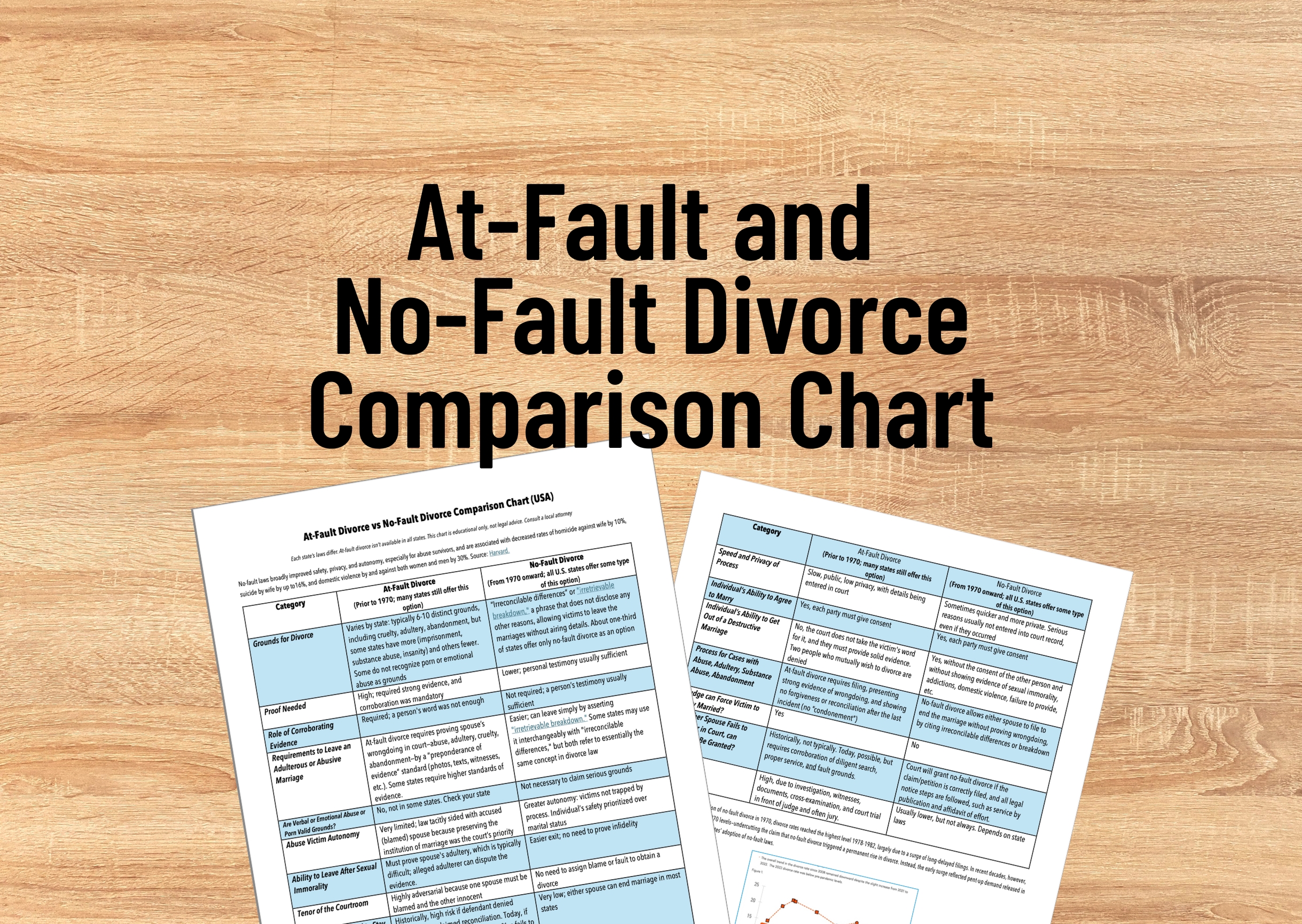
At-Fault Divorce vs No-Fault Divorce Comparison Chart (USA)
Click for print-friendly version
(Each state’s laws differ. At-fault divorce is not available in all states. This chart is educational only, not legal advice. Consult a local attorney.)
No-fault laws broadly improved safety, privacy, and autonomy, especially for abuse survivors, and are associated with decreased rates of homicide against wives by 10%, suicide by wives by up to16%, and domestic violence by and against both women and men by 30%. Source: Harvard Quarterly Journal of Economics.
| Category | AT-FAULT DIVORCE (Prior to 1970; and many states still offer this option) |
NO-FAULT DIVORCE (From 1970 onward. All U.S. states offer some form of this option) |
| Grounds for Divorce | Varies by state: typically 6-10 distinct grounds, including cruelty, adultery, abandonment, but some states have more (imprisonment, substance abuse, insanity) and others fewer. Some do not recognize porn or emotional abuse as grounds | “Irreconcilable differences” or “irretrievable breakdown,” a phrase that does not disclose any other reasons, allowing victims to leave the marriages without airing details. About one-third of states offer no-fault divorce as the only option |
| Proof Needed | High; requires strong evidence, and corroboration is mandatory | Lower; personal testimony usually sufficient |
| Role of Corroborating Evidence | Required; a person’s word is not enough | Not required; a person’s testimony usually sufficient |
| Requirements to Leave an Adulterous or Abusive Marriage | At-fault divorce requires proving spouse’s wrongdoing in court—abuse, adultery, cruelty, abandonment—by a “preponderance of evidence” standard (photos, texts, witnesses, etc.). A few states require higher standards of evidence. | Easier; can leave simply by asserting “irretrievable breakdown.” Some states may use it interchangeably with “irreconcilable differences,” but both refer to essentially the same concept in divorce law |
| Are Verbal or Emotional Abuse or Porn Valid Grounds? | No, not in some states. Check your state | Not necessary to claim serious grounds |
| Abuse Victim Autonomy | Very limited; law tacitly sided with accused (blamed) spouse because preserving the institution of marriage was the court’s priority | Greater autonomy: victims not trapped by process. Individual’s safety prioritized over marital status |
| Ability to Leave After Sexual Immorality | Must prove spouse’s adultery, which is typically difficult; alleged adulterer can dispute the evidence. | Easier exit; no need to prove infidelity |
| Tenor of the Courtroom | Highly adversarial because one spouse must be blamed and the other viewed as innocent | No need to assign blame or fault to obtain a divorce |
| Risk of Being Forced to Stay in Bad Marriage | Historically, high risk if defendant denied allegations or claimed reconciliation. Today, if court denies divorce (for example, if person who files fails to prove fault or the court finds insufficient evidence), petitioner can usually switch to a no-fault divorce | Very low; either spouse can end marriage in most states |
| If Both Parties Agree to Divorce | Not allowed. The divorce is denied, based on “collusion.” | Divorce is granted and usually is faster and less expensive |
| Speed and Privacy of Process | Slow, public, low privacy, with details being entered in court | Sometimes quicker and more private. Serious reasons usually not entered into court record, even if they occurred |
| Individual’s Ability to Agree to Marry | Yes, each party must give consent | Yes, each party must give consent |
| Individual’s Ability to Get Out of a Destructive Marriage | No, the court does not take the victim’s word for it, and they must provide solid evidence as corroboration. Pre-1969, two people who mutually wished to divorce were denied. Mutual divorce is no longer denied for lack of fault. | Yes, without the consent of the other person and without showing evidence of sexual immorality, addictions, domestic violence, failure to provide, etc. |
| Process for Cases with Abuse, Adultery, Substance Abuse, Abandonment | At-fault divorce requires filing, presenting strong evidence of wrongdoing, and showing no forgiveness or reconciliation after the last incident (no “condonation”) | No-fault divorce allows either spouse to file to end the marriage without proving wrongdoing, by citing irreconcilable differences or breakdown |
| Judge can Force Abuse Victims to Stay Married if They Use This Approach? | Yes | No |
| If Other Spouse Fails to Appear in Court, can Divorce Be Granted? | Historically: No, not typically. Today: possible, but requires corroboration of diligent search, proper service, and fault grounds. | Court will grant no-fault divorce if the claim/petition is correctly filed, and all legal notice steps are followed, such as service by publication and affidavit of effort. |
| Legal Fees | High, due to investigation, witnesses, documents, cross-examination, and court trial in front of judge and often jury. | Usually lower, but not always. Depends on state laws |
UNILATERAL No-Fault Divorce Saves Lives
Why did unilateral no-fault divorce lead to drops in wife suicide and homicide?
If you’re under 80, you may not remember how divorce worked before 1969.
Even if your spouse was cruel or unfaithful, you had to prove it in court with witnesses, documents, or medical records. Your own testimony didn’t count.
Many states ran divorce like a civil or criminal trial, requiring corroboration and a “preponderance of evidence.” Standards were often so strict that people hired private investigators to catch a sneaky spouse. Your “gut feeling” wasn’t enough. And you had to be wealthy enough to pay for experts—today the retainer alone could run into the thousands.
Many forms of abuse leave no usable evidence. Coercive control, manipulation, threats, and terrifying rages rarely come with witnesses or paperwork. A spouse who smashes objects, drives recklessly with the kids, or threatens suicide can terrorize the family—yet none of that met the old legal threshold.
Financial abuse also leaves little proof. A controlling spouse might block you from working, seize your IDs, hide money, or punish you for spending on basics. Judges in the fault era often shrugged because it didn’t fit narrow categories.
Sexual betrayal is similar. Many affairs leave no letters, photos, or confessions. Even today, partners usually discover infidelity through behavior changes, not hard evidence. A spouse’s verbal confession to you didn’t count in court. (Not did their confession, in many cases.)
People who sexually exploit children don’t do it in front of witnesses, and they rely on victims being too young or too intimidated to speak.
And emotional abuse—belittling, gaslighting, name-calling, angry silences, sleep deprivation—deeply harms adults and kids, but judges often dismissed it as “marital squabbles.”
If you were taught to always forgive your spouse and did it in writing, they could claim you “condoned” the behavior. Once you forgave and resumed marital relations, that incident often couldn’t be used as evidence unless it happened again afterward.
That’s why the right to a UNILATERAL divorce—leaving without the other spouse’s permission—is vital for anyone trapped with an abuser, cheater, or manipulator who will never admit fault.
This is why fault-based requirements sound simple in theory but, in practice, trap victims. If you want to know where your state stands now, visit The Future of No-Fault Divorce Laws website: https://institutedfa.com/no-fault-divorce-future/
We need to protect unilateral no-fault divorce—because victims’ lives depend on it.
Click here to view print-friendly version (Optional download)
Notes: After the introduction of no-fault divorce in 1970, divorce rates reached the highest level 1978-1982, largely due to a surge of long‑delayed filings. In recent decades, however, rates have fallen to below 1970 levels—undercutting the claim that no-fault divorce triggered a permanent rise in divorce. Instead, the early surge reflected pent‑up demand released in the years following the first states’ adoption of no-fault laws.

Other Articles on No-Fault Divorce
- Side-by-side comparison chart of At-Fault Divorce and No-Fault Divorce.
- 6 Pros and Cons of No-Fault Divorce
- 10 Q&A on No-Fault Divorce Myths
- No-Fault Divorce is a topic that the Federal Reserve in interested in. They look at who has gained or lost “bargaining power.” This this paper
- Update on which states may be changing their no-fault divorce laws.
- VIDEOs: True stories of Life Before No-Fault Divorce. People getting trapped in horrific marriages because of restrictive laws, or inability to find 3rd party witnesses.
 :
:
 :
: Buy PDF