
The Hope Restored Marriage Intensive talks constantly about safety. Here’s what a truly safety-first model would require.
Let’s first look at Hope Restored’s curriculum
One of Hope Restored’s core teachings is the Reactive Cycle.
Robert Paul—one of the architects of Focus Marital Therapy (FMT) and a co-founder of the program that became Hope Restored—describes the reactive cycle as the model they use for what happens underneath conflict.
In his 2026 AACC seminar, he presented it so enthusiastically that he said it applies to “all conflict, period,” especially marriage. Paul presents the Reactive Cycle not as one useful lens among several, but as a near-universal explanation of conflict. He said that when you find something that “applies to everybody,” you have something powerful. He then framed the model as part of a discussion about “timeless truths” that need fresh articulation—explicitly mentioning the Gospel as an example—and says their particular way of expressing the Reactive Cycle is especially powerful.
That’s a bold claim. Let’s take a look.
In This Article: Making Hope Restored Safe
This is a long article, so here are the major concerns I examine:
- The Reactive Cycle is treated as a nearly universal explanation
Robert Paul says it explains “all conflict, period.” But not all marital problems are mutual conflict. - Hope Restored redirects attention away from “what the spouse did”
This is one of the most serious problems with Focus Marital Therapy. In some marriages, abuse, adultery, deception, addiction, exploitation, or danger may be the most important facts in the room. - Serious wrongdoing can be trivialized as “button pushing”
Fear, anger, grief, or distrust may be reasonable responses to something harmful happening now—not merely old wounds being triggered. - The Care Cycle turns the focus toward self-doubt too quickly
“Am I amping this up?” can be a useful question to ask in ordinary conflict, but it is the wrong first question when someone is being harmed. - Hope Restored allows temporary distance—but puts limits on permanent safety
The model permits leaving the “interactive space,” and even acknowledges that some abuse may require physical separation, while continuing to prioritize marital restoration. - The “My Yard / Your Yard” teaching has a missing third option
You cannot control another person, but you can change how much access that person has to you, your children, your money, your home, and your future. - The Hope Restored Marriage Trap
If protecting your “yard” ultimately means divorce, the program says therapy may be terminated and your integrity and faith are questioned. - Abuse is not a tug-of-war
One spouse can “drop the rope” and the other person can still threaten, stalk, cheat, steal, abuse, or endanger the family. “Dropping the rope” is not the cure-all when the harm is coming from one spouse. - A safety-first assessment should come before the Reactive Cycle
Therapists should first ask: What happened? Who did what? Is anyone unsafe? Is there coercion, betrayal, addiction, exploitation, or severe neglect? A new sample chart is proposed. - Accountability must come before reconciliation
Real change requires truth-telling, treatment, restitution, respect for boundaries, and observable behavior change over time. - Hope Restored could be made safer
I outline specific reforms, including better screening, clearer informed consent, measurable accountability, and allowing separation or divorce when serious harm continues. - Other Christian counselors and researchers raise similar concerns
Without naming Hope Restored or the Focus Marital Therapy model, Leslie Vernick, Darby Strickland, and marriage-and-family-therapy researchers have all warned against treating abuse or coercive control as if it were merely mutual relationship conflict.
The idea behind the reactive cycle is simple. Everyone has emotional “buttons”—wounds, fears, sensitivities, or painful beliefs. Something your spouse does pushes one of your buttons. Your heart closes and you react. Your reaction then pushes one of your spouse’s buttons. Your spouse reacts, which pushes another of yours, and around you go. “We’re off to the races,” he says.
Paul says that although the details vary from couple to couple, “the cycle is exactly the same.”
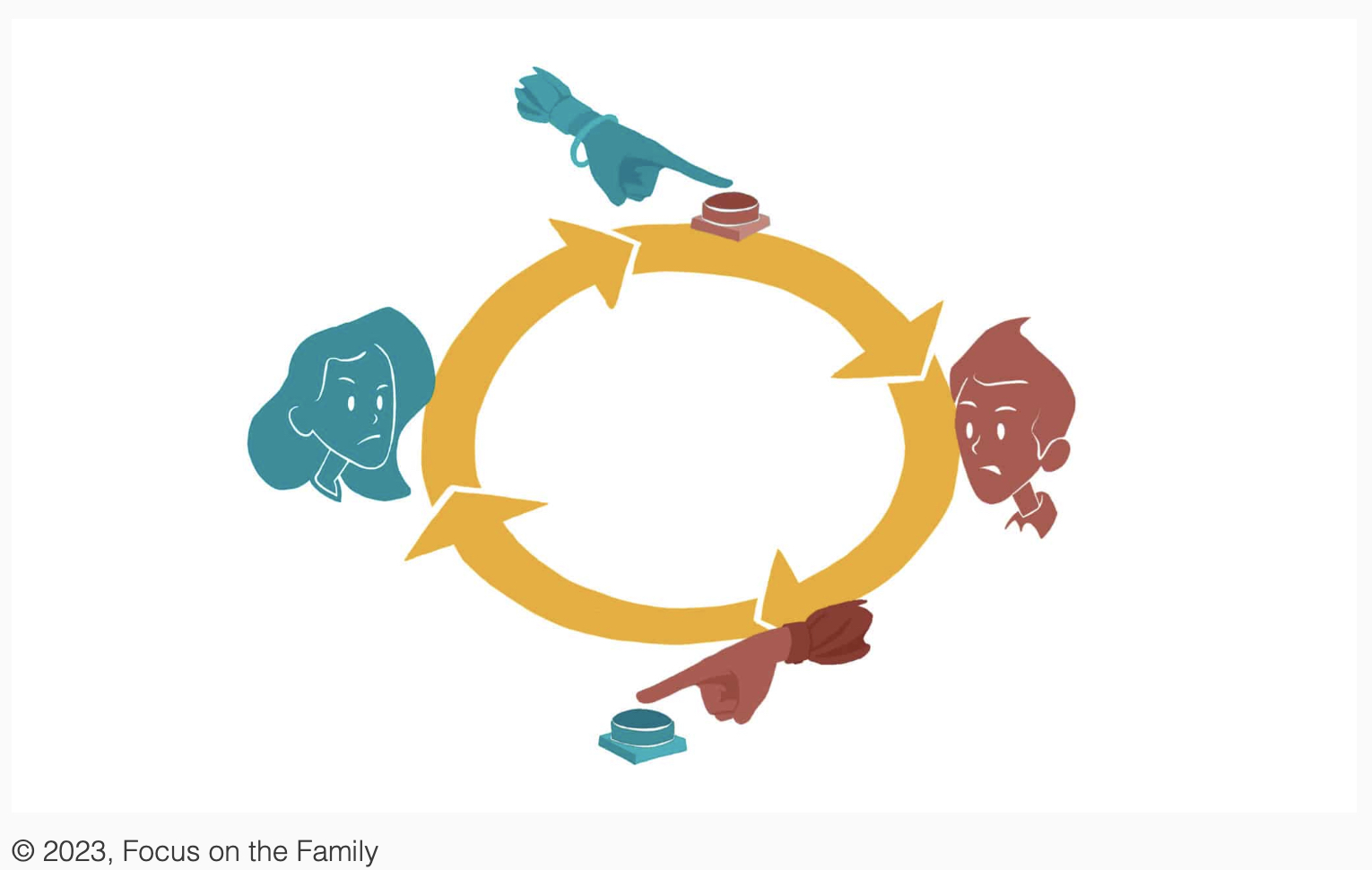
Caption: Focus on the Family’s Reactive Cycle illustrates marital conflict as a repeating pattern of one spouse’s “button” and reaction triggering the other spouse. Image source: The Hope Restored Reactive Cycle, Care Cycle, and “Create Space” graphics shown above are from Focus on the Family’s article, Breaking the Reactive Cycle. © 2023 Focus on the Family, “The Reactive Cycle”
For ordinary marital conflict, this diagram is easy to understand.
One person feels criticized and becomes defensive. The other feels dismissed and raises her voice. He withdraws. She pursues. He becomes more defensive. Both people become increasingly upset.
That really can happen. And personal responsibility in communication is important.
But before we assume that a couple is caught in a mutual cycle of button pushing, there is a more basic question a therapist needs to answer: What actually happened between these two people?
The problem with Hope Restored begins when this pattern is treated as the explanation for nearly every kind of marital distress.
(Another concern is that Focus on the Family isn’t keeping this teaching inside Hope Restored. It is now training and certifying outside therapists to use it in their own practices and offering a FMT Certification, a CFMT. It’s not evident what training Focus requires these therapists to receive in distinguishing ordinary marital conflict from coercive control and abuse before they decide both spouses into a mutual “Reactive Cycle”?)
What happens when it’s not “button pushing,” but marriage-destroying sin?
Paul teaches therapists that people commonly come into counseling wanting to talk about the other spouse and “what they did.” His response is striking:
“Guys, that conversation
is a complete and total waste of time.”
Read that again.
Paul is telling therapists to redirect the conversation away from what the other spouse did and onto the reactive cycle. That’s a direct quote from a seminar he gave to dozens of Christian counselors at AACC 2026.
That may make sense when the couple is arguing about tone, defensiveness, criticism, or other ordinary marital conflict. But Hope Restored markets itself for couples in severe marital crisis. In that setting, “what they did” may be the most important information in the room.
An abuse victim may already be afraid she will not be believed. A betrayed spouse may desperately need someone to understand the extent of the deception. A family may be dealing with violence, serial infidelity, drunkenness, sexual misconduct, financial exploitation, child endangerment, or a secret double life.
Robert Paul also said he does not introduce this to clients right away. He first wants to “establish some trust and some foundation with a client” before introducing what he calls this “exposure.” That matters. It raises a serious question about informed consent: If most U.S. states and Canadian provinces require licensed clinicians to obtain informed consent before therapy begins—including explaining the nature, goals, procedures, and foreseeable risks of treatment—does waiting until trust is established before telling clients that discussion of “what the spouse did” will be redirected toward their own wounds and reactions comply with that requirement?
By the time a distressed spouse is told that discussing “what their spouse did” is a “complete and total waste of time,” they may already have taken time off work, arranged childcare, made financial arrangements, and traveled to the retreat location.
I believe Hope Restored should tell clients before they arrive that its model may redirect discussion away from “what the other spouse did” and toward the client’s own reactions.
Before redirecting either spouse inward, a therapist needs to know what actually happened.
Yet Paul explains that the real “juice” driving the Reactive Cycle comes from the emotional buttons underneath the reactions. The therapist should get the client’s focus “off of the reactions and off of their spouse” and onto the buttons, which he calls “where the real issue is.”
But sometimes what the spouse did is the real issue.
What if the spouse:
- lied repeatedly?
- maintained a secret sexual life?
- committed adultery?
- threatened or intimidated?
- physically assaulted the other spouse?
- sexually coerced or violated?
- controlled or squandered family money?
- repeatedly got drunk or used drugs?
- maintained a hidden addiction?
- endangered the children?
- committed crimes that endangered the family?
- exploited the spouse financially or spiritually?
- abandoned basic responsibilities?
- chronically neglected the marriage?
Those are not mere “buttons.”
They are choices and behaviors. Some are marriage-destroying sins. Some are dangerous. Some are crimes.
And the injured spouse’s fear, anger, grief, or desire to get away may not be evidence that an old emotional wound has been “triggered.”
It may be an entirely reasonable response to what is happening right now.
Sometimes you are reacting because an old bruise was touched. Sometimes you are reacting because your spouse just injured you. A safe therapist has to find out which one it is before treating the reaction as the problem.
A person can certainly bring old wounds into a marriage. But there are at least three possibilities a therapist needs to consider:
- An old wound has been touched.
- The spouse has caused a new injury.
- Both are happening at once.
A model that too quickly assumes the first possibility can miss the second.
That is why a safety-first approach has to begin with FACTS:
What happened? Who did what? Is anyone being harmed?
Only after answering those questions is it safe to ask what emotional wounds or reactions may also be involved.
Hope Restored’s Second Cycle: the Care Cycle
Hope Restored then teaches another core tool: the Care Cycle.
Its five steps are:
Aware → Accept → Allow → Attend → Act
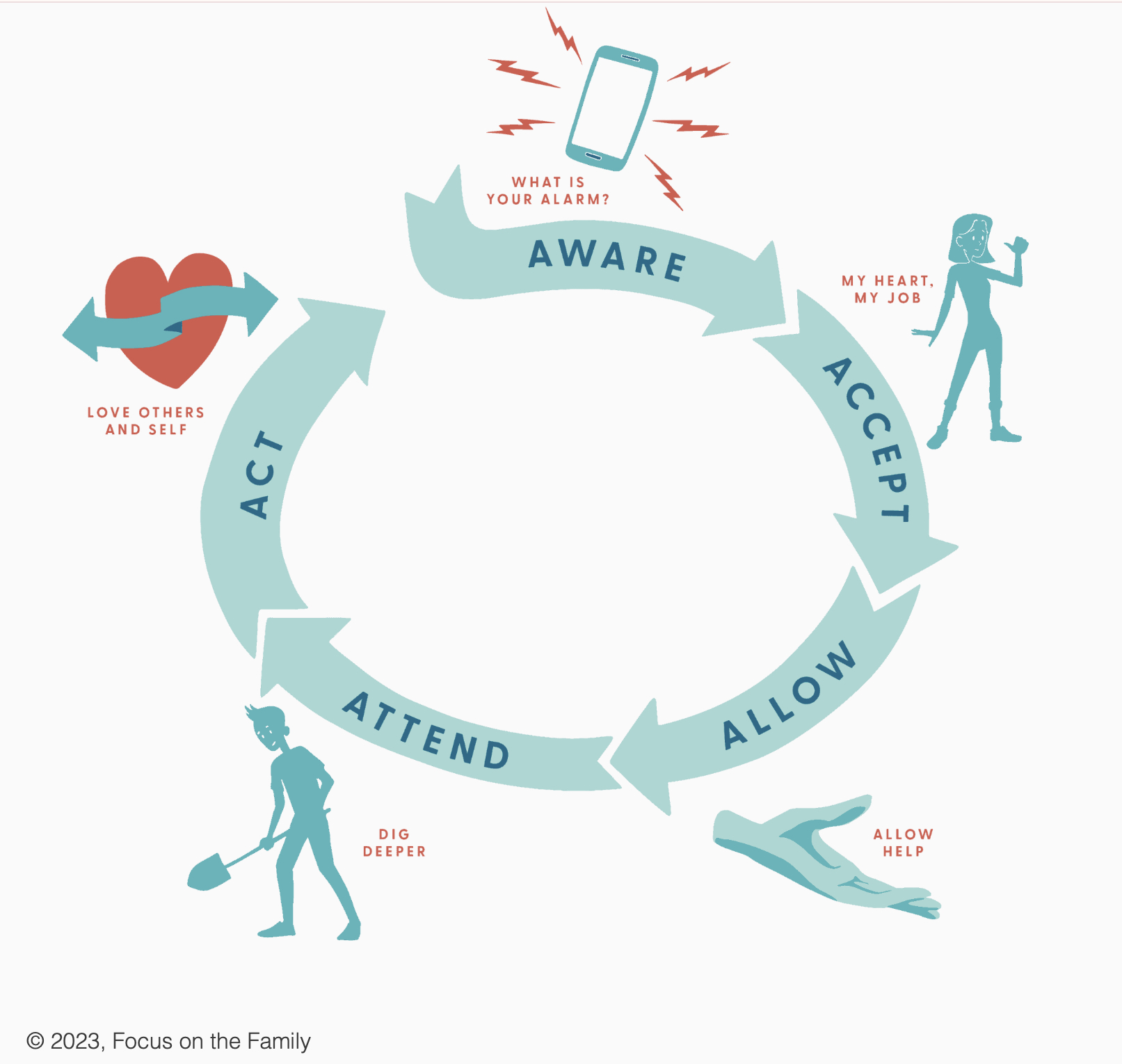
Hope Restored’s Care Cycle teaches five steps for responding to being triggered: Aware, Accept, Allow, Attend, and Act. © Focus on the Family.
Again, much of this is useful.
Become aware that you are “activated.” Accept what you are feeling. Allow help from God and others. Attend to what is happening inside you. Decide what caring for yourself well would look like. Then act.
Robert Paul says the Care Cycle is the main tool Hope Restored uses to help clients care for themselves when their “buttons get pushed.”
During the “Attend” step, Paul has clients ask questions such as:
- What am I feeling?
- What button got pushed?
- What am I believing?
- Is what I am believing true?
- What would taking care of myself look like?
And one of his favorite questions is:
“Am I amping this up in some way?”
There is nothing wrong with asking that question. In ordinary conflict, it may be extremely helpful. Responding out of frustration, irritation, exhaustion, or old wounds may be a sign that we need to slow down and take better care of ourselves.
The concern is when that question comes before an adequate assessment of what the other person is actually doing.
If your spouse forgot an anniversary and you feel overwhelmingly rejected because of an old abandonment wound, asking whether you are “amping this up” may be useful.
But if your spouse has emptied the bank account, threatened you, exposed you to disease through serial infidelity, frightened your children, or maintained a hidden addiction for years, “Am I amping this up?” is not the first question that needs to be asked.
The first question is still:
What actually happened?
Instead, the model turns attention inward
Paul makes that inward shift explicit.
After explaining how to stop the Reactive Cycle, he tells therapists that the next step is:
“Focus on self. Focus on you.”
He says the focus needs to move:
“from out here to in here.”
And immediately before that, he makes an important distinction:
“You don’t leave the covenant, but you leave the interactive space.”
That sentence deserves careful attention.
Paul allows for stepping out of the immediate interaction. He strongly promotes self-care and personal responsibility. His examples include calming yourself, taking a timeout, praying, breathing exercises, noticing what is happening in your body, and creating “space” between your button and your reaction. He describes this as learning “how to self-regulate, how to manage what’s going on inside of you.”
But how far is a spouse allowed to go to become safe?
Paul says:
“You don’t leave the covenant, but you leave the interactive space.”
That distinction matters.
If two basically safe people are having an argument, stepping away from the interaction may be exactly what is needed. But what if the problem is violence, coercive control, serial infidelity, chronic deception, addiction, exploitation, or danger to children?
Then the question may not simply be whether someone should leave the interactive space.
The question may be whether that person needs to leave the relationship itself.
And this creates a tension with something Robert Paul says earlier in the same presentation:
“The well-being of the individual always takes precedence over
the well-being of the marriage without exception.”
If individual well-being really takes precedence without exception, then there must be situations in which safety requires more than calming down, taking a timeout, and returning to the marriage. Biblically, marriage is not an unconditional covenant. It can be shattered by betrayal.
There must be room for boundaries strong enough to include separation or divorce when serious harm continues.
Robert Paul actually comes close to saying this himself
Robert Paul told the audience that fear can alert us to a “genuine threat” that we need to “neutralize” or “get out of dodge.” He said pain may tell us that “the damage is being done and you need to stop it.”
Exactly.
The unanswered question is:
What if the genuine threat—and the source of the damage—is the spouse?
Paul illustrates his self-responsibility framework with a “My Yard / Your Yard” diagram. Your spouse’s buttons and reactions are in their yard. Your own buttons and reactions are in your yard. His point is that you cannot control what happens in your spouse’s yard; you are responsible for what happens in your own.
Interestingly, Restoring Hope itself takes the yard metaphor one step further. It asks how you would feel if a neighbor began “tearing up your yard and making landscape changes without even consulting with you” (p. 311).
That is precisely the problem.
What if the person tearing up your yard is your spouse? You may start by asking them to stop. Then you may need a stronger boundary or a higher fence. But if they keep entering your yard and damaging it, protecting your yard may eventually require outside intervention, legal protection, physical separation, or moving somewhere the trespasser can no longer reach you.
And, to its credit, Restoring Hope does acknowledge part of this. Immediately after discussing these boundaries, the authors write that “abusive dynamics” —they tend not to call it “abuse”—can become so serious that a spouse may need “physical distance/separation” and that some situations can become life-threatening (p. 311).
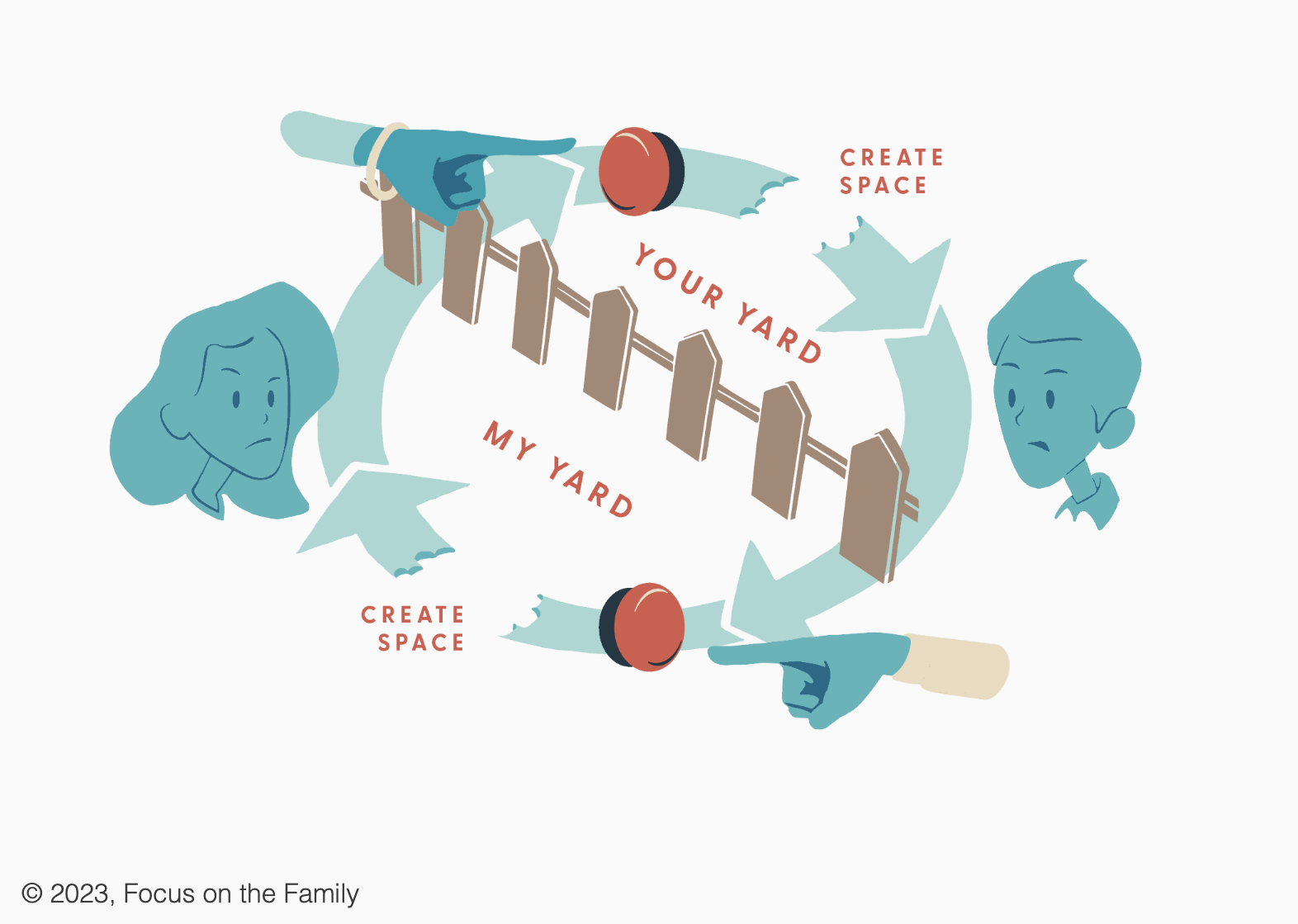
In Focus Marital Therapy, “create space” refers primarily to space between your emotional button and your reaction—so time, not necessarily physical space between spouses. © Focus on the Family.
That is a useful distinction as far as it goes. You are responsible for your own behavior, and you cannot make another adult behave differently.
But Paul’s framework tends to present the choice as:
- Try to control the other person, or
- Take responsibility for yourself.
There is a third option:
3. Change your exposure to the other person.
You may not be able to make another adult stop lying, cheating, drinking, threatening, exploiting, or abusing.
But you can decide how much access that person has to you, your children, your money, your home, your body, and your future.
You do not have to control someone’s behavior in order to evaluate it.
You do not have to remain exposed to destructive behavior merely because you cannot force the other person to change.
And you do not have to call your response a “button” when the danger is real.
But Hope Restored puts a limit on how far that third option can go
This is where the tension becomes especially important.
Restoring Hope acknowledges that some abusive situations may require physical separation. But Hope Restored is not designed to help a spouse decide that ending the marriage is the appropriate outcome.
The manual states that one of the primary questions asked of spouses seeking admission to a Hope Restored program is:
“If God were to perform a miracle in your marriage, would you be willing to accept it?” (p. 190)
And then it states plainly:
“To be accepted into an FMT program, the answer must be yes.” (p. 190)
The authors explain that helping a couple dissolve a marriage is “not an acceptable goal within the scope of FMT” and that spouses who have already decided to leave and who “reject the possibility of a miracle from God” are referred elsewhere (pp. 190–191).
And if someone arrives at Hope Restored but will not work toward its restoration objective, the manual says:
“therapy is respectfully terminated.” (p. 191)
The book even warns therapists that some clients may enter Hope Restored “under false pretenses and with a hidden agenda” (p. 191) when their actual goal—to make themselves and their children safe—does not match Hope Restored’s restoration goal.
So consider what this means inside the yard analogy.
Hope Restored tells you that you are responsible for protecting and caring for your own yard. Its own manual acknowledges that another person may tear up your yard and that abusive circumstances may require physical separation.
The Hope Restored Marriage Trap
If you finally conclude that the only way to protect your own yard—your life, your safety, or your children—is to divorce, Hope Restored draws the line there. Its manual says divorce assistance is outside the scope of FMT and that clients who will not continue pursuing restoration may have therapy “respectfully terminated” (pp. 190–191), even if there are biblical grounds for the divorce. Former participants have told me that when this happens, Hope Restored does not refund any portion of the thousands of dollars they paid.
So the message can become brutally contradictory: protect your own yard—but if protecting your life, your safety, or your children ultimately requires divorce, the program may end, your money may be gone, and your faith itself may be called into question because you are no longer willing to keep pursuing the “miracle” Hope Restored required you to say you were open to.
That can feel like being kicked while you are already down. A spouse who has finally concluded, I am not safe here anymore, may leave not only carrying the devastation of the marriage but also the insinuation that you came “under false pretenses” (p. 191) and that setting a permanent boundary reflects a failure of faith. And in a coercive or abusive marriage, that spiritual judgment can hand the destructive spouse one more weapon: See? Even the Christian marriage experts say you are the one who gave up on God.
But Jesus did not use God’s law to keep suffering people trapped. He announced freedom for captives, and when religious leaders objected that his acts of healing violated their understanding of God’s law, Jesus challenged their interpretation rather than abandoning the suffering person. In Luke 13, when he freed a woman who had been bound for eighteen years, the synagogue leader objected because Jesus had healed on the Sabbath. Jesus’ response was not to send the woman back into bondage in order to preserve the religious leader’s rule. He called her a “daughter of Abraham” and asked why she should not be “set free” from what had bound her.
That is an important biblical question for any Christian marriage ministry: when preserving the institution and freeing the suffering person come into conflict, whose burden gets heavier?
You may be told to protect your yard—right up until protecting it means permanently closing the gate.
The Reactive Cycle works only when there really is a mutual cycle
Later Robert Paul used a tug-of-war analogy to explain the Reactive Cycle.
He says the tug-of-war can continue only while both people are pulling. If either person lets go, the game is over. He applies that directly to marriage and tells therapists that one spouse can “single-handedly stop the cycle regardless of what their spouse does or doesn’t do.”
That makes sense if the problem really is a reciprocal argument.
But abuse is not a tug-of-war.
- A spouse can stop arguing and still be threatened.
- She can stop reacting and still be stalked.
- She can remain calm while money is stolen.
- She can use perfect communication while her spouse maintains an affair.
- She can regulate her nervous system while her children remain endangered.
- She can “drop the rope” and the other person can keep harming her anyway.
Stopping your participation in an interaction is not the same thing as stopping someone else’s unilateral harmful behavior.
That distinction is crucial.
Yet Paul presents the Reactive Cycle not as one useful lens among several, but as a near-universal explanation of conflict. In his 2026 AACC presentation he said they had found a model for “all conflict, period” and that when you find something that “applies to everybody,” you have something powerful.
This is very concerning.
A safety-first decision tree is needed first
This is the new step I believe Hope Restored needs before applying either the Reactive Cycle or the Care Cycle.
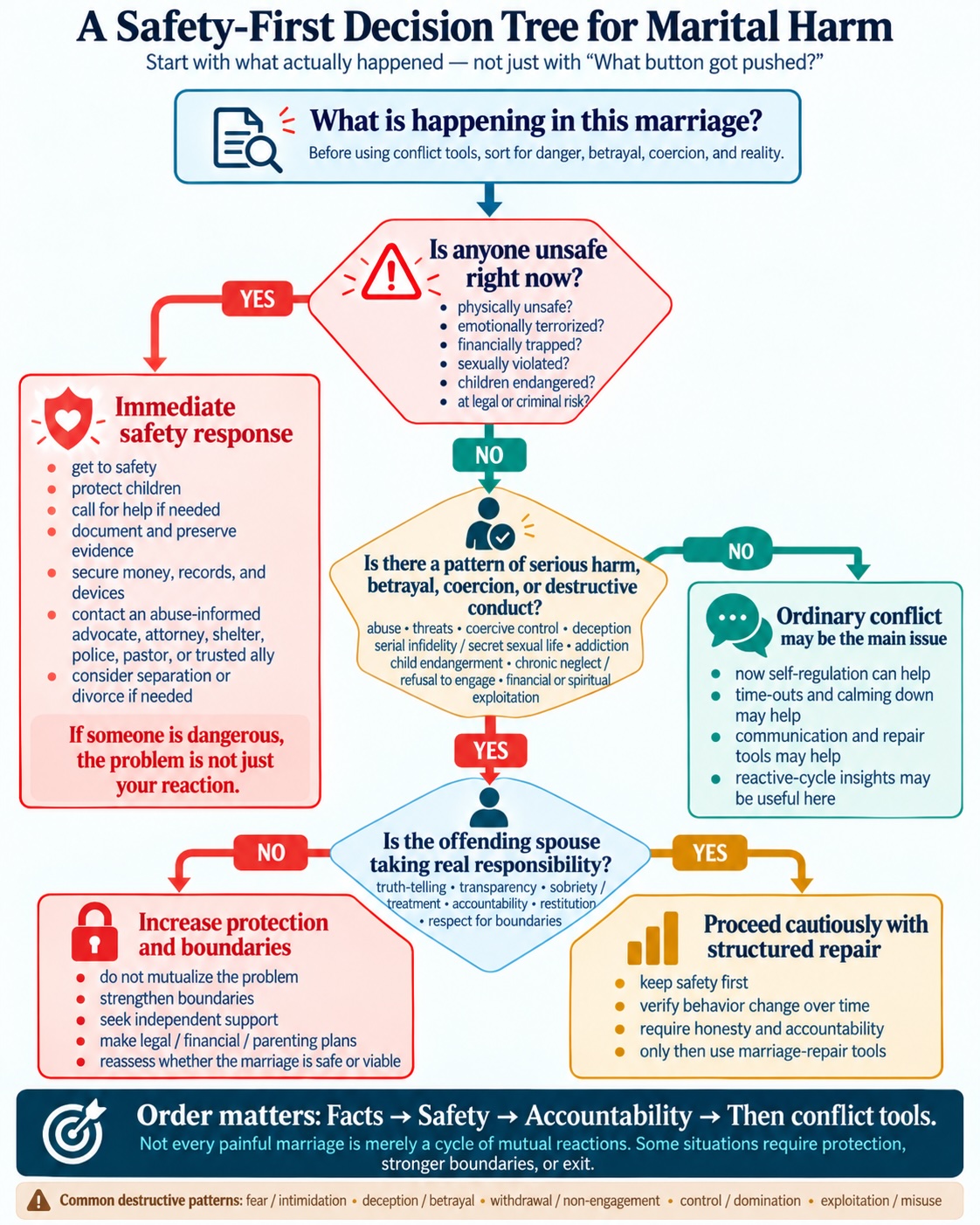
Before treating marital distress as a cycle of mutual reactions, first ask what actually happened, whether anyone is unsafe, and whether serious harm or betrayal is occurring. © Gretchen Baskerville
The first question should be:
What is actually happening in this marriage?
Then:
Is anyone unsafe right now?
And if no one is in immediate danger…
Is there nevertheless a pattern of serious harm, betrayal, coercion, deception, addiction, exploitation, or severe neglect?
Only when those questions have been answered should a therapist decide whether ordinary conflict tools are appropriate.
That matters because marital destruction does not always look like physical violence.
It may look like:
- chronic intimidation
- sexual betrayal
- a secret double life
- financial exploitation
- coercive control
- substance abuse
- dangerous compulsive behavior
- chronic deception
- severe neglect
- spiritual manipulation
- refusal to participate in the marriage
- child abuse or endangerment
Not every painful marriage is simply two wounded people pushing each other’s buttons.
Sometimes one spouse is doing something profoundly wrong.
Accountability has to come before reconciliation
If serious harm is present, the next question should not be:
How can both spouses stop reacting?
It should be:
Is the person doing the harm taking real responsibility?
That means more than saying the right words in an intensive.
Look for:
- truth-telling
- no blame-shifting
- transparency
- appropriate treatment
- sobriety where addiction is involved
- restitution
- respect for boundaries
- willingness to accept consequences
- observable behavior change over time
If those things are absent, the answer is not better couple communication.
The answer is stronger protection.
If they are genuinely present, structured repair may eventually be appropriate.
But safety and accountability come first.
So what would it take to make Hope Restored safer?
I would not throw out every part of the Focus Marital Therapy model.
Teaching people self-control is good.
Teaching emotional awareness is good.
Teaching people not to lash out when hurt is good.
Helping couples recognize ordinary patterns of defensiveness, withdrawal, criticism, and escalation can be very useful.
But those tools need guardrails.
At minimum, I would make these changes:
- Put a safety-and-integrity assessment before the Reactive Cycle.
First determine whether the couple is dealing with ordinary mutual conflict or serious asymmetric harm. - Stop treating “what the other spouse did” as a wasted conversation.
In a destructive marriage, those facts may be the most important information the therapist receives. - Distinguish old wounds from new injuries.
Sometimes a spouse merely touches an old bruise. Sometimes the spouse causes the bruise. - Do not automatically mutualize serious wrongdoing.
Abuse, coercion, betrayal, exploitation, addiction, and child endangerment are not simply two people participating in the same cycle. - Teach a third form of empowerment: changing exposure.
A client may not be able to control a spouse, but can change access, proximity, finances, contact, living arrangements, and legal relationship. - Make accountability measurable.
Reconciliation should depend on sustained truthfulness, safety, treatment, restitution, and behavioral change—not merely emotional connection during an intensive. - Allow safety to reach its logical conclusion.
If the well-being of the individual truly takes precedence over the marriage “without exception,” then separation and divorce must remain legitimate outcomes when serious harm continues.
People in Abusive Marriages Deserve an Apology
The Reactive Cycle starts with a button. A Safety-First Model starts with reality.
- What happened?
- Is anyone being harmed?
- Who is responsible for the harmful behavior?
- Is that person taking genuine responsibility?
- What boundary is necessary now?
Only after those questions are answered should therapists turn to ordinary conflict tools.
Because sometimes the central problem really is your reaction.
But sometimes the problem is not your reaction.
Sometimes the problem is what the other person is doing.
And a marriage ministry that works with couples in severe crisis has to be able to tell the difference.
And when couples do poorly after attending their program, the leadership at Hope Restored needs the self-awareness to say:
- “We misclassified abuse, perhaps because we considered it a ‘wasted conversation.’”
- “We pressured people to stay, because we didn’t allow them to change their exposure permanently.”
- “We encouraged vulnerability that was later weaponized, because we didn’t evaluate safety first.”
- “We failed to protect someone, because we focused too much on the couple’s cycle and not enough on the actual danger.”
- “Our model itself contributed to harm, because it treated serious wrongdoing as mutual reactivity instead of identifying who was doing what to whom.”
Other Christians Critique This Model Too
I’m not the only one criticizing this kind of model. Other Christian counselors and abuse experts do too.
They may not name Focus on the Family or Hope Restored directly, but they identify the same underlying method as potentially unsafe: treating abuse, coercive control, or serious unilateral wrongdoing as if it were simply a mutual relationship cycle.
- Leslie Vernick argues that abuse is not primarily a “marriage problem” but a problem of one person’s destructive behavior. She warns that ordinary couples counseling can shift attention toward the victim’s “role” in the problem rather than holding the abusive spouse responsible.
- Darby Strickland, a Christian counselor with CCEF, says abusive marriages require counselors to “shape the counseling process differently than typical marriage counseling.” In other words, abuse should not simply be run through a standard reciprocal-conflict model.
- Ironically, Focus on the Family itself publishes Strickland distinguishing ordinary “bad conflict” from emotional abuse. That distinction matters, because the Reactive Cycle broadly describes marital conflict as two spouses pushing each other’s emotional buttons and reacting.
- Marriage-and-family-therapy researchers have raised the same concern about systems models. A review of systemic treatment for intimate partner violence notes that therapists have been criticized for neglecting individual responsibility for perpetrating violence when they focus too heavily on the couple’s interactional pattern.
- The broader intimate-partner-violence literature also warns that couples therapy may be inappropriate or unsafe when coercive control or intimate terrorism is present.
So this is not simply my personal objection to Hope Restored.
There is also an interesting inconsistency in how Greg and Erin Smalley—prominent Focus on the Family marriage executive couple—appear to have handled their own daughter Taylor’s divorce.
Greg has described Taylor as fighting for the marriage, begging her husband to get help, and even offering Hope Restored—while her husband would not engage. He did not publicly analyze her “buttons,” reactions, or contribution to the cycle.
In other words, when it was their own daughter, the explanation did not sound much like the Reactive Cycle. It sounded like one spouse’s choices were the central problem. Learn more here: When Divorce Is Personal: What Greg Smalley’s Story Reveals About Church Double Standards
The broader criticism is well established.
Before treating a marriage as a mutual cycle, counselors must first determine whether the problem is actually mutual.
Recommended Reading
- Hope Restored’s Bait-and-Switch: Why Focus on the Family’s Marriage Intensives Disappoint
A closer look at the gap between what distressed spouses may expect from Hope Restored and what its marriage model actually emphasizes. - Will Focus on the Family’s Hope Restored Marriage Intensive Fix My Desperate Marriage?
An overview of Hope Restored for spouses dealing with abuse, deception, betrayal, or other serious marital problems. - Book Review: Restoring Hope by Robert S. Paul, Robert K. Burbee, and Christine A. Arnzen
A detailed review of the textbook that explains Focus Marital Therapy, the counseling model behind Hope Restored. - Hope Restored Marriage Intensive: Real Results From 44 Former Attendees
Results from my independent survey of former Hope Restored participants, including marital outcomes and whether they would recommend the program. - The Truth About Focus on the Family’s Hope Restored Study
A closer examination of the 2011 research frequently cited in support of Hope Restored’s success claims. - Will a Marriage Intensive Fix Your Marriage?
Independent survey findings from people who attended Christian marriage intensives and multi-day marriage retreats. - What Are Focus on the Family Donors Really Funding? An Investigation into Hope Restored and Abuse
An examination of how Focus on the Family responds to severe marital distress and what donors may not know about the system they are supporting. - Are Focus on the Family’s Hope Restored Marriage Intensive “Miracle” Claims True?
A review of Hope Restored’s success claims, its research evidence, and reports from past participants.
 :
:
 :
: Buy PDF