

The Truth About Focus on the Family’s “Hope Restored” Study: What the 2011 Research Really Says
Keywords: Hope Restored marriage intensive, Focus on the Family research, Robert S. Paul, Restoring Hope book, Christian counseling, faith-based therapy, marriage intensive, trauma-informed therapy
🧩 The Study Behind Hope Restored’s “Miracle” Claims
EDITED 6-2-2026: Hope Restored’s staff and marketing repeat the claim that 8-in-10 attendees of their $3,000-$6,000 program are still married two years later. But when asked for evidence of that, they point to a flawed 14-year-old study. In 2011, the leadership team of Focus on the Family’s Hope Restored marriage intensives—then called the National Institute of Marriage (NIM)—published what they described as a “research study” proving their program could save marriages in severe distress.
More than a decade later, those same numbers reappeared on Hope Restored’s website and at the 2025 AACC World Conference, where cofounder Robert S. Paul cited the study again as proof that couples spending thousands of dollars could expect miraculous results.
If you search online, you’ll find a free version of the study on The Free Library—but that version omits the abstract and Figure 1. The full text, published in the Journal of Psychology and Christianity (Vol. 30, No. 1), tells a different story. It may be obtained by contacting a Christian university library.
🔍 What the Study Actually Was
EDITED 6-2-2026: The so-called “study” was not independent research in any meaningful way. It was written entirely by NIM staff—Robert K. Burbee, Brett K. Sparks, Robert S. Paul, and Christine Arnzen—who were all paid staff of the program then, and most still are today. It doesn’t meet the standards of a mental health program survey.
They described Integrative Marital Intensive Therapy (IMIT), the forerunner of Hope Restored’s therapy model, as a blend of Christian theology and counseling. The article documents their own approach, their religious assumptions, and a set of self-reported follow-up surveys.
That’s not experimental research. It’s in-house marketing dressed up as science.
📉 Only About 20% of Participants Responded
The leadership team claimed they surveyed 1,043 couples (2,086 individuals) four times. Yet despite repeated requests, only a total of 426 individuals—roughly 20%—ever responded to any survey.
They reported their rate as “34.4%” by counting couples instead of people, which inflates the number. The rest—80% of participants—never replied. They bragged that 34.4% was a good response, but in reality, it appears they didn’t calculate it properly. They likely sent more than 8,000 emails (2,086 individuals x 4 email surveys) and got only about a 5% response.
The authors quietly admitted the bias of the handful of couples who did respond:
“This group likely contains more motivated former clients… however as a group they are assumed to be representative.” (Burbee et al., 2011, p. 45)
In real research, you can’t assume missing data means success. More likely, those who didn’t respond simply weren’t helped, or they separated or divorced.
📉 Only 84 of the 1,043 Couples Bothered to Respond to the 24-Month Survey
The claim that Hope Restored uses often on their website is that 8 in 10 couples were still married after 2 years. That claim rests entirely on this survey.
But hardly anyone responded to that survey. They admitted it, writing: “Unfortunately, not enough data was available to run a pre-post comparison at 12 months and 24 months.”
Fewer than 1 in 10 responded. When you include the 9-in-10 non-responders, the real picture looks like this:
-
-
At the 24-month survey, more than 9 in 10 couples (roughly 959 of the 1,043 couples) ignored the survey and did not respond.
-
Only 71 of the 84 couples who responded reported still married.
-
That’s 71 / 1,043 = 6.8% of all couples actually identified as still married two years later (not 84.5% of all attendees).
-
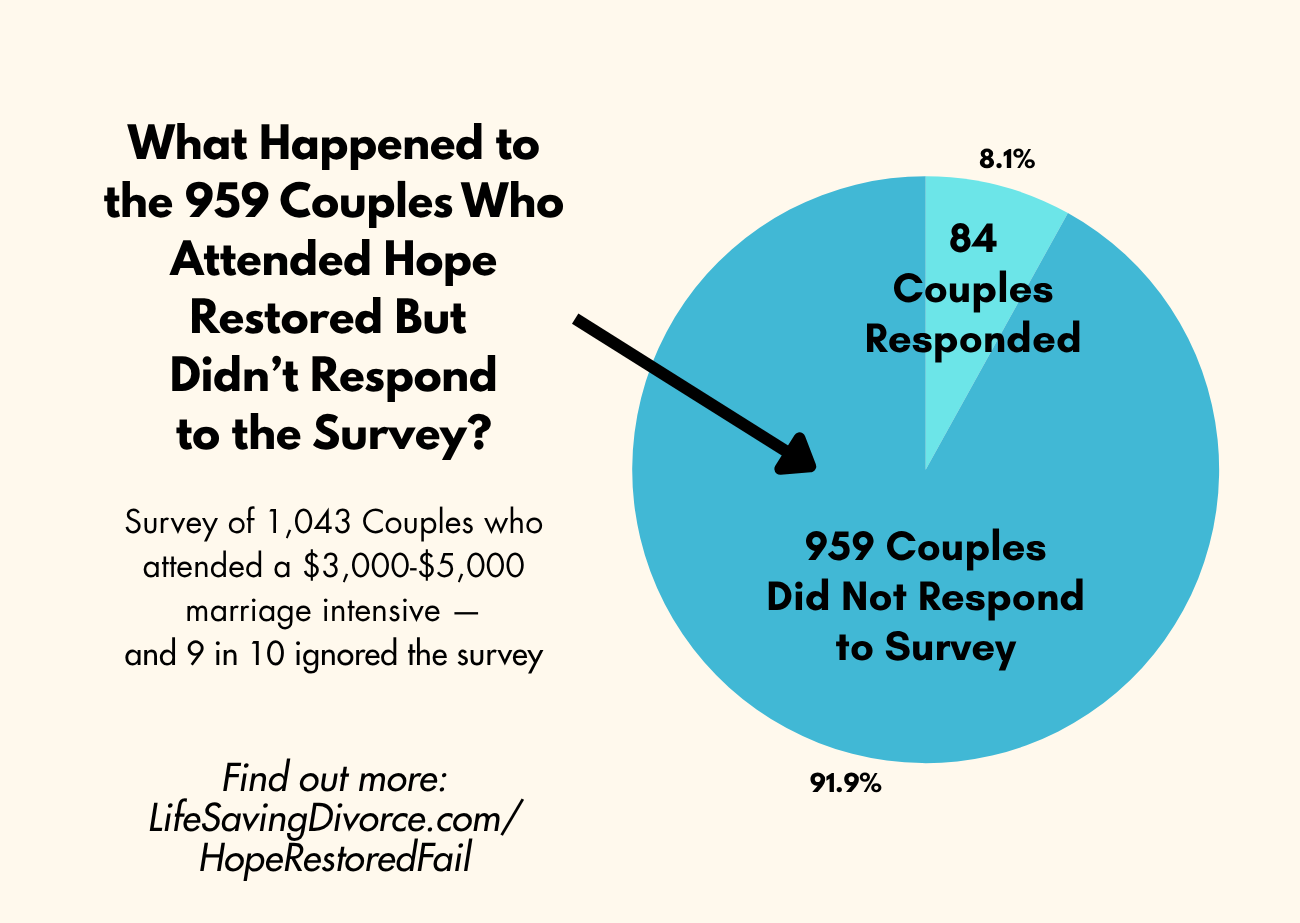
Of 1,043 couples who attended Hope Restored, only 84 responded to the two-year survey. No two-year outcome data was reported for the other 959 couples—91.9% of attendees.

Focus Is Still Paying to Advertise This Claim
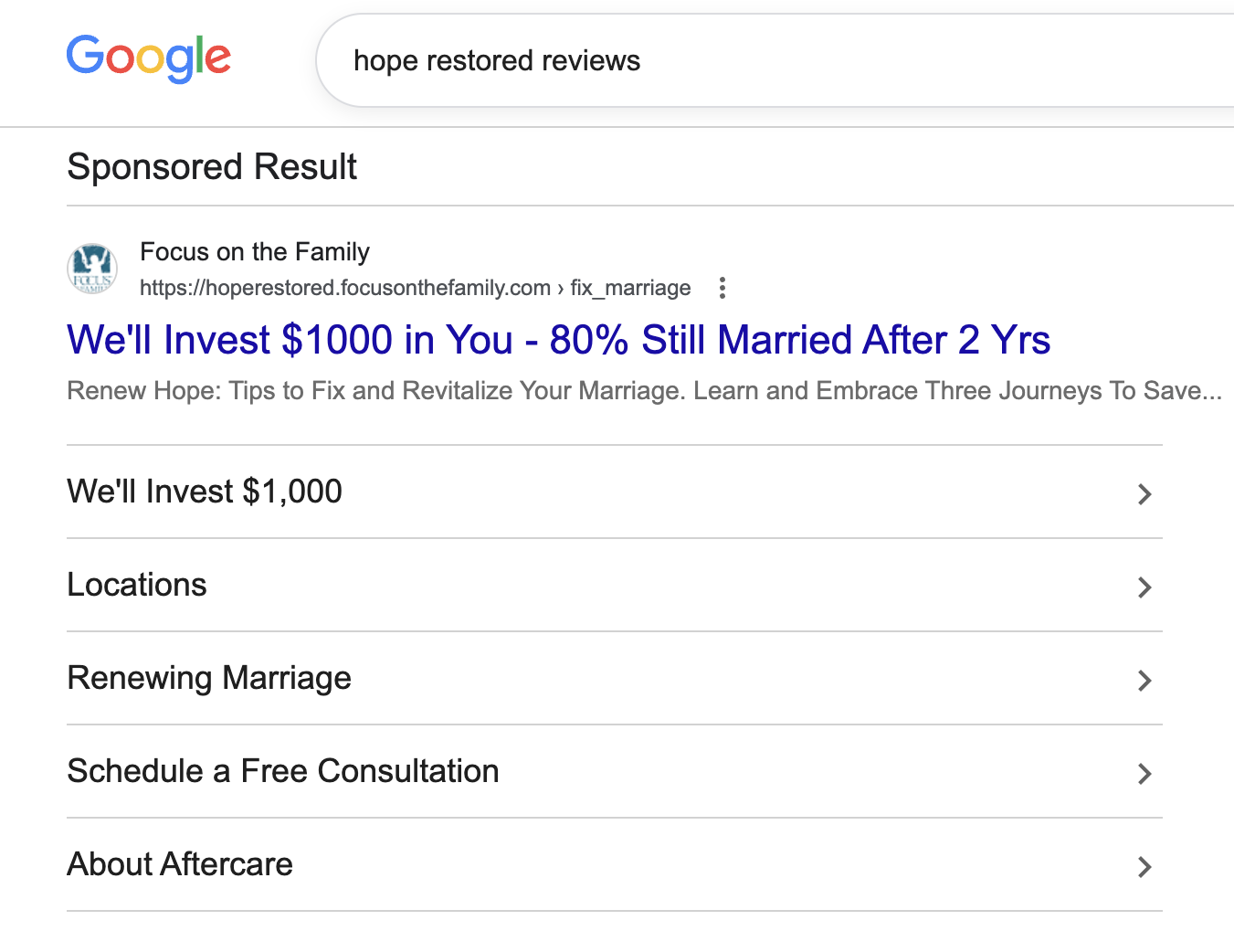
This figure is not merely sitting in an old study or being recycled in a fundraising letter. As of July 2026, Focus on the Family is paying Google to place it in front of people searching for “Hope Restored reviews.” The sponsored result announces: “80% Still Married After 2 Yrs.”
What the ad does not disclose is that only 84 of the 1,043 couples answered the two-year survey. Of those 84 responding couples, 71 said they were still married. There was no two-year outcome data for the other 959 couples.
Video Explanation of How Hope Restored’s Claims Were Calculated
The “miracle success rate” collapses when you do honest math. See my video explanation of Hope Restored Math Trick here:
⚠️ Acknowledged Conflicts of Interest
Every author worked for NIM (now Hope Restored) when the article was written. There was no independent oversight and no neutral reviewers.
They were evaluating—and promoting—their own product.
That’s not objectivity; that’s advertising.
📊 They Admitted It’s Not Empirical
“More work is needed for IMIT to fully establish itself as an empirically validated approach to marital therapy.” (p. 46)
Even the authors concede that IMIT (the Hope Restored model) has never been scientifically validated. Yet the organization continues to advertise it as research-based.
🙏 The “Miracle Question”: Faith as a Prerequisite for Acceptance, and Later, for Staying in the Program
Perhaps the most revealing line in the entire paper:
“Spouses are asked during the registration process, ‘If God were to perform a miracle in your marriage, would you be willing to accept it?’… It serves to identify individuals who really are not open to relationship recovery.” (p. 47)
This “miracle question” isn’t just an icebreaker—it’s a screening test for belief and for participation in the program. They admit they accepted couples on the basis of this question, even when there were serious issues (adultery, abuse, addictions) that professionally and ethically would require individual therapy rather than couples therapy.
Couples who were initially accepted and came to the retreat, and then later expressed doubt that God would fix their marriage, could be denied participation and be “terminated.”
This theology-based criterion later appears in Restoring Hope (2023), their official therapy manual, which instructs counselors to terminate clients who “no longer expect a miracle” or choose divorce in the middle of the program (p. 191, Restoring Hope).
📊 Those Who Didn’t Finish the Program Were Not Factored into the Outcomes
Couples who traveled to the intensive and started it but did not finish the program were excluded from the survey results.
As the authors state: “The National Institute of Marriage (NIM) has been collecting data for several years on participants who have completed their intensive marital therapy programs.”
That’s like a hospital that counts only patients who survive surgery and gives themselves a 100% success rate.
💔 Lacking Data, and Ignoring Negative or Harmful Outcomes
Buried in the fine print, the authors quietly admit that not enough people even returned the 12-month and 24-month surveys to analyze the data properly:
“Unfortunately, not enough data was available to run a pre-post comparison at 12 months and 24 months.” (Burbee et al., 2011, p. 45–46)
Not only did they lack data from more than 90% of participants at the 12-month and 24-month mark, they also didn’t track depression, safety, or trauma outcomes—despite participants beginning the intensive with moderate depression scores (BDI = 16.13).
That single sentence reveals the flaws in their long-term success claims. The so-called “two-year results” come from a tiny, self-selected fraction of couples—too few to draw any reliable conclusions.
In real research terms, that means the data after the six-month mark are statistically meaningless. The longer the follow-up period, the fewer couples responded, until the sample was too small to measure anything at all.
📋 Surveyed Before They Even Left the Building
Those glowing satisfaction numbers—94% “very satisfied” and 100% “would recommend”—came from a questionnaire at the completion of the intensive in 2007, not all participants in the 2004-2007 survey. (Burbee, Sparks, Paul, & Arnzen, 2011, p. 46). In other words, the data reflects the emotional high of the retreat setting itself and group conformity, not the long-term reality of couples’ marriages. Immediate exit surveys like these tend to capture gratitude, relief, and hope—natural emotions after several days of intensive attention—not evidence of lasting change. Once participants returned home to real life, no follow-up satisfaction data was ever published to show whether those good feelings held up. Attendees have reported that this was done before participants left the premises.
It’s not ethical to use survey responses from individuals in this situation.
💰 Expensive, Unproven
The authors themselves wrote that they were “pursuing plans to present these results in a formal research article for scholarly review.” (p. 45)
That was in 2011.
No such article ever appeared. It’s been 14 years.
Yet Focus on the Family still markets the Hope Restored intensives as “research-based” and “scientifically proven.”
🧠 Not Trauma-Informed or Safety-Oriented
The study states that couples with “recent reports of domestic violence” are advised to seek other services until “patterns of violence have subsided.” (p. 47)
There is no mention of safety planning, coercive control, or trauma response—just a hope that abuse has already stopped. Although the word “trauma” appears in their official manual several times, a truly trauma-informed manual would include clear guidance on safety planning, grounding skills, recognizing trauma triggers, supporting survivor autonomy, and informed consent—not just a hope that abuse has stopped.
That’s not trauma-informed practice; it’s risk avoidance.
🔄 Marathon-Style Therapy and High-Pressure Dynamics
The authors liken their format to “marathon group therapy” of the 1960s–70s, then concede:
“Some of these approaches… became viewed as intense or high-pressure, and NIM has taken pains to correct some of the abuses.” (p. 39)
This admission is revealing. They built their model on a format historically linked to emotional overload and group conformity—exactly the conditions where coercion and compliance pressure can thrive.
✝️ Faith Above Safety
From start to finish, IMIT fuses theology with therapy:
“The Christian faith is positioned as a viable and worthwhile option for informing and inspiring the personal transformation necessary to realize a fully recovered and satisfying marital relationship.” (p. 40)
Integrating Christian faith and prayer in marriage intensives—while enriching for participants—is not sufficient to ensure safety during or after the program. No doubt many of these participants have prayed for their marriages for years and have sought prayer from leaders in their church. Safety in counseling, especially for couples dealing with intimate partner violence, addiction, or severe mental health concerns, requires structural safeguards and trained clinical oversight.
⚖️ Violating Christian Counseling Ethics
Hope Restored explicitly targets conservative Christians and people of faith who believe divorce is never an option. Its research is written to reinforce that belief system, not to offer neutral, safety-oriented care.
Today, the National Institute of Marriage operates under the Focus on the Family umbrella (renamed Hope Restored). Focus on the Family’s public position is against divorce even in cases of pedophilia or domestic violence, and that stance shapes the counseling model itself.
Yet according to the American Association of Christian Counselors (AACC) Code of Ethics, Section 1-820, Christian counselors must not make sensational or unsubstantiated claims about therapeutic outcomes. Hope Restored’s marketing and its “miracle-based” model violate both the spirit and the letter of this standard—by:
-
Making miracle claims without empirical evidence
-
Using fear of divorce to motivate compliance
-
Shifting blame to participants when reconciliation fails
-
Omitting factual disclosures about success rates
Even within Christian professional ethics, these tactics are viewed as deceptive and manipulative, exploiting the faith and vulnerability of struggling couples instead of offering informed, transparent care.

Also important, from a digital marketing standpoint: although they mention a solid-sounding 34.4% “response rate,” it wasn’t per survey. It was a cumulative “ever responded” tally across four follow-up waves. On a per-email basis, the return was roughly 5% (426 individuals responded ÷ ~8,344 invitations)—not exactly a strong response.
🧾 Bottom Line
Focus on the Family’s Hope Restored program bases its miracle claims on a single internal survey written by its own staff—not independent research, never replicated, and never updated.
The paper itself admits it’s not validated science, yet it continues to be cited as proof that spending $6,000 and believing in a miracle will save your marriage.
That’s not research.
That’s religious marketing in academic disguise.

📉 Independent Survey Results Raise Serious Questions
In December 2023, I conducted an independent survey of 330 past participants from more than 50 Christian marriage intensives and retreats. Of those, 44 had attended Hope Restored between 2015 and 2023.
While the National Institute of Marriage (now Hope Restored) once claimed that “100% of participants would recommend the experience to a friend,” my survey results told a very different story.
Among those 44 Hope Restored alumni who reported their current marital status:
These self-reported numbers suggest that for roughly 7 in 10 couples, the program did not achieve lasting improvement.
While this survey was not a formal scientific study, the findings highlight the urgent need for independent, trauma-informed research into the real outcomes of faith-based marriage intensives like Hope Restored. I don’t think it will ever happen.
📚 For Further Reading
Here is my collection of articles examining Hope Restored marriage intensives, Focus on the Family’s teachings about divorce, and the LifeWay studies commissioned by Focus on the Family.
🔎 Hope Restored Marriage Intensives and Restoring Hope
- Are Focus On The Family’s Hope Restored Marriage Intensive Miracle Claims True?
https://lifesavingdivorce.com/fotfevidence/ - The Truth About Focus on the Family’s “Hope Restored” Study: What the 2011 Research Really Says
https://lifesavingdivorce.com/hoperestoredfail/ - Breaking: Hope Restored Marriage Intensive “Miracle Claims” Violate FTC Regulations
https://lifesavingdivorce.com/hoperestoredftc/ - Hope Restored Marriage Intensive: Real Results From 44 Former Attendees
https://lifesavingdivorce.com/hoperestoredattendees/ - Will a Marriage Intensive Fix Your Marriage? Independent Survey Findings
https://lifesavingdivorce.com/marriageintensives/ - Will a Hope Restored Marriage Intensive Fix My Desperate Marriage?
https://lifesavingdivorce.com/hoperestoredfix/ - Hope Restored: What Do They Teach About Kids and Divorce?
https://lifesavingdivorce.com/fotf-hope2/ - When Hope Restored Stops the Process: Why You Can’t Choose Divorce Inside the Focus on the Family Marriage Intensive
https://lifesavingdivorce.com/hoperestoreddivorce/ - Hope Restored or False Hope? Inside the Unverified Science of Focus on the Family’s Marriage Intensive
https://lifesavingdivorce.com/hoperestoredrealstory/ - When “Restoring Hope” Meant Losing Safety: Patricia’s Story and the Hidden Cost of Christian Marriage Therapy
https://lifesavingdivorce.com/hoperestoredpatricia/ - Book Review: Restoring Hope by Robert S. Paul, Robert K. Burbee, and Christine A. Arnzen
https://lifesavingdivorce.com/reviewrestoringhope/ - Don’t Sign a Vow Renewal at a Marriage Retreat
https://lifesavingdivorce.com/vowrenewal/
📊 LifeWay Studies Commissioned by Focus on the Family
- Pastors Need to Think Twice About Using Focus on the Family’s Marriage Ministry Materials
https://lifesavingdivorce.com/pastors-think-twice-focus-on-the-family-marriage-ministry/ - What the LifeWay Divorce Study Reveals—and Why Focus on the Family Isn’t Talking About It
https://lifesavingdivorce.com/lifeway-divorce-study-focus-on-the-family/ - Pastors and Christian Divorcees: What LifeWay’s Surveys Reveal About the Church-Divorce Gap
https://lifesavingdivorce.com/pastors-and-christian-divorcees-lifeway-surveys-church-divorce-gap/
📰 Focus on the Family Articles and Divorce Messaging
- Review: Focus on the Family’s “What To Do About Toxic Behavior in Marriage”
https://lifesavingdivorce.com/toxic-behavior-in-marriage-focus-on-the-family-review/ - Focus on the Family’s Dangerous Push to Make Divorce Harder for Abuse Victims
https://lifesavingdivorce.com/focus-on-the-family-no-fault-divorce-abuse-victims/ - Focus on the Family’s 3-Point Strategy That Traps Abused Christian Wives
https://lifesavingdivorce.com/focus-on-the-family-gaslighting-abused-wives/ - Focus on the Family Teaches Abusers How to Get Away With It
https://lifesavingdivorce.com/fotfvideo/ - 12 Facts About Divorce That Focus on the Family Doesn’t Tell You
https://lifesavingdivorce.com/fotf12/ - 15 Questions Before Divorce: What This Popular Christian Article Leaves Out
https://lifesavingdivorce.com/15-questions-couples-should-ask-divorce/ - 12 Half-Truths in Focus on the Family’s “How Could Divorce Affect My Kids?”
https://lifesavingdivorce.com/focus-on-the-family-divorce-kids-half-truths/
Citation for the 2011 study by the founders of Hope Restored (formerly known at the National Institute for Marriage).
| Burbee, Robert K.; Sparks, Brett K.; Robert S. Paul, Christine Arnzen. “Integrative marital intensive therapy: a strategy for marriages in severe distress.” The Free Library 22 March 2011. The full study is available at Christian university libraries. The abridged version from TheFreeLibrary is missing the abstract and Figure 1. |
 :
:
 :
: Buy PDF