
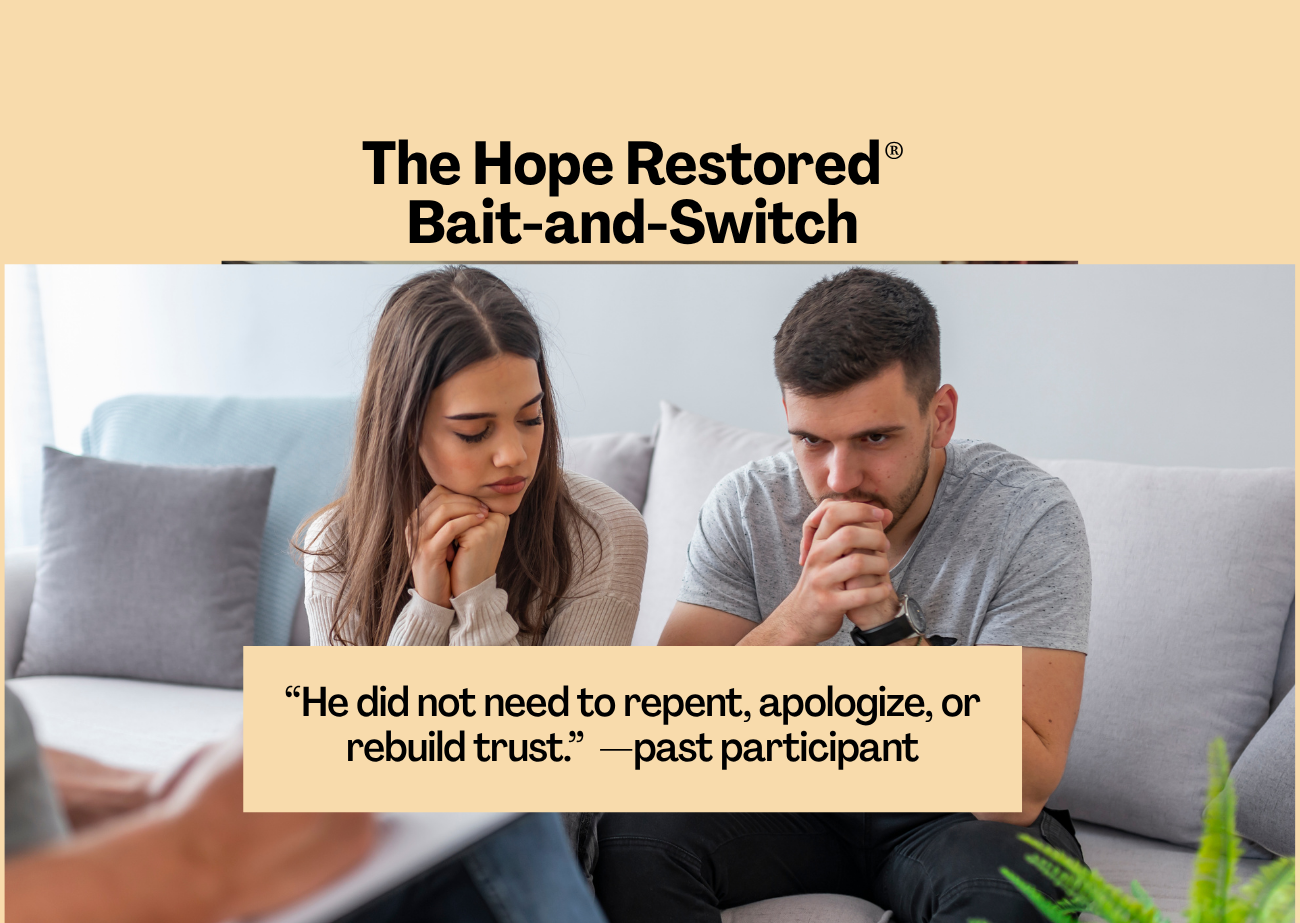
Hope Restored’s Bait-and-Switch
Why Focus on the Family’s Marriage Intensives Are So Disappointing
A couple signs up for a $3,000-$6,000 Hope Restored marriage intensive, often at the insistence of the wife (or husband or parents or pastor), hoping that their spouse will finally realize how much their behavior is hurting her/him, will admit their sin, will feel conviction, will be genuinely contrite, will fully apologize for years of destructive behavior, and will no longer abuse, cheat, be indifferent, or lie.
But Focus’s marriage model is not organized around identifying a destructive spouse or changing them (contrary to what their marketing website suggests).

Click to enlarge.
Focus’s model is organized around asking both spouses to identify their role in a destructive “reactive cycle”—getting each spouse to examine their own contribution to the cycle, regulate their reactions, restore safety, and move back toward connection. That framework is used with severely distressed couples whose marriages may involve affairs, substance abuse, or histories of physical, sexual, or emotional abuse. (See one woman’s 2026 story below.)
Once you understand this, it becomes easier to see why some Hope Restored participants leave so disappointed. They may arrive after years of prayer, desperate for a miracle—for the affair to stop, the addiction to end, the deception to cease, or a destructive spouse finally to change. Hope Restored itself requires participants to remain open to God performing a “miracle” in the marriage. Yet its professional manual then devotes pages to teaching therapists how to “reshape” the clients’ expectations.
The expectation that the program will “Change my spouse” is labeled as “unrealistic” and classified by Hope Restored leadership as a “nontherapeutic goal,” and even a spouse whose complaints are legitimate and obvious can be redirected away from the other spouse’s conduct and back to what FMT calls “their own yard.” We read this in Chapter 9 of their official marriage therapy manual. The program invites desperate couples to hope for transformation, then teaches them that the transformation they can responsibly pursue is primarily their own.
Participants who read pages 188 and 251-253 in the Restoring Hope manual before they arrive might know this, but otherwise the program does not introduce this diversion to clients before the start of the intensive. The architect of the program Robert Paul says he first wants to “establish some trust and some foundation with a client” before introducing what he calls this “exposure.” That matters.
Many past participants have told me that when they talked about the damage being done by abuse, cheating, or addictions, the conversation was directed back to self-examination.
And that actually highlights the larger problem. Hope Restored simultaneously uses powerful language about miracles, restoration, healing, rebuilding trust, and saving marriages. A desperate spouse can understandably hear all of that and believe: Maybe this is where my spouse will finally face what they have done and truly change.
Of course, both husbands and wives need some introspection and basic communication skills to counteract any excessive irritability, negativity, blame-shifting, and unhealthy reactions. But in my experience, many wives in destructive marriages don’t need another lesson in “working on themselves.” They’ve been doing that for years. They’ve turned themselves inside out to be nicer, more loving, more forgiving, more sexually available, and more compliant.
The problem is often under-reaction after years of being taught to trivialize and mutualize abuse.
If you want to save $3,000-$6,000, look at their publicly available worksheets on “working on your own yard” and the Reactive Cycle on their website. You can view and download them. Most of it is key to what you’ll get at Hope Restored. Links to those worksheets and an explanation. Even today, the leadership claims that it is a “conceptual foundation” of their program. Some former Hope Restored attendees have told me that although their marriages did not improve, and they are divorced or separated now, they still found some of those tools useful in their work or social lives. But I doubt many couples would have paid $4,000+ for a marriage intensive if what they expected was primarily communication training.
Is it “Button Pushing” or Serious Sin?
There’s a problem with describing serious marital wrongdoing as “pushing your buttons.” We normally use that phrase for behavior that irritates, annoys, or provokes someone—a spouse who knows exactly what to say to get under your skin, for example.
But cheating on your spouse is not merely “pushing a button.” Neither are abuse, chronic deception, coercive control, or other grave violations of the marriage covenant. Describing a serious offense this way can subtly shift our attention away from the wrongdoing and onto the injured spouse’s emotional response, as though the real problem is that they are too easily triggered.
There is an important moral difference between peevish irritation and righteous indignation. Anger, grief, and outrage can be entirely appropriate responses when someone has been profoundly betrayed. We should be careful not to use therapeutic-sounding language that trivializes the offense while pathologizing the pain it caused.
One of the principle architects of the Focus Marital Therapy manual and Hope Restored program, Robert S. Paul, spoke at the September 2026 AACC conference. He told the audience that he had served as a Focus vice president for eleven years. And he vigorously defends the Reactive Cycle model today.
He made it clear that the Reactive Cycle is not a minor exercise buried inside Hope Restored—it is part of the program’s basic way of understanding marital distress. He claims in the Focus on the Family therapy manual, which he authored, that it provides a “conceptual foundation,” and that Hope Restored Marriage Intensives “always” create and display this cycle map. —Restoring Hope, p. 238.
He described the Reactive Cycle as a model for “all conflict, period,” said it “applies to everybody,” and taught that the cycle can continue only while both spouses are reacting—meaning one spouse can supposedly stop it regardless of what the other does.
Self-examination can be useful when two basically safe spouses who deeply care about each other really are caught in a mutual pattern. But when one spouse has a pattern of abusing, coercing, deceiving, cheating, or intimidating the other, the model can transform unilateral wrongdoing into a shared relationship problem.
The contrast is very clear:
offender-centered question: Who is doing what to whom?
versus
cycle-centered question: What are these two people doing to each other?
Hope Restored centers the second question.
If a wife brings up her husband’s abuse or cheating, the Robert Paul’s FMT manual explicitly instructs therapists to “adjust” or reshape some of the very expectations they brought with them. Much of Chapter 9 teaches therapists how to do this. During orientation, therapists hear each spouse’s hopes and goals, then “add form and shape” to those expectations, including the need “to adjust unrealistic or even nontherapeutic agendas.” —Restoring Hope, p. 255.
Hope Restored asks people to come believing in a miracle, then spends considerable therapeutic effort teaching them not to define that miracle as the destructive spouse actually changing.
One woman who attended in 2026 contacted me. She had seen the promises on Hope Restored’s website (quotes from the site, as of 9/26/2026):
“…this retreat center combines privacy, comfort, and compassionate care from licensed therapists who specialize in marriage restoration.”
“…a serene natural setting—ideal for reflection, reconnection, and healing guided by licensed therapists who care deeply about your marriage.”
“…this marriage center offers space for meaningful conversation, spiritual reflection, and renewed connection…”
Naturally, she thought that having caring licensed Christian therapists would make a difference, and that reflection and reconnection would improve her marriage. She believed that she and her husband would have meaningful interactions and a renewed connection.
But, like so many others, she walked away disappointed by the program.
My husband cheated on me. Hope Restored never wanted to address the infidelity…They said he was not responsible to apologize or fix the marriage. It was his personal responsibility to discover his own feelings. It was my personal responsibility to understand my feelings and get healing solely from God and healing in the marriage, which did not include any actions on my husband’s part. He did not need to repent, apologize to me, learn to build trust, etc. It was a bizarre experience.
That gap between what desperate Christian couples understandably think “marriage healing” means, what the Hope Restored website claims, and what FMT defines as appropriate therapeutic work may explain a great deal of the disappointment I hear from past participants over and over.
When adultery, abuse, addiction, abandonment, chronic deception, or coercive control are reframed as “pushing your buttons” or as part of a mutual “Reactive Cycle,” the seriousness of the wrongdoing can disappear from view. The wife’s grief, anger, fear, or outrage can then be treated as part of the marital problem rather than as an understandable response to being seriously harmed.
That is not a small distinction. Trivializing grave marital offenses does not help an injured spouse see reality more clearly. It can do the opposite: cause her to question whether the betrayal was really that serious, whether her reaction is the real problem, and whether she simply needs to regulate herself better and “work on her own yard.” In practice, that can become a form of gaslighting—obscuring what actually happened and pressuring the injured spouse to doubt her own moral judgment and lived experience.
A wife whose husband is cheating, abusing, addicted, or abandoning his responsibilities does not primarily need someone to teach her how not to react. She needs truth. She needs the wrongdoing named accurately. She needs to know that repentance, accountability, restitution, safety, and changed behavior matter.
Anything less risks deceiving her about the nature of the problem rather than helping her solve it.
That is a far cry from the “miracle” language used in Hope Restored’s marketing.
About me: I’m an active devout Evangelical Christian who gives, volunteers, and serves. I started leading divorce recovery groups in conservative churches in 1998. I’ve donated thousands of dollars to Focus on the Family, listened to its broadcasts since the 1980s, subscribed to its magazines, bought its books, and sent my children on their Brio overseas mission trips. My criticism is focused specifically on Focus on the Family’s teaching and materials about abuse, divorce, and marriage crisis—not its work on adoption, foster care, or other topics.
Here’s a Humorous Short Parody about Hope Restored Telling Abuse Victims to Just “Work on Your Own Yard.”
 :

 :
 Buy PDF