Why Focus on the Family’s Marriage Advice Fails When One Spouse Really Is the Problem
The Problem with the Reactive Cycle (Formerly Called the Fear Cycle or Fear Dance)
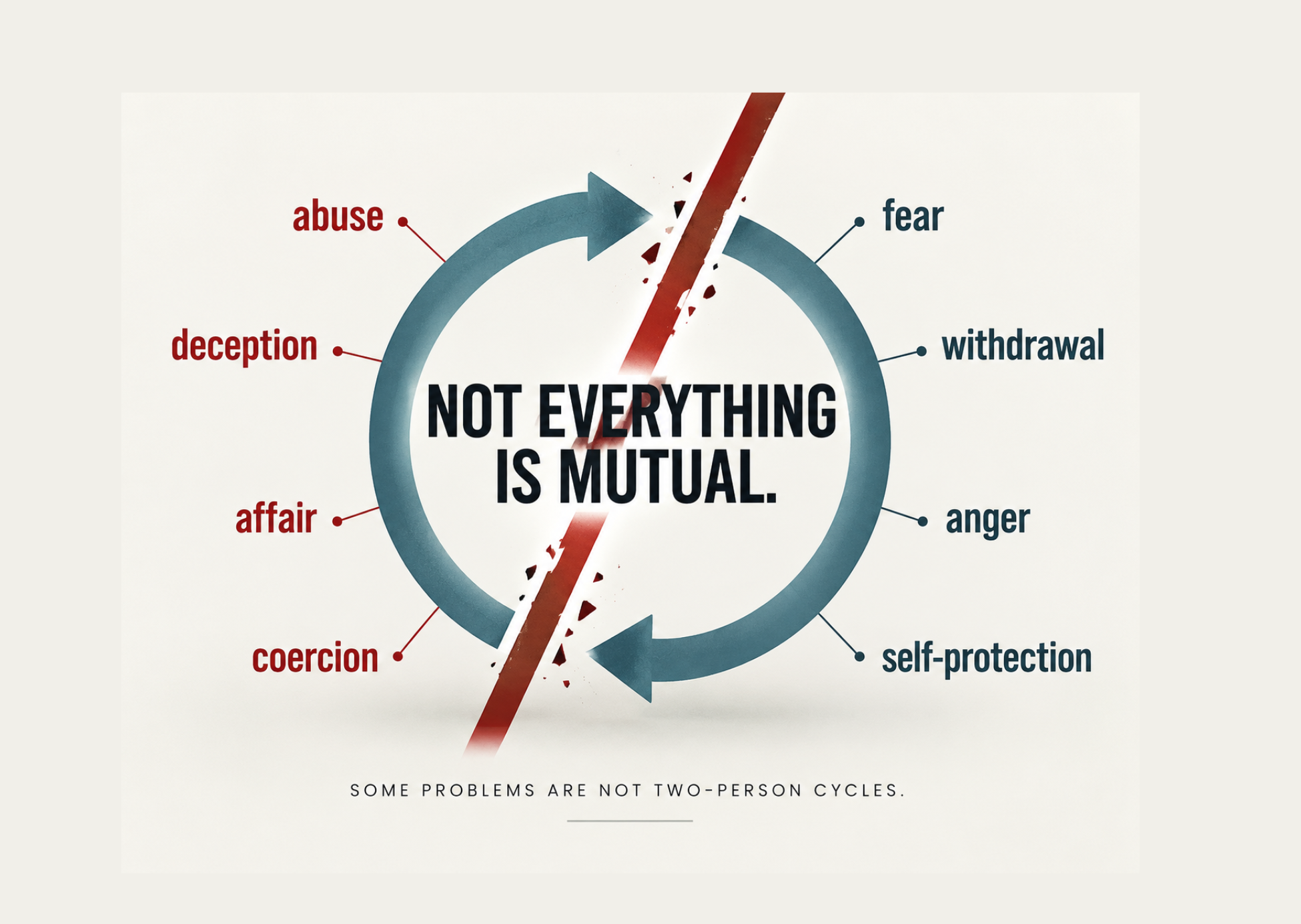
Infidelity, deception, pedophilia, addictions, and domestic abuse are not 50/50 marriage problems. Yet Focus on the Family has long taught a marriage model that can make the victim responsible for “participating” in the very cycle created by the other spouse’s misconduct.
That sounds like a harsh accusation.
Then I started reading Focus on the Family’s own materials—not just broadcast interviews, but the marriage books, participant manuals, worksheets, and professional training materials that have shaped its marriage ministry over decades.
And a pattern became hard to miss.
Table of Contents
- Why the Reactive Cycle can become victim-blaming
- What Focus’s pedophilia article reveals
- What changed in the 1990s and 2000s?
- Pastor Gary Smalley’s influence grows
- 1999: Smalley’s teaching enters marriage intensives and Conflict Becomes a ‘Negative Situation’ and a Fear Problem.
- 2011: Greg Smalley directs Focus’s marriage efforts
- 2013: Focus teaches the Fear Cycle
- 2014: The model becomes part of Focus
- What actually changed?
- Why the problem is systemic—and still taught today
- Unsafe teachings on Focus’s website today
- Focus doesn’t clearly define abuse vs. ordinary conflict
- Robert Paul’s own marriage story challenges the Reactive Cycle theory
- The Reactive Cycle worksheet and its abuse problem
- Odd ways Focus on the Family treats abuse
To be fair, Focus has interviewed guests such as Leslie Vernick, Darby Strickland, Keri Stageberg, and Karen DeArmond Gardner, and a handful of others who take abuse seriously and do not treat the victim as equally responsible for an abuser’s conduct.
But that is not the same thing as asking what Focus’s own marriage model and publishing program teaches.
The Reactive Cycle can mutualize responsibility
In marriage ministry materials produced by Focus staff and the clinicians who developed Hope Restored, couples are repeatedly taught that marital distress comes from both spouses “contributing” to a reciprocal Fear Cycle (now called the Reactive Cycle): one spouse’s emotional “button” gets pushed, that spouse reacts, the reaction pushes the other spouse’s button, and the process continues.
This mutualizes the responsibility—makes both people share the blame for marital problems—even in cases where only one spouse is cheating, abusing, intoxicated, or lying. (For other odd ways Focus on the Family deals with abuse, see the box at the end of the article.)
Shockingly, even in the case of pedophilia, cheating, abuse, deception, swindling. or criminal behavior, their counseling approach makes little or no exceptions.

Caption: The Reactive Cycle (formerly known as the Fear Cycle) as presented in Restoring Hope (Robert S. Paul, Robert K. Burbee, and Christine A. Arnzen, 2023, p. 83). The model depicts one spouse’s “buttons” and reactions triggering the other spouse’s buttons and reactions in a continuous loop. Used here for criticism and commentary.
The 2013 Hope Restored participant manual puts it plainly:
“No one person is to blame for a fear cycle, both partners contribute to the lack of relational safety.”
—Hope Restored Participant Manual, p. 19
The same manual tells couples that questions such as “Who’s at fault?” and even “What really happened?” can lead to greater blame and reactivity, and directs them instead toward examining their own fears and reactions. —p. 42.
Five years later, a 2018 Focus on the Family Reactive Cycle worksheet still placed very different kinds of behavior into the same category of “reactions”: defensiveness, withdrawal and sarcasm appear alongside extramarital affairs, drug or alcohol abuse, manipulation, rage, and becoming physically aggressive or “possibly abusive.”
That is the problem.
The model can mutualize responsibility in situations that are not mutual.
There are marriages in which both spouses are immature people who really are caught in a destructive feedback loop. But there are also marriages in which one spouse is lying, cheating, abusing, exploiting, stealing, coercing, or committing criminal acts and the other spouse is reacting to what is actually happening.
Those are not the same kind of problem.
A cycle asks, “What are we doing to each other?”
That question assumes some degree of mutuality.
Abuse asks, “What is one person doing to the other?”
That question examines power, conduct, coercion, and responsibility.
When the first question is asked before the second, the victim’s fear, anger, withdrawal, or resistance can become part of the supposed “cycle.” The abuser’s conduct is then interpreted as one reaction among two rather than first being evaluated on its own terms.
That is how a marriage model can become victim-blaming even when its authors sincerely oppose abuse.
And Focus’s own materials contain an important contradiction. The 2013 manual briefly says it does not recommend remaining in a “dangerously abusive situation,” and its later professional manual gives much more serious warnings about abusive dynamics.
But the central teaching still returns to the same reciprocal structure:
your buttons → your reactions → your spouse’s buttons → your spouse’s reactions.
The exception says, abuse can be different.
The model says, both of you are participating.
The critical question is what happens when those two teachings collide in an actual counseling room.
It wasn’t always this way. Focus on the Family’s early material often taught that one spouse might be the problem.
Then I started reading Focus on the Family’s marriage materials across the decades—from James Dobson’s early books to the later Gary Smalley-Robert Paul materials that eventually became central to Focus on the Family’s marriage material for churches and Hope Restored—and something unexpected became clear: Focus has not always understood troubled marriages in the same way.
In earlier marriage material from the 1970s and early 1980s, one spouse might behave badly enough to be considered the problem.
But later material changed this.
Even Child Sexual Abuse Doesn’t Entirely Escape the Relational Lens
Today, even child sexual abuse does not entirely escape Focus on the Family’s tendency to turn unilateral criminal behavior into a “relational problem.” In a Focus article responding to a woman whose husband was sexually abusing their six-year-old niece, Focus correctly tells her that she is not responsible for his guilt, that the child must be protected, and that the abuse must be reported.
But then the article makes an extraordinary, unsupported claim: sexual abusers “tend to marry someone who has also been sexually broken.” Nothing in the woman’s letter suggests that she is sexually broken.
The husband sexually abuses a six-year-old child, and somehow the clinical lens still swings around to ask what might be broken in his wife. Focus provides no evidence for that extraordinary generalization.
This is the same instinct that appears in Focus’s marriage-cycle teaching: when one spouse does something profoundly wrong, the framework has difficulty leaving responsibility located entirely with that person’s conduct. It searches for the other spouse’s wounds, fears, reactions, or contribution.
What is especially revealing is the contradiction inside the child sexual abuse article
Focus actually demonstrates that it knows how to identify and describe a predator.
It says perpetrators can be:
seductive, manipulative, highly controlling, deceptive, and skilled at persuading people to doubt themselves.
That’s a completely different anthropology from:
Two hurting people are pushing each other’s buttons because both ultimately want safe intimacy.
In their pedophilia article, Focus understands that some people use relationships transactionally and for dominance or deception. They manipulate. They conceal. They control. They groom. They create a secret double life.
So FOTF has the conceptual vocabulary.
And yet almost immediately they introduce the notion that the offender probably married another sexually “broken” person.
That is worth highlighting:
Focus can recognize a predator—and still feel compelled to locate complementary brokenness in the predator’s wife.
What Changed in the 1990s and 2000s?
Focus on the Family did not always describe serious marital problems primarily as a two-person cycle.
In the 1970s, the founder of Focus on the Family, Dr. James Dobson, had plenty of marriage teaching I disagree with. He was intensely committed to preserving marriage at almost all cost, a view that could make a life-saving divorce extraordinarily difficult to contemplate. Dobson even claimed that some women deliberately provoke their husbands into beating them—suggesting that the resulting bruises could give the wife a moral or legal advantage. So I am not suggesting that his marriage advice should become the new model for abuse counseling.
But Dobson did have something that becomes much harder to see in the later Focus material:
He had a category for an offending spouse.
Dobson was writing about marriage long before the “Gary Smalley & Robert Paul model” existed. His 1975 book What Wives Wish Their Husbands Knew About Women addressed barriers to marital harmony and the emotional experiences of wives.
More important for this discussion was his 1983 book Love Must Be Tough.
The original description is surprisingly blunt. It says Dobson addresses serious marital crises involving infidelity, alcoholism, wife beating, and emotional indifference. And another description of the same book says Dobson believed the source of marital “separateness” was “usually only one partner.”
Read that again.
“Usually only one partner.”
That is almost the opposite of:
“No one person is to blame for a fear cycle, both partners contribute.”
Dobson’s framework could begin with the possibility that one spouse was cheating, drinking, beating his wife, emotionally abandoning the marriage, or refusing to cooperate—and that the other spouse’s problem was figuring out what to do about it.
He called the other person the “offending partner.”
That language has its own problems. But at least it preserves a basic moral distinction:
One person can do something wrong to another person.
The innocent spouse may panic, may appease, may make poor decisions in response. The innocent spouse may desperately try to save the marriage.
But that innocent spouse’s reaction does not turn the original wrongdoing into a 50/50 problem.
Pastor Gary Smalley’s popular advice gets attention
Gary Smalley was not a stranger to Dobson-era Focus. By 1988, Focus on the Family Publishing was publishing Pastor Smalley’s The Language of Love, a book centered on communication, intimacy, and understanding.
Gary Smalley was a hugely popular Christian pastor and relationship author, but I cannot find any evidence that Gary Smalley was ever licensed as an LMFT/MFT, MFCC, LCSW/MSW, LPC, or psychologist. His Masters was an M.Div in theology and he had no relevant degrees in counseling, therapy, or even social work. The doctoral titles he used were honorary, not earned doctorates in psychology or counseling. Like Gary Chapman, author of the Five Love Languages, Gary Smalley was a popular speaker and author, but not a licensed counselor.
So this was not a sudden takeover in which Dobson left one day and the Smalleys arrived the next.
The two streams overlapped for years.
But they were not identical.
Dobson’s crisis-marriage framework could ask: What is the offending spouse doing?
The Smalley-Paul framework increasingly asked: What is the cycle between these two people?
That sounds like a small shift.
It isn’t.
Gary Smalley’s own late-life reflections help show why. In a disturbing interview near the end of his life, Smalley openly described ways he had repeatedly hurt his wife—putting work, ministry, and other activities ahead of her, lecturing her about biblical submission, becoming angry, and withdrawing. Norma Smalley said they had never had an argument during four years of dating, yet just three days after returning from their honeymoon, she was sobbing and thinking, “What have I gotten into?” She had discovered that the man she married was very different from the husband she thought she was getting. But divorce was effectively off the table.
(Many abuse survivors recognize this pattern immediately: a startling personality shift after the wedding takes place—sometimes beginning on the honeymoon itself.)
Yet he still ended the interview by assigning women special responsibility for “regulat[ing] how warm the relationship really is” and suggesting that an angry woman may need to forgive before her judgment about the relationship can be trusted.
In other words, the wife is given extraordinary responsibility for the health of the relationship, while her anger at mistreatment can itself become evidence that her perception is unreliable.
That assumption matters when marriage advice becomes marriage therapy.
1999: Gary Smalley’s teaching gets turned into a marriage intensive model
The history is laid out in the 2023 book Restoring Hope, describing the Focus Marital Therapy model, and published by Focus on the Family. It is very clear.
Greg Smalley had been working near his father Gary’s ministry.
According to the Restoring Hope book, people who encountered Gary’s books, videos, and conferences frequently wanted more direct help applying the material.
Greg learned that Robert Paul had experience with intensive therapy. He then asked Paul whether he could adapt intensive treatment for married couples while “weaving in some of Gary’s teaching and principles.”
That was in the summer of 1999.
This is an important moment.
Gary Smalley’s wife-blaming relationship teaching was no longer simply being sold as popular Christian marriage advice.
It was beginning to be incorporated into an intensive therapeutic model for couples in severe distress.
The distinction matters because the stakes change dramatically when a teaching designed to help ordinary couples communicate better is applied to couples in serious crisis.
“Look at how your behavior affects your spouse” is perfectly reasonable marriage advice.
It becomes something very different when one spouse is violent, hostile, irresponsible, drunk, or unfaithful.
2004: Conflict Becomes a ‘Negative Situation’ and a Fear Problem.
The developing model’s first major publication, according to Restoring Hope, was The DNA of Relationships by Gary Smalley, sons Greg Smalley and Michael Smalley, and Robert Paul. It was followed in 2006 by The DNA of Relationships for Couples by Greg Smalley and Robert Paul.
This is where the ideas that would eventually become the Hope Restored marriage intensive become easier to recognize:
- fear
- emotional buttons
- reactions
- safety
- openness
- intimacy
- personal responsibility
and the idea that each person’s defensive behavior triggers the other person’s wounds.

p 60 The DNA of Relationships by Gary Smalley, Dr. Greg Smalley, Michael Smalley, and Robert S. Paul
But the 2004 book goes even further. It tells readers outright that “the external problem is rarely the problem,” that “the core problem is our fear,” and that healthier relationships begin by understanding that “the other person isn’t the problem.” (DNA of Relationships, p 60)
That is a revealing assumption. Before the model has established what actually happened, it shifts attention away from conduct and toward each person’s internal fear and reaction.
That may be useful when two basically safe, honest people are fighting over money, chores, or misunderstandings.
But sometimes the external problem is the problem.
The affair is the problem.
The strangulation is the problem.
The hidden addiction is the problem.
The stolen money is the problem.
The child sexual abuse is the problem.
And sometimes the other person’s conduct really is the central problem.
A model that begins by telling people that “the other person isn’t the problem” risks obscuring the very thing a frightened spouse most needs help identifying: What is this person actually doing?
For a fuller look at why this matters, see What Would It Take to Make Hope Restored Safe?, where I examine how Hope Restored’s Reactive Cycle can redirect attention away from abuse, betrayal, coercion, addiction, deception, and other serious harm—and what a truly safety-first model would require.

From The DNA of Relationships (2004), p. 197. Notice how the exercise begins by defining conflict as a “conflict, argument, or negative situation,” then immediately directs the reader inward: What did it make you feel? What fear did it trigger? The worksheet never first asks the more basic question: “What actually happened?”
The worksheet itself actually says:
“Identify a recent conflict, argument, or negative situation … something that really ‘pushed your buttons’ or upset you.” It then asks readers to identify their feelings and finally, “How did this conflict make you feel about yourself?”
That framing matters. Conflict is treated primarily as a negative emotional experience that reveals something about your own fears, rather than as information that might reveal something important about the other person, their choices, and their character. Sometimes conflict does educate us. It can reveal deception, entitlement, coercion, addiction, infidelity, dangerous anger, incompatible values, or a spouse’s refusal to take responsibility. Before asking, “What fear did this trigger in me?” a sound marriage model should first ask: “What happened, and what does it tell us?”
The basic idea is compassionate:
People hurt each other because they are hurting.
But compassion becomes dangerous when it turns into a universal explanation.
Sometimes people hurt others because they are frightened.
Sometimes they hurt others because hurting or controlling the other person gets them what they want.
Those require different responses.
2011: The son, Dr. Greg Smalley, is put in charge of Focus’s marriage direction.
Then the relationship became institutional.
By 1999, son Greg Smalley had earned a Psy.D. in clinical psychology from Biola University’s Rosemead School of Psychology.
Restoring Hope says that in 2011, Focus president Jim Daly asked Greg Smalley to bring “direction and vision” to Focus on the Family’s marriage efforts. Greg developed a strategy organized around preparing marriages, strengthening marriages, and saving marriages in crisis.
The book makes another revealing point: Focus already had what it calls a long and rich history of preparing and strengthening marriages.
What it lacked was substantial direct work with couples in crisis.
That was the gap Greg Smalley wanted to fill.
And the program he had previously developed with Robert Paul, M.S., LPC, was sitting right there.
That means the Smalley-Paul model did not merely add another book to Focus’s bookstore.
It increasingly became Focus’s answer to the question:
What do we do with marriages that are falling apart?
Robert Paul and other staff members published an outcome study that appeared (on the surface) to be 84% successful, but the authors acknowledged major limitations and said more rigorous research was still needed. Fifteen years later, as of this writing, that more rigorous follow-up research has still not been published. And there are many stories coming out from couples whose abusive or demeaning marriages did not improve through the program, including one story of a victim of felony-level violence being sent home at the end of the program three times with no meaningful safety plan. There’s also been an independent study of past participants, the majority of whom reported later separating or divorcing, that casts doubt on the success claims.
2013: The Fear Cycle (Reactive Cycle) is already being taught to Focus couples
By 2013, Focus’s own Hope Restored participant manual was teaching the model explicitly.
The manual is copyrighted by Focus on the Family and identifies Robert Paul, Greg Smalley, Robert Burbee, Christine Arnzen, and others as contributors to the relationship-recovery model.
The manual teaches the Fear Cycle (later renamed the Reactive Cycle)
A husband’s fear gets triggered.
He reacts.
His reaction triggers his wife’s fear.
She reacts.
Her reaction retriggers his fear.
Around they go.
And then comes the line that exposes the problem:
“No one person is to blame for a fear cycle, both partners contribute to the lack of relational safety.”
—2013 Hope Restored Participant Manual, p. 19
There is the philosophical shift in one sentence.
No one person is to blame.
Both contribute.
Again, that can be exactly right for an ordinary pursue-withdraw marriage.
But it cannot safely be assumed before determining what is actually happening.
The same 2013 manual later tells couples that questions like:
“Who is right and who is wrong?”
“Who’s at fault?”
and even
“What really happened?”
can lead to blame and reactivity.
Instead, couples are encouraged to focus on their own fears and reactions and how they are contributing to the Fear Cycle. —p. 42.
That may be the clearest evidence of the difference between the two approaches.
Dobson’s crisis model started with:
Who is doing what? Is there an unsafe or offending spouse?
The later model teaches couples that dwelling on:
“What really happened?” may itself be part of the problem.
But in abuse cases, what really happened is everything.
- Did he threaten her?
- Did she hide thousands of dollars?
- Did he sexually assault someone?
- Did she maintain a secret affair?
- Did he prevent his wife from leaving the room?
- Did she forge his signature?
Those are not merely competing marital perceptions.
They are facts that determine what kind of case you are dealing with.
Hope Restored’s leadership seems unwilling to identify an offender. It shows up in much of the Focus on the Family and Hope Restored material. Once you’ve read hundreds of their blog posts, books, and worksheets and watched their broadcasts, the avoidance of truth is horrifying. Sometimes gallows humor is the only way to deal with the crushing reality of Focus’s willful blindness. It would be comical if real lives weren’t at stake. After spending years reading their material, I had to do a funny song as a parody just to blow off steam. Turn up the sound. 🎵
2014: The model becomes part of Focus itself
The next step was organizational.
In 2013, Robert “Bob” Paul approached Greg Smalley about working with Focus on an Focus Marriage Therapy (FMT)-related project. According to Restoring Hope, Smalley was already “completely committed to the FMT model and approach.”
Discussions expanded into a merger.
On May 12, 2014, the National Institute of Marriage joined Focus on the Family to form the Focus on the Family Marriage Institute. Robert “Bob” Paul took responsibility for clinical services, FMT content development, and training. The intensive program was eventually branded Hope Restored.
At that point, the Smalley-Paul approach was no longer merely influencing Focus.
It was inside the institution.
And the old and new Focus teachings did not entirely replace each other
This history is not perfectly neat.
Focus did not throw Dobson’s old material into a dumpster the day the National Institute of Marriage arrived.
In fact, the very pedophilia article we just examined recommends Dobson’s Love Must Be Tough in its resource list.
That makes the contradiction even more fascinating.
Focus still has access to an older framework that understands:
Sometimes there is an offending spouse.
At the same time, its dominant marriage-therapy model increasingly teaches:
Both spouses participate in the cycle.
Those ideas can coexist when the problem is ordinary conflict.
They collide when the problem is abuse.
What actually changed?
I don’t think the simplest answer is “Focus stopped caring about victims.”
The documents don’t support that.
The newer materials sometimes say very good things about abuse. The 2013 Hope Restored manual briefly acknowledges domestic violence. The later 2023 Restoring Hope professional manual goes much further, warning that conjoint marriage therapy can actually worsen abusive dynamics and that, in some severely distressed marriages involving violence, affairs, substance abuse, or lack of commitment, couples therapy may even be contraindicated.
But this is where the double standard becomes hard to ignore.
On paper, the model recognizes that some couples are too unsafe or too unstable for conjoint marriage therapy. Yet what Robert Paul said in his 2026 AACC seminar something quite different:
He was far more expansive than the cautions in the professional manual. He told a room full of therapists and counselors that the threshold question is whether a spouse would accept a miracle in the marriage: “If the answer is yes, we say, ‘Bring it.’ We don’t care how bad it is.”
That sweeping invitation sits uneasily beside FMT’s own acknowledgment that some distressed couples should not be treated conjointly. (The Gottman Institute says that it is unethical, and perhaps even illegal, for a therapist to do couples therapy where abuse is disclosed or even suspected.)
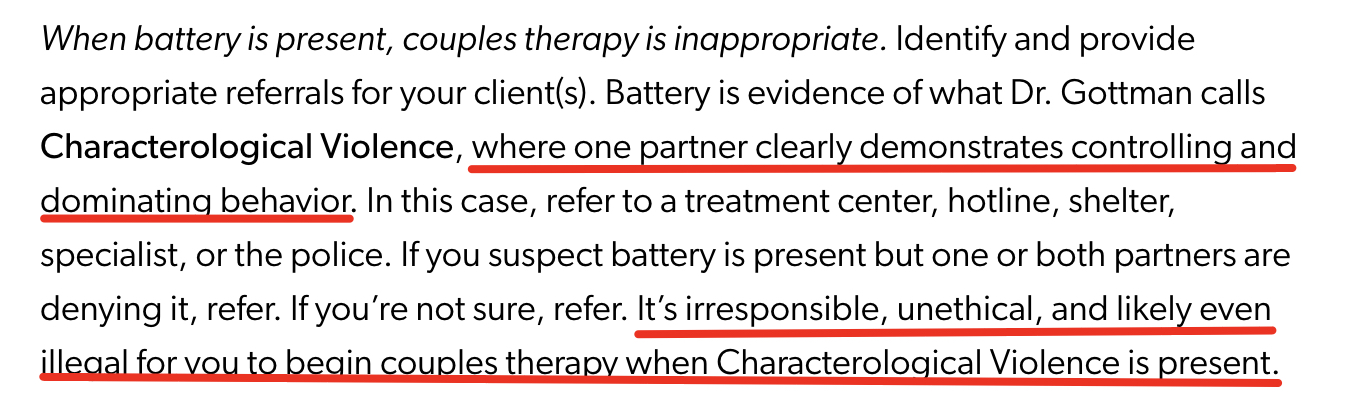
A portion of the Gottman article “V is for Violence”
Elsewhere, Restoring Hope uses composite case examples of highly distressed couples to illustrate how Hope Restored handles severe marital crises, while structuring treatment around restoration of the marriage. But when one spouse concludes that divorce may be the only safe or viable option, the book says the couple’s therapy is “terminated” and they are referred elsewhere. (Restoring Hope, p. 191) And the resulting devastation in real people’s lives can be horrifying.
So the problem is not that Focus has no language for abuse.
It is that the exceptions and the core model point in different directions.
The abuse sections say: some situations are asymmetric, dangerous, and may require separation or a different form of treatment.
The central marriage model says: look for the cycle, examine your part, take responsibility, and move toward restored intimacy.
That is the contradiction.
The deeper change was in how Focus conceptualized the marriage problem itself.
The center of gravity shifted.
From:
wrongdoing
to:
relationship dynamics.
From:
What is this person doing?
to:
What cycle are these two people creating?
From:
Is one spouse behaving destructively?
to:
What fear is driving each spouse’s reaction?
From:
How should the innocent spouse respond to the offender?
to:
How can each spouse take responsibility for their part?
From:
discernment about character
to:
hope for intimacy.
That last change may be the most consequential of all.
The 2013 manual says that people have a deep need for intimate connection and describes mutual safety as the environment in which that intimacy naturally emerges.
In other words:
Make people safe enough, help them stop reacting, and their hearts will tend to open.
That is a beautiful theory when you are dealing with two people of good will.
But it contains a massive unspoken assumption:
Both people want the same kind of relationship.
- A predator does not necessarily want mutual intimacy.
- A controlling spouse may want connection without autonomy.
- A deceiver may want marriage without honesty.
- An adulterer may want a spouse without fidelity.
- An exploiter may want commitment without reciprocity.
- A child sexual abuser may want a respectable family identity while secretly using vulnerable people.
Those are not failures of communication.
They are failures of character and conduct.
And no amount of drawing arrows between two people’s emotional buttons changes that.
The problem is not that Focus believes in cycles
Marital cycles are real.
Almost every experienced marriage therapist recognizes some version of them.
The problem is treating a cycle as the default explanation before establishing that the problem is actually reciprocal.
That reverses the order.
The correct order should be:
First: What happened?
Second: Is anyone unsafe?
Third: Is there deception, coercion, exploitation, addiction, criminal behavior, or abuse?
Fourth: Are both people operating in good faith? Do both care about the wellbeing of the other and sacrifice for the other’s best interests.
Only then: Is there a mutual relationship cycle that both spouses can responsibly work on?
Focus’s later model too often starts at step five.
And once the diagram is on the whiteboard, everything begins to look like a circle.
The husband’s rage becomes a reaction.
The wife’s fear becomes a reaction.
His control pushes her button.
Her withdrawal pushes his.
His escalation pushes hers.
And eventually the moral clarity of who chose to do what disappears into arrows.
That is why the historical shift matters.
James Dobson’s old marriage advice was hardly a model of modern abuse-informed care.
But at least Love Must Be Tough understood something very basic:
Sometimes the problem is not “the marriage.”
Sometimes one spouse is doing something destructive to the other.
Focus on the Family once had that category prominently in view.
Somewhere along the road from “the offending partner” to “the Reactive Cycle,” it became much harder to see.
And this matters far beyond Hope Restored.
The same assumptions run through Focus on the Family’s marriage books, worksheets, articles, and teaching materials: look for the cycle, examine your own reaction, take responsibility for your part, and assume that underneath the conflict both spouses are seeking connection. The 2013 Hope Restored manual explicitly told couples that “both partners contribute to the lack of relational safety,” and the 2018 Focus worksheet continued to place manipulation, affairs, substance abuse, rage, and possible physical abuse inside the category of marital “reactions.”
That viewpoint may be useful for two basically safe, honest, good-faith spouses who are caught in a destructive pattern. But once it is built into general marriage advice, it becomes a serious liability. It trains people to look for mutuality even when the facts call for moral clarity.
And we have reason to question whether the model produces the results Focus claims. Robert Paul and other staff members published an outcome study that appeared on the surface to be more than 80% successful, but the authors acknowledged major limitations and said more rigorous research was still needed. Fifteen years later, that stronger follow-up research still has not been published. Meanwhile, my own independent 2023 survey of former Hope Restored participants produced a radically different picture: about seven in ten respondents reported that they separated or divorced later. That survey was not a random scientific sample either, but the enormous gap between those results and Focus’s promotional claims is precisely why genuinely independent, long-term research is needed.
Until that research exists, I would be extremely cautious about treating Focus on the Family’s marriage materials as a trusted default resource.
The problem is not one unfortunate worksheet or one badly worded article. The underlying framework appears repeatedly across the ministry’s own materials, articles, and broadcasts. It affects how conflict is explained, how responsibility is assigned, how “safety” is understood, and what distressed spouses are encouraged to examine first.
The problem is systemic and continues today
Robert Paul is not merely a historical figure in this story.
Robert Paul, M.S., LPC, is the Vice President of the Focus on the Family Marriage Institute and the primary architect of the Hope Restored Marriage Intensive programs. He is also one of the principal architects of Focus Marital Therapy (FMT), the model used at Hope Restored.
Paul still defends this model today. At the 2026 AACC seminar “Strategies for Counseling Marriages in Distress”, he called the Reactive Cycle a model for “all conflict, period,” said it “applies to everybody,” and taught that the cycle “can only continue as long as both people are reacting”—so either spouse can supposedly stop it “regardless of what their spouse does or doesn’t do.”
That is why this is not a problem confined to an old manual or one poorly worded worksheet. It is being taught right now. The same flawed assumption still sits at the heart of the Focus on the Family’s model and continues to shape Focus on the Family’s marriage teaching today.
The FOTF materials are permeated by a model that too easily converts unilateral wrongdoing into a shared relationship problem.
That helps explain why so many devout Christians in my Life-Saving Divorce private group came away feeling betrayed: they were taught to see serious wrongdoing as a 50/50 marriage problem that they could solve by changing their own reactions. They couldn’t, and final needed to leave for good to save themselves and their children.
That does not mean every Focus marriage article is bad, or that every couple will be harmed by it. Couples dealing with ordinary communication problems may find some of the exercises helpful.
But what about the $3,000-$6,000 Hope Restored marriage intensive that attracts many desperate couples when one spouse is abusive or cheating?
Their therapy manual clearly states that stopping abuse is outside of the program expectations. Dozens of past participants have reported their disappointment — and have separated or divorced later.
These resources should not be used in place of high-quality, evidence-based marriage education, and they certainly should not substitute for specialized, abuse-informed safety assessment when there is coercion, deception, violence, sexual misconduct, addiction, exploitation, or criminal behavior.
A good marriage resource should help spouses take appropriate responsibility.
It should never teach one spouse to take responsibility for the other person’s wrongdoing.
And before anyone asks a frightened spouse to identify her “button,” examine her “reaction,” or discover her part in the cycle, there is a much more basic question that has to be answered:
What did the other person actually do?
Sometimes there are two people caught in a bad cycle.
And sometimes there is no circle at all.
Sometimes there is a victim, an offender, and a line that should never have been crossed. But a model that begins with “no one person is to blame” is badly equipped to recognize the moment when one person actually is.
Are Unsafe Teachings Promoted on the Focus on the Family Website Today? Yes.
This is not merely Robert Paul defending an old clinical model. Greg Smalley is still teaching the same assumptions on Focus on the Family’s public website. In a 2024 article, he writes that “conflict is never about the issue or topic you’re arguing about,” says either spouse can stop the Reactive Cycle “without the cooperation of the other,” and concludes that “the Reactive Cycle only continues if both people play.” He even tells readers, “Your spouse is never your enemy!”
Those statements may work for ordinary marital conflict. They become dangerously misleading when the “issue” is abuse, deception, coercion, infidelity, intentional medical neglect, or criminal behavior. Sometimes the issue really is the issue. Sometimes the other person really is unsafe. And a victim does not become responsible for keeping abuse alive merely because she reacts to it.
The same assumptions appear in Focus articles that do not even mention the Reactive Cycle by name. In another 2024 article, Greg Smalley says “your marriage needs healthy conflict” and warns that an absence of conflict may indicate “deadened emotions or a hardened heart.” But in an abusive marriage, avoiding conflict may be neither emotional deadness nor unhealthy withdrawal. It may be a rational response to intimidation. A closed heart is not always the cause of an unsafe marriage; sometimes it is the consequence of one.
Again, the model interprets behavior relationally before asking whether the relationship itself is safe.
An interesting double standard
There is one revealing exception to Greg Smalley’s usual “cycle” language: his own daughter’s divorce.
When Taylor’s marriage ended, Greg did not describe her as equally “participating” in a destructive cycle. He wrote that she begged her husband to get help, offered Hope Restored, and that her husband “wasn’t willing to fight for our daughter.”
Elsewhere in the same article, speaking generally about other divorces, Greg acknowledges that one spouse may do things that break the marriage, such as abuse, infidelity, or addiction. He does not say that Jeremy did any of those things.
What he also does not do is ask what Taylor’s “part” was, what fear she triggered in Jeremy, how she contributed to the lack of safety, or what she should have changed about herself. Her grief, anger, and withdrawal are treated as understandable responses—not as evidence that she was helping create the problem.
Greg does insert one qualifying sentence—“divorce is never one-sided”—but he never actually identifies Taylor’s supposed contribution.
That contrast is worth noticing. When the woman in the story is his own daughter, the analysis becomes much more concrete: Who tried to save the marriage? Who refused help? Who made the choice to leave? That is precisely the kind of moral clarity the Reactive Cycle can blur when it starts by assuming both spouses are participating in the problem.
To Focus’s credit, I found one incident where the current Reactive Cycle assessment now includes a prominent warning that the tool “isn’t for everyone” and tells people experiencing abuse or a “toxic marriage” to get to safety and seek trauma-informed help. That is an important improvement. But immediately afterward, the assessment returns to categorical claims: “Conflict is never about the issue,” “it only takes one person to stop” the cycle, fighters may “follow their spouse around the house,” and withdrawing from conflict “always” communicates disconnection. The disclaimer recognizes that abuse is different. The model itself still struggles to distinguish self-protection from unhealthy withdrawal and coercive pursuit from ordinary conflict.
The problem is not that Focus never acknowledges abuse. It does. The problem is that its abuse warnings sit beside a marriage model built on assumptions of mutuality, emotional reciprocity, and reengagement—and the materials do not always make clear where ordinary conflict ends and coercive behavior begins.
Their Reactive Cycle assessment asks this question:
“How do you feel I contribute to conflict in our marriage?”
That is a useful question in a healthy marriage. But if someone has already crossed into abuse, deception, or coercive control, “How do I contribute?” can become exactly the wrong first question.
The right first question remains: What actually happened?
A 2025 Focus on the Family Reactive Cycle report makes the connection even clearer. It warns that the assessment is not for abusive or “toxic” marriages and tells victims to seek safety—a welcome safeguard. Yet the report still says “conflict is never about the issue,” teaches that it takes only one person to stop the cycle, and classifies both following a spouse around the house and walking out of the room as ordinary conflict styles. It then directs distressed couples toward Hope Restored. In other words, the abuse disclaimer sits at the edge of a model that still interprets marital distress primarily through mutual emotional reactivity.
Focus on the Family doesn’t give a meaningful definition of abuse vs. ordinary “button pushing.”
They acknowledge abuse as an exception, but they do not give readers a usable definition for distinguishing abuse from ordinary “button pushing,” fighting, withdrawing, or unhealthy conflict.
The Reactive Cycle does not merely risk treating a victim’s response as part of the problem. It can also encourage the victim to reinterpret an accurate perception of coercion as an internal wound or false belief.
An example from FOTF’s own confusing material:
A Focus on the Family “Journey to Us” presentation makes the problem even clearer. It teaches that emotional buttons often come from “lies” written on the heart—and actually lists “People will try to control me” as one of those lies. For someone carrying an irrational fear of control, that may be useful insight. But for a person whose spouse really is controlling, it turns an accurate perception of coercion into an internal belief to be questioned. The model then directs the person inward: your feelings are your responsibility, ask “What’s the Truth?”, reopen your heart, and return to connection.
Before challenging someone’s belief that she is being controlled, a competent model should first ask the obvious question: Is someone actually controlling her?`
Robert Paul’s Own Marriage Story May Be the Best Evidence Against the Reactive Cycle Theory
In his 2026 seminar, Robert Paul tells a remarkable story from the early years of his marriage. At the time, he believed that whenever his wife Jenni did something he disliked, his job was to tell her what she had done wrong and what he wanted her to change.
One day he confronted her. Jenni finally said “No” and walked away.
Paul followed her.
She moved from room to room. He followed, continuing to talk at her. Finally, Jenni went into the bedroom and locked the door. Paul sat outside and continued what he now calls his “barrage.”
Then he heard their car start.
Jenni had removed the bedroom window screen, climbed out the window, gotten into the car, and was “peeling out down the driveway.” Paul says he was furious. Years later, he understood why she had not simply used the front door:
“The truth is, I would have not let her leave the house.”
He now acknowledges,
“there was nothing safe about Bob Paul in my home.” …
“The truth is, I would have not let her leave the house, and I would have felt completely self-righteously justified in doing so.”
But this story creates a serious problem for his Reactive Cycle theory.
Restoring Hope teaches that if a Reactive Cycle is occurring, “it is an absolute guarantee both are participating,” and that the moment either spouse refuses to react, “the cycle stops.” —p. 91.
Jenni did stop.
She said no. She walked away. She locked a door. She finally climbed out a window.
That was not a cycle continuing because two people kept participating. It was one person trying repeatedly to disengage while the other refused to let her disengage.
And there is a second danger here. The Reactive Cycle curriculum generally treats disengagement as temporary: regulate yourself, reopen your heart, and return to the interaction. That may be healthy in ordinary conflict. But when the other spouse is coercive, violent, deceptive, or refuses to respect your attempt to leave, reengagement may be exactly what is unsafe. This teaching can endanger lives. Anyone on church ministry teams knows that some people never change, no matter how many confessions are made or heartfelt prayers are uttered.
Paul’s own marriage story may be one of the clearest counterexamples to the theory he still teaches.
The Shocking FOTF Worksheet that Never Asks: “What Actually Happened?”
This Reactive Cycle worksheet currently available on the FOTF website makes the problem easy to see. It puts ordinary reactions like defensiveness and withdrawal in the same category as affairs, drug or alcohol abuse, manipulation, rage, and even becoming physically aggressive or “possibly abusive.”
Odd Ways Focus on the Family Treats Abuse
- Abuse is treated as an exception—but often not defined.
Focus’s current Reactive Cycle materials warn abused people not to use the model, but give little or no help distinguishing abuse from ordinary “button pushing.” - Even child sexual abuse can get reframed as a marriage problem both spouses must address.
One of the most disturbing examples is Focus’s article on pedophilia in marriage.
Even when the husband described had violently sexually abused a child in the home, the article turns back toward preserving and reconciling the marriage. It invokes “God hates divorce” while omitting Jesus’ severe warning about harming children. - Their pricey Hope Restored marriage intensive can discuss safety, but if you choose divorce, they terminate your therapy.
If a participant recognizes danger, decides to end the marriage, and will no longer pursue restoration, the program refers them elsewhere or terminates therapy. Read the documentation here. If people are being removed from the program, this leads to serious questions about the validity of their success claims. Read here. - Abuse isn’t mentioned—even once—in Focus’s 31-page 2025 Marriage Health in America report.
Focus and Ipsos studied marital health, marriages “in crisis,” and the problems couples face. Although “feeling safe with each other” was one measure of relationship health, the published report never identifies domestic abuse, intimate-partner violence, or coercive control as a distinct marital problem, even though abuse is one of the top reasons given for divorce in the United States. - Focus still does not condone divorce for abuse in its official policy.
It may tell victims to “leave” or “get to safety,” while still encouraging an extended opportunity for the abusive spouse to change. Abuse is not one of the three circumstances Focus condones for divorce and remarriage. - Focus’s own premarital counseling book doesn’t identify serious red flags or tell couples when to postpone or call off the wedding.
The book explicitly says that if readers encounter “topics or issues that seem to cause concern or red flags,” they should enlist a pastor or counselor. But it does not identify abuse, coercive control, threats, stalking, sexual coercion, dangerous anger, chronic deception, or any criteria for postponing or cancelling a wedding. Read the summary here. - Focus has funded research that complicates its own divorce messaging.
Its commissioned research found most divorced Christians remained committed to their faith, most serve and volunteer at their churches, and most continue to donate the same or more money than they did before the divorce. Yet those findings receive almost no attention. Instead, the research focuses on how divorce harms the reputation of churches.
See what the LifeWay research found.
 :
:
 :
: Buy PDF