

Hope Restored Marriage Intensive: Real Results From 44 Former Attendees
As a Christian divorce recovery leader, I am asked frequently about marriage intensives. So I did a survey of 330 past participants of multi-day Christian marriage intensives or marriage retreats. Forty-four had attended Hope Restored. I compared the claims on the Hope Restored website with the responses from those from my independent unscientific survey. I wanted the pros and cons, the positives and negatives. Here’s a clear comparison between Hope Restored’s official claims and what the 44 participants in the dataset actually reported. The survey was offered in many online Christian women’s groups, not just my private divorce recovery group. Those general Christian groups provided approximately 80% of the respondents.
🏕️ Participation Overview
-
Total Hope Restored participants: 44
-
Format mix: Included both group and private intensives (consistent with Hope Restored’s offerings).
💍 Marital Outcomes
| Hope Restored’s Claim | Actual Results (from 44 participants) |
|---|---|
| 80% of couples are married and significantly happier two years later | Only 7 of 44 (16%) are still married, and only 3 (7%) described being married and happy. |
| 32 of 44 (73%) are either divorced or separated. | |
| 5 of 44 (11%) said they were married but not happy or planning to separate. |
➡️ Reality check: Long-term marital stability and happiness were far below Hope Restored’s published 80% success rate.
-
Are Focus on the Family’s Hope Restored Miracle Claims True? https://lifesavingdivorce.com/fotfevidence/
-
The Truth About the Hope Restored Study (2011) https://lifesavingdivorce.com/hoperestoredfail/
⭐ Satisfaction & Recommendation
| Metric | Hope Restored’s Claim | Actual Participant Data |
|---|---|---|
| Session Satisfaction | 99% satisfaction | Only 14 of the 44 participants were satisfied with the session content (32%, about 1 in 3) |
| Recommendation Likelihood | Not specified (but implied high) | Only 12 of the 44 participants would recommend the program to others. (27%, about 1 in 4) |
| Group Format Satisfaction | “99% satisfaction rate” | Narrative comments included mixed or negative feedback about group pressure and lack of trauma-awareness. |
➡️ Reality check: Satisfaction levels were significantly lower than advertised, with only moderate feelings of hope after the event.
❤️ Emotional Impact (Last Day)
| Emotional State | Count | Description |
|---|---|---|
| Hopeful | 23 | About half said they “felt hopeful” on the last day — but this did not translate to lasting change. |
| Hopeless, Confused, Disappointed or Indifferent | 10 | Reported feeling unseen or discouraged. |
| Clarity | 5 | Gained insight about their spouse or future. |
| Injured, Worse, or Same | 6 | Reported emotional harm or no improvement. |
➡️ Reality check: Many left with temporary hope, but post-intensive outcomes show that this hope often did not sustain.
What happens if you realize you may need to divorce while at a Hope Restored intensive? https://lifesavingdivorce.com/hoperestoreddivorce/
Breaking: Hope Restored “Miracle Claims” Violate FTC Regulations https://lifesavingdivorce.com/hoperestoredftc/
🎯 Hope Restored’s Claim of Getting to the Root Issues
“The Intensive format allows couples to get to the root of their issues quickly and focus on true resolution.”
They position this as the key differentiator from traditional weekly counseling — deep breakthroughs in a few days.

Claim on the Hope Restored website
Hope Restored’s approach assumes that most marital problems stem from a breakdown in communication—two people misunderstanding one another’s needs or failing to express them with grace. But for many attendees, especially those describing patterns of coercion, control, or emotional neglect, the “root issue” wasn’t miscommunication at all. It was domination. When a relationship lacks safety or equality, better communication doesn’t solve the problem—it can actually deepen the harm.
-
Chart: Participants’ Expectations vs Reality at Hope Restored (near the bottom of this post): https://lifesavingdivorce.com/hoperestoreddivorce/
-
130 Examples of Abuse https://lifesavingdivorce.com/130examples/
🧩 What the 44 Participants Said About “Getting to the Root Issues”
1. Some agreed — temporarily.
About a third said they did uncover emotional patterns or painful truths during the intensive.
-
Words like “clarity,” “understood,” and “insight” appeared frequently among those who felt hopeful at the end.
-
However, that insight didn’t translate into long-term change for most.
“We learned a lot about why we were stuck, but it didn’t change how my spouse treated me afterward.”
“It helped me see the pattern, but not fix it.”
2. Many said the process stopped at the surface.
Among the lowest-rated responses, a clear pattern emerged: counselors often focused on shared sin and reconciliation rather than personal accountability.
That approach can sound fair and even spiritual — after all, both partners are encouraged to reflect, confess, and forgive. But in practice, this model often breaks down — sometimes dangerously — in marriages marked by abuse, coercion, or chronic betrayal.
It creates false equivalence.
By treating both spouses as equally responsible for the breakdown, counselors risk minimizing real harm.
For example, one woman described disclosing emotional and sexual abuse, only to be asked to confess her “bitterness” and “lack of respect.” In that moment, the focus shifted away from her safety and toward her supposed sin — framing the abuser and the victim as equally at fault and erasing the power imbalance.
“They said they were getting to the root, but really they wanted us to pray and forgive. That wasn’t the root problem.”
“The root wasn’t communication; it was control.”
Several participants said the intensive claimed to uncover deep issues but ultimately ignored the real root — emotional and spiritual harm.
3. The “root work” felt one-sided.
Many participants, particularly women, said that “getting to the root” often meant examining their own hearts or attitudes, while their husband’s behavior went largely unaddressed. This dynamic left some feeling shamed, blamed, or spiritually gaslit.
Others said the program blurred the line between spiritual surrender and emotional healing, implying that prayer or forgiveness could replace accountability or safety.
“The counselor asked what I could do differently, even after I told them my husband had cheated.”
-
This created feelings of shame or blame among certain participants.
-
Others said the intensive confused spiritual surrender with emotional healing.
🧠 Getting to Root Issues?
| Aspect | Hope Restored Claim | Attendees’ Reality |
|---|---|---|
| Depth of Insight | “We get to root issues quickly.” | Many gained awareness but not lasting transformation. |
| Balance | Biblical and psychological blend. | Often perceived as biblical over therapeutic, meaning counselors leaned heavily on scripture, prayer, and moral framing rather than evidence-based psychological tools. Sessions emphasized repentance, forgiveness, and God’s design over emotional regulation, trauma repair, or behavioral accountability. Complex issues (abuse, betrayal, addiction) were sometimes spiritualized rather than clinically treated. (See chart of expectations vs. reality near bottom of this post.) |
| Sustainability | “Couples are significantly happier 2 years later.” | Only 7% still married and happy. Root issues reemerged. |
➡️ Reality check: Most attendees felt something was uncovered, but few felt the intensive actually resolved their “root issues.” The data suggest that while Hope Restored’s process may spark short-term emotional clarity, it rarely leads to durable healing — especially in relationships marked by power imbalance, trauma, or chronic betrayal.
🌤️ Positive Participant Themes
Patterns found in comments:
-
Appreciated the kindness and hospitality of the leaders (“Everyone seemed to genuinely care”).
-
Enjoyed the biblical emphasis and prayerful atmosphere.
-
Some found short-term hope or emotional clarity.
-
Felt that “being with others who understood” reduced shame or isolation.
Example quotes:
-
“It was great. Everyone there seemed to care and just wanted to guide you back to God and your spouse.”
-
“The screening process should have caught that we had a toxic relationship and not let us go.”
→ Even positive feedback sometimes included a warning about unsafe pairing. -
“I honestly enjoyed it, which surprised me. Everyone seemed genuine.”
🌧️ Negative Participant Themes
Patterns found in comments:
-
Felt emotionally unsafe or retraumatized, especially in cases involving abuse or addiction.
-
Reported that counselors failed to identify signs of emotional or sexual abuse.
-
Described pressures to reconcile with unsafe partners.
-
Noted that aftercare was minimal or ignored if the spouse resisted change.
-
Several said the program should have screened better for high-conflict or abusive marriages.
Example quotes:
“It was good while we were there but went back to crap when we got home. My former spouse did not want to participate in the coaching calls.”
“I wish the counselors had recognized the signs of emotional abuse. They said it was a ‘safe place,’ but it wasn’t.”
“Not one of these retreats helped me see what was truly going on in my marriage. My husband continued to lie and cheat while at Hope Restored.”
Here’s another example of a Hope Restored story that I have permission to share anonymously:

🧩 Key Insight: Why Do the Outcomes Diverge?
| Claim | Participant Reality | Likely Explanation |
|---|---|---|
| “80% success rate” (still married 2 years later) | 7% still married and happy | Many cases involved ongoing abuse or trauma. The intensive format did not correct systemic issues. |
| “99% satisfaction” | Only 14 of the 44 | Only 14 of the 44 participants were satisfied with the session content (32%, about 1 in 3) |
| “Group format 99% satisfaction” | Only 12 of the 44 | Only 12 of the 44 participants would recommend the program to others. (27%, about 1 in 4) |
| “Therapists are specialists” | Mixed competency reports | Some leaders were warm but untrained in trauma dynamics or addiction. |
| “Aftercare ensures lasting change” | Many said aftercare was brief or ineffective | Follow-up coaching wasn’t sufficient for high-conflict or abusive dynamics. |
For further reading:
Hope Restored Success Rate Rests on an Unscientific Study Where only a Tiny Number of People Responded at Year 2
When Hope Restored sends abuse victims back home without a safety plan: Patricia’s story.
🧠 Summary Insight
-
Short-term hope was common; lasting change was rare.
-
Safety and screening gaps were the biggest weakness: participants with abusive partners often left worse off.
-
Marriage Counseling in Abusive Situations is Unethical https://lifesavingdivorce.com/couplescounseling/
-
Am I Being Abused? 5 Free Self-Tests https://lifesavingdivorce.com/free-abuse-danger-assessments
-
-
Faith and care were appreciated, but clinical or trauma expertise was inconsistent.
-
The real-world success rate falls far short of Hope Restored’s self-reported 80% still married at the 2-year mark.
🧑🏫 Conclusion
Hope Restored’s claims of near-universal satisfaction and “miraculous” success are contradicted by past participants’ frequent reports of divorce, emotional distress, and ineffective intervention for serious marital dysfunction. Hope Restored may be highly effective for some, but many participants—especially those with abusive or deeply troubled marriages—did not experience lasting improvement, and some reported harm and poor screening. This reflects their marriage-first focus rather than a safety-first approach.
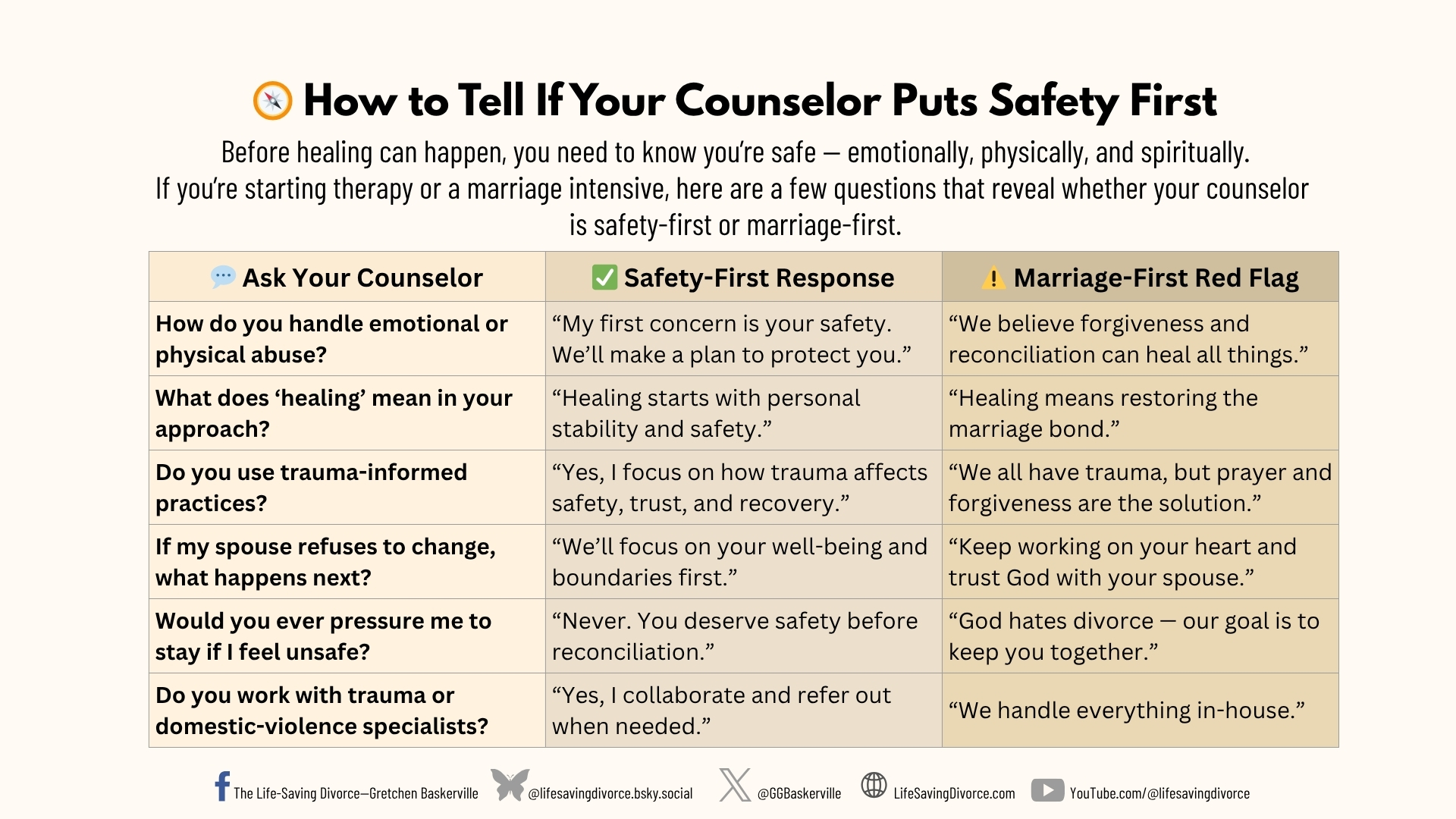
🧭 How to Tell If Your Counselor Puts Safety First Before healing can happen, you need to know you’re safe — emotionally, physically, and spiritually.
Related Reading on Hope Restored & Marriage Intensives
-
Are Focus on the Family’s Hope Restored Miracle Claims True?
https://lifesavingdivorce.com/fotfevidence/ -
The Truth About the Hope Restored Study
https://lifesavingdivorce.com/hoperestoredfail/ -
Safety-First vs. Marriage-First Counseling
https://lifesavingdivorce.com/safety-first-counseling/ - Safety is Biblical
https://lifesavingdivorce.com/safety-is-biblical-toxic-marriages/
 :
:
 :
: Buy PDF