

Book Review: Restoring Hope by Robert S. Paul, Robert K. Burbee, and Christine A. Arnzen
Video version here:
Book Review: Restoring Hope by Robert S. Paul, Robert K. Burbee, and Christine A. Arnzen
Restoring Hope: An Integrative Approach to Marital Therapy is not written for distressed couples so much as for the counselors, pastors, and therapists who work with them. The manual presents Focus on the Family’s Hope Restored model, also called Focus Marital Therapy, as a structured, faith-based approach for helping marriages in severe distress. Its stated goal is ambitious: to integrate Christian theology, clinical counseling principles, and intensive therapeutic methods into a model that can help couples rebuild safety, communication, trust, and emotional connection.
Restoring Hope explains their framework step by step, including concepts such as the Healthy Marriage Model, the Reactive Cycle, Care of Self, and communication tools designed to help couples slow down conflict and reconnect emotionally. For Christian counselors who already share the manual’s theological assumptions that divorce is never an acceptable outcome, the book may feel helpful for working with high-conflict marriages.
The deeper question is whether the book adequately protects the vulnerable people it claims to help.
That is where Restoring Hope becomes troubling.
The book repeatedly presents the Hope Restored model as research-based and effective, but the evidence offered deserves much closer scrutiny. The authors rely heavily on outcome claims tied to their own program, including reports that many participants would recommend the intensive and that a high percentage remained married afterward. Yet the research behind those claims appears limited, self-reported, and drawn from program completers rather than from a fully independent, controlled study. For a book making strong claims about couples in severe distress, that weakness matters.
The book’s most serious flaw is its handling of abuse. Although Restoring Hope acknowledges that abusive dynamics can appear in distressed marriages, it also states that “a comprehensive treatment of abusive dynamics in marital therapy is beyond the scope of this text.” For a model aimed at marriages on the brink, that is not a minor omission. It is a central failure. Couples in severe distress often include patterns of coercion, intimidation, betrayal, addiction, or emotional abuse. A marriage therapy model that does not fully address those realities risks treating danger as a communication-skill problem.
The authors offer many useful tools for ordinary marital conflict. Their emphasis on emotional safety, personal responsibility, and communication can be helpful in marriages where both spouses are basically safe, honest, and willing to change. But those same tools can become harmful when applied to relationships marked by control, fear, or deceit. In those cases, asking both spouses to “work on the cycle” may blur accountability and leave the harmed spouse carrying responsibility for a relationship dynamic they did not create.
So while Restoring Hope may function as a polished training manual for a specific Christian marriage intensive model, it falls short as a trustworthy guide for all marriages in crisis. (See selected comments from 44 past participants below.)
My conclusion: Restoring Hope may help some troubled marriages, but it is not “trauma-informed” and does not adequately equip counselors to distinguish ordinary marital distress from abuse. And without that distinction, “restoring hope” can become a slogan that protects the marriage more than the people inside it.
1. Questionable Research Claims
The authors of Restoring Hope—Robert Paul, Robert Burbee, and Christine Arnzen—present their Focus Marital Therapy (FMT) model as “research-based.”
But their evidence is built on sand.
They repeatedly cite a 2011 article titled Integrative Marital Intensive Therapy: A Strategy for Marriages in Severe Distress—a paper they themselves wrote while directing the National Institute of Marriage, which was later renamed “Hope Restored.”
CORRECTED 6-2-2026: That “study” was not independent research, and relied solely on self-reported surveys from a small, self-selected group of attendees who stayed until the end of the program.
Out of nearly 1,043 couples, only about 84 responded at the 2-year mark. That means that more than 9 in 10 past participants ignored the email survey. There was no control group, no independent oversight, and no safety data.
Acknowledging the limitations of their paper, they claimed they had plans for a “formal research article for scholarly review.” They never did it. The low response rate, the conflict of interest, the lack of a better study, and the lack of scientific validity are red flags for scholarly review.
Yet from that limited sample, the authors claim “80 percent remained married two years later” and that “99 percent would recommend the program.”
These recycled numbers have circulated for more than a decade as proof of success.
In short, Restoring Hope uses its own marketing survey as “science.” Faith-based therapy deserves better than self-authenticated miracles.
2. When Faith in a Miracle Becomes a Condition for Care
“If God were to perform a miracle in your marriage, would you be willing to accept it?”
— Restoring Hope, p. 190
The Restoring Hope therapy model makes participation in Hope Restored conditional on belief.
Every participant must answer yes to this “miracle question,” both before and during the intensive.
If you say no—even due to fear of your spouse—you’re out. (See #6 below.) The process of the intensive is “stopped” if one spouse realizes that their safety requires a divorce.
Imagine deciding to divorce and being accused by the staff of attending “Hope Restored therapy under false pretenses and with a hidden agenda.” —p. 191
This policy moralizes suffering. It treats clarity as rebellion and survival as sin.
Therapy becomes a test of devotion, not a path to healing.
You can be helped only if you still believe God will fix your marriage.
And when participants are “terminated,” they’re also erased from Hope Restored’s outcome reports. According to the 2011 study, couples who began but were terminated—often because they no longer believed restoration was possible—were not included in the follow-up surveys that generate the program’s published success rates. As the authors themselves note, “The National Institute of Marriage (NIM) has been collecting data for several years on participants who have completed their intensive marital therapy programs.”
It’s as if a hospital counts only patients who survive surgery and calls it a 100% success rate.
3. When Faith Demands Staying Instead of Safety
“A comprehensive treatment of abusive dynamics in marital therapy is beyond the scope of this text.”
— Restoring Hope, p. 275
This single line exposes everything.
Hope Restored attracts couples in crisis but admits it does not treat abuse.
Screening depends on self-disclosure—so victims who don’t yet recognize coercion can still be accepted.
When violence surfaces mid-program, the book recommends ending therapy, not reforming it.
That isn’t trauma-informed care; it’s theological liability management.
4. Faith Without Safety Isn’t Healing
“FMT therapists do not advise or encourage people to divorce… They encourage people to take the issue before the Lord Himself.”
— Restoring Hope, p. 190
This “never suggest divorce” rule turns endurance into holiness and safety into disobedience.
Victims are told to pray and forgive instead of protecting themselves legally through divorce.
Yet Scripture calls believers to flee evil, not fellowship with it (2 Timothy 3:1–5; 1 Corinthians 5:11).
Protecting yourself and your children from cruelty isn’t rebellion—it’s obedience to God’s justice.
5. Ignoring Their Own Research
“A successful outcome for such couples may include them deciding to terminate the relationship… and couples therapy may be contraindicated.”
— Restoring Hope, p. 331

They quote research acknowledging that therapy can be dangerous in violent marriages—then ignore it.
Instead, they double down on forgiveness and communication drills, the very tactics that can escalate danger.
6. When “Never Suggesting Divorce” Becomes Dangerous
“However, spouses who are already determined to exit their marriage and reject the possibility of a miracle from God are respectfully and sensitively referred to other resources for marriage dissolution therapy… If the client is unwilling to work toward that objective, therapy is respectfully terminated.”
— Restoring Hope, p. 191
If a client no longer expresses faith in the possibility of a miracle—or chooses divorce for reasons of safety—the program is ended.
Therapists are instructed to terminate counseling, framing the client’s decision as a lack of faith or sincerity.
Yet a major Harvard study showed that when divorce became legally easier to obtain in the 1970s, domestic-violence homicides and suicides among wives dropped sharply.
Freedom to leave saves lives.
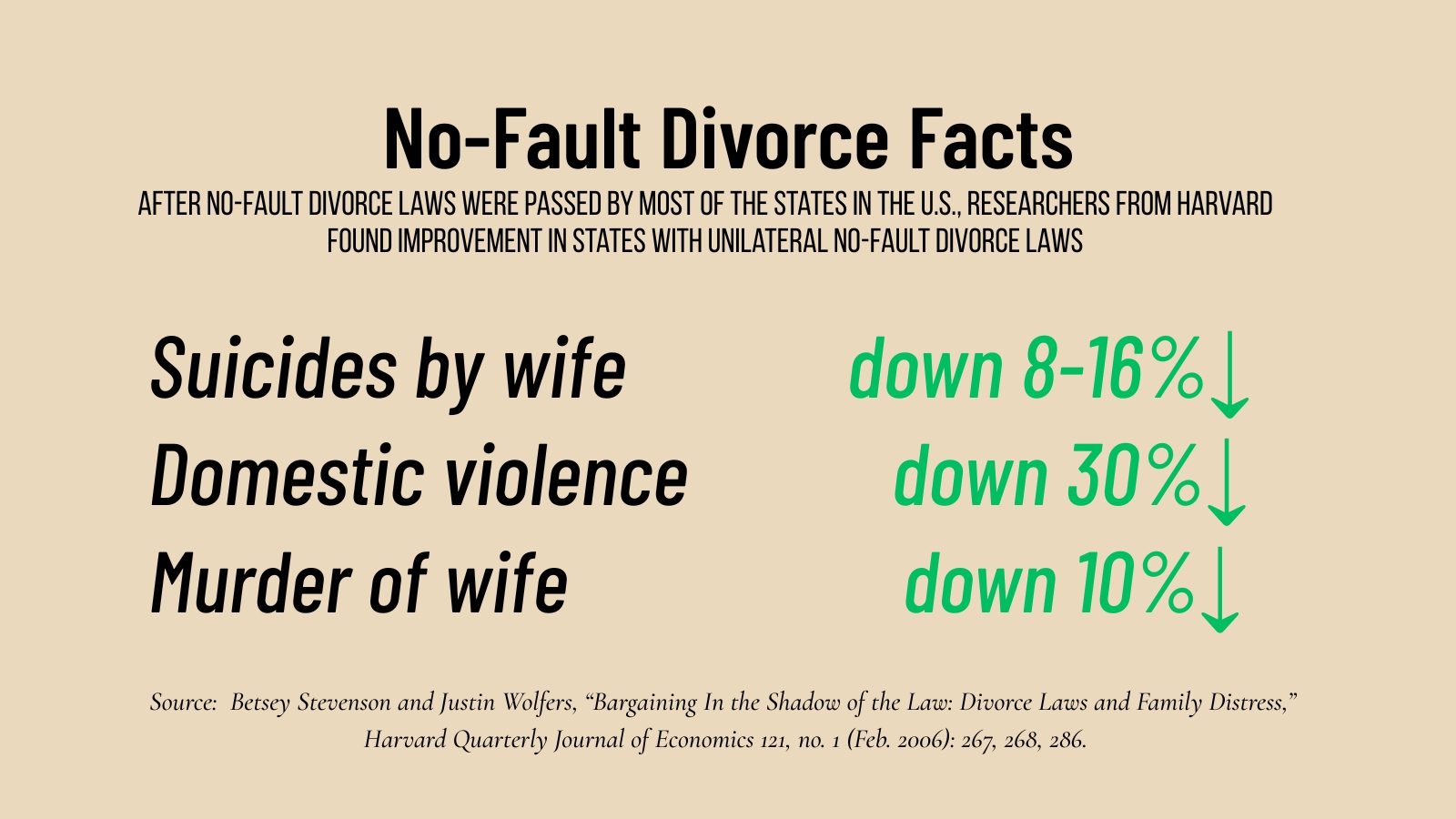
Research found that unilateral no-fault divorce laws were associated with lower rates of suicide, domestic violence, and intimate-partner homicide.
7. Spiritual Framing That Shames Victims
“Spouses who are already determined to exit their marriage and reject the possibility of a miracle from God are respectfully and sensitively referred to other resources.”
— Restoring Hope, p. 190
This language cloaks coercion in compassion.
Those seeking safety are portrayed as faithless, while those inflicting harm are urged to keep “working on communication.”
That isn’t pastoral care—it’s spiritual pressure.
8. The “Therapeutic Alliance” That Protects Abusers
“Spouses may be exceedingly sensitive and reactive to the suggestion that their behavior… is abusive.”
— Restoring Hope, p. 271
Here, the authors admit that confronting the person exhibiting abusive behavior might “stress the therapeutic alliance.”
Translation: protecting harmony matters more than protecting the victim.
By redefining violence as a “mutual interaction problem,” they erase accountability and retraumatize survivors.
9. Not Trauma-Informed, Not Evidence-Based
Despite using the word trauma, Restoring Hope never mentions PTSD, coercive control, or trauma-informed principles.
It substitutes prayer and polite communication for safety planning and accountability.
This isn’t professional therapy that meet ethical standards—it’s theology with a counseling price tag.
10. Hope Deferred: When Restoration Replaces Rescue
Hope Restored markets itself as a lifeline for marriages “on the brink.”
Yet its model consistently places the institution of marriage above the safety of people. It teaches people how to care for themselves and their safety, but divorce is off the table.
In independent surveys, about half of survivors describe brief optimism at the end of the intensive—followed by despair when old patterns of control and abuse return.
By defining success only as reconciliation, Restoring Hope trades rescue for reputation.
It preaches salvation but delivers silence.
What Attendees Say (Anonymized)
These first-person accounts (summarized and quoted from 44 Hope Restored attendee responses to an independent survey) show the pattern: initial hope fueled by intensive communication work, followed by disillusionment when deeper harm resurfaces. Costs commonly ranged from $3,000–$6,000, sometimes sponsored by friends or churches.
“My hope was restored. I had hope my husband cared and wanted to work on us.” — Status now? About the same
“We wanted a healthy relationship and to understand each other. We’re divorced.” — Status now? Divorced
“I felt responsible. I hated giving up without trying… after the intensive, I knew it was over.” — Now separated.
“We got tools and felt hopeful, but it didn’t address the deeper issues.” — Now separated
“I wanted boundaries and a miracle. We’re separated.”
“I was done, but hoped they’d tell my husband he needed help. Clarity—we’re separated.”
“I reported physical abuse during the trip. We left worse than we came.” —Worse than before
“They failed to call out my husband’s adultery and gaslighting. I was blamed.” —Now Separated
“We left hopeful; on the drive home he said nothing had changed.” —Now Divorced.
“I thought we were healed… we’re divorced.” —Now divorced
“The intensive was amazing and a turning point for us.” Better now.
Taken together, these stories show a consistent throughline: short-term hope from communication work often collapses when unaddressed patterns—coercion, deceit, rage, addiction—resurface. In a few cases (about 15%), couples reported meaningful improvement; in many others, separation or divorce follows.
What Clients Expect vs. What They Actually Get
See the side-by-side chart comparing Expected Results and Program Goals.
In Restoring Hope, the authors acknowledge that couples arrive at Hope Restored with powerful expectations. Many come desperate, told this is their “last chance,” believing they’re about to witness a miracle—that God will use this $3,000–$6,000 weekend to save their marriage.
But the fine print tells a different story.
In the section on Collaborative Goal Setting (pp. 254–259), therapists are instructed to “shape” or “adjust” participants’ expectations if they are “unrealistic or nontherapeutic.” In practice, that means couples who came for help fixing betrayal, addiction, or abuse are quickly redirected to work on communication skills and self-responsibility. The book warns therapists to reframe clients’ goals toward “what they can control,” meaning their own attitudes—not their partner’s harmful behavior.
So, while the marketing promises divine transformation, the reality is a kind of spiritual bait-and-switch. Participants who come hoping for repentance or rescue often leave with a few talking tools and the message that they must change how they respond to pain.
One woman wrote, “I hoped for a miracle. My husband had been cheating and lying. We left with ‘communication tools,’ but the deeper issues were never addressed.”
Another said, “They taught us how to talk better—but not how to stop the abuse.”
The contradiction couldn’t be starker: Hope Restored asks you to believe in a miracle but delivers a workshop in polite conversation. It preaches divine intervention but practices interpersonal technique. And for those trapped in destructive marriages, that gap between expectation and reality isn’t just disappointing—it can be devastating. No wonder that independent surveys find that more than 7 in 10 Hope Restored attendees later divorce or separate.
Why Avoiding the Possibility of Personality Disorders Is Dangerous
Restoring Hope never mentions narcissism, sociopathy, or antisocial behavior—conditions that often drive chronic manipulation and abuse. Without screening for these patterns, counselors can mistake cruelty for “poor communication” and advise victims to speak more gently to those who harm them.
Ignoring pathology doesn’t make therapy more faithful; it makes it less safe. It’s no wonder I hear so many stories of wives weeping in despair during the intensive — and being ignored.
Shifting the Blame to the Victim
The paragraph (below) at the top of page 271 is a classic example of double-speak: it appears to acknowledge there may be danger from a deceitful or abusive spouse while subtly reframing responsibility away from the therapist and onto the victim.
“A significant challenge to the therapeutic alliance between a couple in distress and their marriage therapist/counselor may be how the professional addresses dynamics of abuse occurring in the relationship. Spouses may be exceedingly sensitive and reactive to the suggestion that their behavior in the relationship is abusive to their spouse. An abused spouse may be struggling with feelings of fear and anxiety about disclosing abusive patterns, reluctant to invite greater inquiry about details of the relationship which would alert the therapist/counselor to the abusive dynamics occurring. Most experienced marriage therapists and counselors recognize how delicate and yet critical it may be to address abusive dynamics occurring in the relationship, even if it stresses the therapeutic alliance being sought with a couple.”
— Restoring Hope, p. 271
At first glance, this seems balanced and professional. It acknowledges that therapists must assess risk and that abuse can be complex. It uses the right words—“risk,” “safety,” “degree of abuse”—and positions the therapist as cautious and discerning. This paragraph appears to show clinical awareness (“delicate and yet critical”), but it’s actually a rhetorical maneuver. It’s a mind game.
When the authors worry that talking about abuse might “stress the therapeutic alliance,” they’re really saying that keeping the peace with both spouses matters more than protecting the person being hurt. In other words, the focus shifts from safety to not upsetting anyone. It puts the therapist’s comfort and the couple’s surface harmony above the victim’s safety. Instead of stopping the harm, the goal becomes keeping everyone calm.
And there’s even a deeper problem.
This paragraph quietly shifts responsibility for identifying abuse onto the couple rather than the professional Hope Restored therapist. It says that therapy is complicated when “one or both spouses do not self-identify as abusive” — implying that unless an abuser openly admits their behavior, the therapist’s hands are tied. That’s false and ethically indefensible.
In legitimate trauma-informed practice, it is the therapist’s professional duty to assess and name abuse, regardless of self-report. Abusers rarely “self-identify.” Victims often minimize or hide their fear. When a model treats denial as a barrier instead of a symptom, it effectively excuses the professional from intervening. This is why on the last day of the intensive, half people in an independent survey said they left the intensive “hopeful” and the other half left confused, disappointed, hopeless, indifferent, injured, or worse.
Then comes the rhetorical sleight of hand: the paragraph concludes by urging both spouses to be “honest about how their interactions affect one another.” That sounds fair, but it’s a false equivalence — equating mutual communication breakdown with abuse. It recasts a power imbalance as a shared “interaction problem.”
Here are some comments from Hope Restored participants:
“The screening process should have caught that we had a toxic relationship and not let us go.”
→ This shows the program’s failure to screen for danger — exactly what the book calls a “delicate challenge” for maintaining the therapeutic alliance (aka keeping the peace).
“At the end of one of the sessions, my husband verbally attacked me in front of everyone. The counselors did not address this at all… At the end of the week, they praised my husband for being ‘so committed to his marriage.’ It was sickening.”
→ This is the clearest real-world proof of the danger: therapists prioritized keeping the peace over addressing open aggression.
“I felt bruised and undermined and felt like he was viewed as a victim due to his childhood… I was emotionally and psychologically abused by him, but the tables were turned. They said ahead of time the intensive wasn’t for domestic violence, but I didn’t know I was in an emotionally destructive marriage.”
→ This shows how abusers are reframed as wounded while victims are treated as overreactive — a hallmark of “therapeutic alliance” over truth-telling.
Restoring Hope: An Integrative Approach to Marital Therapy by Robert S. Paul, Robert K. Burbee, and Christine A. Arnzen (ISBN-10: 1646070043, ISBN-13: 978-1-64607-004-6) presents the Focus on the Family “Hope Restored” marriage-intensive model, also known as Focus Marital Therapy (FMT). Published by Tyndale House in partnership with Focus on the Family, the book promotes a faith-based counseling approach designed for couples in severe marital distress. I first heard Robert S. Paul, coauthor of Restoring Hope, speak at the #AACC2025 American Association of Christian Counselors Conference, where he described the Hope Restored marriage intensive as a biblically grounded path to reconciliation. The program, developed by Focus on the Family, reflects the same ideas found in this book: that communication, prayer, and forgiveness can heal any relationship. Yet this approach—called Focus Marital Therapy (FMT)—raises serious questions for those seeking trauma-informed Christian counseling or safety within faith-based marriage therapy. As many survivors of spiritual abuse and domestic violence have noted, the line between faith and endurance can blur when “restoring hope” becomes more important than protecting people from harm. For readers exploring Christian marriage counseling, Hope Restored reviews, or critiques of Focus on the Family’s counseling model, this discussion highlights the urgent need for safe, evidence-based, Christ-centered care.
⭐ Amazon Review Summary
★☆☆☆☆ Faith Without Safety Isn’t Healing
I bought Restoring Hope to understand Focus on the Family’s Hope Restored program.
Instead, I found a manual that recycles its own unverifiable data, punishes honesty, and pressures victims to stay.
The authors boast that therapists “never advise or encourage divorce” (p. 190) and that “a comprehensive treatment of abusive dynamics is beyond the scope” (p. 275).
They even instruct counselors to end therapy if a client no longer believes God will perform a miracle (p. 191).
For those living with coercion or fear, this approach confuses faith with endurance.
True Christian counseling must protect the vulnerable, not sanctify their suffering.
Faith without safety isn’t healing. It’s harm with a halo.
Suggested links
-
2011 “Integrative Marital Intensive Therapy” article used as source data (CORRECTED 6-2-2026: Be cautious about using this version of the study. This free version of their journal article is missing the abstract and Figure 1, but Tables 1-3 are present at the end. It’s better to get a copy of the full study from a Christian college library. Note the comment that this study includes only those who completed the intensive. That alone makes the study scientifically weak. Look for Journal of Psychology and Christianity, 2011, Vol. 30, No. 1, 37-50)
- Independent survey of past marriage intensive participants, including those from Hope Restored.
Other articles critical of Hope Restored and the Focus Marital Therapy model that underpins it.
- Hope Restored’s “Miraculous” Claims — Inaccurate and Unethical
Includes testimonies from three former participants. (Independent surveys show that about7 in 10 former attendees are now separated or divorced.)
🔗 Watch critique | Follow-up video
- Will Focus on the Family’s Hope Restored Marriage Intensive Fix My Desperate Marriage?
🔗 lifesavingdivorce.com/hoperestoredfix-2 - Will a Hope Restored Marriage Intensive Fix My Marriage?
🔗 lifesavingdivorce.com/hoperestoredfix - Twelve Problems with Hope Restored’s “Success Rate” Claims
🔗 lifesavingdivorce.com/hoperestoredfail
💭 Hope Restored Marriage Intensives Fail to Meet Expectations
- When Hope Restored Stops the Process: Why You Can’t Choose Divorce Inside the Intensive
Contains a chart comparing Client Expectations versus Hope Restored’s Goals. Therapists are instructed to terminate counseling if one spouse decides to divorce—effectively punishing honesty and autonomy.
🔗 lifesavingdivorce.com/hoperestoreddivorce
 :
:
 :
: Buy PDF