
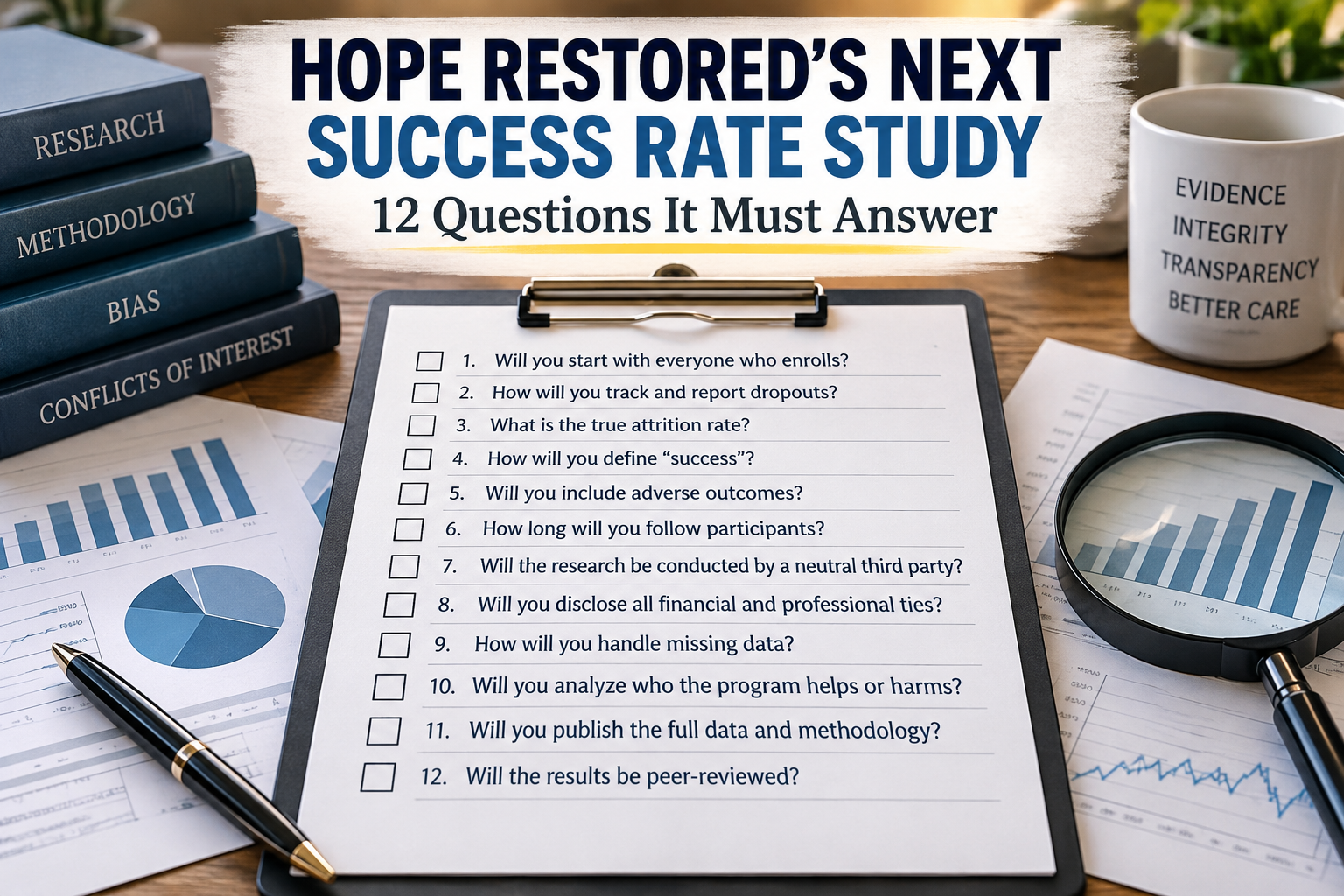
Before Hope Restored Publishes Another Success Rate:
12 Questions Its Longitudinal Study Must Answer
October 4, 2026: Focus on the Family’s Hope Restored Marriage Intensive has publicly promoted impressive success claims for years, even though its own published research acknowledged that the evidence did not meet empirical standards and called for more rigorous follow-up research.
Now, as Hope Restored moves toward more longitudinal research, I genuinely hope the researchers do it well.
Because this study could answer questions that have gone unanswered for far too long.
Do couples actually become and stay happily married years after attending a Hope Restored Marriage Intensive?
What happens to the couples who divorce?
What happens to the people who entered Hope Restored with abuse, coercive control, chronic deception, serial infidelity, dangerous addictions, or severe neglect?
Are they safer afterward?
And perhaps most importantly:
Will the researchers be willing to follow the evidence wherever it leads—even if the findings are disappointing for Hope Restored?
There is a reason I am publishing these questions now, before the results are known. We want the standards to be clear in advance. If the study is rigorous, transparent, and independently scrutinized, I will welcome that. If unfavorable findings are never published, important outcomes disappear from the analysis, or the study answers easier questions than the ones posed here, readers will have a public benchmark against which to evaluate it.
That question matters because some of the people who initiated or shaped this research have spent decades building, teaching, promoting, researching, or defending the very marriage model now being evaluated.
Their professional reputations—and in some cases their livelihoods—are closely tied to Hope Restored’s success.
Greg Smalley’s compensation has been substantial—Focus’s 2025 public nonprofit disclosure reports more than $220,000 in total compensation—so the professional and financial stakes are not trivial. Focus spent more than $35 million on its marriage program in fiscal 2025, including more than $18 million in salaries and benefits.
Robert Paul’s professional livelihood has been tied to this model for decades. In the National Institute of Marriage’s 2013 IRS filing (over a decade ago, before they merged with Focus on the Family and changed the program’s name to Hope Restored), he was listed as co-president earning $142,214 annually.
That doesn’t invalidate their research.
But it makes rigorous methods, independent scrutiny, conflict-of-interest disclosure, and extraordinary transparency essential.
1. Who exactly will be included in the study?
This sounds elementary, but it is enormously important. I’ve been following the lives of past participants and reading Hope Restored curriculum and listening to the founders’ and leaders’ speeches and interviews for years.
Suppose 1,000 couples attend Hope Restored.
Do researchers follow all 1,000?
Or only the couples who finish the intensive? What if only one spouse stays or only one participates—are they included or excluded?
What about couples whose therapy is “terminated” after one spouse says the marriage feels too unsafe to continue because that no longer fits Hope Restored’s stated restoration goal?
What about someone who decides during the intensive that divorce is necessary?
What about the spouse who never completes a later questionnaire?
What about the battered wife who wants nothing more to do with the organization?
Those people cannot simply disappear.
A program can look remarkably successful if dissatisfied participants gradually vanish.
Start with everyone. Tell us what happened to everyone. Don’t cherry-pick the success stories.
2. What happens to the people who stop responding?
This is one of the biggest challenges in longitudinal research: attrition.
People disappear.
They move. They stop answering emails. They divorce. They become angry with the program. They lose interest. They may be so discouraged that they simply do not want to spend more time responding.
But attrition becomes especially dangerous when the people most likely to disappear are also the people with poor outcomes: the abuse did not stop, the betrayal continued, or the neglect, indifference, or hostility remained.
Imagine this:
The happily married couples happily respond to another Hope Restored questionnaire.
The separated or divorced participants think, Why would I ever talk to those people again? What a waste of time and money!
If researchers analyze only the people who answer, they may end up measuring the people who remained positively engaged with Hope Restored, not the original population.
That is why I want to see an attrition table.
How many couples began?
How many responded at each follow-up?
How many could not be located?
How many refused?
How many divorced?
How many separated?
How many said the program harmed them?
And how were all those missing people handled statistically?
My 2023 survey was not a random scientific sample, so it cannot establish Hope Restored’s true success rate. But among 44 former Hope Restored attendees—most of whom found out about the survey through general Christian women’s groups online rather than through my own divorce-focused community—nearly 3 in 4 were already divorced or separated, and more than 8 in 10 were divorced, separated, or planning to leave. Only 3 of the 44 described themselves as married and happy.
3. Divorce cannot automatically be classified as treatment failure
This is crucial.
If a woman entered Hope Restored married to a violent man and eventually left him, the divorce itself does not tell us whether she failed.
She might be safer.
Her children might be safer.
Her mental health might have improved dramatically.
Conversely, remaining married cannot automatically be classified as success.
A couple can remain married while experiencing fear, coercion, chronic infidelity, addiction, profound neglect, or ongoing abuse.
So please do not give us another study in which:
married = success
and
divorced = failure.
The outcomes need to be much richer than marital status. Safety and respect matter.
4. Will they actually measure abuse?
This may be the most important question of all. And it’s a genuine concern. In 2025, Focus on the Family released a 31-page study on Marriage in America and never mentioned abuse once.
Hope Restored works with couples in severe marital crisis.
That means researchers should not merely ask whether couples feel close, communicate better, or report greater marital satisfaction.
They need to know whether there is:
- physical violence
- coercive control
- sexual coercion
- stalking or intimidation
- financial exploitation
- serial infidelity
- dangerous substance abuse
- chronic deception
- child abuse or endangerment
- threats
- severe neglect
- a secret double life
And they need to distinguish ordinary marital back-and-forth conflict from unilateral harmful conduct.
Otherwise the same problem I have documented in Hope Restored’s Reactive Cycle can simply migrate into the research.
The husband’s intimidation becomes one “reaction.”
The wife’s fear becomes another “reaction.”
And once again, who did what to whom disappears inside the circle.
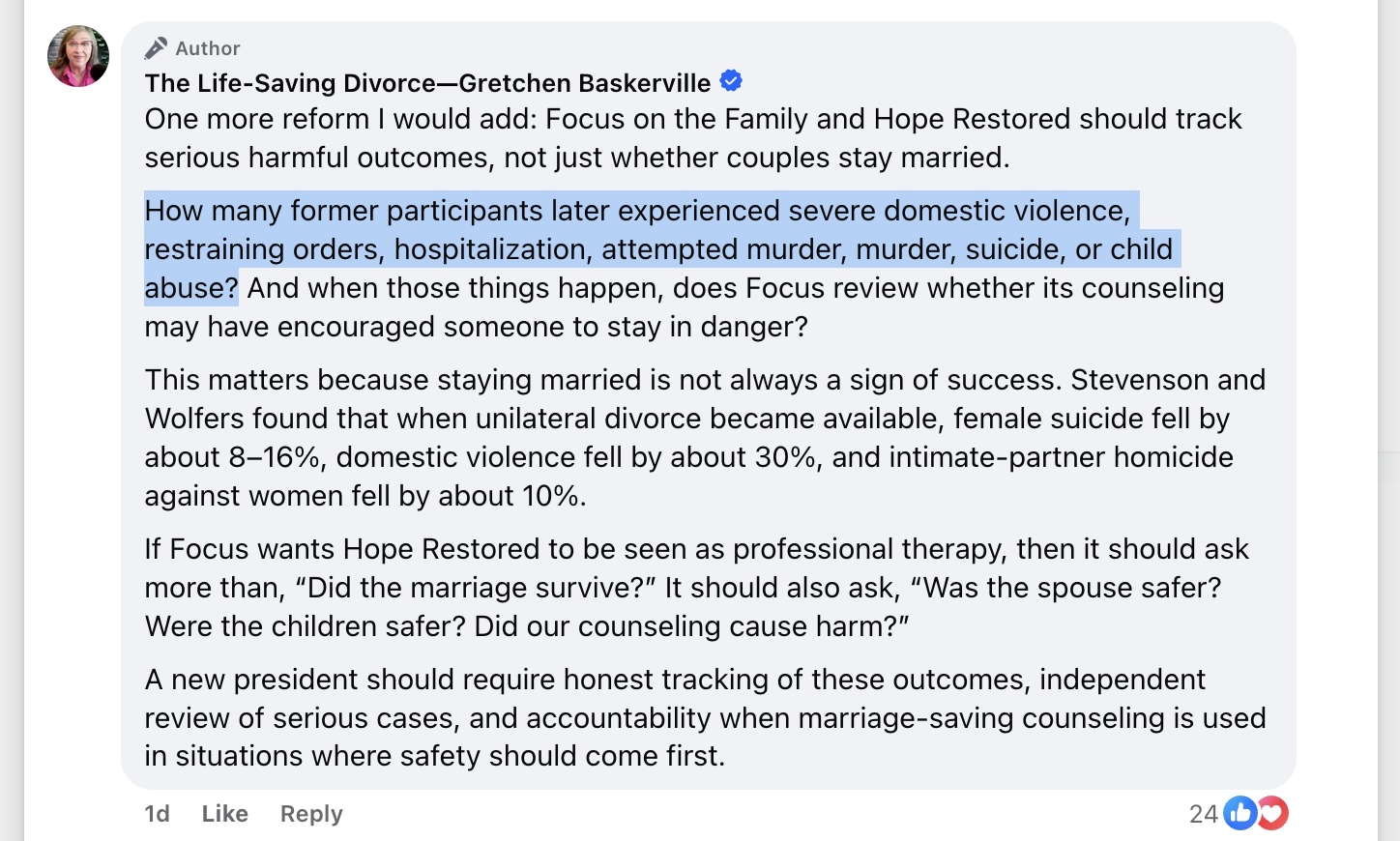
A proposed reform for Focus on the Family and Hope Restored: measure whether spouses and children are safer after marriage counseling—not simply whether the marriage remains intact.
5. They need to measure adverse outcomes—not merely benefits
Medical researchers don’t ask only:
Did the treatment help?
They also ask:
Did the treatment hurt anyone?
Marriage interventions deserve the same seriousness.
Did disclosures of fears, needs, and insecurities during couples therapy result in retaliation, dismissal, or other harmful use afterward?
In my 2023 survey, about 3 in 4 Hope Restored attendees who were asked to share those vulnerabilities said their spouse did not use the information in loving and respectful ways afterward.
Did a participant feel pressured to disclose information to an unsafe spouse?
Did someone delay leaving a dangerous relationship because the program encouraged continued restoration efforts?
Did children remain exposed to danger?
Did someone’s financial situation deteriorate?
Did symptoms of trauma worsen?
Did a spouse use information disclosed during the intensive against the other person later?
A meaningful longitudinal study needs a mechanism for capturing harm, not simply insufficient improvement.
6. Researchers must not explain every bad outcome as client failure
This is particularly important because Hope Restored’s own literature gives me reason for concern about how disappointing outcomes may be interpreted. In books and studies by program leaders and some employees, struggling couples are sometimes framed in terms of insufficient perseverance, motivation, openness, or willingness to keep working—rather than first asking whether the model itself failed, whether one spouse was unsafe, or whether reconciliation was inappropriate.
That pattern appears in 9 Lies That Will Destroy Your Marriage and in Tara Lalonde and Robert Paul’s Empowered to Love, where unsuccessful or painful outcomes can be interpreted through the harmed spouse’s response rather than through the possibility that the relationship itself was unsafe, destructive, or no longer appropriate for reconciliation.
There is a powerful temptation in any therapeutic system to explain success this way: The model worked.
And to describe failure this way: The client didn’t work the model.
Perhaps the couple wasn’t sufficiently committed.
Perhaps one spouse wasn’t open enough.
Perhaps they didn’t persevere.
Perhaps they failed to use the tools.
Perhaps they weren’t vulnerable.
Perhaps they didn’t maintain the gains they made during the intensive.
Some of those explanations may sometimes be true.
But researchers must also be willing to ask:
Did the intervention fail?
Was the model wrong for this couple?
Was the marriage unsafe?
Did encouraging further vulnerability create harm?
Would a different intervention have produced a better outcome?
A study of Hope Restored cannot be persuasive if every success demonstrates that the model works while every failure demonstrates that the participants didn’t work the model hard enough.
Robert Paul has said Hope Restored is now about four years into a new longitudinal research effort, with academic involvement from Southeastern University. That is encouraging—but until the methodology, response rates, attrition, safety outcomes, and results are published for independent review, it cannot substitute for transparent evidence supporting the success claims Focus is already making. (See below: “All eyes are on Dr. Thomas Gollery.”)
7. The researchers need to deal honestly with Hope Restored’s old attrition problem
Under its former name, Hope Restored’s leadership published an outcome study years ago.
It has often been cited in ways that make the results sound spectacular.
But the long-term sample became very small.
Of 1,043 people originally invited, only 84 couples were represented at the 24-month follow-up. Seventy-one of those couples were still married.
Seventy-one sounds impressive when the denominator is 84.
It looks quite different when readers understand how many people were originally invited.
That doesn’t prove the missing participants divorced.
It proves that we don’t know what happened to most of them.
The new longitudinal research has an opportunity to fix that.
8. The research team needs independence
This is where things become uncomfortable.
Robert Paul has been deeply involved with this model since approximately 1999. He helped develop what became Focus Marital Therapy and the Hope Restored intensive, and his work appears prominently in the Smalley relationship books going back more than two decades.
Greg Smalley has also been closely associated with the model and with Focus on the Family’s marriage ministry.
Erin Smalley has professional and research ties to Focus as well.
None of that makes these people dishonest.
But it creates researcher allegiance.
If you have spent decades developing a treatment model, teaching it, writing about it, defending it, and building a major ministry with millions of dollars of income around it, discovering that it performs poorly—or causes harm in a meaningful subgroup—would be professionally consequential.
That’s exactly why independent researchers matter.
The people with the greatest investment in a model should not be the only people evaluating whether the model works.
So who designed this new study? Who is paying for it? Who controls the data? And will the final analysis be conducted by researchers who are truly independent of Hope Restored and Focus on the Family?
This is why so many people trust Consumer Reports. CR buys the products it tests itself rather than accepting free products or outside funding that could create pressure or bias. The whole point is independence: the evaluator should be a neutral third party, not someone financially or professionally invested in the product being evaluated.
The same principle matters in research. The strongest evaluation comes from a neutral third party with no financial, professional, or reputational stake in whether the program succeeds.
9. Conflicts of interest need to be disclosed clearly
This is not theoretical either. It happened just last month.
Erin Smalley’s September 2026 dissertation was an analysis of marriage research connected to Focus on the Family. Yet the dissertation did not clearly disclose her longstanding professional and family ties to Focus—an omission that matters when readers are evaluating possible conflicts of interest.
Her dissertation advisor was Dr. Tom Gollery.
That history matters now.
Researchers don’t become disqualified because they have ties to an organization.
But readers deserve to know those ties.
If someone works for Focus, is married to a senior Focus executive, has participated in Focus’s marriage ministry, or is studying a program developed by close professional colleagues, say so plainly.
Disclosure lets readers evaluate possible bias for themselves.
Non-disclosure does the opposite.
10. Publish the protocol before knowing the answer
One of the best protections against unconscious bias is deciding beforehand:
What outcomes matter?
Which time points matter?
How will divorce be handled?
How will abuse be measured?
How will missing respondents be handled?
What counts as success?
What counts as deterioration?
Which statistical tests will be used?
Then publish or preregister those decisions.
Why?
Because once researchers see the results, humans are extraordinarily good at finding reasonable-sounding explanations for why the favorable measure was the important one all along.
A credible longitudinal study should make it difficult to move the goalposts after the data arrive.
11. Publish disappointing results too
This may be the real test.
Suppose the study discovers that Hope Restored works wonderfully for couples experiencing ordinary reciprocal conflict.
Wonderful. Publish it.
But suppose it also discovers that the program performs poorly when there is coercive control.
Publish that too.
Suppose serially betrayed spouses do worse.
Publish that.
Suppose couples involving addiction need an entirely different treatment approach.
Publish that.
Suppose a substantial number divorce and report that leaving was the healthiest outcome.
Publish that too.
The purpose of research is not to protect a ministry’s marketing message.
It is to discover what is true.
12. Let independent people see enough information to evaluate the claims
I have a personal concern here.
I have asked Focus on the Family—directly and through Ipsos—nearly half a dozen times for the questionnaire and more detailed results from an earlier publicly released marriage study.
I still have not received the materials I requested.
That is troubling because accepted survey-research standards emphasize transparency.
The American Association for Public Opinion Research says publicly reported research should disclose sufficient methodological information to permit independent review, including the sponsor, measurement instruments, population, sampling, data collection, sample sizes, weighting, data processing, and limitations. It also specifically addresses disclosure of panel attrition and says researchers should generally make de-identified data and documentation available for independent verification, subject to appropriate privacy protections. AAPOR
So my request for the next study is simple:
Don’t make outsiders fight for the questionnaire.
Publish it. Be transparent.
Publish the methodology.
Deposit the anonymized dataset with the Association of Religion Data Archives (ARDA) so qualified scholars can examine the details.
Publish the attrition.
Publish the adverse outcomes.
Explain the missing data.
Disclose the conflicts of interest.
Let qualified independent researchers examine the work.
If the evidence is strong, transparency will strengthen Hope Restored’s claims.
All eyes are on Dr. Thomas J. Gollery
Dr. Thomas J. Gollery is a professor of education and quantitative methodologist at Southeastern University in Lakeland, Florida, where he works with doctoral research involving study design, statistics, dissertations, publications, and program evaluation. He earned his doctorate from the University of Florida in Educational Leadership and Exceptional Student Education, with a cognate in research and statistics. Southeastern University
Gollery supervised Erin Smalley’s 2026 dissertation. That makes his role especially relevant to questions about research design, disclosure, and methodological rigor in future Hope Restored research.
If he is involved in advising or evaluating future research connected to Hope Restored, the standard for transparency needs to be higher this time.
That means clear conflict-of-interest disclosures.
It means methodological rigor.
It means no disappearing negative outcomes.
It means accounting for abuse and adverse effects.
And it means following the evidence even if the evidence threatens conclusions that people involved in the project sincerely hoped would be true.
This isn’t about assuming bad faith.
It’s about recognizing how much is at stake.
There is another constituency the researchers cannot ignore: former participants
For years, people contacted me privately after attending Hope Restored.
One thing I heard repeatedly was startling:
They thought they were the only ones.
They thought theirs was the only marriage that Hope Restored hadn’t saved.
They thought they were the only people who had come away deeply troubled by the experience.
They wondered whether the failure was theirs.
That is what happens when disappointing experiences remain private.
Every person thinks:
Maybe it was just us.
I think Focus on the Family benefited for years from the extraordinary loyalty of evangelical Christians—and may have come to rely on it too much.
Many Christians, including divorced Christians and people who had painful experiences at Hope Restored, may have felt pressure to stay quiet because we are all supposed to be “on the same team.”
Criticizing a respected Christian ministry can feel like embarrassing Christianity itself.
That silence had consequences.
Survivor and former-participant stories matter because they test a model against reality.
A success percentage can be debated statistically.
A theoretical model can be defended academically.
But when former participants say:
Here’s what happened to me.
Here’s what the therapist told us.
Here’s what happened when we went home.
Here’s why I became less safe.
those accounts demand investigation.
They should not automatically be dismissed as disgruntled clients, unsuccessful couples, or people who failed to apply the tools correctly.
They are data—not necessarily representative data, but important signals that competent researchers should investigate.
I actually want this study to succeed
I don’t mean that I want it to produce a high success rate.
I mean I want it to find the truth.
Robert Paul has said Hope Restored is now several years into longitudinal research. Yet Focus has not, to my knowledge, publicly highlighted preliminary findings from that work. That does not tell us what the results are—but it makes the need for publication and transparency even more important.
If the study is eventually used to support Hope Restored’s marketing claims, the complete methodology and results should be available for independent evaluation.
Maybe Hope Restored is enormously beneficial for a clearly identifiable group of couples.
If so, let’s identify them.
Maybe it is ineffective for another group.
Let’s identify them too.
Maybe some couples should never be sent to conjoint marriage therapy at all.
Let’s find out.
Maybe some people become safer by reconciling.
Maybe others become safer by separating permanently.
Research should be capable of discovering both.
That is what would make a Hope Restored longitudinal study genuinely valuable.
Not another impressive percentage.
Not another testimonial.
Not another claim that marriages have been “saved.”
But an honest accounting of who was helped, who wasn’t, who disappeared from follow-up, who was harmed, who divorced, who became safer, and why.
Because the real test of this longitudinal study will not be whether Hope Restored can produce another impressive success rate.
It will be whether the research design makes it impossible to lose sight of the people for whom Hope Restored did not work.
Given the history of small long-term samples, undisclosed ties, and limited transparency, readers have good reason to watch this study very closely.
The final test of transparency may be whether the study sees the light of day if the findings are unfavorable to Hope Restored.
We don’t know what the new study shows. That is exactly the problem. Publish it.
 :
:
 :
: Buy PDF