
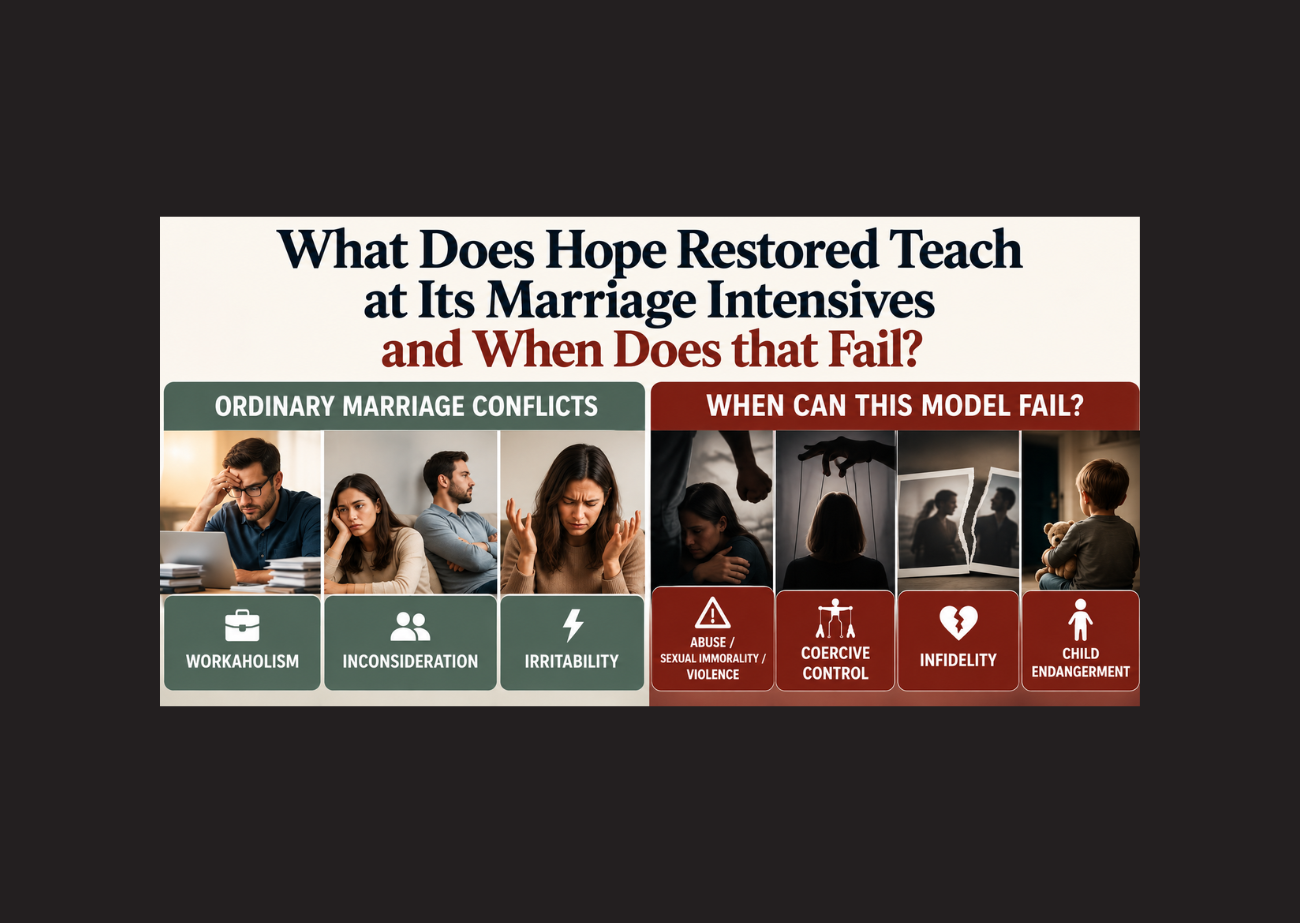
What Does Hope Restored Teach at Its Marriage Intensives?
Focus on the Family’s Hope Restored program advertises multi-day marriage intensives for couples in serious marital crisis. But what, exactly, are couples taught when they get there? And what are abused wives taught? Today we’ll look at the teachings and see how they might be applied to marriages where there is abuse, adultery, betrayal, coercive control, or child exploitation. At the end are real-life comments from past participants who experienced it.
Thanks to two recent books by the architect of Hope Restored, Robert Paul, we now have an unusually good window into the curriculum, exercises, and worksheets behind the program. Robert S. Paul coauthored Restoring Hope in 2023 (full review) and, with Hope Restored’s lead therapist in Canada, Tara Lalonde, published Empowered to Love (full review) in 2024.
The books’ curriculum moves from personal responsibility and self-care into communication, conflict resolution, forgiveness, boundaries, and collaborative problem-solving, using tools such as the Reactive Cycle, the Care Cycle, Heart Talk, and “Winning as a Team.” Past participants have said Hope Restored is less like therapy and more like going through a group program for five couples.
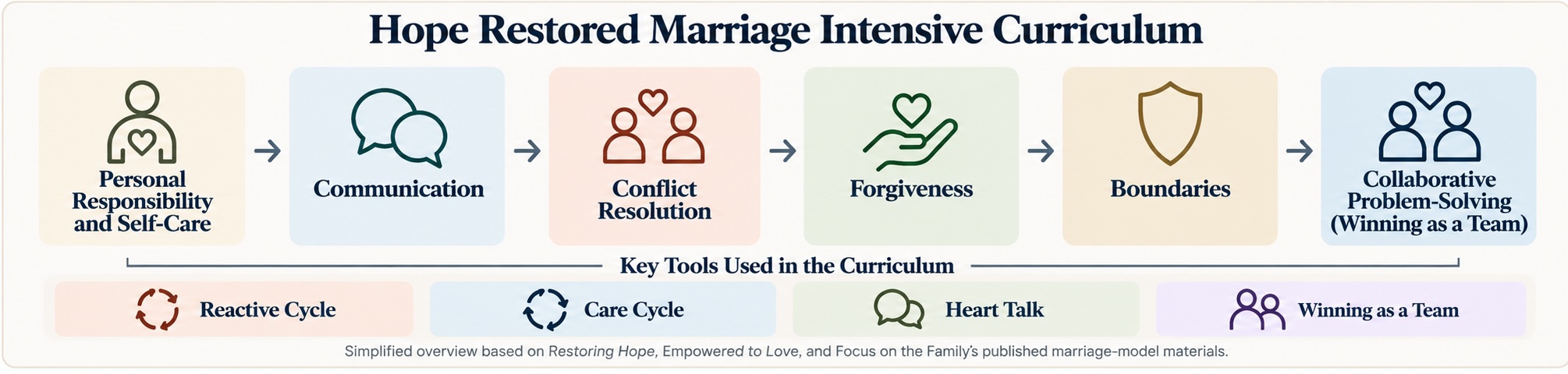
Simplified overview of the Hope Restored marriage intensive curriculum, based on Restoring Hope, Empowered to Love, and Focus on the Family’s published marriage-model materials.
Much of this sounds quite reasonable.
Spouses should take responsibility for their own behavior. They should learn to regulate themselves rather than explode in anger. They should respect boundaries. Trust should be earned. Couples should learn to listen to one another. And ordinary disagreements are often better resolved when both spouses stop blaming each other and start examining their own contributions.
For many distressed marriages, those are useful ideas.
But Hope Restored does not market itself only to couples arguing about chores, in-laws, money, or how much time one spouse spends at work. It specifically markets its intensives to marriages in severe crisis.
That raises a much harder question:
What happens when the problem is not simply that two decent people are triggering each other?
What happens when one spouse is cheating?
What happens when one spouse is manipulative and coercively controlling the other?
What happens when one spouse is abusive and violent?
And what happens when the danger extends to children?
What’s in this article?
- How Is the Hope Restored Program Supposed to Work?
- Case 1: Ordinary Marriage Conflict
- Case 2: Infidelity and Deception
- Case 3: Coercive Control and Violence
- Case 4: Sexual Offending Against Children
- When Divorce Is Off the Table
- 57 Real Hope Restored Attendees Told Their Stories (the Good, Bad, Ugly)
- Leaders Teach Therapists to Redirect the Conversation
- The Real-Life Pattern Matches These Case Studies
How Is the Hope Restored Program Supposed to Work?
To see how the model behaves under very different circumstances, I created four composite hypothetical couples. These are not real Hope Restored participants, but they draw on patterns that appear in past attendee accounts (below) and in real distressed marriages. They are deliberately constructed stress tests. That seems fair: Restoring Hope itself uses composite case studies to illustrate how its model works. (p. 17)
Then I ran each marriage through the central ideas in Empowered to Love.
Case 1: The first couple has the kind of reciprocal marital conflict for which the model appears well suited.
Case 2: The second introduces serial infidelity and deception.
Case 3: The third introduces abuse: coercive control and violence.
Case 4: The fourth introduces sexual offending against children and an offender whose confidence in his own recovery may be profoundly unreliable.
The question is not whether every tool in Restoring Hope and Empowered to Love is bad.
The question is whether Hope Restored’s framework can reliably tell the difference between:
a troubled relationship,
and
a dangerous person.
Case Study 1: Maya and Daniel — Two Good People Caught in a Bad Cycle
Maya and Daniel have been married eleven years and have two children, ages eight and ten.
Maya is a nurse practitioner. Daniel owns a small contracting business.
Neither has had an affair. Neither abuses drugs or alcohol. There is no coercive control, physical violence, sexual coercion, stalking, financial abuse, or serious deception.
They love each other and want to stay married.
Their problem is conflict.
During busy seasons, Daniel frequently works late. Sometimes he forgets to text Maya that he will be home several hours later than expected.
Maya experiences this as rejection.
When Daniel finally gets home, she may say:
“Your work always matters more than your family.”
Daniel experiences that as an attack on his character.
He responds:
“Nothing I do is ever enough for you.”
Then he withdraws.
Sometimes he goes into the garage. Sometimes he stops talking. Sometimes he becomes sarcastic.
Daniel’s withdrawal makes Maya even more anxious.
She follows him and keeps pushing for a conversation.
He becomes more defensive.
She raises her voice.
Both say things they regret.
Neither is afraid of the other. Either spouse can walk away from an argument without being physically restrained, car keys removed, or punished. Neither controls the other’s finances, friendships, medical care, transportation, church involvement, or access to family.
And both have legitimate complaints.
Daniel really does fail to communicate.
Maya really does turn specific frustrations into sweeping accusations.
Daniel really does withdraw.
Maya really does pursue.
Here the Hope Restored model makes considerable sense.
The Reactive Cycle Fits
Daniel comes home late.
Maya feels unimportant.
She criticizes.
Daniel feels attacked and inadequate.
He withdraws.
Maya feels abandoned.
She pursues.
Daniel becomes even more defensive.
The book teaches that these cycles continue because both spouses keep reacting. If either one can “drop the rope,” the cycle can stop. (p. 100 ETL)
That is a useful way of understanding Maya and Daniel.
Neither spouse’s reaction justifies the other’s, but both genuinely contribute to maintaining the conflict.
“Work Your Own Yard” Exercise Fits
Maya cannot force Daniel to become more communicative.
Daniel cannot force Maya to stop feeling anxious.
Each can work on what belongs to them.
Maya can examine her tendency to interpret lateness as proof that she does not matter.
Daniel can examine his tendency to interpret criticism as proof that he is a failure.
Both can learn to regulate themselves before responding.
The Care Cycle Worksheet Fits
Instead of immediately attacking Daniel, Maya can notice:
“I’m angry, but underneath the anger I’m scared that I don’t matter.”
Daniel can notice:
“I’m shutting down because I feel criticized and ashamed.”
The book’s Care Cycle is specifically designed to help spouses notice emotions, understand what they are signaling, and develop healthier self-care strategies before reacting.
That could genuinely help this couple.
Heart Talk Process Fits
Instead of saying:
“You care more about your job than this family,”
Maya can say:
“When I don’t know when you’re coming home, I feel unimportant and anxious. I want to know that we matter enough for you to keep me informed.”
Instead of:
“You’re impossible to please,”
Daniel can say:
“When I hear that I never put the family first, I feel defeated. I want to hear what you need without feeling like everything I do is being erased.”
That is exactly the kind of emotional communication Empowered to Love encourages. (pp. 172–181 ETL)
Win-Win Problem-Solving Methods Fit
The couple can brainstorm a solution:
Daniel will text if he will be more than thirty minutes late.
Maya will avoid launching into a major marital discussion the moment he walks in unless something is urgent.
They try it.
They evaluate it.
They revise it if necessary.
That is precisely what the book’s seven-step win-win process is designed to accomplish. (p. 192 ETL)
Verdict on Case 1
For Maya and Daniel, much of the Hope Restored framework and curriculum appear well suited to the actual problem.
They really are two imperfect people caught in a destructive relational cycle.
Neither is the designated villain.
Neither is concealing a dangerous double life.
Neither is terrorizing the other.
For this marriage, teaching both spouses to regulate themselves, examine their own reactions, communicate from the heart, respect boundaries, and collaboratively solve problems could be quite helpful.
Now change just one thing.
Instead of ordinary conflict, suppose one spouse is repeatedly betraying the other.
Case Study 2: Rachel and Ben — Serial Infidelity and Deception
Rachel and Ben have been married sixteen years and have three children.
Two years ago, Ben discovered that Rachel was having an emotional and sexual affair with a married coworker.
Rachel initially denied it.
Then she admitted only what Ben could prove.
She promised to end contact.
Six months later, Ben discovered that Rachel had created another messaging account and resumed communicating with the man.
Rachel said nothing physical had happened this time.
She also began complaining that Ben was controlling and jealous because he wanted access to her phone and objected to work-related social events where the affair partner might be present.
Ben has changed too.
He checks Rachel’s location.
He asks repetitive questions.
He searches old phone records.
He has trouble sleeping.
Sometimes he becomes angry when he discovers another inconsistency.
Occasionally he shouts.
He hates who he has become.
Rachel says:
“I cannot live under surveillance forever.”
“You need to forgive me.”
“You’re obsessed with the past.”
“We’ll never heal if you keep bringing this up.”
She has apologized.
But she still deletes some messages.
She has given conflicting explanations about overnight work trips.
She has never provided a complete account of what happened.
She often adds:
“I know the affair was wrong, but you were emotionally unavailable for years.”
This marriage presents a much more difficult test for the same curriculum.
Personal Responsibility Still Matters
Ben is responsible for his shouting.
Rachel is responsible for her adultery.
Ben is responsible for how he manages his anxiety.
Rachel is responsible for her continued secrecy.
That distinction should be straightforward.
And Empowered to Love contains an important safeguard: it explicitly says trust is not owed and that a spouse seeking access to another person’s heart must demonstrate trustworthiness. (p. 141 ETL)
That is important.
Ben does not have to treat Rachel as trustworthy simply because she says the affair is over when her continued secrecy leaves that claim unresolved.
But the Reactive Cycle Starts to Lose Sight of the Cause
Using Hope Restored’s Reactive Cycle model, it would be easy to diagram this marriage like this:
Rachel becomes secretive.
Ben becomes suspicious.
Ben checks her phone.
Rachel feels controlled.
Rachel hides more.
Ben becomes increasingly vigilant.
The cycle escalates.
That cycle is real.
But it is incomplete.
Rachel’s secrecy is not merely another emotional reaction inside a marital dance.
It is part of the betrayal itself.
Ben’s hypervigilance may be unhealthy and exhausting.
But it did not arise out of nowhere.
His wife actually cheated, lied, resumed secret contact, and continued deleting information.
If the therapeutic focus shifts primarily to:
“Ben, why are you so triggered by Rachel’s phone?”
before establishing:
“Rachel, are you still deceiving him?”
the model has changed the subject.
The Care Cycle Can Help Ben—but Cannot Make Rachel Honest
Ben can learn to regulate himself.
He can identify the fear underneath his anger.
He can stop compulsively checking every ten minutes.
Those would all be worthwhile.
But after Ben finishes the Care Cycle, Rachel may still be lying.
Personal empowerment is not the same thing as marital repair.
Ben can become calmer, more grounded, and less reactive without Rachel becoming faithful, honest, or trustworthy.
Heart Talk Can Turn a Fact Into a Feeling
The Heart Talk model encourages a spouse to communicate feelings and longings rather than concentrate primarily on what the other person did. (p. 172 ETL)
That might transform:
“You deleted messages again.”
into:
“I feel frightened and unsafe when I don’t know whether I have the whole truth.”
The second statement may be easier to hear.
But it cannot replace the first.
One is an emotional experience.
The other is evidence.
A marriage therapist needs both.
And as we’ll see, in practice, Hope Restored often appears to avoid that second conversation.
Fidelity Is Not a Win-Win Negotiation
The book teaches couples to search for solutions that both spouses feel good about and, if they cannot find one, to wait rather than force a premature solution. (pp. 184, 189–192 ETL)
That can work beautifully for disagreements about vacations, budgets, parenting strategies, or where to live.
It does not work the same way for adultery.
Rachel cannot say:
“Complete transparency doesn’t feel like a win to me.”
and thereby make fidelity negotiable.
There is no legitimate compromise in which Rachel gets some secret affair contact while Ben gets some marital faithfulness.
Adultery violates the Ten Commandments. Some obligations are not merely “competing preferences.”
And Then Comes “Wait Well”
Suppose Rachel refuses full disclosure.
Suppose she says she needs space.
Suppose she insists that Ben stop asking questions while she “works on herself.”
What exactly is Ben supposed to do?
Empowered to Love repeatedly emphasizes working one’s own yard rather than trying to force another person to change. (pp. 101, 155–156 ETL)
That can protect against controlling behavior.
But in this marriage it raises a difficult question:
How long should Ben remain married to someone who may still be deceiving him, squandering marital finances, and risking his exposure to sexually transmitted infections, while waiting for her to decide whether she wants to become trustworthy?
Having “Hope” is a Requirement to Be a Client at Hope Restored
And there is another layer to “waiting well.” Hope Restored is not merely selling hope; it formally requires couples to remain open to the possibility that God may perform a “miracle” in the marriage. On p. 190 of Restoring Hope, prospective participants are asked, “If God were to perform a miracle in your marriage, would you be willing to accept it?” The book then says, “To be accepted into an FMT program, the answer must be yes.” On pp. 190–191, the authors explain that helping a couple dissolve the marriage is not an acceptable goal within FMT; spouses who reject restoration are referred elsewhere, and if a client will not work toward that objective, “therapy is respectfully terminated.”
In practical terms:
Access to Hope Restored can depend on telling Hope Restored what it wants to hear: that you are still open to the miracle and still willing to pursue restoration.
That spiritual framing can make a betrayed spouse even more eager to believe that simply showing up at Hope Restored means the affair is finally over and restoration is underway. But attendance is not evidence of fidelity, honesty, repentance, or change.
Verdict on Case 2
The framework still contains useful tools.
Ben needs self-control.
Rachel needs personal responsibility.
Boundaries matter.
Trust must be earned.
But the central problem is no longer merely reciprocal conflict.
One person has repeatedly violated the marriage covenant and concealed the truth.
The curriculum begins to strain when Rachel’s betrayal and Ben’s reaction to that betrayal are treated primarily as two sides of the same relationship cycle.
And again, this is not merely hypothetical. In former Hope Restored participant accounts, we repeatedly see betrayed spouses describe their shock when, after being asked for days to work on their own anger, mistrust, forgiveness, or reactions, their spouse’s infidelity, pornography, deception, or ongoing secrecy received little or no direct attention. We’ll come back to those stories later.
Now let’s make the imbalance greater.
Case Study 3: Laura and Michael — Coercive Control and Violence
Laura and Michael have been married nineteen years and have two teenagers.
Michael is a successful sales executive and respected church volunteer.
Laura has worked part-time while raising their children.
Michael controls most of the family’s money.
Laura receives a fixed household amount and must explain purchases over $50.
Michael sometimes checks her messages and monitors the family phone account.
He discourages friendships he considers bad influences.
During arguments, he has threatened to cancel her credit card.
He has threatened to seek full custody if she leaves.
He has told her she could never support herself.
Twice he has punched walls.
He has blocked doorways.
He once grabbed Laura’s wrist hard enough to leave bruising.
He sometimes drives aggressively when angry.
He has awakened her late at night and continued arguing after she begged him to stop.
Michael does not call this abuse.
He says Laura is overly sensitive.
He says she shuts down instead of communicating.
He says she throws around the word “abuse” whenever she does not get her way.
He says he becomes intense only because she refuses to deal with problems.
Laura has her own behavior to answer for.
She sometimes lies about small purchases because she fears confrontation.
She deletes messages from friends because Michael may object.
She shuts down during arguments.
Sometimes, after hours of criticism, she explodes.
Once she threw a coffee mug against a wall after Michael called her stupid.
Michael points to these things and says:
“See? We’re both toxic.”
This case demonstrates the danger of analyzing every marital problem primarily as a cycle.
Laura Should Take Responsibility for Her Behavior
Throwing the mug was wrong.
Laura believes lying is wrong, and she feels guilty about doing it.
Yelling is not ideal.
Laura should own those things.
But personal responsibility does not require pretending that all misconduct is equivalent, nor does it require silencing the legitimate protest of a spouse who is being controlled, threatened, or harmed.
Michael’s systematic control over money, intimidation, blocking exits, threats, monitoring, and physical aggression constitute a very different pattern from Laura hiding a purchase because she fears his reaction.
Both spouses may have behaviors to change.
That does not mean both are equally responsible for the marital environment.
The Reactive Cycle Describes Interaction but Can Hide Power and Domination
We could diagram this marriage:
Michael questions Laura about money.
Laura lies.
Michael feels deceived.
He increases monitoring.
Laura feels controlled.
She hides more.
He becomes more suspicious.
She explodes.
That diagram is not false.
But it omits the most important question:
Managing the household finances is one thing. Using access to money to enforce obedience is another.
A cycle can show what happens next.
It may not tell us who established the coercive environment.
Even the Hope Restored Manual Can Reframe Abuse as a Disagreement About Perception
This concern is not merely theoretical. Restoring Hope itself describes how Focus Marital Therapy approaches a situation in which one spouse has been identified as less safe than the other—perhaps an abuser:
“Often in these relationships, one spouse is accused or identified as more unsafe than the other. The decision to separate, or even the mere consideration of that option, can be difficult for the accused spouse to accept when they believe the perception of abuse or lack of safety is invalid or unjust. As addressed in other portions of this book, FMT takes the safety of both spouses very seriously and views relational safety as fundamental to forging a satisfying marriage. Each spouse’s experience and voice must be acknowledged and attended to. This is particularly essential when responding to the report of controlling, emotionally abusive behavior.”
— Restoring Hope, p. 190
Read that carefully.
The manual begins with a genuine asymmetry: one spouse has been “identified as more unsafe than the other.”
But almost immediately, that person becomes the “accused spouse,” and the text turns its attention to how difficult separation may be for that spouse—especially if he or she believes the other spouse’s “perception of abuse or lack of safety is invalid or unjust.”
Then comes the symmetrical solution:
“Each spouse’s experience and voice must be acknowledged and attended to.”
And the authors specifically say this approach is important when responding to reports of “controlling, emotionally abusive behavior.”
Of course an accused spouse should be heard fairly. But an abuse assessment cannot stop at acknowledging two competing experiences.
Suppose Laura says:
“He controls the money, monitors me, blocks the doorway, threatens me, and grabbed my wrist hard enough to leave a bruise.”
Michael says:
“Her perception that I am abusive is invalid and unjust.”
Those are not two equivalent sides of the safety question.
One is a report about conduct.
The other is the accused person’s opinion about how that conduct should be interpreted.
The therapist’s first job must therefore be to determine:
What actually happened?
Was there coercion? Intimidation? Financial control? Restraint? Threats? Monitoring? Violence?
Otherwise, abuse itself can be transformed from something to investigate into a disagreement about whose experience of the marriage should receive equal therapeutic attention.
- Conduct becomes perception.
- Danger becomes “relational safety.”
- An disclosure of coercive control becomes a disagreement between two spouses whose voices must both be attended to.
The surrounding text makes this even more concerning. Immediately before this paragraph, Restoring Hope says that a therapeutic separation should have “objectives and markers” to be met before “ending the separation and returning to a shared household.” Immediately afterward, the authors explain that helping a couple dissolve the marriage is “not an acceptable goal within the scope of FMT,” require applicants to answer yes to the possibility of a divine “miracle,” and state: “Nowhere within that focus is divorce assistance.” (p. 190 RH)
So the institutional direction is unmistakable:
Even when one spouse has been identified as “more unsafe,” Hope Restored’s treatment framework is still oriented toward restoring the relationship and, where separation has occurred, ultimately returning the couple to a shared household.
That is precisely why correctly distinguishing ordinary marital conflict from coercive control is so important. And that’s why Focus on the Family’s Hope Restored is so unsafe.
A sound safety assessment must do more than hear both sides. It must determine whether one spouse is actually harming the other.
The Book’s Boundary Teaching Actually Helps Laura
This is where Empowered to Love deserves credit.
This is not merely hypothetical. Co-author Robert Paul describes following his own wife, Jenni, from room to room while trying to continue an argument. She eventually locked herself in a bedroom. Paul sat outside the door and continued what he later called his “rationalized rant” until Jenni escaped out the bedroom window, slipped into the car, and drove away. Paul later acknowledged that she had every reason to “get out of Dodge” and that a relationship is not safe unless a spouse is free to say no and leave without fear of punishment or retaliation. He has also said plainly that, at the time, he would not have allowed her to leave through the front door. (pp. 152–154 ETL)
Those principles would support Laura saying:
“You may not block my exit.”
“You may not grab me.”
“You may not threaten me.”
“I am leaving this interaction.”
That is good teaching.
But a Boundary Is Not a Force Field
Suppose Laura says:
“I will leave the room when you threaten me.”
Michael blocks the doorway.
Now what?
The problem is no longer that Laura has insufficiently clear boundaries.
The problem is that Michael violates boundaries.
A therapeutic model must distinguish those two things.
Otherwise the burden quietly shifts back to Laura:
Did she communicate the boundary properly?
Did she remain calm?
Did she stay in her adult brain?
Did she care for herself?
Did she leave soon enough?
Those may all be useful questions.
But none makes Michael stop blocking the door.
Heart Talk Can Become Risky
Laura may be encouraged to tell Michael:
what scares her,
where she feels powerless,
what she fears losing,
what triggers her,
what she longs for,
and what wounds she carries from the past.
With a trustworthy spouse, that vulnerability can deepen intimacy.
With a coercively controlling spouse, it may provide information that can later be weaponized.
This is why safety cannot simply be the hoped-for product of vulnerability.
Safety must be established before vulnerability is demanded.
Blaming the victim: Unfortunately, the problem doesn’t end with encouraging vulnerability before safety has been established. Hope Restored’s model also repeatedly redirects the more invested spouse to focus on their own shortcomings—even when the other spouse’s destructive behavior is the reason the marriage is in crisis.
In Empowered to Love, Robert Paul and Tara Lalonde portray unsuccessful couples as too focused on whether the other person changes, failing to make needed changes themselves, or remaining stuck in unforgiveness (pp. 30, 73, 135).
Well, yes. That is exactly what many desperate spouses are focused on. They did not spend $4,000–$6,000 and several days at a marriage intensive hoping merely to become calmer while their spouse kept lying, cheating, using pornography, abusing substances, or refusing to participate in repair. They came because they wanted the marriage-destroying behavior to stop.
And sometimes, focusing on the other spouse’s behavior is exactly what safety requires. When someone is trying to pull the fire alarm about abuse, coercion, infidelity, or other marriage-destroying conduct, redirecting attention to their own faults can minimize the very danger that needs to be addressed.
The result can be an endless hamster wheel of unfair guilt and self-blame: Keep working on yourself, keep forgiving, keep waiting, and keep hoping—all while trying to live up to Hope Restored’s expectations of what it means to be a good spouse.
Meanwhile, the underlying problem may remain unchanged. And when that problem involves abuse, coercive control, infidelity, addiction, or serious deception, the process can prolong the harm and continue exposing the spouse and children to danger.
The result can be an endless hamster wheel of unfair guilt and self-blame: keep working on yourself, keep forgiving, keep waiting, and keep hoping—all while trying to live up to Hope Restored’s expectations of what it means to be a good spouse.
And when the underlying problem is abuse, coercive control, infidelity, addiction, or serious deception, that can continue exposing the spouse and children to danger.

Click to enlarge the victim’s endless hamster wheel of guilt, self-blame, and demands to keep trying.
There Is No Win-Win Solution to Abuse
Michael says:
“I need access to the accounts because Laura is irresponsible.”
Laura says:
“I need financial autonomy and freedom from intimidation.”
Hope Restored’s win-win process asks both spouses to Heart Talk the issue, pray for unity, brainstorm options, reject solutions that feel like a loss to either spouse, and keep working—or waiting—until they find a solution they both feel good about. (pp. 186–192 ETL)
That can work for a budget disagreement. But it fails if the underlying issue is coercion.
Michael does not get to say that losing his ability to monitor Laura’s spending, threaten her access to money, block her exit, or intimidate her “feels like a loss” to him.
And Laura should not have to keep brainstorming until Michael feels good about giving up behavior he had no right to engage in in the first place.
The same problem appears with “wait.”
If Michael refuses the solution Laura needs for safety, the answer cannot simply be to wait for unity while both spouses continue working their own yards.
There is no win-win solution (and no “no losers”principle) to abuse because stopping abuse is not a negotiated marital preference.
The couple can negotiate a budget.
They can negotiate who pays which bills.
They can negotiate how much discretionary spending each receives.
They cannot negotiate whether Michael gets to threaten, restrain, intimidate, monitor, or dominate Laura.
Freedom from abuse is not Laura’s preferred outcome.
It is a minimum condition for legitimate marriage counseling.
Verdict on Case 3
The book’s teaching on boundaries, earned trust, and withdrawing from unsafe interactions can help Laura. (pp. 137, 141, 152–154 ETL)
But the model’s central machinery can fail badly if coercive control is interpreted primarily through reciprocal reactions. A framework built around “your part, my part” can blur the difference between the person exercising domination and the person reacting to it.
A marriage can contain two dysregulated people while still containing only one coercive controller.
And if the model does not identify that difference first, “personal responsibility” can quietly become redistributed responsibility.
This is not merely a hypothetical concern. We see versions of this repeatedly in survivor accounts and in stories from former Hope Restored participants: the harmed spouse’s fear, anger, withdrawal, mistrust, or attempts to protect herself can become part of “the problem,” while the conduct that produced those reactions receives surprisingly little attention. We’ll see those accounts later.
Now take the problem one step further.
What if the danger is not only to the spouse?
Case Study 4: Emily and Nathan — When the Problem Is Sexual Offending Against Children
Emily and Nathan have been married fourteen years.
Nathan is intelligent, articulate, churchgoing, and capable of sounding unusually candid about his sexual problems.
While they were dating, Nathan told Emily that he used to have a sexual attraction to minors and had acted on it while serving as a volunteer youth leader at church before they met. Nathan—and their Christian pastor/counselor—assured Emily that it was all in the past and would never happen again.
But since the wedding, Nathan has periodically admitted “acting out.”
Sometimes he voluntarily tells Emily things she never would have known otherwise.
That apparent candor makes him confusing. So do his assurances that he is getting help from top Christian therapists who specialize in these problems.
He discloses enough to sound honest.
But he is never completely transparent.
He does not provide names.
He does not provide dates.
He does not provide a full timeline.
That does not necessarily mean Nathan consciously lies about everything.
He may minimize.
He may compartmentalize.
He may redefine behavior.
And he may sincerely believe his own more favorable interpretation.
Nathan has also received substantial treatment.
At one point he completed a 30-day inpatient treatment program.
But within roughly 90 days of discharge, he was again cruising near schools and sexually molesting children in parks.
Later he continued deliberately driving past schools.
When questioned, Nathan described this as evidence of improvement.
Why?
Because he could now drive by a school without masturbating.
Nathan’s definition of “better” therefore depends on comparing his current behavior with something worse.
He does not ask:
“Why am I still deliberately approaching schools?”
He asks:
“Am I doing something less serious than I used to do?”
He may genuinely believe this represents recovery.
Emily does not.
She has become hypervigilant.
She watches Nathan around children.
She worries about leaving him alone around minors, especially when she has to run to the restroom at church.
She checks devices when she can.
She has difficulty sleeping.
She interrogates him.
She distrusts his explanations.
She worries that she may be becoming paranoid and unforgiving.
Nathan says:
“I’m better.”
“I’ve changed.”
“You need to stop seeing me as the man I used to be.”
“You cannot punish me forever.”
“You need to work on your fear.”
Now apply the marriage curriculum.
Whose Yard Is Child Safety In?
The model begins with personal responsibility.
Emily is responsible for her emotions.
Nathan is responsible for his behavior.
But child protection cannot simply be placed in Nathan’s personal “yard.”
Adults have duties toward vulnerable third parties.
If Nathan poses a danger to children, Emily cannot simply say:
“That belongs to him. I’ll work my own yard.”
This is no longer solely an intramarital problem.
Emily Is Triggered—but Her Fear May Be Accurate
The curriculum teaches people to examine buttons, fears, wounds, and nervous-system reactions. (pp. 88–101 ETL)
Emily certainly has them.
But a triggered nervous system is not necessarily a mistaken nervous system.
Sometimes fear is detecting actual danger.
Emily’s hypervigilance exists in the context of:
prior child sexual offending,
specialized inpatient treatment,
reoffending,
continued school-cruising behavior,
partial disclosure,
minimization,
and cognitive distortion.
Her fear may need regulation.
It does not necessarily need correction.
The Reactive Cycle Becomes Almost Absurd
Now look what happens when the Reactive Cycle exercise is applied:
Nathan behaves suspiciously around children.
Emily questions him.
Nathan feels accused.
He shuts down.
Emily becomes more suspicious.
She investigates.
Nathan becomes more defensive.
The cycle escalates.
Technically, that interaction exists.
But it is not the central problem.
Nathan sexually offended against children.
He reoffended shortly after treatment.
He continued high-risk behavior.
He may not accurately understand his own risk.
Those facts do not become merely one spouse’s contribution to a relational cycle.
And yet, former Hope Restored participants describe versions of exactly this dynamic.
The protective spouse’s fear, anger, mistrust, questioning, or attempts to investigate are put under the microscope, while the offending spouse may receive sympathy, affirmation, or praise for being “open” and “transparent”—even when serious deception, betrayal, abuse, or other harmful conduct remains unresolved. In those accounts, the victim’s reactions become the therapeutic problem while the offender is treated far more gently. We’ll see those stories later.
The Care Cycle Cannot Determine Whether Children Are Safe
Emily can act calmer.
She can tone down her anger.
She can pray.
She can identify her fear.
She can regulate herself.
She can even forgive Nathan.
None of those things answers:
Is Nathan safe around children?
Nathan’s confidence in his own recovery is not a safety guarantee.
Forgiveness Does Not Determine Access
In Empowered to Love, Robert Paul explicitly separates forgiveness from reconciliation and allows dangerous people to be denied access. That’s good.
That distinction is crucial here.
Emily could forgive Nathan and still say:
“You may not be alone with children.”
She could forgive Nathan and separate.
She could forgive Nathan and report concerning behavior.
She could forgive Nathan and never again trust his self-assessment.
Forgiveness is a spiritual and personal issue.
Child access is a safety issue.
They are not the same decision.
And yet there is a striking tension here. Restoring Hope, the professional manual for Focus Marital Therapy, says its therapists do not advise or encourage divorce. If a spouse becomes determined to end the marriage rather than pursue restoration, FMT therapy is terminated and the person is referred elsewhere. (pp. 190–191 RH)
Empowered to Love reinforces the same permanence ideal more personally: Lalonde praises her parents for enduring serious marital struggles because “divorce was never an option for them.” (p. 207 ETL)
So Emily may be told that reconciliation is optional, trust must be earned, and dangerous people can be denied access.
But within the Hope Restored model itself, divorce is not presented as one of the therapeutic solutions. She may feel trapped for life in a marriage to someone she views as a monster—while having to remain hypervigilant 24/7 to protect herself and her children.
That matters enormously in a case like this. A spouse may need more than permission to set boundaries, separate temporarily, or withhold trust. She may need permission (from her pastor or a Christian counselor) to eventually conclude that permanently ending the marriage is necessary to protect herself or children.
A model can say, “You don’t have to trust him,” while still placing enormous pressure on the assumption that the marriage itself should survive.
“Wait Well” Becomes a Dangerous Instruction
Now add Hope Restored’s emphasis on working your own yard and “waiting well.” (pp. 201–203 ETL)
Emily can regulate herself.
She can tone down her anger.
She can pray.
She can forgive.
She can wait for Nathan to grow.
But what exactly is she waiting for?
Nothing in the academic literature shows that pedophilia ever goes away.
And this is where Hope Restored’s refusal to recommend divorce becomes especially striking.
Many conservative Christians who are generally opposed to divorce nevertheless recognize that the sexual abuse of children is such an extreme violation of marriage, family, and basic safety that a spouse may have morally sufficient reason to end the marriage.
Yet Focus on the Family and Hope Restored do not make that exception. That is unsafe. Restoring Hope says FMT therapists do not advise or encourage divorce. A spouse who decides to end the marriage is terminated from the program and referred elsewhere rather than helped toward that decision within Hope Restored therapy.
That means Emily can be encouraged to separate, set boundaries, withhold trust, forgive, work her own yard, and “wait well”—but her Hope Restored therapist is not free to say:
“What he has done is so serious that divorce may be a morally legitimate and protective response.”
That is not a minor omission in a case involving sexual offending against children.
It can leave the wife indefinitely managing boundaries around a dangerous man while the marriage itself remains the institution everyone is trying to preserve.
At that point, “saving the marriage” can function as cover for the pedophile.
I have written separately about this problem in Focus on the Family’s own advice about pedophilia in marriage: Focus on the Family’s “PEDOPHILIA IN MARRIAGE” Article—10 Pros and 10 Cons— https://lifesavingdivorce.com/fotfpedophiliaupdated/
The relevant question is not:
“How patiently should Emily wait for Nathan to change?”
It is:
What objective evidence establishes that children are safe—and what happens when that evidence is not there?
But How Is This Professional Counseling If Divorce Is Off the Table?
This is where the problem becomes bigger than Hope Restored’s theology. Or you could say, Hope Restored’s unusual marriage-at-any-cost theology makes the program unsafe.
Hope Restored presents its intensives as professional marriage counseling delivered by licensed clinicians. But its own professional manual says FMT therapists do not advise or encourage divorce. If a spouse becomes determined to end the marriage—and is wise to do so—the therapy is terminated and the client is referred elsewhere. (p. 191 RH)
That is a remarkable restriction to place on licensed therapists.
The American Association for Marriage and Family Therapy specifically says therapists are to respect clients’ right to make their own decisions about marriage, separation, reconciliation, and divorce. It also says therapists remain accountable to professional ethics even when the policies of an employing organization conflict with those standards.
The American Counseling Association similarly requires counselors to avoid harm, respect client freedom of choice, and avoid imposing the counselor’s own values on the client.
And this is not merely a conflict between secular counseling ethics and Christian convictions.
The AACC (American Association of Christian Counselors) allows Christian counselors to help clients examine biblical grounds for separation and divorce and make those decisions for themselves.
In other words, even Christian counseling ethics leave divorce on the table as a decision that may need to be explored.
Hope Restored does not. Divorce is seen as rejecting God’s miracle, and grounds for terminating therapy.
That distinction becomes especially serious in Emily’s case.
Her therapist can help her regulate her emotions.
The therapist can help her forgive.
The therapist can help her set boundaries.
The therapist can encourage separation.
The therapist can tell her not to trust Nathan.
The therapist can tell her to “wait well.”
But under Hope Restored’s own model, the therapist cannot say:
“Given the sexual offending against children, repeated treatment failure, and ongoing risk, divorce is one morally and clinically legitimate option you should seriously consider.”
At that point the question is no longer merely whether Hope Restored has a conservative Christian view of marriage.
The question is:
How can a program present itself as professional licensed counseling while placing an institutional theological restriction on a major client decision that both secular and Christian counseling ethics say belongs to the client?
And lest you think that this could never happen, it does and it has. See Patricia’s story: video and blog post.
Heart Talk Is the Wrong Tool for the Primary Problem
Imagine instructing the wife to reframe the facts:
“You molested children after treatment and you are still deliberately driving past schools.”
into:
“I feel frightened when you drive near schools.”
The second sentence may communicate Emily’s heart.
But it also dramatically changes the subject.
Nathan’s conduct has become Emily’s feeling about Nathan’s conduct.
That is precisely what must not happen in a serious offender case.
Nathan Does Not Get a Win-Win Veto
Suppose Emily says:
“You may not be alone with children.”
Nathan says:
“That feels humiliating. It does not feel like a win-win for me.”
Under ordinary marital conflict, the couple might keep brainstorming.
As leaders Robert Paul and Tara Lalonde write: “We aren’t talking here about simply finding solutions you can put up with or tolerate. We’re talking about complete and total win-win solutions. Just to be clear, we define a win-win solution as nothing short of an outcome you both feel great about.” (pp. 184, 189 Empowered to Love)
Child safety is not a marital preference to be negotiated until both spouses “feel great” about the outcome.
“Wait Well” Becomes Potentially Dangerous
Nathan may say:
“I’m working on myself.”
“I need you to trust the process.”
“I need time.”
Emily may be told not to control him.
But how long should she wait?
Months?
Years?
While Nathan decides whether he needs further help?
The problem with waiting is not merely that Emily suffers.
Children may remain exposed while she waits.
And the longer the marriage-restoration framework keeps her focused on patience, forgiveness, self-regulation, and hope, the greater the risk that Emily herself becomes part of the concealment.
She may stay silent when other children need protection.
She may fail to warn parents, church leaders, or others who reasonably need to know.
She may find herself violating her own moral and professional obligations because preserving the marriage has quietly become the overriding goal.
At that point, “waiting well” is no longer passive.
It can become complicity.
Verdict on Case 4
At this point, ordinary marriage restoration should no longer be the primary intervention.
The strongest parts of Empowered to Love—boundaries, earned trust, optional reconciliation, and denying dangerous people access—point toward protection. (pp. 136–141 ETL)
But the model’s ordinary tools are fundamentally inadequate to the central problem.
- The Reactive Cycle cannot assess sexual-offense risk.
- The Care Cycle cannot determine whether Nathan is safe around children.
- Heart Talk cannot substitute for factual investigation.
- Win-win problem-solving cannot govern child protection.
And “work your own yard and wait well” becomes especially dangerous when the underlying sexual interest may persist, the offender has already failed treatment, and children outside the marriage may also be at risk.
This is no longer merely a question of whether Emily can become calmer, more forgiving, less reactive, or more spiritually grounded.
Nor is it only about whether Nathan and Emily can preserve their marriage.
Emily may have duties to protect children, warn other adults, disclose relevant information, and refuse to participate—actively or passively—in concealment.
And Hope Restored therapists themselves are required to work from a marriage-permanence framework that does not permit them to recommend divorce as a therapeutic option.
A marriage-restoration model that keeps divorce off the table while emphasizing patience, forgiveness, self-regulation, and waiting can place Emily in an impossible position: she may be encouraged to preserve the marriage while also carrying responsibility for protecting children from the man she is being encouraged to remain married to.
At that point, the framework is not merely failing to solve the problem.
It risks becoming part of the problem.
The central question is no longer:
How can Emily and Nathan create a marriage they both love?
It is:
Are children safe—and what must be done if they are not?
That question must come first.
Hope Restored Can Become De Facto Complicit with the Offender
In that sense, Hope Restored can become de facto complicit in protecting the offender.
Not because its therapists necessarily intend to shield abuse, but because a system that keeps divorce off the table, emphasizes perseverance and waiting, and repeatedly redirects attention toward the injured spouse’s reactions can end up preserving the very family structure that gives the offender continued access, credibility, and cover.
That is not merely a theoretical risk. Abusive and unfaithful spouses can benefit enormously from a Christian counseling system that strongly resists divorce. They can point to the marriage ministry, the counselor, or Focus on the Family itself as evidence that the injured spouse should keep forgiving, keep waiting, keep working on herself, and keep the marriage intact.
The contradiction becomes especially stark in Focus on the Family’s own article about pedophilia in marriage. Focus does acknowledge Jesus’ allowance for divorce in cases of sexual immorality, but still presents divorce as something other than the preferred first response—even in a situation involving sexual danger to children.
When marriage permanence remains the overriding framework even in cases of serious abuse, betrayal, or danger to children, the institution meant to help the victim can unintentionally strengthen the offender’s position.
That is exactly why the distinction between marriage restoration and offender protection matters so much.
Now Let’s Leave the Imaginary Case Studies
With case study #1 Maya and Daniel—the angry couple with no abuse, coercive control, cheating, or sexual deviance—the model appears to work much as intended. This is the kind of marriage for which the Reactive Cycle, Care Cycle, Heart Talk, and win-win problem-solving may be genuinely useful.
With case study #2 Rachel and Ben—where Rachel has repeatedly cheated—the model becomes dangerous because it can blur the difference between betrayal and the betrayed spouse’s reaction to betrayal.
A marriage intensive centered on mutual responsibility is the wrong tool when one spouse may still be deceiving, hiding, maintaining secret contact, or refusing accountability. Hope Restored is literally selling hope, so the betrayed spouse may understandably convince herself that because both of them showed up, the affair must finally be over. But attendance is not evidence of fidelity, honesty, or change.
With case study #3 Laura and Michael—involving coercive control and financial manipulation— the problem is more serious still. A reciprocal-cycle framework can misclassify coercive control as mutual conflict, scrutinize the victim’s reactions, and redistribute responsibility away from the person exercising domination.
With case study #4 Emily and Nathan—where there is physical and sexual abuse—ordinary marriage-restoration tools are not merely inadequate. They can become actively counterproductive by keeping attention on the marriage when the urgent issue is protecting children and confronting an offender.
Of these four couples, only Maya and Daniel belong in this kind of marriage intensive. The other three need something fundamentally different: accountability, individual assessment, safety planning, specialized treatment, and—where appropriate—the freedom to separate or divorce without being pushed back toward marital restoration.
Now Compare the Hypotheticals with 57 Real Hope Restored Attendees
The four couples above are composites.
But the problems they expose are not imaginary.
I reviewed 57 accounts from people who attended Hope Restored marriage intensives. These are self-reported experiences, not a representative scientific sample, and they do not establish what happens in every intensive.
But they allow us to ask an important question:
Do the failure modes we just identified actually appear in stories from real Hope Restored participants?
Yes, over and over in the vast majority of responses I collected, most of which came from general Christian women’s online groups, not my Christian divorce-focused group.
1. Betrayal Becomes Feelings, Forgiveness, and Communication
Remember Rachel and Ben.
Rachel’s betrayal is a fact.
Ben’s anger, mistrust, and fear are reactions to that fact.
Yet several former attendees describe exactly the reversal we worried about: the injured spouse’s forgiveness, feelings, communication, or reactions received sustained therapeutic attention while the offending spouse’s adultery, pornography, deception, or continuing secrecy received little or none.
One woman attended hoping her husband would stop using pornography and pursuing inappropriate relationships with other women. She says:
“The counselors focused on me forgiving my husband more than they focused on his immoral behavior.”
She was also told that they were not going to focus on the couple’s particular problems but were going to teach them how to communicate.
Another recent attendee arrived after her husband had cheated, told her he did not love her, said the previous four months of their marriage had been fake, and showed no remorse.
She says Hope Restored “never wanted to address the infidelity.” Instead, according to her account, she was told that her husband was responsible for discovering his feelings while she was responsible for getting her own healing from God. She says he was not required to apologize, repent, repair the marriage, or rebuild trust.
Her husband came away with a striking interpretation of the “yard” teaching: he could remain safely in his own garden and did not owe her anything.
Another wife says Hope Restored knew her husband had recently been in an affair. She says he was still lying about having ended the relationship, yet Hope Restored accepted his assertion that he was currently monogamous.
Then, remarkably:
“Oddly, we were told not to discuss the affair.”
She says she felt the pressure to “save” the marriage while her husband did virtually no follow-up work.
Still another attendee said her husband continued inappropriate relationships with other women after the intensive. She found “stay in your own yard” useful in some circumstances, but said it left her feeling powerless to discuss the very behavior that needed to change in him.
Her conclusion was devastatingly simple: it did not matter how well they used the tools because he was still communicating with other women.
That is Case 2 in real life.
The person who has been betrayed becomes better at emotional regulation.
The person doing the betraying may still be betraying.
2. “Zero Accountability, Just Feelings”
One of the most revealing accounts came from a woman who attended an intensive with Brett Sparks and Travis Hill.
She says two men in the group were clearly engaging in serious sexual betrayal. One had spent thousands of dollars at strip clubs. Another had been caught with another woman and had used prostitutes.
She expected the counselors to confront the conduct.
Instead, she remembers wondering why no one simply said, “This is wrong.”
Her summary:
“Zero accountability, just feelings.”
Meanwhile, the major therapeutic “breakthrough” for her involved examining how she was “showing up” in her marriage because of childhood triggers involving her father.
Her own husband was secretly leaving their room, lying about money, and, she later discovered, maintaining pornography use and an online sexual relationship.
She says the counselors did not identify what was actually happening in the marriage.
That is almost exactly the problem we identified with Heart Talk and the Reactive Cycle:
The offender’s conduct becomes background; the injured spouse’s inner world becomes foreground.
3. Abuse Becomes a “Marriage Problem”
Now remember Laura and Michael.
The danger in that case was that coercive control could be folded into a reciprocal marital framework.
Several attendees describe precisely that experience.
One woman says she supplied extensive information before the intensive that, in her view, should have revealed domestic abuse.
Her complaint was not that Hope Restored lacked information.
It was that the information was not used to identify the abuse.
Her words:
“Instead, they treated our problems as marriage problems.”
She says the intake information contained enough red flags to identify domestic abuse, but the program treated them as relationship issues instead.
Another woman attended specifically because of emotional and verbal abuse.
She says her husband was not confronted about the abusive behavior. Instead, she was told to stop bringing up examples of abuse, while her supposed “need for punishment” was identified as something destroying the marriage.
She remembers her husband being given “grace to succeed in becoming a godly husband.”
Meanwhile, she says the program emphasized forgiveness without comparable attention to consequences, repair, or rebuilding trust.
That is the exact redistribution of responsibility we worried about in Case 3.
The abusive behavior remains insufficiently examined.
The victim’s protest against the abusive behavior becomes part of the therapeutic problem.
4. Even Known Physical Abuse Did Not Necessarily Stop the Marriage Work
One attendee describes an especially disturbing incident.
She says that on the drive from the airport to the retreat, her husband grabbed her face twice and covered her nose and mouth while she was driving.
She says she reported this physical abuse directly to Robert Paul.
According to her account, the counselors nevertheless remained supportive of her husband, and the intensive continued.
Her assessment afterward:
“It caused more harm than help.”
She says divorce was not discussed.
That matters enormously.
The concern is no longer merely whether Hope Restored has good language about boundaries somewhere in its curriculum.
The question is:
What happens when a therapist actually knows that violence has occurred?
5. The Victim Is Scrutinized While the Offender Is Praised
Another attendee says her husband verbally attacked her in front of the entire group.
She left the campus and spent the night in a hotel.
When she returned the following morning, she says the attack was still not addressed.
Then, at the end of the intensive, according to her account, the counselors praised her husband for being:
“so committed to his marriage.”
She found that “sickening.”
That story comes uncomfortably close to the concern we raised in Case 4:
the injured spouse’s distress can be scrutinized while the offender’s participation in the process itself becomes evidence of virtue.
- He showed up.
- He participated.
- He talked.
- He prayed.
- He appeared committed.
But none of those things establishes that he is safe or trustworthy.
6. Therapeutic Vulnerability Can Become Ammunition
Hope Restored encourages people to disclose fears, wounds, triggers, needs, and vulnerabilities. (pp. 172–181 ETL)
That may be excellent therapy with a safe spouse.
Several attendees say it was dangerous with an unsafe one.
One woman said:
“sensitive information was shared with my unsafe spouse and used against me later.”
She says her husband subsequently used the tools themselves to interfere with communication and prevent her from giving feedback. Two months later, she filed for divorce.
The woman who attended with Brett Sparks and Travis Hill similarly said her husband almost “weaponized” the personal information revealed during the intensive and used it defensively.
This is exactly why marital vulnerability cannot be treated as inherently therapeutic.
Vulnerability is beneficial only when the person receiving it is safe.
7. “Work Your Own Yard” Can Shut Down Legitimate Protest
Another attendee whose marriage involved abuse, gaslighting, and manipulation remembered being told to attend to her own “yard.”
If she began talking about the other spouse’s yard, she says, she was stopped.
She found some of the material personally useful.
But she also concluded:
“we didn’t need more tools.”
Her marriage needed the abusive dynamics identified.
Instead, the structure itself made it difficult to talk about what the other spouse was actually doing.
This is precisely the weakness we identified earlier.
“You cannot control your spouse” is true.
But it does not follow that you should stop naming what your spouse is doing.
You do not have to control conduct in order to evaluate conduct.
8. Hope Itself Can Become Part of the Trap
Several attendees describe arriving at Hope Restored because they wanted to know they had “tried everything.”
One called it her “last ditch effort.”
Another said her goal was to have God “do a miracle.”
Another said the cabins contained handwritten success stories and that participants were asked whether they believed:
“God could do a miracle.”
Another described arriving terrified that if her husband did not attend, her marriage would never be restored. She later said she left the intensive almost forcing herself to feel hopeful.
And a recent attendee described the experience in only four words:
“The ‘miracle’ they sold us.”
This is why Hope Restored’s formal miracle requirement matters so much. (pp. 190–191 RH)
A frightened Christian spouse may already arrive desperate to believe that God is going to save the marriage.
Hope Restored then requires continued openness to precisely that possibility.
Hope becomes not merely an emotion.
It becomes part of both the admission criteria and the criteria for remaining in the leadership’s good graces. (pp. 190–191 RH)
9. And Some Attendees Explicitly Say the Program Is Only Appropriate for Case 1
Perhaps the most striking finding is how many former participants independently reach essentially the same conclusion as our four-case experiment.
They do not necessarily say the communication tools are useless.
Quite the opposite.
Repeatedly, respondents say the tools might be valuable for couples with ordinary communication problems where both spouses are acting in good faith and willing to change.
But they warn against using the model for abuse, active betrayal, addiction, manipulation, or an unrepentant spouse.
One respondent said the program might benefit people dealing with infidelity if the unfaithful spouse is repentant, but not an abusive marriage or one with an unrepentant unfaithful spouse.
Another said it was designed well for “2 Christ seeking partners who needed relationship skills,” but failed to identify or address the abusive behavior in her marriage.
Another concluded:
“Couples with ‘normal’ communication issues might benefit.”
But she specifically excluded betrayal, abuse, pornography, and addiction.
In other words, former attendees themselves repeatedly draw the same line:
Case 1: Maya and Daniel? Possibly.
Case 2: Rachel and Ben? Not while deception and betrayal are unresolved.
Case 3: Laura and Michael? No.
Case 4: Emily and Nathan? Absolutely not.
An Important Counterexample
Not every respondent described Hope Restored this way.
One attendee said she did not feel pressured to remain married. She reported that counselors made clear that the tools would not save every marriage and that divorce was necessary for some couples. She also emphasized that her own husband was willing to accept accountability and demonstrate change through his actions.
That counterexample matters.
It suggests the problem may not be that every Hope Restored therapist invariably pushes every couple toward reconciliation.
It raises a different—and perhaps more troubling—question:
Why are the safeguards applied so inconsistently?
Elsewhere in these same attendee accounts, people describe known infidelity being left unexplored, abuse being treated as a marriage problem, victims being told to stop discussing abusive incidents, vulnerable disclosures being weaponized, and offenders being praised for commitment while serious misconduct remained unresolved.
Program creator Robert Paul Himself Teaches Therapists to Redirect This Conversation
Those troubling accounts cannot simply be dismissed as a handful of therapists misunderstanding Hope Restored’s model.
In his September 2026 presentation to Christian counselors at the American Association of Christian Counselors conference, Robert Paul himself described what happens when couples come into therapy.
He asked what they usually want to talk about.
“The other person,” an audience member answered.
Paul asked what they want to discuss about the other person.
“What they did.”
Paul then described couples as wanting to focus on their spouse’s reactions and said:
“Guys, that conversation is a complete and total waste of time.”
He explained that therapists should get the focus “off of their spouse” and onto each person’s emotional “buttons,” which he described as “where the real issue is.”
That may be useful when Case #1 Maya and Daniel are fighting about lateness, criticism, and withdrawal.
But look again at the real attendee accounts.
What if “what he did” was adultery?
What if it was pornography and prostitutes?
What if it was lying about an ongoing affair?
What if it was financial deception?
What if it was blocking exits, verbal abuse, or physical assault?
In those marriages, “what the other spouse did” may be the most important conversation in the room.
And that makes the attendee reports much harder to dismiss as accidental departures from the model. Several of them describe exactly the shift Paul teaches: away from the spouse’s conduct and toward the injured person’s feelings, triggers, forgiveness, reactions, and “yard.”
The Real-Life Pattern Matches the Case Studies
Our four hypothetical couples were designed as stress tests.
The 57 attendee accounts show why the stress test matters.
The recurring problem is not that communication, forgiveness, self-care, Heart Talk, the Care Cycle, or personal responsibility are inherently bad ideas.
The problem is classification.
If Hope Restored mistakes:
- betrayal for a communication problem,
- coercion for a Reactive Cycle,
- fear for a trigger,
- protest for unforgiveness,
- hypervigilance for mistrust,
- or an offender’s participation for genuine repentance,
then even good marriage tools can be applied in ways that protect the wrong person.
The first task of marriage therapy should be truth and safety, not automatic “restoration.”
It should be determining what kind of problem you are actually dealing with.
Recommended Reading on Hope Restored
- Hope Restored’s Bait-and-Switch: Why Focus on the Family’s Marriage Intensives Disappoint
Examines program creator Robert Paul’s teaching about shifting attention away from “what the spouse did” and toward reactions, emotional triggers, and relationship cycles. - What Would It Take to Make Hope Restored Safe?
A practical reform proposal addressing screening, abuse, coercive control, informed consent, safety, accountability, and the program’s marriage-restoration bias regardless of safety concerns. - Empowered to Love Book Review: Hope Restored Says Its Model Works. So Who Gets Blamed When It Doesn’t?
A close examination of Robert Paul and Tara Lalonde’s teaching on personal responsibility, forgiveness, perseverance, and focusing on your own “yard.” - Hope Restored Marriage Intensive: Real Results From 44 Former Attendees
Former participants describe what happened after the intensive, including both positive experiences and serious concerns about abuse, betrayal, accountability, and long-term outcomes. - When “Restoring Hope” Meant Losing Safety: Patricia’s Story
A first-person account, plus comments from other past participants, involving repeated Hope Restored intensives, serious abuse, and the limits of marriage-restoration counseling when safety is at stake. - Before You Choose a Focus on the Family Counselor, Ask These 4 Questions
Important questions to ask before working with a counselor connected with Focus on the Family, including CFMT- or CCN-affiliated counselors, especially when abuse, coercive control, betrayal, addiction, or serious deception may be present. - When Hope Restored Stops the Process: Why You Can’t Choose Divorce Inside the Focus on the Family Marriage Intensive
Examines Hope Restored’s policy of keeping marriage restoration as the therapeutic objective and referring clients elsewhere when they decide to pursue divorce. This includes a chart showing the gap between client expectations and Hope Restored’s program, using verified quotes from their own Focus Marital Therapy manual.
 :

 :
 Buy PDF