
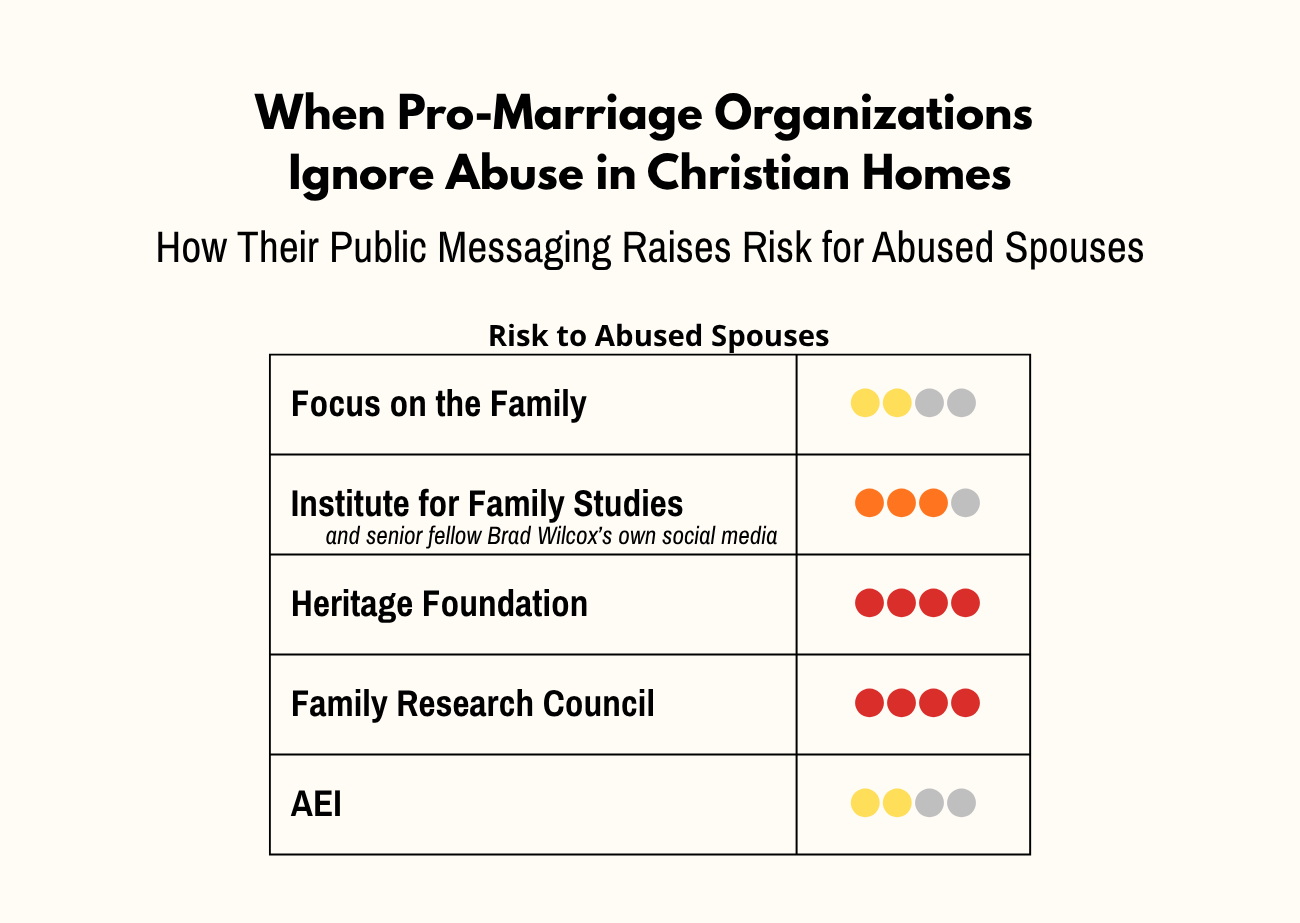
When Pro-Marriage Organizations Ignore Abuse: How Christian and Traditional Voices Fail Christian Wives and Mothers
How Focus on the Family, Institute for Family Studies, Heritage Foundation, Family Research Council, and American Enterprise Institute Messaging Endangers Lives
As Christians, we value the sanctity of marriage. We believe in marriage vows. We believe God meant marriage to be loving, undefiled, and faithful. But what if it is not? What if that marriage has become dangerous?
Too many pro-marriage voices praise marriage, motherhood, and “family stability” without saying clearly enough that safety comes first. Good wives and husbands matter. Wives (or husbands) living with cruelty, coercion, intimidation, betrayal, or abuse matter. When they turn to a trusted organization and do not hear clear exceptions for abuse, domestic violence, child exploitation, or betrayal, they may feel spiritually and morally pressured to stay in danger.
Today I looked at the past 1,000 tweets from these 5 organizations, and reviewed them for marriage messages only (4/2/2026 at 4pm ET). Sadly the pattern was consistent: idealizing marriage, stigmatizing divorce, urging women toward self-erasure, and offering little or no safety-aware counterbalance. Not every post was equally severe. But the overall message still leaned toward preserving the marital status rather than protecting the person.
That is dangerous.
This is also a kind of moral injury. When trusted conservative Christian organizations praise marriage, stigmatize divorce, or flatten abuse into ordinary marital struggle, they do not just give bad advice. They wound the consciences of abused Christian wives and mothers who expected truth, protection, and justice from their own side. See also “Church Betrayal After Abuse: Christian Divorce When the Church Sides with Your Abuser”.
A woman in harm’s way does not need romanticized slogans about thriving, lifelong marriage, or “biblical womanhood.” She needs moral clarity: abuse is not a marital inconvenience, caution is not rebellion, and leaving danger is not sin.
Let’s look at problematic tweets from these 5 Christian or traditional nonprofits. In each case is an exact quote and date, the category of problem, explanation of why it is a red flag, and a rating of severity.
FOCUS ON THE FAMILY’S last 1,000 Tweets from X.com
Potential red flags
- 2026-03-24
Exact quoted line: “Forgiveness is a change in your own attitude. It’s being willing to still show love, gentleness, and kindness to the other person.”
Category: Rushed forgiveness
Why it is a red flag: This frames forgiveness in a way that can pressure hurting spouses to stay warm and accessible to someone harming them, without any safety qualifier. See also “Forgiveness Takes Time Where There’s Marital Abuse or Betrayal”.
Severity: 2
- 2026-02-23
Exact quoted line: “Be willing to make the first move toward reconciliation, even if it feels unfair or vulnerable.”
Category: Pressured reconciliation
Why it is a red flag: Telling someone in a marriage crisis to reconcile even when it feels “unfair or vulnerable” can be dangerous in coercive or abusive dynamics. See also “Safety-First vs. Marriage-First Counseling” and “Marriage Counseling in Abusive Situations is Unethical”.
Severity: 3
- 2026-02-23
Exact quoted line: “Stay present. Listen first.”
Category: Pressured reconciliation
Why it is a red flag: In an abusive context, “stay present” can function as pressure to remain emotionally available rather than prioritize safety and distance. See also “Safety-First vs. Marriage-First Counseling” and “Marriage Counseling in Abusive Situations is Unethical”.
Severity: 2
- 2026-02-23
Exact quoted line: “Even in deep dysfunction, every spouse longs to feel chosen, valued, and emotionally safe.”
Category: Minimizing abuse
Why it is a red flag: “Deep dysfunction” can blur the line between ordinary conflict and abuse, redirecting attention toward the hurting spouse’s duty to soothe the relationship. See also “130 Examples of Abuse: Physical, Emotional, Sexual, Spiritual, Financial and Neglect” and “Can I Divorce for Abuse? Can Christians Divorce for Abuse?”.
Severity: 2
- 2026-02-25
Exact quoted line: “wives should submit to their husbands in everything”
Category: Submission or male entitlement
Why it is a red flag: This is classic submission language that abusive men can weaponize, especially without any warning about misuse or coercion. See also “The Bible Teaches Us to Get Away from Abusers”.
Severity: 3
- 2026-02-07
Exact quoted line: “Til death do us part”
Category: Divorce stigma / church-spiritual pressure
Why it is a red flag: This elevates permanence as the ideal in a way that can intensify shame and spiritual pressure on women considering leaving a harmful marriage. See also “Are “Traditional Marriage Vows” Biblical? How Focus on the Family Misuses Them” and “Marriage Is a Conditional Covenant (Not an Unbreakable Promise)”.
Severity: 2
- 2026-02-07
Exact quoted line: “you’re promising a close marital bond that can’t be broken”
Category: Divorce stigma
Why it is a red flag: This presents marriage as unbreakable, which can trap women morally and emotionally when serious harm is present. See also “Marriage Is a Conditional Covenant (Not an Unbreakable Promise)” and “27 Myths about Divorce That Probably Don’t Apply to Committed Christians”.
Severity: 3
- 2025-08-20
Exact quoted line: “If you don’t move swiftly at the first feelings of resentment or unforgiveness toward your spouse”
Category: Rushed forgiveness
Why it is a red flag: This treats resentment as the urgent problem, which can discourage protective anger and clear-eyed recognition of mistreatment. See also “Forgiveness Takes Time Where There’s Marital Abuse or Betrayal”.
Severity: 2
- 2026-03-16
Exact quoted line: “Love is, in fact, a choice we have to make each day. We have to choose to forgive”
Category: Rushed forgiveness
Why it is a red flag: This makes forgiveness sound like a daily marital duty, without distinguishing normal conflict from repeated harm. See also “Forgiveness Takes Time Where There’s Marital Abuse or Betrayal”.
Severity: 2
- 2026-03-16
Exact quoted line: “love covers over a multitude of sins”
Category: Sin-leveling
Why it is a red flag: While this aspect from a list of descriptors of love from 1 Corinthians 13, stating this without the other aspects from the same passage gives — such as “it does not rejoice at wrongdoing” and “love always protects”— can flatten serious wrongdoing into generic “sins,” which may minimize patterns of abuse, coercion, or cruelty. See also “130 Examples of Abuse: Physical, Emotional, Sexual, Spiritual, Financial and Neglect” and “Can I Divorce for Abuse? Can Christians Divorce for Abuse?”.
Severity: 3
- 2026-02-23
Exact quoted line: “If your marriage is in crisis, first surrender to God. Lean into Him with everything you have – there is no better source of help.”
Category: Church/spiritual pressure
Why it is a red flag: Spiritual counsel can help, but phrased this way it can steer people toward endurance and inward spiritual work before practical safety steps. See also “The Bible Teaches Us to Get Away from Abusers” and “Adultery, Abuse, Abandonment are Biblical Grounds for Divorce”.
Severity: 2
Summary
Focus on the Family messaging is frequently a meaningful risk for abuse victims, divorcees, or women contemplating marriage. The main pattern is forgiveness-and-reconciliation pressure, permanence language, and submission teaching without enough safety nuance. It often speaks as though the central marital problem is hurt feelings, resentment, or distance, which can blur the line between ordinary conflict and abusive behavior. The result is a feed that may encourage women to endure, soften, reconcile, and spiritualize situations that may actually require boundaries, separation, or outside intervention.
Counterbalancing safety-aware messages
Focus on the Family does sometimes speak responsibly about abuse:
- 2026-03-07 — “You do not have to stay silent about what’s hurting you. God gave you a voice and dignity. Pray, reach out, and let someone safe hear your heart”
- 2025-05-15 — “If you are in an abusive relationship, go to a safe place and call the National Domestic Violence Hotline”
- 2026-01-25 — “God’s design for marriage never included abuse, violence or coercive control”

Heritage Foundation’s last 1,000 Tweets from X.com
Potential red flags
Date: 2026-03-22
Exact quoted line: “Heritage Policy Analyst @emlwaters new book, Lead Like Jael, aims to teach college students and young adults how to recover biblical womanhood, and is an essential how-to guide to create a world after feminism.”
Category: church/spiritual pressure
Why it is a red flag: It frames “biblical womanhood” as the corrective and feminism as the problem, which can pressure women toward religious-role expectations without any safety exceptions for sexually immoral, coercive, or abusive marriages. See also “The Bible Teaches Us to Get Away from Abusers” and “Adultery, Abuse, Abandonment are Biblical Grounds for Divorce”.
Severity: 2
Date: 2026-03-18
Exact quoted line: “You can’t do it all at one time, but I would say put first things first. And getting the family worked out first and then figuring out the career after that.”
Category: boundary-undermining
Why it is a red flag: This tells women to prioritize family formation before career stability, which can make women more vulnerable if a relationship becomes controlling, unsafe, or financially entrapping. See also “But He Never Hit Me: Divorce for Neglect, Emotional, and Financial Abuse” and “Turning Point 1: Fear, I Escaped and Never Went Back”.
Severity: 2
Date: 2026-03-18
Exact quoted line: “Serving in Congress has paled to the most important job I’ve ever had, which is to be a wife, a mother, a [grandma], and soon to be great-grandma.”
Category: submission or male entitlement
Why it is a red flag: It idealizes women’s relational roles as their highest calling. In real-world harmful marriages, messaging like this can normalize self-erasure and make it harder to treat safety and autonomy as priorities. See also “The Bible Teaches Us to Get Away from Abusers”.
Severity: 1
Date: 2026-03-06
Exact quoted line: “Giving into the lie that marriage and motherhood will ruin your life could actually be the thing holding you back from the greatest adventure you’ve ever embarked on.”
Category: minimizing abuse
Why it is a red flag: Calling fears about marriage and motherhood “the lie” can flatten legitimate caution from women who have seen abuse, coercion, betrayal, or abandonment up close. See also “But He Never Hit Me: Divorce for Neglect, Emotional, and Financial Abuse” and “Turning Point 1: Fear, I Escaped and Never Went Back”.
Severity: 3
Date: 2026-02-13
Exact quoted line: “Resotre marriage, restore the family, restore America.”
Category: divorce stigma
Why it is a red flag: It treats marriage restoration as a social cure-all, which can stigmatize divorce or separation even when those choices are protective and necessary. See also “Marriage Is a Conditional Covenant (Not an Unbreakable Promise)” and “27 Myths about Divorce That Probably Don’t Apply to Committed Christians”.
Severity: 2
Date: 2026-02-12
Exact quoted line: “The family is the most fundamental unit of self-government, undergirded by marriage.”
Category: divorce stigma
Why it is a red flag: It centers marriage as the proper foundation of family life, which can marginalize women and children whose safety depends on leaving a destructive marriage. See also “Marriage Is a Conditional Covenant (Not an Unbreakable Promise)” and “27 Myths about Divorce That Probably Don’t Apply to Committed Christians”.
Severity: 2
Date: 2026-02-12
Exact quoted line: “We seek an America where a husband, his wife, and their children are protected by law, encouraged by government, and supported by societal institutions so that they may prosper in peace and security, and pass on our heritage to subsequent generations.”
Category: boundary-undermining
Why it is a red flag: It presents one idealized family form as the model to be reinforced by law and institutions, with no acknowledgment that some wives and children need distance, not preservation of the unit. See also “But He Never Hit Me: Divorce for Neglect, Emotional, and Financial Abuse” and “Turning Point 1: Fear, I Escaped and Never Went Back”.
Severity: 2
Date: 2026-01-28
Exact quoted line: “Yes. Children need a mom and a dad, as God designed, committed to each other in marriage for life.”
Category: stay-for-the-kids pressure
Why it is a red flag: “Marriage for life” plus a mom-and-dad ideal can pressure women to remain in damaging marriages for the children rather than prioritize safety. See also “Is it Always Best to ‘Stay for the Kids’? No, Not If the Home is Toxic”.
Severity: 3
Date: 2026-01-28
Exact quoted line: “Proud to be a part of this coalition. God designed marriage as the union of one man and one woman. Social science clearly shows that children (and adults) thrive best in this family structure.
Moms & dads are not optional. The needs of children are greater than adult “equality.””
Category: stay-for-the-kids pressure
Why it is a red flag: It treats one family structure as the unquestioned best and explicitly subordinates adult concerns, which can be used to pressure women to stay despite serious harm. See also “Is it Always Best to ‘Stay for the Kids’? No, Not If the Home is Toxic” Also, note that this tweet is talking about the #GreaterThan campaign coalition, headed by Katy Faust; and it’s important to debunk the messages she espouses in her book Them Before Us.
Severity: 3
Overall account rating
High concern.
Summary
The pattern is heavy on marriage idealization, motherhood idealization, and religious framing with little sign of safety exceptions. The strongest concerns are posts that present marriage as broadly superior, lifelong, and child-centered in ways that can stigmatize divorce and make women feel morally obligated to endure harmful situations. The account does not usually blame victims directly, but it repeatedly promotes a framework that can minimize relational danger and undermine boundaries. For abuse victims, divorcees, or women realistically assessing marriage risk, this is unsafe-leaning messaging.
Counterbalancing safety-aware tweets
I did not find clear marriage/family tweets in this file subset that explicitly affirmed leaving abuse, prioritizing safety, respecting boundaries, or resisting pressured reconciliation.

AEI’s last 1,000 Tweets from X.com
Potential red flags
Date: 2025-12-15
Exact quoted line: “The narrative has taken hold that marriage is a riskier proposition than perhaps it once was, particularly for young women who have professional ambitions.”
Category: minimizing abuse
Why it is a red flag: This can read as if women’s caution about marriage is mainly a “narrative,” rather than sometimes being grounded in realistic concerns about unequal labor, coercion, or mistreatment. See also “130 Examples of Abuse: Physical, Emotional, Sexual, Spiritual, Financial and Neglect” and “Can I Divorce for Abuse? Can Christians Divorce for Abuse?”.
Severity: 1
Date: 2025-11-17
Exact quoted line: “When divorce becomes common in a friend group, it can influence how people view commitment, conflict, and the purpose of marriage itself.”
Category: divorce stigma
Why it is a red flag: It frames divorce in socially corrosive terms and can encourage people to view divorced friends as a bad influence rather than as people who may have made necessary safety decisions. See also “Marriage Is a Conditional Covenant (Not an Unbreakable Promise)” and “27 Myths about Divorce That Probably Don’t Apply to Committed Christians”.
Severity: 2
Date: 2025-11-06
Exact quoted line: “Divorce is contagious. If a high % of your close friends are divorced, you are more likely to get/be divorced.”
Category: divorce stigma
Why it is a red flag: “Divorce is contagious” is highly stigmatizing language. It can shame divorcees and imply their presence spreads marital failure rather than recognizing abuse, betrayal, or chronic harm as real causes of divorce. See also “When ‘Divorce is Contagious’ Misses the Real Story” and “Why Calling Divorce “Contagious” Hurts Christians Who Need Community.”
Severity: 3
Date: 2025-12-10
Exact quoted line: “Today, there is no group of women in America who are less happy than prime-aged women with no immediate family”
Category: divorce stigma
Why it is a red flag: It stigmatizes women without spouses or children and can pressure women to stay in or pursue unsafe relationships to avoid that status. See also “Will I Find Happiness Again? Remarry or Stay Single After Divorce!” and “12 Positive Outcomes of Divorce that Nobody Told Us”.
Severity: 3
Date: 2025-12-04
Exact quoted line: “Elizabeth Gilbert’s ‘Eat, Pray, Love’ empowered women to leave their husbands and travel the world to find themselves”
Category: divorce stigma
Why it is a red flag: It casts leaving husbands in a negative, dismissive light without distinguishing selfish exits from necessary departures from harmful marriages. See also “Marriage Is a Conditional Covenant (Not an Unbreakable Promise)” and “27 Myths about Divorce That Probably Don’t Apply to Committed Christians”.
Severity: 2
Overall account rating
Moderate concern.
Summary
The pattern here is less overtly harsh than Family Research Council or Heritage Foundation, but it still contains repeated marriage-and-motherhood idealization, church-based marriage messaging, and stigmatizing comparisons that can be unsafe for women facing real relational harm. The biggest concerns are the posts that treat marriage and motherhood as the happiness path, suggest church is the simple answer for stronger marriages, and shame women outside that model. The account does not strongly traffic in direct victim-blaming, but it does create pressure toward conformity and away from safety-based caution. For abuse victims, divorcees, or women contemplating marriage realistically, that can still be harmful.
Counterbalancing safety-aware tweets
There was some limited nuance in the file around not treating “marry young” as one-size-fits-all, but I did not find clear safety-aware tweets explicitly affirming leaving abuse, prioritizing safety, protecting boundaries, or resisting pressured reconciliation.
Institute for Family Studies’ Last 1,000 Tweets on X.com
Potential red flags
Date: 2026-03-23
Exact quoted line: “I realized the career-first, put-off children script I’d followed had quietly postponed the very desire for motherhood it had told me to ignore.”
Category: boundary-undermining
Why it is a red flag: It frames caution and delayed childbearing as a harmful script, which can pressure women to downplay legitimate concerns about safety, readiness, or relational risk. See also “But He Never Hit Me: Divorce for Neglect, Emotional, and Financial Abuse” and “Turning Point 1: Fear, I Escaped and Never Went Back”.
Severity: 2
Date: 2026-02-17
Exact quoted line: “For both men and women, the primary predictor of marital happiness is clear: high commitment to your spouse.”
Category: minimizing abuse
Why it is a red flag: In unsafe marriages, “high commitment” language can blur the line between healthy perseverance and staying bound to harmful treatment. See also “130 Examples of Abuse: Physical, Emotional, Sexual, Spiritual, Financial and Neglect” and “Can I Divorce for Abuse? Can Christians Divorce for Abuse?”.
Severity: 2
Date: 2026-01-15
Exact quoted line: “There is at least one step young couples can take to strengthen their marriages, and it’s pretty simple: Go to church.”
Category: church/spiritual pressure
Why it is a red flag: It presents church involvement as a marital fix without any safety caveat for coercion, abuse, or dangerous dynamics. See also “The Bible Teaches Us to Get Away from Abusers” and “Adultery, Abuse, Abandonment are Biblical Grounds for Divorce”.
Severity: 2
Date: 2026-02-13
Exact quoted line: “A recent study by @FamStudies shows regular church attendance leads to stronger marriages.
| National Marriage Week”
Category: church/spiritual pressure
Why it is a red flag: It ties marital strength to church participation, which can feed the idea that spiritual compliance is the answer even when a marriage is unsafe. See also “The Bible Teaches Us to Get Away from Abusers” and “Adultery, Abuse, Abandonment are Biblical Grounds for Divorce”.
Severity: 2
Date: 2026-02-12
Exact quoted line: “.@Gallup survey finds married couples more likely to be ‘thriving.’
| National Marriage Week”
Category: divorce stigma
Why it is a red flag: It promotes marriage as the thriving path without acknowledging that some women thrive only after separation or divorce from harmful spouses. See also “Will I Find Happiness Again? Remarry or Stay Single After Divorce!” and “12 Positive Outcomes of Divorce that Nobody Told Us”.
Severity: 2
Overall account rating
Concerning / unsafe-leaning for abuse victims, divorcees, or women weighing marriage under real-world relational risk.
Summary
The pattern is not usually explicit victim-blaming, but repeated idealization of marriage, motherhood, and traditional womanhood without meaningful safety exceptions. Several posts frame caution about marriage as misguided, and several elevate marriage as socially foundational in a way that can stigmatize divorce or separation. The strongest red flags are the tweets that treat fear of marriage/motherhood as “a lie” and those that urge women to put family before career. In a real-world abuse context, that messaging can make women doubt prudent caution, minimize risk, and feel morally pressured to fit a preferred family script.
Counterbalancing safety-aware tweets
I did not see clear counterbalancing marriage/family tweets in this file subset that explicitly affirmed leaving abuse, prioritizing safety, respecting boundaries, or resisting coercive reconciliation.

Brad Wilcox’s Last 1,000 Tweets on X.com
Brad Wilcox is a senior fellow at the Institute for Family Studies, so his personal feed is worth examining alongside IFS itself.
Potential red flags
Date: 2026-03-23
Exact quoted line: “For years, pushing back against the cult of female victimhood has been one of my core messages.”
Category: victim-blaming
Why it is a red flag: This is open contempt for women naming harm. In Christian settings, women already struggle to be believed when they describe coercion, betrayal, sexual selfishness, intimidation, or abuse. Messaging like this trains readers to treat women’s pain as exaggeration or ideology instead of something that may need moral clarity and protection. See also “27 Ways Churches Gaslight Abuse and Betrayal Victims (And the Biblical Truth)” and “When Your Friend Doesn’t Believe You’re Being Abused”.
Severity: 3
Date: 2026-03-23
Exact quoted line: “Women were lied to. We were taught to put off love for more ‘important’ things like self, status and stuff, and family would come easily later in life.”
Category: boundary-undermining
Why it is a red flag: This judges women’s caution and life planning. In the real world, some women delay marriage because they are trying to finish school, become financially stable, heal from trauma, or avoid becoming trapped with an unsafe man. Framing that caution as a lie can push women to distrust their own prudence. See also “Why You Did Not See the Red Flags And Why It Is Not Your Fault” and “Book Review: Before You Say ‘I Do’ Christian Premarital Workbook”.
Severity: 2
Date: 2026-03-23
Exact quoted line: “countless women have become victims of something—the seductive lies peddled by ‘girl boss’ feminism.”
Category: victim-blaming
Why it is a red flag: Instead of showing concern for women harmed by actual men, this shifts sympathy toward a culture-war story in which feminism is the real villain. That can make readers less willing to take women’s reports of mistreatment seriously. See also “27 Ways Churches Gaslight Abuse and Betrayal Victims (And the Biblical Truth)” and “Unconditional Love in Marriage Does Not Mean Enduring Abuse”.
Severity: 3
Date: 2026-04-02
Exact quoted line: “These conservative students view the divorce revolution, 2nd/4th waves of feminism, and the devaluation of masculinity as driving today’s societal malaise.”
Category: divorce stigma
Why it is a red flag: This casts divorce itself as a driver of social decline. That can shame women for even contemplating divorce, even when divorce may be the safer and more truthful response to coercion, infidelity, abuse, or chronic deception. See also “No-Fault Divorce Myths and How to Refute Them” and “Marriage Is a Conditional Covenant (Not an Unbreakable Promise)”.
Severity: 3
Date: 2026-02-11
Exact quoted line: “If you are worried about the risk of divorce, the risks can be minimized, “by focusing on finding a mate who is a good friend, as well as by embracing a common faith and avoiding cohabitation.””
Category: church/spiritual pressure
Why it is a red flag: Shared faith and friendship can matter, but this makes divorce risk sound manageable through premarital virtue and religiosity. That can hide the reality that some harmful spouses deceive well, perform faith well, and still become coercive or abusive. See also “Adultery, Abuse, Abandonment are Biblical Grounds for Divorce” and “But I Thought It Was God’s Will for Me to Marry This Person!”.
Severity: 2
Date: 2026-03-31
Exact quoted line: “Married mothers are the happiest among young women.”
Category: divorce stigma
Why it is a red flag: This creates a hierarchy where married motherhood is the happiest and therefore most desirable status. That can shame single women, childless women, and divorcees, and can push women to preserve a marriage at too high a cost. See also “Will I Find Happiness Again? Remarry or Stay Single After Divorce!” and “12 Positive Outcomes of Divorce that Nobody Told Us”.
Severity: 2
Date: 2026-03-31
Exact quoted line: “Get married and be open to the gift of life.”
Category: church/spiritual pressure
Why it is a red flag: This is direct marriage-and-childbearing pressure. It leaves no room for the woman who needs to slow down, vet a man carefully, remain single, or leave a relationship that has already become unsafe. See also “Unconditional Love in Marriage Does Not Mean Enduring Abuse” and “Afraid You’ll Never Find a Healthy Relationship After Abuse?”.
Severity: 3
Date: 2026-02-27
Exact quoted line: “Single, childless young women are markedly less happy than their peers who are married mothers.”
Category: divorce stigma
Why it is a red flag: This stigmatizes women outside marriage and motherhood. That kind of messaging can make women fear singleness more than they fear a destructive marriage. See also “Will I Find Happiness Again? Remarry or Stay Single After Divorce!” and “5 Christians Who Divorced and Are Thriving Now”.
Severity: 2
Date: 2026-02-27
Exact quoted line: “women who marry in their 20s & start having kids are clearly happier than their single, childless peers today”
Category: boundary-undermining
Why it is a red flag: This pressures women toward earlier marriage and motherhood as the superior path. It can weaken careful discernment and feed the idea that waiting, screening, or choosing singleness is failure. See also “Book Review: Before You Say ‘I Do’ Christian Premarital Workbook” and “Why You Did Not See the Red Flags And Why It Is Not Your Fault”.
Severity: 2
Date: 2026-03-03
Exact quoted line: “Parents’ divorce => adult children’s lower fertility”
Category: stay-for-the-kids pressure
Why it is a red flag: This frames divorce as something that harms children’s later life outcomes, which can pressure mothers to stay in marriages that are dangerous, cruel, or degrading. See also “Is it Always Best to ‘Stay for the Kids’? No, Not If the Home is Toxic” and “New Study Shows Kids of Divorce Rarely Face Teen Pregnancy, Jail, or Early Death”.
Severity: 2
Date: 2026-04-02
Exact quoted line: “Children in the West grow up seeing their own working mothers tired, worn out, & burdened by the second shift.”
Category: boundary-undermining
Why it is a red flag: This shames women’s paid work and can push women toward dependency or traditional-role pressure rather than emphasizing informed choice, safety, and the ability to support oneself if a marriage becomes harmful. See also “But He Never Hit Me: Divorce for Neglect, Emotional, and Financial Abuse” and “How to Afford Divorce When Your Spouse Controls the Money”.
Severity: 1
Date: 2026-02-12
Exact quoted line: “Too many women aren’t prioritizing family”
Category: boundary-undermining
Why it is a red flag: This blames women for not centering family enough, which can pressure them to subordinate safety, discernment, and autonomy to a preferred family script. See also “Unconditional Love in Marriage Does Not Mean Enduring Abuse” and “God Hates Abuse”.
Severity: 2
Overall account rating
Orange-Red / unsafe.
Summary
Brad Wilcox’s personal feed is slightly worse than the Institute for Family Studies account because the same general themes show up with more direct contempt for women’s warnings. The pattern includes victim-blaming language, anti-divorce framing, marriage-and-motherhood idealization, and repeated pressure toward pronatalism and traditional roles. The strongest concerns are the tweets mocking “female victimhood,” presenting feminism and divorce as civilizational harms, and portraying married motherhood as the happiness standard women should pursue. For abuse victims, divorcees, or women contemplating marriage realistically, this is unsafe messaging.
Counterbalancing safety-aware tweets
I did not find clear counterbalancing tweets in this file subset that explicitly affirmed leaving abuse, prioritizing safety, protecting boundaries, or resisting pressured reconciliation.
Family Research Council’s Last 1,000 Tweets on X.com
Potential red flags
Date: 2026-04-01
Exact quoted line: “A great story with a great message. Thank you, @howertonjosh, for affirming biblical marriage to the next generation 👏”
Category: church/spiritual pressure
Why it is a red flag: It presents “biblical marriage” as the norm to affirm without any safety carve-out for women facing coercion, abuse, or destructive marriages. See also “The Bible Teaches Us to Get Away from Abusers” and “Adultery, Abuse, Abandonment are Biblical Grounds for Divorce”.
Severity: 2
Date: 2026-03-24
Exact quoted line: “Q. What would you say to people in this generation who have a perfectionist mindset on marriage?
A. “Marriage [is] the uniting of two sinners into a relationship that will bless you and test you and shape you and fashion you.” –The late Dr. Voddie Baucham https://t.co/9svvKeBcu0”
Category: minimizing abuse
Why it is a red flag: It frames marital hardship as part of growth and testing, which can blur the line between normal imperfection and genuinely harmful behavior. See also “130 Examples of Abuse: Physical, Emotional, Sexual, Spiritual, Financial and Neglect” and “Can I Divorce for Abuse? Can Christians Divorce for Abuse?”.
Severity: 2
Date: 2026-03-19
Exact quoted line: “”Being their momma is who I’m meant to be.” Love this testimony from @AmericanIdol’s Hannah Harper!
Motherhood isn’t easy, but it is one of life’s greatest rewards. https://t.co/somtml3l0s”
Category: boundary-undermining
Why it is a red flag: It idealizes motherhood as core female purpose in a way that can pressure women to discount risk, loss of safety, or the need for independence before marriage. See also “But He Never Hit Me: Divorce for Neglect, Emotional, and Financial Abuse” and “Turning Point 1: Fear, I Escaped and Never Went Back”.
Severity: 2
Date: 2026-02-13
Exact quoted line: “A recent study by @FamStudies shows regular church attendance leads to stronger marriages.
| National Marriage Week”
Category: church/spiritual pressure
Why it is a red flag: It ties marital strength to church participation, which can feed the idea that spiritual compliance is the answer even when a marriage is unsafe. See also “The Bible Teaches Us to Get Away from Abusers” and “Adultery, Abuse, Abandonment are Biblical Grounds for Divorce”.
Severity: 2
Date: 2026-02-12
Exact quoted line: “.@Gallup survey finds married couples more likely to be ‘thriving.’
| National Marriage Week”
Category: divorce stigma
Why it is a red flag: It promotes marriage as the thriving path without acknowledging that some women thrive only after separation or divorce from harmful spouses. See also “Will I Find Happiness Again? Remarry or Stay Single After Divorce!” and “12 Positive Outcomes of Divorce that Nobody Told Us”.
Severity: 2
Date: 2026-02-10
Exact quoted line: “Recent studies show that, compared to single peers, married couples experience…
- Less than half the rate of suicide and alcohol abuse
- Less than a quarter of the rate of drug deaths
- Over twice the average financial assets
- Almost twice the rate of happiness (for women)
- Almost twice the rate of meaning in life (for men)
- 13% greater trust in their partner’s faithfulness
- 16% greater belief in their partner’s trustworthiness
- 16% greater trust in their partner’s financial management
| National Marriage Week”
Category: divorce stigma
Why it is a red flag: It strongly markets marriage as safer, happier, and more stable than singleness, which can shame divorcees and push women to undervalue prudent caution. See also “Marriage Is a Conditional Covenant (Not an Unbreakable Promise)” and “27 Myths about Divorce That Probably Don’t Apply to Committed Christians”.
Severity: 3
Date: 2026-01-28
Exact quoted line: “Yes. Children need a mom and a dad, as God designed, committed to each other in marriage for life.”
Category: stay-for-the-kids pressure
Why it is a red flag: “Marriage for life” plus a mom-and-dad ideal can pressure women to remain in damaging marriages for the children rather than prioritize safety. See also “Is it Always Best to ‘Stay for the Kids’? No, Not If the Home is Toxic”.
Severity: 3
Date: 2026-01-28
Exact quoted line: “Proud to be a part of this coalition. God designed marriage as the union of one man and one woman. Social science clearly shows that children (and adults) thrive best in this family structure.
Moms & dads are not optional. The needs of children are greater than adult “equality.””
Category: stay-for-the-kids pressure
Why it is a red flag: It treats one family structure as the unquestioned best and explicitly subordinates adult concerns, which can be used to pressure women to stay despite serious harm. See also “Is it Always Best to ‘Stay for the Kids’? No, Not If the Home is Toxic”.
Severity: 3
Overall account rating
High concern.
Summary
The pattern is heavy on marriage idealization, motherhood idealization, and religious framing with little sign of safety exceptions. The strongest concerns are posts that present marriage as broadly superior, lifelong, and child-centered in ways that can stigmatize divorce and make women feel morally obligated to endure harmful situations. The account does not usually blame victims directly, but it repeatedly promotes a framework that can minimize relational danger and undermine boundaries. For abuse victims, divorcees, or women realistically assessing marriage risk, this is unsafe-leaning messaging.
Counterbalancing safety-aware tweets
I did not find clear marriage/family tweets in this file subset that explicitly affirmed leaving abuse, prioritizing safety, respecting boundaries, or resisting pressured reconciliation.
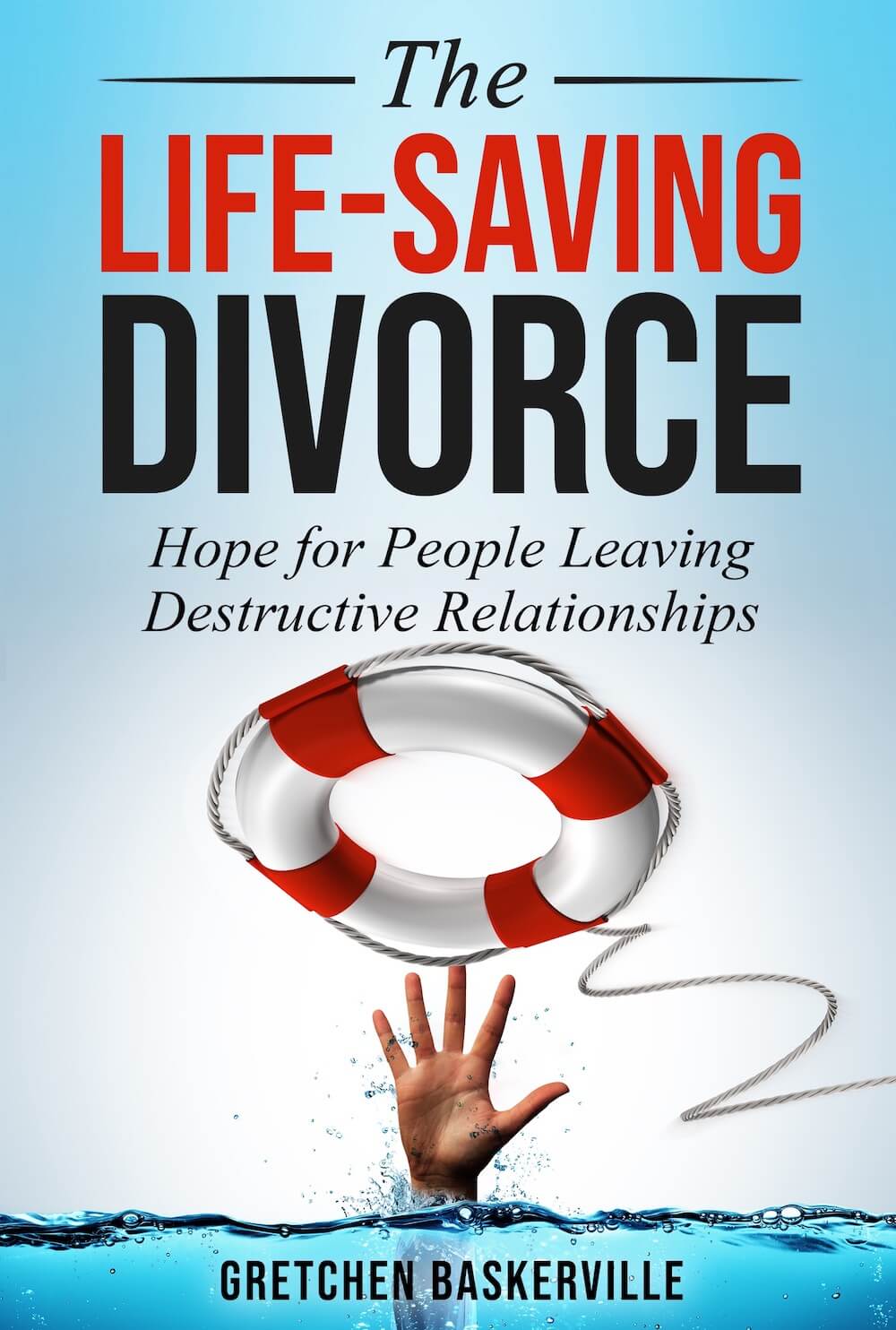
How often do conservative Christians find themselves in dangerous or destructive marriages? More often than many pastors and churchgoers realize. See also “What the LifeWay Study of 1,000 Churchgoing Divorcees Reveals — And Why Focus on the Family Isn’t Talking About It”.
 :
:
 :
: Buy PDF