
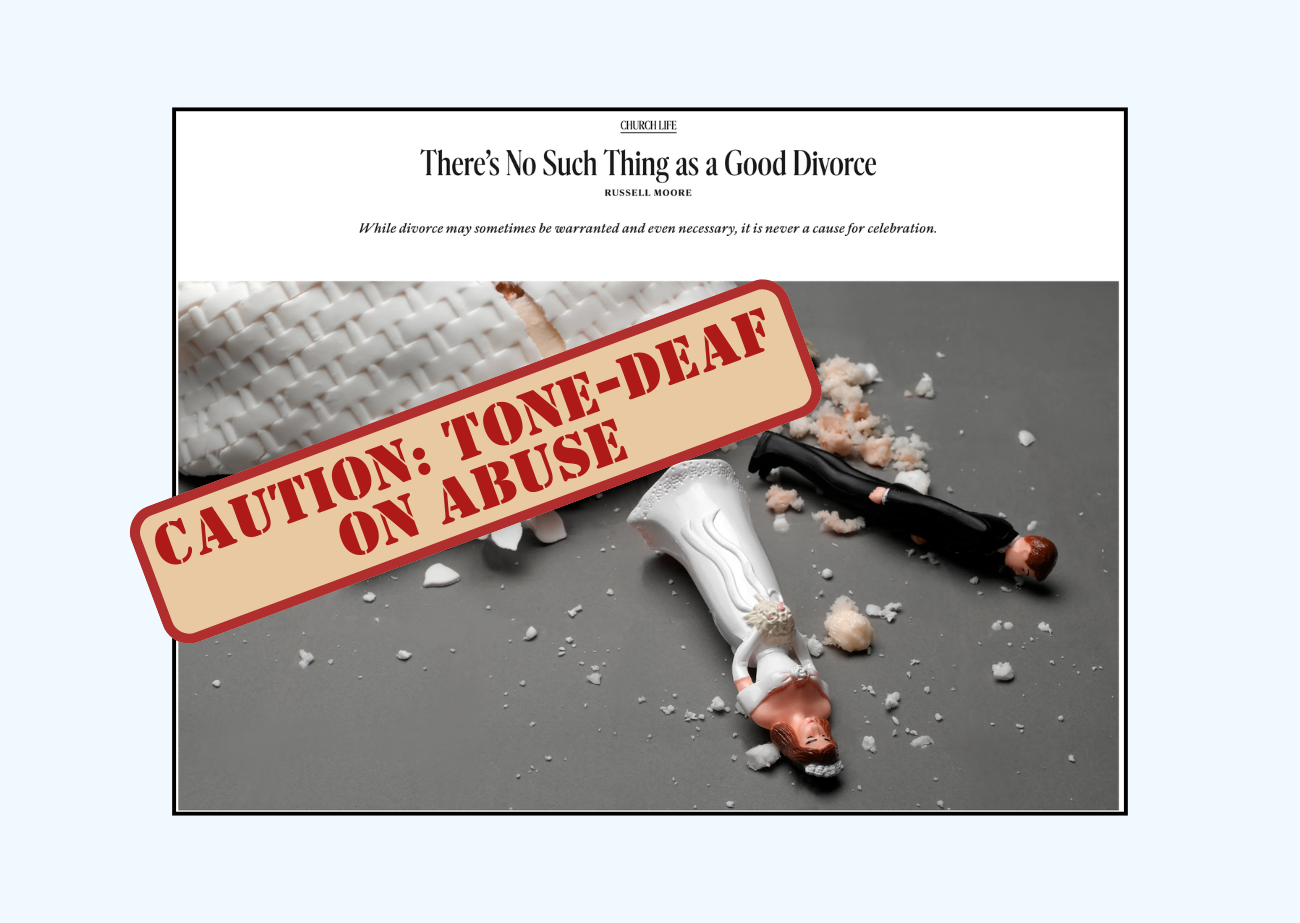
Open Letter to Russell Moore: Divorce as God’s Protection of Abused and Betrayed Spouses
This is an updated version of the email I sent to Russell Moore two weeks ago.
Dear Russell Moore,
I’ve followed you for many years, and I’m writing as someone who has often appreciated the nuance you bring to difficult topics, for example, the fact that you view separation or divorce in cases of abuse to be the “right” thing. Thank you.
I also represent an online private group of nearly 7,000 divorced and separated Christians, many of whom read your article, “There’s No Such Thing as a Good Divorce,” and felt crushed by it.
Recently, one of our members sent me the latest Christianity Today Facebook post recirculating your article.
The response was striking.
Your Article Was Badly Ratioed
The Facebook post had 231 total comments.
Of 84 visible top-level comments that I reviewed 4 in 5 disagreed with some aspect of the post.
- 68 comments (81.0%) pushed back on the article’s framing
- 8 comments (9.5%) supported it
- 7 comments (8.3%) were mixed or mainly semantic
- 1 comment (1.2%) was off-topic
That means the people most moved to respond overwhelmingly objected to the framing of your article.
Christians Push Back
You acknowledge abuse and the necessity of divorce, yet still seem to tone-police those who speak with gratitude about God’s gracious rescue through divorce.
The pushback was remarkably consistent.
Many readers said your piece:
- gave too little weight to abuse
- treated divorce itself as the problem rather than the betrayal, violence, or chronic sin behind it
- ignored the relief many survivors and children experience when a destructive marriage ends
That matters.
Because the people objecting were not mainly casual critics of Christian marriage.
Many were Christians. Many were survivors. Many were speaking from lived experience.
I want to speak plainly, because the people I represent deserve that much.
Your article tries to preserve the seriousness of marriage. I understand that instinct. We were taught the same. Very few divorced Christians treat the collapse of a marriage lightly. We know the grief, the shame, the confusion, the financial upheaval, the disruption for children, and the heartbreak of what should have been.
We do not need to be convinced that divorce is painful.
What we needed from you was evidence that you understand what many conservative Christians have actually lived through.
You Need to Listen More
Your article speaks about divorce in a way that may sound compassionate from a distance, but lands as judgment without enough listening.
Yes, you acknowledge that divorce can be necessary, even in abusive situations.
But the thrust of the piece still tells readers what divorce must mean: trauma, dismemberment, loss, never anything good.
That may feel theologically careful to you.
To many of us, it felt spiritually tone-deaf.
For some of the people I represent, divorce was not the start of chaos.
It was the end of chaos.
It was not the destruction of peace.
It was the first real possibility of peace in years.
It was not a descent into instability, but an exit from:
- fear
- coercion
- manipulation
- addiction
- chronic betrayal
- secrecy
- abandonment
- contempt
We did not become healthier after divorce because we were celebrating sin.
We became healthier because we were finally safe.
Because our homes were quieter.
Because our children could breathe again.
Because our bodies stopped living in constant alarm.
Because we could finally tell the truth.
Divorce did not create the destruction in many of these homes.
It acknowledged that the destruction was already there.
Many of Us Still Thank God for the Rescue
That does not make divorce “beautiful.”
But it does mean the story is more complex than your article allowed.
And years later, many of us are still grateful to the Lord for that rescue.
We thank God that we are alive.
We thank God for the stability that returned slowly over time.
We thank God for helping us get back on our feet emotionally, physically, and financially.
We thank God for peace where there used to be chaos.
So when you ask us to speak only in the language of sadness about our divorces, you are asking many of us to stop giving glory to God for his mercy in delivering us. Some of us have been invited to share our testimonies in church services and then quietly corrected for sounding “too happy.” But we cannot repent of gratitude. We must give glory to God for his rescue.
You may intend to protect the sanctity of marriage.
But for many survivors, that framing feels like a refusal to honor the grace of God that met us in the aftermath of a marriage already shattered by abuse, betrayal, or destruction.
Problem: Describing Divorce as Violent but Not Abuse
Your “dismemberment” metaphor captures one dimension of divorce, but it is too totalizing to describe every case. In some marriages, the violence has already happened. The covenant has already been ripped apart by abuse, exploitation, or chronic betrayal. In those situations, divorce does not create the wound so much as acknowledge it.
A single metaphor cannot carry the moral and emotional complexity of every divorce.
For some, it may capture loss.
For others, it misses reality altogether.
In some marriages, the body has already been torn apart by:
- abuse
- deceit
- exploitation
- addiction
- long-term covenant-breaking
In those cases, legal divorce does not create the violence.
It acknowledges it.
That distinction matters.
What came through again and again in the Facebook comments was this:
People are tired of Christian leaders speaking as though divorce is the main moral problem, while abuse, chronic betrayal, and destructive marriages remain under-addressed.
Readers repeatedly said your article should have focused less on condemning divorce language and more on naming the sins that shatter marriages and endanger spouses and children.
The Evangelical Attendance Gap
This is part of why so many divorced evangelicals no longer trust evangelical voices.
As I explain in Do Evangelicals Shoot Their Own Wounded Divorcees?, based in part on Ryan Burge’s 2020 Christianity Today reporting, the church attendance gap between married and divorced evangelicals is worse than in any other major Christian tradition. That gap did not appear out of nowhere. Many divorced Christians know exactly why it has widened: too often, our marital status matters more to churches than our lives and safety.
The issue is not always doctrine.
It is often:
- tone
- framing
- credibility
- whether safety is centered
- whether survivors are actually heard
When Christians sound more concerned with preserving a moral slogan than with telling the full truth about destructive marriages, survivors hear that.
When an article about divorce does not clearly center safety, abuse, and the realities children endure inside toxic homes, survivors hear that too.
Many of the visible commenters did not object because they were unserious about marriage.
They objected because they know, firsthand, that:
- some children beg for the divorce
- some survivors thank God for it
- some broken homes begin to heal only after the marriage ends
Divorce Is Not Always Rebellion Against God
Divorce is not always selfish.
You seem troubled by any language that sounds like celebration after divorce. But Scripture is full of celebration when people escape danger, oppression, bondage, or destruction.
- Israel sang after crossing the Red Sea.
- The Psalms repeatedly praise God for rescue and refuge.
- Jubilee proclaimed release.
- The prophets spoke of liberty for captives, and
- Jesus announced freedom for the oppressed.
In the Bible, people do not celebrate evil itself; they celebrate deliverance from it. That is why some abused and betrayed spouses speak with gratitude, relief, and even joy after a life-saving divorce. They are not rejoicing that a covenant was shattered. They are rejoicing that they and their children were not destroyed with it.
Sometimes it is the last truthful response to a covenant that has already been shattered by:
- abuse
- adultery
- abandonment
- addiction
- chronic deceit
Sometimes it is not rebellion against God.
Sometimes it is God’s protection of the oppressed.
What a More Pastoral Article Would Have Said
If you wanted to write a more pastoral piece, it would have sounded different. (And if you need quotes, scientific research, and nuance, see the links at the bottom of this post.)
- It would have said that divorce is often grievous, but that grief is not the whole story.
- It would have said that some divorced Christians feel both sorrow and gratitude, both loss and relief.
- It would have said that children are harmed not only by divorce, but also by years of fear, volatility, humiliation, and emotional violence inside intact homes.
- It would have said that the church must stop romanticizing marriage when marriage has become a cover for domination, deception, or despair.
- It would have said that Christians should be more concerned with telling the truth and protecting the vulnerable than with policing whether someone uses hopeful language about life after divorce.
- It would have said that if people are having “divorce parties,” the answer is not only to critique the symbolism, but to ask what kind of suffering made that joy feel like freedom.
- It would have said that release from bondage matters more than rhetoric.
- It would have said that most children of divorce turn out fine.
Most of all, it would have let abused and betrayed spouses speak for themselves.
I Am Asking You to Tell the Truth More Fully
I am not asking you to trivialize divorce.
I am asking you to tell the truth more fully.
The truth is that some marriages end in grief and some in terror.
The truth is that some divorces represent tragic failure and some represent long-delayed rescue.
The truth is that some people are not tempted to call divorce good because they are shallow, but because they survived something.
And the truth is that a Christian witness worthy of Christ must be able to say both:
this is grievous
and
this is also, for some, deliverance.
If Christian leaders cannot say that, then we are not protecting marriage.
We are protecting a narrative.
A Final Appeal
I hope you will reconsider how you speak about this subject in the future.
Nearly 7,000 divorced and separated Christians are not asking for applause for broken covenants.
We are asking for:
- honesty
- humility
- language spacious enough to hold the realities we have lived
- fewer abstractions
- more listening
We are asking to be treated not as cautionary tales, but as members of Christ’s body whose stories deserve more than a metaphor.
Sincerely,
Gretchen Baskerville
On behalf of nearly 7,000 divorced and separated Christians in the Life-Saving Divorce private group
Examples of Pushback from the Facebook Thread
1. Abuse and Safety Were Being Minimized
- One commenter said divorce can be “extremely good” when the spouse is cruel or chronically deceitful, because it allows someone to recover a decent life.
- Another wrote that Christians should condemn abuse and toxicity as “not good,” rather than demonize the victim’s means of escape.
- One woman said her divorce was “absolutely fantastic” because her husband was abusive and later convicted.
- Another said there is “no such thing as a good marriage to an abuser” and thanked God for setting her free through divorce.
- One commenter said the article lacked compassion and real insight because, for the abused spouse, divorce can mean finally being able to breathe again.
2. The Article Ignored What Children Endure in Destructive Homes
- Multiple commenters said children are often better off after divorce when the alternative is living in abuse, terror, or chronic volatility.
- One commenter said her children, now older, still say they are glad the divorce happened. (By the way, in my group this is common. Nearly 9 in 10 parents indicate that their child supported the divorce.)
- Another said some children literally beg the safer parent to divorce.
- One woman said her children directly thanked her for leaving and told her they had not felt safe for a long time.
- Another pushed back on any claim that children “never” see divorce as good, saying her own parents’ divorce was clearly a good thing.
3. The Rhetoric Felt Shaming, Simplistic, or Aimed at the Wrong Problem
- Several commenters argued that the article treated divorce as the problem, when the real issue was abuse, adultery, abandonment, addiction, or betrayal that had already shattered the covenant.
- One person said the “good versus bad” framing was itself the wrong question, and that the better question was how truth, justice, grace, and safety are being honored.
- Another said the “dismemberment” language implied a person can never be whole again after divorce, as though the gospel cannot reach that far.
- A commenter said the piece would have been more honest if it had focused on the causes of divorce rather than shaming good-willed spouses for leaving dangerous situations.
- One of the longest critiques said the article centered the response, divorce, without adequately representing the contexts that make it necessary, and that it invited guilt and shame instead of honest conversation.
Resources for Further Consideration
Why Divorced Evangelicals Pull Away from Church
- Why So Many Faithful Divorcees Can’t Find a Safe Church Home
- Christians Who Divorced: What LifeWay Research Surveys Reveal About Them and How Can Pastors Respond
- Do Evangelicals Shoot Their Own Wounded Divorcees?
When Churches Minimize Abuse and Overprotect Marriage
- 27 Ways Churches Gaslight Abuse and Betrayal Victims (And the Biblical Truth)
- Churches That Block Abused Wives (and Husbands) From Divorcing
- Southern Baptists make Evangelicalism Unsafe for Abused Wives & Husbands
- How Pro-Marriage Organizations Minimize Abuse While Mourning Divorce
Why Some Divorces Are Experienced as Rescue, Not Ruin
- What is a Life-Saving Divorce? Nearly 6 in 10 Divorces Are For Abuse, Adultery, or Addictions
- Harvard Study Shows Divorce Saves Lives
- Is it Always Best to “Stay for the Kids”? Research Says No
- 75% of Divorced People Are Happy (GSS 2024)—So Why Does the Church Say the Opposite?
- Does the Waite and Gallagher Study Really Say Your Marriage Will Become Happy If You Stay 5 Years? No!
What Children Suffer in Destructive-but-Intact Homes
- Research Tells Us Sometimes Divorce is a Net Benefit to Children
- The ACE Study: Adverse Childhood Experiences, Abuse, and Divorce
- Is it Best to ‘Stay for the Kids?’ No, Not Where There’s Abuse
- Judith Wallerstein’s Unexpected Legacy of Divorce Study is Clear: Where There’s Abuse, Divorce is Better for the Kids
- 12 Half-Truths in Focus on the Family’s “How Could Divorce Affect My Kids?”
Biblical and Theological Resources
- Adultery, Abuse, Abandonment are Biblical Grounds for Divorce
- Marriage Is a Conditional Covenant (Not an Unbreakable Promise)
- Does God Hate Divorce? What Malachi 2:16 Really Says in 18 Bible Translations
- Safety Is Biblical: When a Marriage Becomes Harmful
What Pastors Often Miss in Destructive Marriages
- Safety-First vs. Marriage-First Counseling
- Good vs Bad Pastoral Counselors: Marital Abuse
- Pastor Education: How to Respond Biblically to Abuse and Betrayal in Marriage
- Stop Bashing Divorce Survivors From the Pulpit
 :
:
 :
: Buy PDF