
Do Children Resent the Parent Who Leaves a Destructive Marriage? What Two Community Polls Can—and Cannot—Tell Us
We’ve always been told they do. But these two polls suggest the story is more complicated when there’s abuse or betrayal.
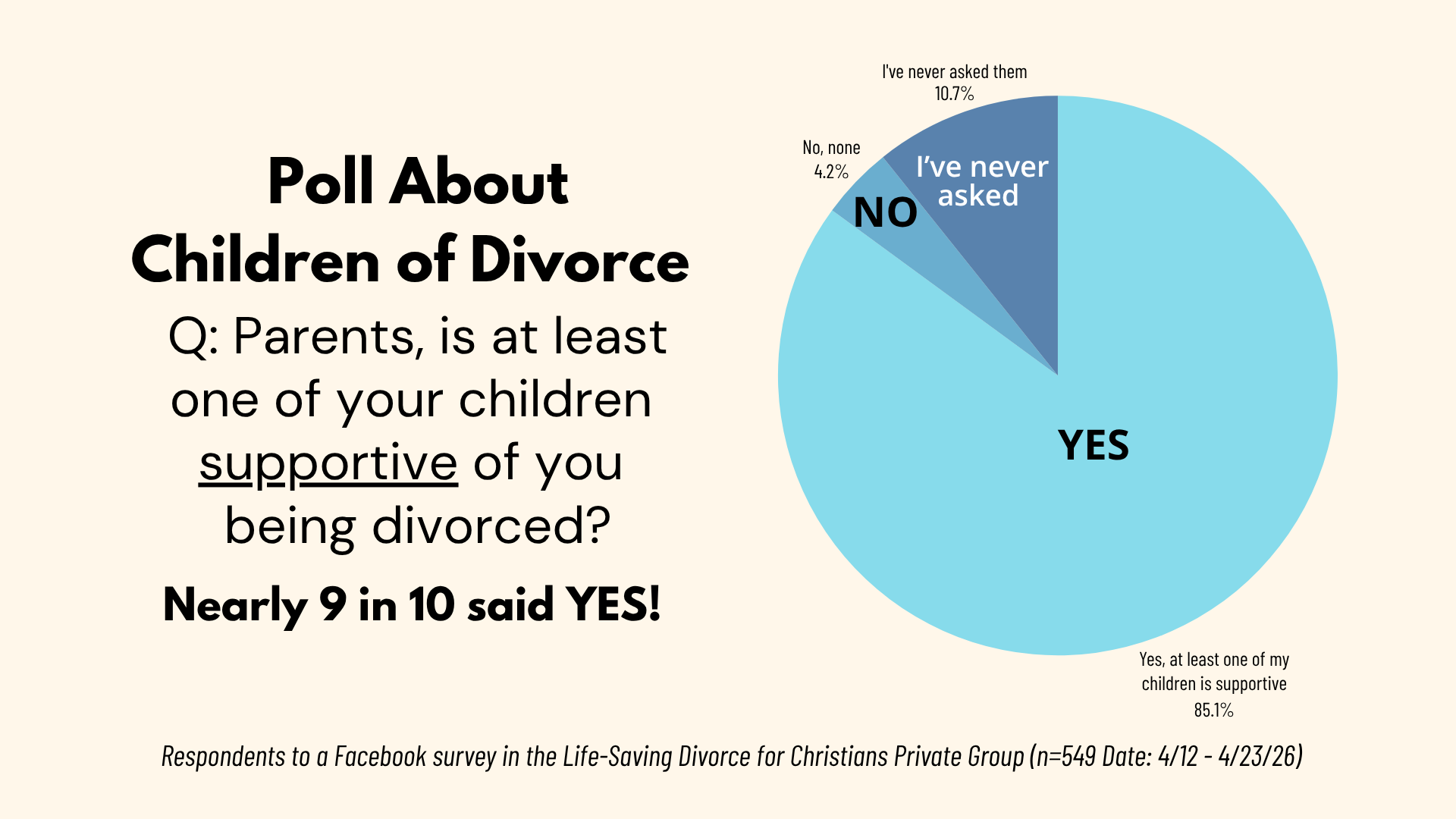
Many Christians are told that if they leave a destructive marriage, their children will resent them for breaking up the family. But in two community polls in my Life-Saving Divorce group, nearly 9 in 10 respondents said that at least one of their children was supportive of the divorce.
Between the two polls, 801 parents participated. In both, nearly 9 in 10 said yes: 88.2% in 2022 and 85.1% in 2026 said that at least one child was supportive of the divorce. That does not prove that all children support divorce. It does not prove that most children everywhere support the parent who leaves. But it does cast doubt on the sweeping claim that children will resent the parent who leaves a destructive marriage.
Read more: Is it Always Best to “Stay for the Kids”? No, Not If the Home is Toxic
I also need to explain why I asked the question the way I did.
My group attracts highly religious Christians who were taught that divorce is wrong, yet ended up needing one for very serious reasons. Many come from conservative church cultures. Many are or were stay-at-home mothers. Many homeschool their children. Many have large families. In the 2022 and 2026 polls, among those who mentioned family size in the comments, about 6 in 10 had three or more children. That matters. When a family has several children, there is often a wide age range, and children are not always in lockstep.
That is why I asked whether at least one child was supportive.
- Children in the same family may react very differently.
- Older children may understand more because they have seen more.
- One child may feel relief while another feels confusion.
- A child’s response may change over time.
So no, that wording was not an attempt to inflate the result. It was an attempt to reflect reality more honestly.
I also need to say something else plainly: my group is not a random sample of the general public. It is a support community for highly religious people, and many members are survivors of serious marital harm. In another poll in this same community, the overwhelming top reason named for the marriage breakdown was mental, verbal, financial, or spiritual abuse or control. Others mentioned cheating, addiction, physical abuse or intimidation, and neglect.
Read more: But He Never Hit Me: Divorce for Neglect, Emotional, and Financial Abuse
Here is what these two polls can tell us:
- The claim “your kids will resent you for divorcing” is not supported by these two polls.
- In destructive homes, children often appear relieved when the marriage ends.
- Some children later say the parent should have left sooner.
- Children often sense more than adults realize.
Here is what these polls cannot tell us:
- They cannot predict how every child will respond.
- They cannot stand in for national random-sample research.
- They cannot prove that divorce is easy on children.
- They cannot erase the grief and disruption children often feel.
Still, the comments under both polls were striking. Again and again, parents described children who felt calmer, safer, or relieved that the tension was over. Some children had been watching, absorbing, and coping for years before the divorce was ever filed.
Below are sample comments from parents in the two polls. I am intentionally including a few “haven’t asked yet” and “not supportive” responses, even though they were a much smaller share, because I want readers to see the full range.
What Parents Actually Said
These parents are speaking for themselves. I’ve grouped the comments for readability, but I have not changed their basic meaning.
Relief and peace
- “All 3 kids were relieved when we separated and divorced. One of them even said, ‘I love that our house and lives are happy now.’”
- “For at least 1.5 years after I escaped and left the house and got my own apartment, the kids would just about every week to two weeks tell me that they were so very happy that I got a divorce. To have peace, even 50% of the time, is so much better than 100% chaos.”
- “Both supportive and grateful for it. Both wish it had happened sooner.”
- “All five of mine were for the divorce. They are all supportive of momma.”
- “All my children were glad.”
“You should have left sooner”
- “My three boys are 19, 16 and 15. My oldest first asked me to divorce his dad at age 8.”
- “Mine (now 23, 22, 18 & 16) are entirely supportive. They told me they wanted me to leave sooner than I did.”
- “My adult son said he doesn’t know why I didn’t leave much sooner.”
- “My oldest said he had wondered why he wasn’t angry at me for not leaving sooner.”
- “Unfortunately my children wanted this to happen a long while ago.”
Support that grew with time
- “I answered yes. But that wasn’t the case initially when I left. It took both my children to see for themselves why I had to leave.”
- “Our daughter was 18 at the time. At first she was mad at me for asking him to leave… That changed everything. That was 6 yrs ago and she is still telling me that was the best decision I made and she is so proud of me.”
- “Both of my children told me to do what I needed to do when I told them separately that I was thinking about divorcing their dad.”
- “He doesn’t want to know specifics… but he has been extremely supportive.”
- “My daughter said, ‘It’s been broken a long time. I’m glad you guys are finally admitting it.’”
Some had not asked
- “I’ve never asked, they are too young (5 and 3).”
- “I haven’t asked because he’s literally still a toddler lol.”
- “Mine are a tad young. so i haven’t come out and asked…”
Some were not supportive, or were mixed
- “This is complicated. My adult kids begged me to leave and then when I did the narrative changed and he became the victim… I became the villain in a story they all watched unfold.”
- “I don’t think any of my kids want the separation/divorce… while they’re not ‘supportive’ they’re also not dead against it, I don’t think.”
- “My daughter who lives with me yes. 2 of my sons cut contact with me…”
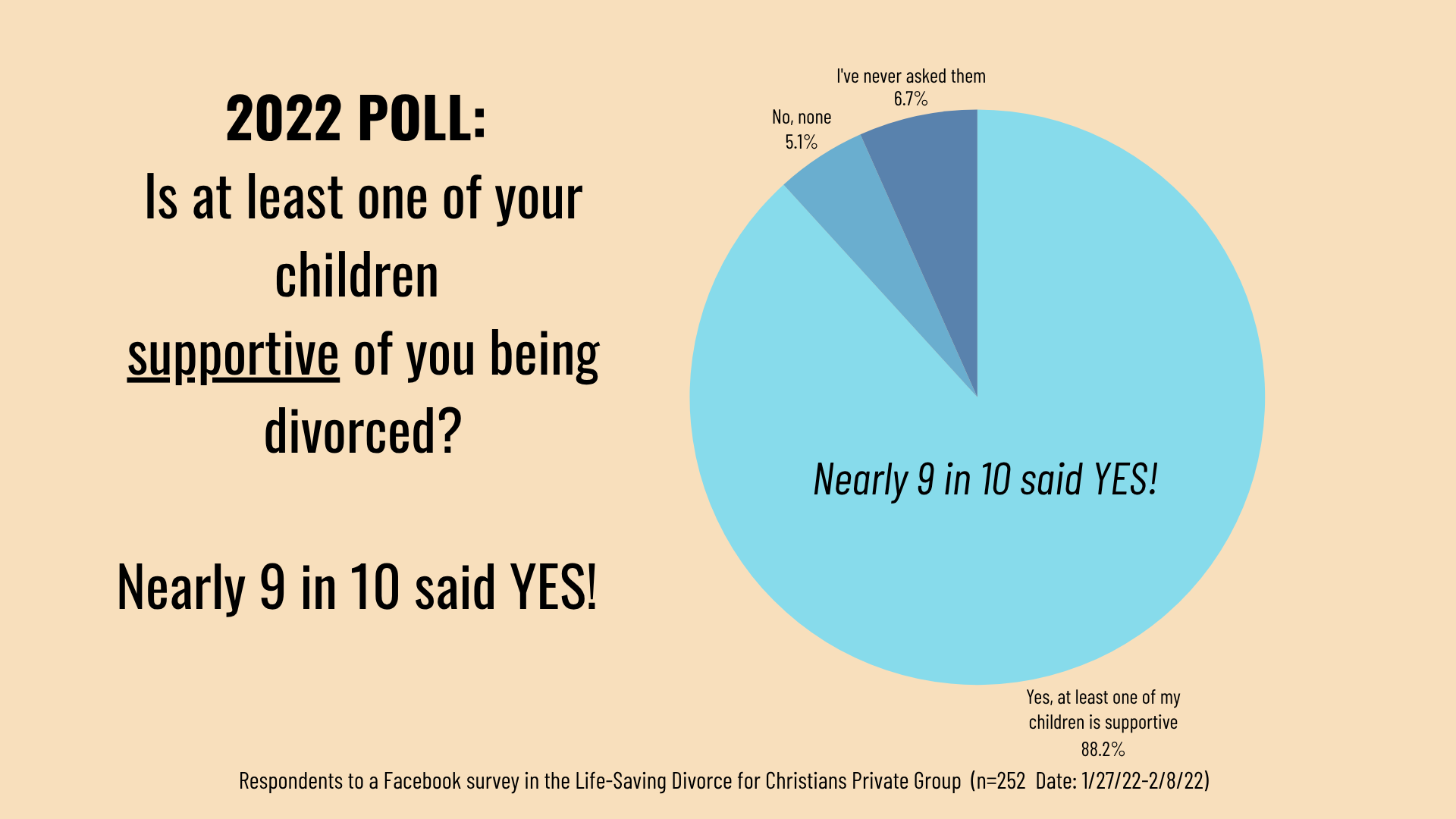
Click to enlarge: Pie chart showing 2022 Life-Saving Divorce poll results
That should not surprise us as much as it does.
Children may not know terms like coercive control, trauma response, or emotional abuse.
Read more: 130 Examples of Abuse: Physical, Emotional, Sexual, Spiritual, Financial and Neglect
But they often know:
- who brings peace into the room,
- who brings fear into the room,
- when everyone is walking on eggshells,
- and when the home finally feels calmer.
At the same time, I do not want to romanticize this. Some children are against the divorce. Some want their parents back together no matter how unhealthy the marriage was. Some are too young to understand. Some are manipulated afterward and drawn into loyalty conflicts.
Read more: 12 Tips for Talking with Alienated Kids
Children may feel several things at once:
- grief,
- relief,
- confusion,
- anger,
- and growing clarity later.
That is exactly why Christians should stop making blanket statements.
When church leaders or Christian authors tell a suffering spouse, “Your children will resent you if you leave,” they are speaking beyond what they know. They may be placing crushing pressure on someone in a home marked by control, betrayal, intimidation, or chronic emotional abuse.
Read more: 27 Myths about Divorce That Probably Don’t Apply to Committed Christians
A child can grieve divorce and still be relieved by it. A child can miss the dream of an intact family and still feel safer after one parent leaves. A child can love both parents — even a destructive one — and still understand that the marriage was unsafe.
That is the conclusion I draw from these two polls: not that children always support divorce, but that conventional wisdom has badly overstated one side of the story. In destructive marriages, relief is more common than we were told, and resentment is not inevitable.
Read More
- How To Tell the Kids About The Divorce
- Will the Kids and I Ever Be Happy Again After Divorce? Studies Say Most People Are!
- Can I Divorce for Abuse? Can Christians Divorce for Abuse?
- What is a Life-Saving Divorce? What Are the Reasons for Divorce?
- Best Parenting Plan Workbook for High-Conflict Divorce
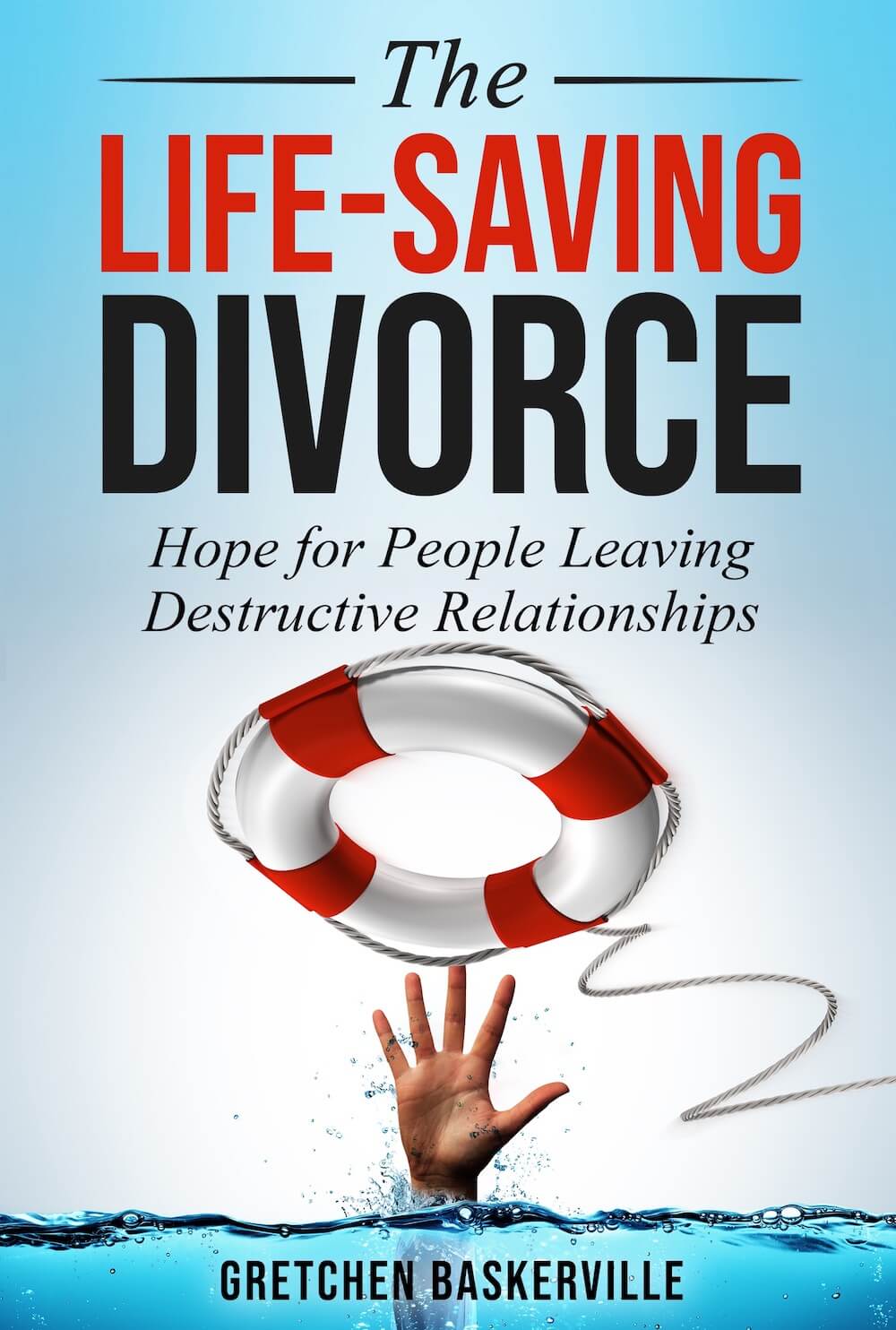
For more on this, see chapter 7 in The Life-Saving Divorce.
 :
:
 :
: Buy PDF