
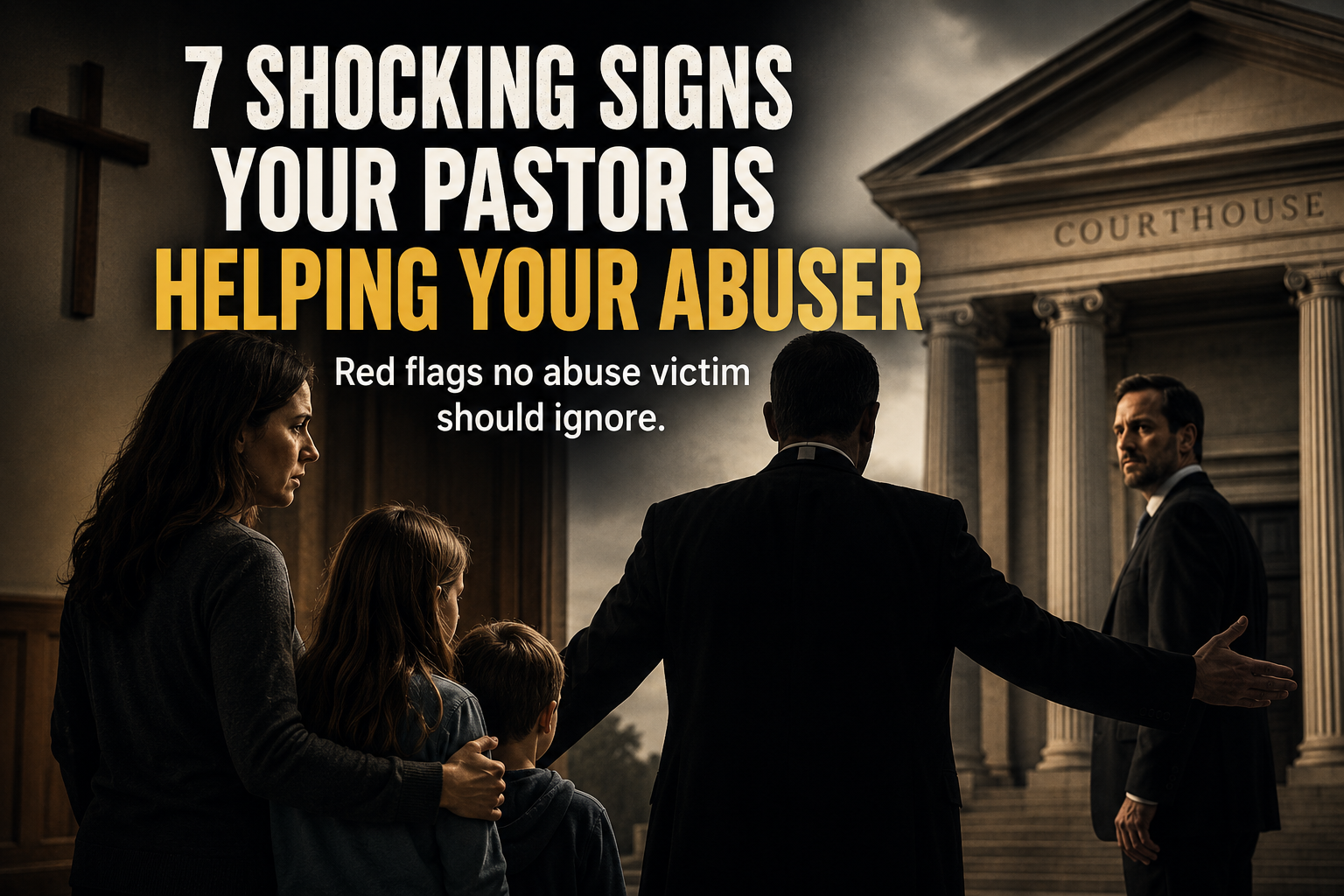
7 Shocking Signs Your Pastor Is Helping Your Abuser
How to Know You’ve Got a Bad Pastor When You’re in an Abusive Marriage
A good pastor does not need to be perfect. He does not need to know everything about domestic abuse on day one. But he does need humility, curiosity, courage, and a willingness to protect the vulnerable.
A bad pastor may sound biblical, quote Scripture, pray sincerely, and still make your situation more dangerous.
If you are trying to decide whether your pastor is safe to talk to about abuse, betrayal, coercive control, addiction, or severe neglect in your marriage, watch for these warning signs. You may also find it helpful to read 11 Ways to Know if a Church is Safe for Abuse Victims or Divorcees.
Danger Sign 1. He Publicly Sides with Your Abuser in Court and Endangers the Children
This should be an immediate disqualifier.
If a pastor knows about abuse, threats, coercive control, criminal behavior, child endangerment, sexual betrayal, addiction, or frightening conduct—and then publicly sides with the harmful spouse in child custody court—that pastor is not acting as a shepherd. He is using spiritual authority to make your family less safe.
This is especially dangerous when children are involved. A pastor who testifies, writes letters, or speaks publicly in favor of unsupervised visitation while ignoring known safety concerns is not neutral. He may be helping place children in harm’s way. For more on why child safety must come first, see The Hidden Danger of Requiring Equal 50/50 Child Custody.
A pastor’s belief in forgiveness, restoration, or miracles is not the same thing as safety. Children should not be asked to ignore their fear because an adult in spiritual authority wants to believe the best about someone who has caused harm.
Safe pastors protect children. Safe pastors take credible concerns seriously. Safe pastors do not use their title to discredit victims, pressure courts, or silence children’s instincts about danger.
If this has happened to you, please remember: a pastor’s opinion is not the voice of God. Adults in authority can make deeply harmful mistakes. Your children do not have to ignore their instincts about safety. You can keep calmly telling your children, “I believe you. Your instincts matter. Safe adults protect children.” For more help talking with children during divorce, see How To Tell the Kids About The Divorce.
For more on this, see Pastor Education: How to Respond Biblically to Abuse and Betrayal in Marriage and Good vs Bad Pastoral Counselors: Marital Abuse.
Danger Sign 2. He Turns Abuse into “Marriage Conflict”
A bad pastor hears about intimidation, threats, coercion, chronic deception, sexual betrayal, addiction, or emotional cruelty and calls it “communication problems.”
He may say things like, “It takes two,” “There are two sides,” “You both need to repent,” or “Every marriage has problems.”
But abuse is not ordinary marital conflict. Abuse is a pattern of power, control, intimidation, entitlement, and harm. If you need help identifying abuse, see my post 130 Examples of Abuse. You may also want to read Abuse Isn’t “Subjective”: How Control Patterns Are Measurable.
If your pastor automatically treats your situation as “two sinners sinning” without first asking whether one spouse is being harmed, controlled, threatened, or silenced, that pastor is not safe.
3. He Reframes Your Fear and Anger as Sin
A bad pastor may admit your spouse did something wrong, but then quickly shifts attention to your reaction.
Your fear becomes “lack of trust in God.” Your anger becomes “bitterness.” Your grief becomes “self-pity.” Your desire for safety becomes “unforgiveness.” Your refusal to reconcile quickly becomes “hard-heartedness.”
This is spiritually dangerous. Fear can be a God-given warning. Anger at injustice can be morally appropriate. Exhaustion after years of mistreatment is not rebellion.
A pastor who moralizes every trauma response may end up protecting the abuser and correcting the victim. For more on this, see Forgiveness Takes Time Where There’s Marital Abuse or Betrayal and 27 Ways Churches Gaslight Abuse and Betrayal Victims.
4. He Makes You List Your Sins Before He Will Address the Abuse
Some pastors cannot let a victim speak plainly unless that person first proves they know they are also a sinner.
They may ask, “What did you do to contribute?” “How did you provoke it?” “What are your sins in the marriage?” or “You’re not faultless either.”
This can sound humble and balanced. But in abuse cases, it often becomes a silencing tactic.
Yes, every human being is a sinner. But not every spouse is abusing, terrorizing, deceiving, coercing, or destroying the other. For more on this common objection, see How Can I Claim to be the Innocent Spouse? I Had My Faults Too!
A pastor who cannot distinguish between destructive behavior and a victim’s survival responses is not practicing wisdom. He is practicing sin-leveling.
5. He Claims to Know Your “Heart Issue”
The phrase “heart issue” can sound biblical. But in unsafe hands, it becomes a tool for spiritual mind-reading.
A bad pastor may decide you are bitter, rebellious, unsubmissive, manipulative, defensive, hard-hearted, codependent, or unwilling to receive correction.
Once he labels you, everything you say may be used as evidence against you. If you cry, you are unstable. If you explain, you are defensive. If you bring evidence, you are bitter. If you set boundaries, you are rebellious.
That is not shepherding. That is spiritual interrogation. For more on how biblical counseling can become behavioral control, see Self-Confrontation: When Biblical Counseling Becomes Behavioral Control.
6. He Refuses to Investigate Reality
Good pastors ask careful questions. They look at evidence. They understand that abusers often look charming in public and cruel in private.
Bad pastors refuse to know.
They may refuse to read documentation, look at protective orders, talk to witnesses, or understand patterns of coercive control. Some say they “do not want to take sides,” which often means they side with the person doing harm by default.
If your pastor does not want facts, he is not qualified to give counsel. Documentation can matter when you are dealing with destructive behavior, so see 12 Ways to Document and Protect Yourself & Kids in a Divorce. For a better pastoral model, see Pastor Education: How to Respond Biblically to Abuse and Betrayal in Marriage.
7. He Becomes a Spiritual Interrogator
A bad pastor may start gathering information, controlling who you talk to, pressuring you to keep things private, requiring meetings, demanding repentance, or threatening church discipline.
He may say he is doing this “for your good.”
But if the process makes you feel trapped, watched, shamed, silenced, or spiritually unsafe, pay attention.
Good pastoral care should not feel like being cross-examined by someone who has already decided you are the problem. If this kind of pressure has left you feeling betrayed by your church, see Church Betrayal After Abuse.
What a Good Pastor Does Instead
A good pastor listens before correcting. He asks whether you and the children are safe. He understands that abuse is often hidden. He knows victims usually minimize at first. He does not rush reconciliation. He does not pressure couples counseling in abuse. He encourages documentation and legal protection when needed. He refers to trained domestic abuse professionals. And he refuses to let Scripture be used as a weapon.
A good pastor understands that “saving the marriage” is not the highest goal when someone is being destroyed. Marriage counseling in abusive situations can be dangerous; see Marriage Counseling in Abusive Situations is Unethical.
Safety matters. Truth matters. Justice matters. Children matter. Your life matters.
For more biblical support, see Can I Divorce for Abuse? Can Christians Divorce for Abuse?, The Bible Teaches Us to Get Away from Abusers, and Safety Is Biblical: When a Marriage Becomes Harmful.
The Bottom Line
You may have a bad pastor if you leave every meeting feeling more confused, guilty, ashamed, and responsible for fixing the person who is harming you.
You may have a bad pastor if he publicly sides with your abuser while ignoring the safety of your children.
You may have a safe pastor if you leave feeling clearer, steadier, believed, protected, and free to make wise decisions.
A pastor who minimizes abuse is not neutral.
A pastor who pressures reconciliation without safety is not wise.
A pastor who treats your fear as sin may be helping your abuser.
A pastor who endangers children to defend an abusive spouse has disqualified himself from counseling abuse victims.
And a pastor who cannot tell the difference between marital conflict and coercive control should not be counseling abuse victims.
For more on this, see chapter 8 in The Life-Saving Divorce.
 :
:
 :
: Buy PDF