
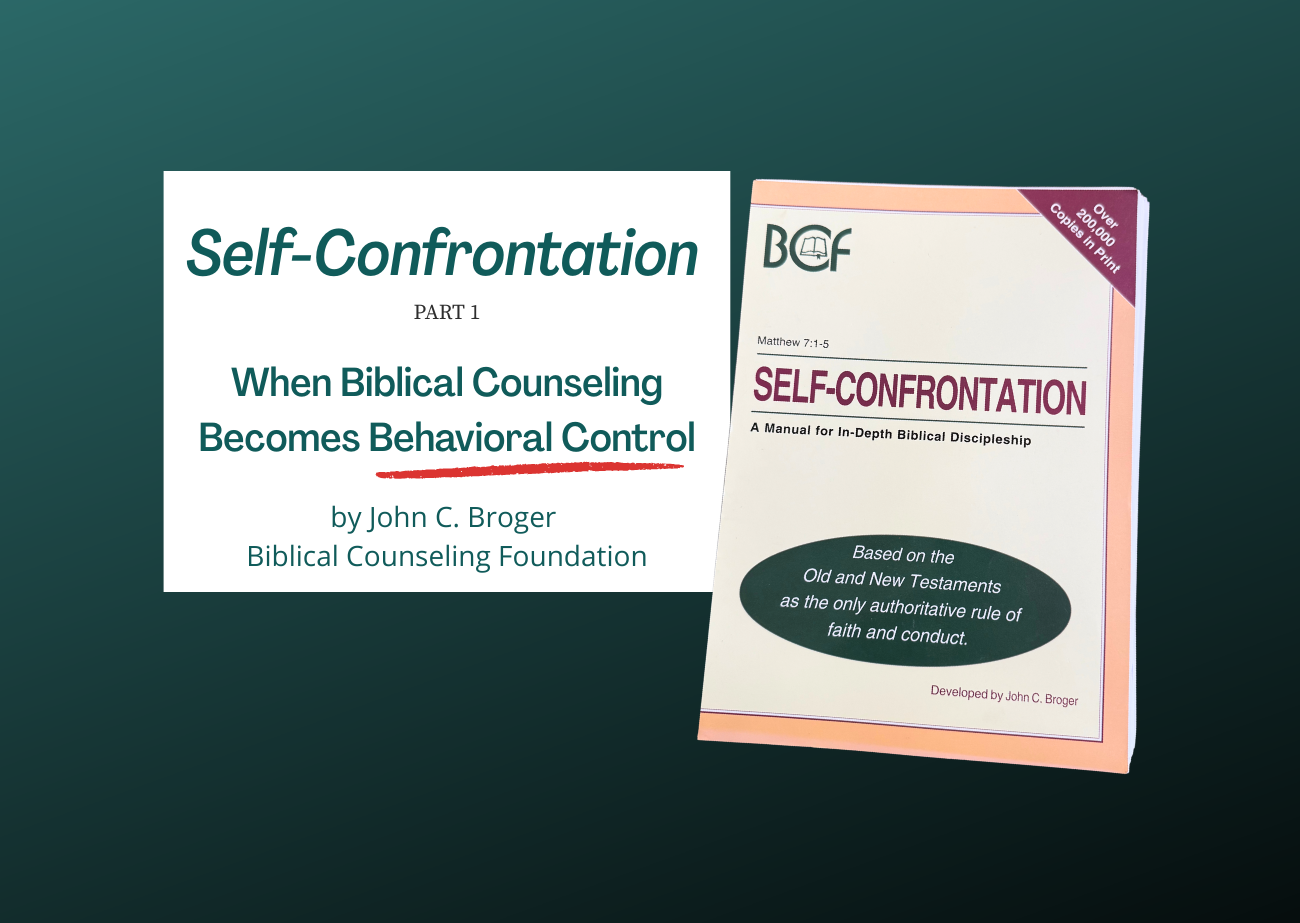
Self-Confrontation: When Biblical Counseling Becomes Behavioral Control
This is Part 1 of a four-part critique on John C. Broger’s Self-Confrontation manual. This article examines Broger’s background, the Biblical Counseling Foundation, and the system behind the manual. Part 2 will examine the Mary and Tom case study and how the manual mishandles marital abuse, addiction, and victim-blaming dynamics. Part 3 will examine spiritual self-surveillance, scrupulosity, and how “self-confrontation” can become behavioral control. Part 4 offers a practical list for detecting distinct Self-Confrontation keywords and concepts in sermons.
John C. Broger’s Self-Confrontation remains an influential “biblical counseling” manual in conservative Christian circles. First published through the Biblical Counseling Foundation (BCF), the organization he founded in the 1970s, the book promises readers “105 biblical principles” that can supposedly be applied “in a systematic manner to overcome any problem of life.”1
That promise should concern all Christians — especially conservative ones — far more than it attracts them.
The danger is not that BCF’s Self-Confrontation program is “too biblical.”
The problem is that it is not biblical enough.
It chooses in advance which parts of the Bible count as counseling material and which parts can be ignored, minimized, or reclassified as sinful responses. BCF’s system can become less accountable to Scripture than it claims, because it treats its own counseling categories as though they are the Bible’s categories. It quotes Scripture to support self-confrontation, obedience, and repentance, but gives far less weight to the Bible’s own language of lament, protest, suffering, oppression, righteous anger, and justice. In practice, the biblical counseling system does not simply submit to Scripture; it manages Scripture and decides what matters, leaving other teachings out.
The apostle Paul’s letters actually assume that faithful Christians will not all process life the same way. In Romans 14 he makes room for believers whose consciences differ on disputable matters and insists that “each one should be fully convinced in his own mind,” while warning others not to judge or despise those who land differently. Systems like Self‑Confrontation run the other direction: they standardize conscience by pre‑deciding which emotions, questions, and responses are allowed to “count” as biblical, then treating other responses as heart‑sin by default.
The result is a framework that can easily become emotionally and spiritually coercive in churches, marriages, and counseling relationships—especially in church cultures that are already suspicious of empathy, quick to label explanations as “excuses,” and prone to confuse compassion with coddling. This danger intensifies when a church takes pride in being hard-nosed, disciplined, and “serious” about obedience. In that kind of environment, tenderness can be treated as weakness, patience as compromise, and careful attention to a victim’s story as worldly softness. The suffering person is not first heard; they are evaluated. Their story is screened for self-pity, bitterness, fear, blame-shifting, and rebellion before it is received as testimony. We see this in the case study of Mary in the manual. She is married to an alcoholic who abandons her and the children, yet Mary is criticized mercilessly and offered no support or assistance.
And that is what some conservative Christians are pushing back on.
A System for Forming Compliant People
The core atmosphere of Self-Confrontation is one of continual monitoring:
- examine yourself,
- analyze your motives,
- identify “heart attitudes,”
- track sinful patterns,
- distrust feelings,
- confront yourself constantly,
- and submit your interpretations to approved biblical frameworks.
The book repeatedly calls for ongoing “self-confrontation” and “constant self-examination.”2 Readers are trained to interpret emotional struggles and relational conflict primarily through categories like self-centeredness, pride, bitterness, improper focus, or resistance to God’s authority.
At first, this can feel spiritually powerful. The system offers certainty, structure, explanations, and a sense of disciplined growth.
But the paradox is what makes systems like this so powerful: the person believes they are becoming freer while simultaneously becoming more self-policing, more dependent on approved frameworks, more fearful of independent thought, and more vulnerable to spiritual authority. Many people have found themselves so burdened by guilt and self-examination, their lives and ministry ability are impaired by obsessive thoughts.
That is why many former participants describe feeling spiritually trapped even while believing they were becoming more “biblical.” The control gradually becomes internalized.
People begin monitoring their own thoughts, confessing constantly, correcting one another, fearing “rebellion,” and distrusting their own instincts. Over time, this can create a state of constant, crushing guilt: never fully resting in grace, never sure whether one’s motives are pure, and always wondering what hidden sin still needs to be uncovered.
For people trapped in destructive church systems, this can resemble the dynamics described in spiritual abuse and moral injury, where fear and self-doubt slowly replace freedom and trust.
It can also make people feel deeply “othered.” Once a counselor or leader has targeted you as the person who does not measure up, every fear, hesitation, question, or objection can be treated as further evidence of your spiritual problem. You are no longer simply a Christian being helped; at best, you become “the struggling one.” If you offer even the slightest pushback or try to explain what you are going through, you may quickly become “the bitter one,” “the defensive one,” “the rebellious one,” or “the one who won’t receive correction.”
What “Heart Issue” Language Can Do
In many evangelical counseling settings, the phrase “heart issue” sounds harmless, even biblical. It usually means that outward behavior flows from inward desires, motives, beliefs, or spiritual commitments.
But in systems like Self-Confrontation, “heart issue” language can become dangerous when counselors move from observing behavior to claiming confidence about a person’s hidden motives. In the manual, a betrayed and mistreated wife’s fear is labeled as unbelief. Her anger is labeled as bitterness. Her exhaustion labeled as self-focus.
Once that happens, the victim’s inner life becomes the counseling target, while the harmful behavior around her receives less scrutiny — a dynamic many survivors describe in destructive Christian marriage counseling and unsafe pastoral counseling relationships.
Conservative Christian Critics Raised Alarm Bells
What makes this especially notable is that many of the strongest critiques came not from secular voices, but from conservative Christians Martin and Deidre Bobgan of PsychoHeresy Awareness Ministries, more than 30 years ago. They brought up 10 problems with the Self-Confrontation book in 1995, and it appears that those problems still exist, even though BCF is the publisher and likely could change it any time they chose.
- The Bobgans warned that Self-Confrontation risks becoming “self-preoccupation,” “works oriented activity,” and spiritual “bondage.”3
- They criticized the manual’s tendency to encourage Christians to evaluate one another’s motives and “heart attitudes.”4
- They also warned that the book’s “105 biblical principles” could function as a Bible-plus authority structure that unintentionally elevates the counseling system itself alongside Scripture.5
According to the Bobgans:
- The system is also weak at teaching people to critically evaluate abusive leaders, manipulative ministries, authoritarian systems, or false teaching inside conservative Christianity itself.
- The case study “Mary’s Husband Has Left Her” is missing ordinary acts of kindness: when Mary is ill and overwhelmed, the manual turns immediately to her “sinful self-focus” rather than suggesting practical love, such as helping clean her house or helping buy groceries. Read Part 2 to find their specific list of problems regarding “A Case Study: Mary’s Husband Has Left Her.”
That concern overlaps with problems frequently seen in churches that minimize abuse, discourage discernment, or pressure suffering spouses to remain in dangerous situations “for the sake of marriage.” See also: church divorce policies and abuse.
That imbalance matters. If people are constantly taught, “you are defensive,” “your heart is deceitful,” “focus on your own sin,” “don’t judge others hypocritically,” and “yield your rights,” but are not equally trained to identify spiritual abuse, coercion, false authority, misuse of Scripture, or domineering leadership (which is condemned in the Bible), then the system can produce people who are highly self-critical but insufficiently critical of authority.
Their critique is especially striking because the Bobgans themselves strongly opposed secular psychology. Yet even they believed Broger’s counseling system had become intrusive and overreaching.
Broger’s Background Matters
John C. Broger was not a minor figure, and he should not be treated as one. By all appearances, he was a man of deep Christian conviction, remarkable energy, and lifelong zeal for advancing the kingdom of God as he understood it. His career was unusually wide-ranging: Navy service, missionary broadcasting, international radio ministry, Pentagon communications, Cold War ideological education, and eventually the founding of the Biblical Counseling Foundation. Even critics should acknowledge the scale of his labors and the seriousness of his commitments.
That is precisely why his background matters.
The issue is not that Broger lacked conviction, discipline, or devotion. The issue is that his long career formed him in systems of mass communication, indoctrination training, and behavioral instruction. Before creating the Biblical Counseling Foundation, Broger spent decades building and managing institutions designed to shape belief, loyalty, conduct, and response. Self-Confrontation did not emerge from nowhere. It came from a man whose life’s work had repeatedly involved structured teaching systems, disciplined messaging, and the formation of people through authoritative communication.
That background helps explain why Self-Confrontation feels so procedural, ideological, and controlling that even very conservative Christians have pushed back against it.
| Year / period | Event | Why it matters |
|---|---|---|
| 1913 | John C. Broger was born in Tennessee. | His later career would span missionary broadcasting, military communications, Cold War ideological education, and biblical counseling.6 |
| World War II | Broger served in the Navy, wrote or edited radar-training manuals, and worked as an electronics officer. | His earliest major work already combined technology, training, and disciplined instruction.6 |
| 1945 | Broger helped found the Far East Broadcasting Company with Robert “Bob” H. Bowman and William J. Roberts. | FEBC was built to broadcast Christian programming internationally, especially into Asia. Official FEBC history says it was incorporated in 1945 by Bowman, Broger, and Roberts “with one goal in mind: broadcasting Christ to the world.”7 |
| 1948 | FEBC broadcasting began in the Philippines. | This was Broger’s first major institutional platform for mass religious communication.8 |
| 1953 | A newspaper profile described Broger as president of FEBC and a “famed gospel broadcaster.” It said FEBC’s Manila radio center broadcast across Asia and the Middle East for 20 hours a day in 36 languages and dialects. | This shows Broger was already working at scale before his Pentagon career: multilingual communication, religious messaging, and transnational audience formation.9 |
| 1954 | Broger moved into Washington defense work after Admiral Arthur Radford asked him to consult because of his experience with spiritual and ideological conflict in Asia. | This is the hinge between missionary broadcasting and Cold War military communications.6 |
| Mid-1950s | Broger became associated with Militant Liberty, a Department of Defense ideological project meant to strengthen resistance to communism through structured moral and political education. |
Although Militant Liberty had the strong backing of Admiral Arthur Radford, key agencies eventually concluded it was too tied to specifically American and Protestant‑evangelical ideas of “individual conscience” to work as a universal program. About two years after the booklet was produced, Militant Liberty was effectively abandoned: kept as background reading but not pushed worldwide, partly because it went beyond teaching basic civics and tried to prescribe how people everywhere should think and feel about freedom. |
| 1960 | Broger became Director of Information for the Armed Forces of the United States. | BCF’s own biographical material presents this as distinguished service; it says he oversaw Armed Forces radio and television stations, newspapers, publications, press, and motion-picture services.6 |
| 1970 | Jay Adams published Competent to Counsel, launching what became known as the modern biblical or nouthetic counseling movement. | Adams argued for a counseling model based on biblical sufficiency and strongly opposed the encroachment of secular psychology into pastoral counseling. The Institute for Nouthetic Studies describes Adams as the founder of the modern biblical counseling movement, launched with Competent to Counsel in 1970.11 |
| 1974 | Broger began developing biblical counseling training material for the Chiefs of Chaplains of the U.S. Armed Forces and co-founded the Biblical Counseling Foundation. | BCF’s own account places the origin of Self-Confrontation in a military/chaplaincy training context. Broger wasn’t a local‑church pastor working in a day‑to‑day pastoral care setting. His missionary background was primarily in Christian broadcasting, not in walking with real congregations through complex marriage and abuse cases.12 |
| 1977 | Broger retired from federal service. That same year, investigative columnist Jack Anderson criticized Broger’s Pentagon communications role. | The 1977 Anderson article is significant because it gives an outside, critical account of Broger’s Pentagon power and the way his military communications role overlapped with conservative evangelical activism. He alleged broad problems: weak property controls, questionable contracts, administrative mismanagement, and a communications network shaped by Broger’s anti-communist and evangelical commitments. The Fort Belvoir Jay Adams “Christian Counselor” seminar served as one example of that overlap, especially because Anderson reported that it was recorded by military technicians and later reproduced and marketed commercially.13 |
| 1978–1991 | Self-Confrontation was copyrighted in 1978 and revised in 1980, 1987, and 1991. | The manual became the foundation of BCF’s training system.14 |
| 1995, 2002 | Conservative Christians, Martin and Deidre Bobgan, outline 10 problems with the training manual in 1995. As of the Sixteenth Printing (Summer 2002) of the International Version, none of the issues appear to have been fixed. | This matters because critiques raised in the 1990s were not simply about an obsolete first edition.14 |
| 2007 and later BCF materials | BCF continued to market Self-Confrontation and its training system as a Bible-sufficient answer to “life’s problems,” after Broger’s death in 2006. | Its Weekend Seminar brochure says the Bible is the “only source” that identifies causes and solutions for “all of life’s problems.” This shows that the same core philosophy continued: Scripture as sole authority, counseling as discipleship, and biblical change as the answer to broken marriages, depression, anger, anxiety, fear, worry, and other problems.15 |
What This Means
No one is accusing Broger of malicious intent. Broger may well have believed he was serving Christ faithfully at every stage. But good intentions do not make a system safe. His background helps explain why Self-Confrontation often reads less like ordinary pastoral care and more like a comprehensive program for spiritual mind management. Understanding Broger’s background does not prove bad motives. Broger may well have believed he was serving Christ faithfully at every stage of his career. But good intentions do not make a system safe.
Across Broger’s life, the same pattern appears again and again: structured communication aimed at shaping belief, conduct, loyalty, and response. FEBC broadcast Christian programming across nations. Pentagon communications shaped military information flow. Militant Liberty tried to strengthen anti-communist commitment through moral and ideological education. BCF then applied a similar structure to church counseling and discipleship.
That background helps explain why Self-Confrontation reads less like ordinary pastoral care and more like a training system. It has lessons, principles, worksheets, case studies, daily homework for 30-60 minutes, Scripture-memory assignments, counseling records, measuring levels of sin, and procedures for correcting failure. BCF’s later Training Philosophy brochure confirms that this was deliberate: Level I is Self-Confrontation; Level II adds role-play; Level III introduces multiple counselees and the full counseling process; Level IV gives students experience in actual counseling meetings; and Level V trains students to lead local counseling ministries.16
That is why Self-Confrontation can feel rigorous and attractive to some churches—and not to others. It promises order. It promises clarity. It promises that every problem can be named, categorized, and addressed through biblical principles. In church cultures that prize toughness, discipline, certainty, and “no excuses” obedience, this kind of system can feel like serious Christianity.
But the same features that make it attractive also make it dangerous.
BCF’s system does not merely say Scripture is authoritative. It says the Bible is the only source that identifies causes and solutions for all life problems.15 Its Statement of Faith goes further: even when outside wisdom seems to correspond to Scripture, the counselor should disregard “so-called validation” outside the Bible; it also rejects approaches that focus on “other persons or circumstances” as the reason someone is not overcoming life difficulties.17
That is where the system becomes less accountable to the Bible than it claims.
The danger is not that BCF’s Self-Confrontation program is “too biblical.” The problem is that it is not biblical enough. It chooses in advance which parts of the Bible count as counseling material and which parts can be ignored, minimized, or reclassified as sinful responses. It quotes Scripture in support of self-confrontation, obedience, repentance, and correction, but gives far less weight to the Bible’s own language of lament, protest, suffering, oppression, righteous anger, and justice.
In practice, the biblical counseling system does not simply submit to Scripture; it manages Scripture.
That helps explain the connection to Jay Adams. Adams supplied the broader nouthetic framework: counseling as biblical admonition, suspicion of secular psychology, emphasis on sin, repentance, and correction. Broger did not invent that world. But he helped operationalize it. He turned Adams-style nouthetic assumptions into a more comprehensive discipleship apparatus: a church-based training pipeline that could be reproduced through manuals, seminars, role-play, counseling records, and supervised levels.
The result is not merely “biblical counseling.” It is a system of spiritual management.
This is especially dangerous in churches that are already suspicious of empathy, quick to label explanations as “excuses,” and prone to confuse compassion with coddling. The danger becomes worse when a church takes pride in being unusually tough, disciplined, and unsentimental about obedience. In such settings, tenderness is easily dismissed as weakness, context as excuse-making, and protection as refusal to forgive. A suffering person is not first heard; they are evaluated. Their story is screened for self-pity, bitterness, fear, blame-shifting, and rebellion before it is received as testimony.
Why Churches Should Avoid This
Churches should avoid building their counseling culture around Self-Confrontation unless they are prepared to submit the system itself to the whole witness of Scripture. In practice, churches deeply shaped by this model often develop recognizable patterns: heavy authority structures, invasive counseling, constant searching for “heart issues,” suspicion of outside perspectives, heavy-handed discipleship, minimization of abuse, and fear-based introspection.
Submitting the system to Scripture also means honoring Paul’s teaching about conscience. He does not demand that all believers share identical scruples, or that they all interpret every situation the same way. Instead, he urges mutual forbearance, warns against binding one another’s consciences beyond what God has revealed, and reminds leaders they are “workers with you for your joy, for you stand firm in your faith” (2 Corinthians 1:24), not masters over it. By contrast, Self‑Confrontation tends to treat Broger’s counseling grid as if it were God’s own voice, effectively pressuring Christians to surrender their Spirit‑formed judgment in favor of a man‑made pattern.
The danger is especially serious in churches already inclined to distrust empathy, label explanations as “excuses,” and confuse compassion with coddling. It becomes worse when a church takes pride in being unusually tough, disciplined, and unsentimental about obedience. In that kind of environment, tenderness can be dismissed as weakness, context as excuse-making, and protection as refusal to forgive.
Gifted and caring leaders can slowly become spiritual evaluators: always assessing, diagnosing, correcting, and confronting others “for their own good.” The manual’s framework often moves too quickly from visible behavior to confident claims about hidden motives. That can produce weak, speculative, or false accusations—and because the system is saturated with Scripture references, disagreement can be made to feel like rebellion against God himself.
If a church wants to be serious about obedience, it must be equally serious about the commands to show mercy, defend the oppressed, listen carefully, grieve compassionately, and refuse to crush the bruised reed. It also has to be honest: the Bible does condone divorce in certain cases, something quietly mentioned on page 246 in the manual (“Only the sinfulness and corresponding hardness of heart in a marriage partner can lead to breaking the covenant relationship of marriage”) but not applied to Mary’s story, perhaps because Tom appears to be cooperating in the counseling process.
Healthy Christianity should produce humility, wisdom, compassion, honesty, patience, courage, and freedom. Too often, Self-Confrontation produces chronic self-monitoring, ideological conformity, spiritual dependency, obsessive fixation on guilt, and emotionally controlling church cultures.
That is one reason many survivors eventually seek safety-first counseling instead of correction-heavy systems centered on endless self-analysis.
Christians should therefore approach this book—and churches built around it—with extreme caution.
The Paradox of Self-Focus
The manual repeatedly says not to be self-focused, not to protect your rights, not to indulge self-pity, and not to be self-centered. Yet the actual practice of the course can become intensely self-preoccupied:
- analyze your motives,
- monitor your thoughts,
- track your sins,
- inspect your reactions,
- identify patterns,
- fill out worksheets,
- evaluate your heart,
- examine your attitudes,
- confess your failures,
- record your progress,
- repeat constantly.
That is exactly why the Bobgans say “self-confrontation easily becomes self-preoccupation” and warn that “constant self-examination may lead to disguised self-improvement and self-righteousness.”18
That is a devastating critique because it exposes the paradox: the system condemns self-focus while structurally producing obsessive self-focus.
Christian parenting author Marissa Franks Burt describes a related danger as the fusion of “American individualism,” evangelical self-help, Christian moralism, and spiritual heroism — a culture where “extremism is faith.”19 That is exactly the soil in which Self-Confrontation flourishes: ordinary limits become suspect, spiritual intensity becomes proof of obedience, and self-monitoring is mistaken for holiness.
For readers struggling with chronic guilt, obsessive self-examination, or fear-based spirituality, see also our resources on moral injury and emotionally destructive religious systems.
Part 2 will examine the Mary and Tom case study and how the manual mishandles marital abuse, addiction, and victim-blaming dynamics. Part 3 will examine spiritual self-surveillance, scrupulosity, and how “self-confrontation” can become behavioral control. Part 4 looks at words and phrases and concept used in the manual, so that they can be identified in sermons and messaging from Christian groups.
Endnotes
- John C. Broger, Self-Confrontation: A Manual for In-Depth Biblical Discipleship (Biblical Counseling Foundation), Internet Archive, https://archive.org/details/selfconfrontatio0000brog. ↩
- Broger, Self-Confrontation, course introduction and principles sections. ↩
- Martin and Deidre Bobgan, “Confronting the Biblical Counseling Foundation’s Self-Confrontation Manual,” PsychoHeresy Awareness Ministries, critique of “constant self-examination,” “self-preoccupation,” and “bondage,” PDF. ↩
- Bobgan and Bobgan, critique of evaluating “heart attitudes” and motives in Self-Confrontation. ↩
- Bobgan and Bobgan, critique of the “105 biblical principles” framework. ↩
- Broger, Self-Confrontation, biographical front matter on John C. Broger, including his birth, education, World War II service, FEBC work, Pentagon appointment, and later BCF work. ↩ ↩ ↩ ↩
- FEBC official history, “History,” Far East Broadcasting Company, stating that FEBC was incorporated in 1945 by Bob Bowman, John Broger, and William Roberts, https://www.febc.org/about/history/. ↩
- FEBC Philippines, “The Story of FEBC Philippines,” https://anniversary.febc.ph/about-febc/. ↩
- “Famed Gospel Broadcaster To Speak Here,” Progress-Bulletin — Pomona, California, May 20, 1953, p. 16. ↩
- John C. Broger, Militant Liberty: A Program of Evaluation and Assessment of Freedom (U.S. Government Printing Office, 1955), Internet Archive/CIA Reading Room scan. See also CIA memorandum on Militant Liberty, Sept. 27, 1957, objecting to its emphasis on the “sensitive individual conscience” as a specifically “Protestant evangelical” assumption rather than a universal principle. ↩
- Institute for Nouthetic Studies, “Dr. Jay E. Adams,” describing Adams as the founder of the modern biblical counseling movement and identifying Competent to Counsel as the book that launched the movement in 1970, https://nouthetic.org/about/jay-adams/. ↩
- Biblical Counseling Foundation, memorial and historical materials on Broger and the founding of BCF; see also Self-Confrontation front matter describing BCF as founded in 1974 and incorporated in 1977. ↩
- Jack Anderson, “A curious communications Czar,” Press-Telegram — Long Beach, California, Jan. 13, 1977, p. 30; Jack Anderson, “Audit omits facts, clears official,” The Bakersfield Californian, Jan. 16, 1977, p. 23. ↩
- Broger, Self-Confrontation, copyright/front matter: copyright 1978, revised 1980, 1987, and 1991; the uploaded copy is the Sixteenth Printing, Summer 2002, International Version. ↩ ↩
- Biblical Counseling Foundation, BCF Weekend Seminar brochure, © 2007, stating: “The only source that identifies causes and provides solutions to all of life’s problems is the Bible.” ↩ ↩
- Biblical Counseling Foundation, BCF Biblical Discipleship/Counseling Training Philosophy brochure, describing the five training levels from Self-Confrontation to role-play, multiple counselees, actual counseling meetings, and leading a local training ministry. ↩
- Biblical Counseling Foundation, Statement of Faith for the Ministry of Biblical Discipleship/Counseling, Form BCF 210, rejecting “so-called validation” outside the Bible and rejecting methodologies that focus on other persons or circumstances as the reason someone is not overcoming difficulties in life. ↩
- Bobgan and Bobgan, critique of “constant self-examination,” “self-preoccupation,” and “self-righteousness.” ↩
- Marissa Franks Burt (@mburtwrites), Threads post, Apr. 17, 2026, describing postpartum panic, compulsive Bible reading/prayer, evangelical moralism, and a culture where “extremism is faith,” https://www.threads.com/@mburtwrites/post/DXPQRBoFLO3. ↩
 :
:
 :
: Buy PDF