
About Me: If you’re new to my blog, read this first. I’m a committed Evangelical Christian. I began leading Christian divorce recovery groups in conservative churches in 1998. Despite what I was taught, I do not believe the vast majority of divorces are for frivolous reasons. I write about “life-saving divorces”—divorces that occur for very serious, destructive, or dangerous reasons. Life-saving divorces make up about half of divorces in the United States. Read the definition HERE. If you want to understand why a nuanced view of divorce is biblically responsible, see THIS. And here is the biblical rationale for recognizing justified divorce. Although I believe many divorces are treacherous, immature, or sinful, I also believe there are justified divorces that are a gift from God to protect people and their children.
▶️ Watch the short 2.5-minute video overview here
Will Your Pastor Try to Pressure You to Stay Married to Your Abuser?
Find out with the
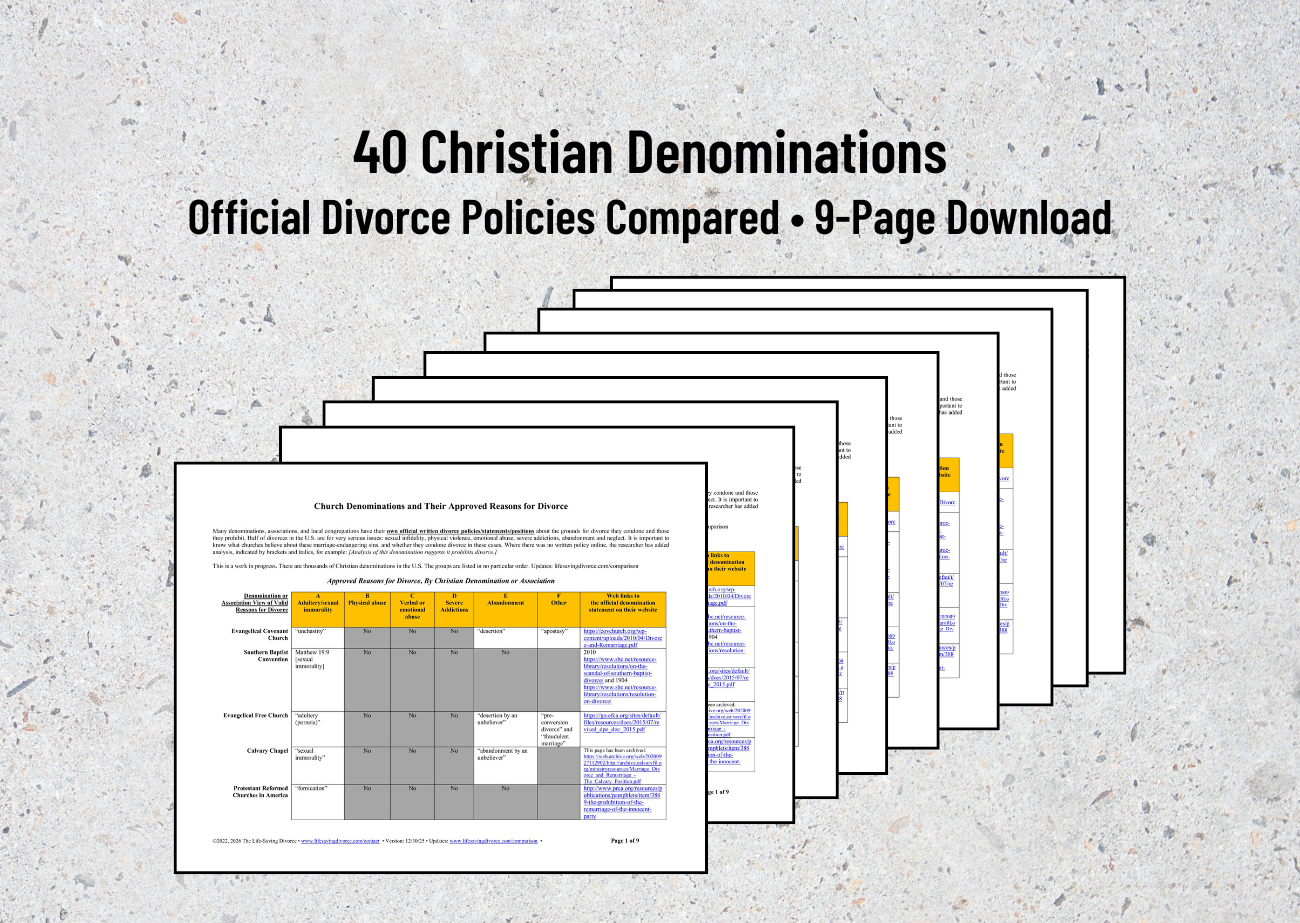
Christian Denominations and Accepted Reasons for Divorce Comparison Chart
This 9-page chart is a side-by-side comparison of more than 40 Christian denominations, associations, and national church bodies and their official written policies on divorce. It documents what they explicitly condone in their formal statements regarding divorce for:
- Sexual immorality / adultery
- Physical abuse
- Emotional or verbal abuse
- Severe addictions
- Abandonment
- Other covenant-breaking grounds
The chart includes direct quotations and links to official denominational documents wherever available.
How to Download the Most Recent Version
- This document is updated regularly with corrections, additions, and policy changes. For that reason, it is hosted on Dropbox:
Click HERE to Download the Chart
- When you arrive at Dropbox, click the PDF icon to download the most current version.
This is a work in progress. Policies change. Churches revise language. Updates are ongoing.
Denominations and Christian Groups Included in the Comparison Chart
Important: Not all of these denominations theologically block abuse victims from divorcing. Some explicitly allow divorce for abuse. Some are ambiguous. Some strongly discourage it. The chart documents their official written positions so you can evaluate accurately using their own official policy statements.
- African Methodist Episcopal (AME)
- African Methodist Episcopal Zion Church (AME Zion)
- Alliance of Baptists
- American Baptist Association
- American Baptist Churches USA (ABCUSA)
- Anglican Church of North America (ACNA)
- Apostolic Lutheran Church of America
- Assemblies of God
- Association of Reformed Baptist Churches in America (ARBCA)
- Calvary Chapel
- Christian & Missionary Alliance (CMA)
- Christian Church (Disciples of Christ)
- Christian Reformed Church in North America (CRCNA)
- Church of God in Christ (COGIC)
- Church of the Nazarene
- Communion of Reformed Evangelical Churches (CREC)
- Covenant Order of Evangelical Presbyterians (ECO)
- Episcopal Church in America
- Evangelical Covenant Church
- Evangelical Free Church of America (EFCA)
- Evangelical Lutheran Church in America (ELCA)
- Evangelical Presbyterian Church (EPC)
- Focus on the Family
- KJV Independent Fundamental Baptist Churches (USA)
- Lutheran Church—Missouri Synod (LCMS)
- Mennonite Church USA
- National Baptist Convention, USA
- National Center for Family-Integrated Churches (NCFIC)
- North American Presbyterian and Reformed Council (NAPARC)
- Orthodox Church in America
- Orthodox Presbyterian Church (OPC)
- Presbyterian Church (USA) – PCUSA
- Presbyterian Church in America (PCA)
- Primitive Baptists
- Providence Baptist Church (Raleigh, NC)
- Quakers (Religious Society of Friends)
- Reformed Church in America (RCA)
- Reformed Church in the United States (RCUS)
- Roman Catholic Church (U.S. Conference of Catholic Bishops)
- Salvation Army
- Seventh-day Adventist Church
- Southern Baptist Convention (SBC)
- The Wesleyan Church
- United Church of Christ (UCC)
- United Church of God
- United Methodist Church (UMC)
- Vineyard USA
- Wisconsin Evangelical Lutheran Synod (WELS)
7 Common Questions About Church Divorce Policies
1. My pastor makes it sound like most divorces are frivolous. Is that true?
No. Major research shows that approximately half of divorces involve serious issues such as adultery, sexual immorality, physical violence, emotional abuse, addiction, abandonment, or severe neglect. See What Is a Life-Saving Divorce? for documentation and sources.
For a deeper discussion of why many churches mishandle abuse cases, see my article on pastor education on domestic violence and biblical response.
2. Is abuse biblical grounds for divorce?
Yes. Both physical abuse and emotional abuse constitute covenant-breaking behaviors. See What Do Top Bible Scholars and Pastors Say About Abuse and Divorce? for direct quotes and theological support.
3. Should I wait for my pastor’s permission?
You are responsible for your safety and your children’s safety, which degrade with time. Churches sometimes repeat common divorce myths about happiness, remarriage failure, or damaged children. Research does not support most of those claims.
4. Can a church legally prevent my divorce?
No. Divorce and remarriage are civil legal matters in the United States. Churches may refuse to officiate a ceremony, but they cannot legally block you. For more on legal separation versus divorce, see Legal Separation vs. Divorce.
5. Can a church discipline or excommunicate me?
Some churches do. If you are in danger, it may be wise to change churches before filing. For examples and guidance, see Church Discipline and Divorce.
6. Can I find a better church?
Yes. According to LifeWay Research on behalf of Focus on the Family, 6 in 10 churchgoing Protestant divorcees switch churches after divorce. It’s very common. Those divorcees who switch tend to serve, volunteer, and donate the same or more to their new church.
7. How do I vet a church before attending?
Listen to marriage sermons online. Do leaders name abuse as unacceptable? Do they acknowledge justified divorce? Compare what they say against documented research in 27 Myths About Divorce. If you do not hear clarity and compassion, a discussion of abuse, and permission to leave, continue searching.
Here is one woman’s story of trying to find a church. She’s a conservative Christian who wants to bring up her teens at church. But how does she find a church that won’t condemn her and look down at her kids? After all, she wasn’t the one who committed adultery over and over!
But don’t worry if you cannot find a loving church. You’re not alone. At least 1 million Christians love the Lord, identify as evangelicals, and still cannot find a church that doesn’t judge divorcees. But there’s good news: Now many good churches have their services online, and you can find a church in another state that will suit your needs. Here’s a list of pastors who believe in divorce in cases of abuse. I’ve included a wide variety of denominations, so there may be one who’s right for you.
 :
:
 :
: Buy PDF