

The Hidden Divorce Attendance Gap in Evangelical Churches
Why Many Faithful Divorcees Aren’t in the Pew — And Churches May Not Realize It
Why So Many Divorced Christians Cannot Find a Safe Church
A significant attendance gap shows up in evangelical churches after divorce. Christianity Today reported on it. Sociologist and pastor Dr. Ryan Burge found that evangelicalism is unusually likely to lose believers from regular church attendance after divorce—far more than other Christian traditions. (See his graph below.) Committed Christians who need to divorce for infidelity or abuse are walking away—often reluctantly.
What makes this so striking is that in historically Black Protestant churches, Mainline churches, and Catholic churches, divorced adherents are more likely to continue attending. But in evangelicalism, divorced church members are more likely to leave.
Most churches don’t realize this.
Evangelical churches may not realize how many divorced believers quietly relocate. A 2015 Lifeway Research study found that nearly 6 in 10 Protestant churchgoers who divorced either switched churches or stopped attending altogether during the divorce process. The shift isn’t small — it’s widespread. (See: What the Lifeway Divorce Study Reveals — and Why Focus on the Family Isn’t Talking About It.)
Evangelical pastors care deeply about people. They strive to be faithful to Scripture. They defend marriage. They want healthy families and thriving congregations. They are not trying to wound anyone.
And yet, many faithful divorcees are missing from the pew.
Even more worrisome, the attendance gap between the two has actually widened among evangelicals in the past decade. — Dr. Ryan Burge
These are not people who have “walked away from God.” They love the Lord. They pray. They read Scripture. They have raised their children in the faith. They long to belong and serve.
But week after week, they hear blanket messages: “God hates divorce.” “No divorce for any reason.” “You must try harder.” “Divorce destroys children.” No distinction is made between a frivolous divorce and a life-saving divorce—one pursued because of adultery, abuse, addiction, or serious harm. (For a clear definition, see: What Is a Life-Saving Divorce?.)
Over time, something shifts.
Some begin to feel marked. Some feel misunderstood. Some feel as if the innocent spouse is carrying the shame of another person’s sin. And eventually, many quietly stop attending.
If you are a pastor, this may be a blind spot—not a lack of compassion.
If you are a divorced Christian who has pulled back from church, you may feel guilty. You may wonder if your absence means your faith is weak.
It doesn’t.
Something deeper may be going on.
One divorced mother tells about her search for a safer church home
We need to hear from the people who are no longer in the pew.
And these are not casual Christians. Many were deeply involved in church life before their divorce—serving, volunteering, raising their children in the faith, fully expecting to remain.
One divorced mother shared her search for a safer church home. Listen to the cry of her heart. She is not alone. Many God-honoring divorcees have the same story.
I’m devastated. I visited another church with my children (15, 12 & 8) this morning and we really liked it. This is a church known for standing firm on Scripture and engaging the culture with conviction. Then the pastor had to slip in that God hates divorce. I was taking notes so I could remember what he said.
Do you know what my children are hearing when the pastor says “No divorce for any reason,” and “God hates divorce,” and “Divorce destroys lives,” over and over? They’re hearing “Church is for everyone but us!” And “My mom must be a really bad person for leaving our dad, that the churches have to keep bringing it up.”
I just want to crawl in a hole and never come out. We have been bearing the scarlet letter of another person’s sin! My husband was a serial adulterer who also psychologically, verbally, and financially abused me and the children.
The churches are missing out! I am a healed and very whole person! I will celebrate 3 years out of the marriage soon, and I couldn’t be happier! We’ve come a long way. I have a lot of experience serving in the church including planning and executing large events, directing two nursery ministries, and being the church secretary. Plus I love intercessory prayer!
These churches have no idea how much I long to plug in and serve and become one of them! They have no idea that I have really neat kids who are a lot of fun to be around and would love to plug in too! My heart just breaks for them as they keep hearing these sermons about divorce, when it wasn’t even in the text! Ugh! Jesus, please come now!
Consider what her story tells us:
1. She loves the Lord. She wants to go to church.
2. She’s a conservative Christian.
3. As a mother, she takes her responsibility seriously, and she wishes to raise her children in the church.
4. She and her children know the divorce was justified. (Due to her husband’s serial adultery, psychological, financial abuse.)
She winces at messages from the pulpit with no distinction between frivolous and life-saving divorces:
6. She feels it’s unfair to her—the innocent spouse—to wear the stigma of a scarlet letter. She wasn’t the one who committed adultery or abuse!
7. She has a heart to give and serve the church. She’s got experience doing large events. She’s directed nursery ministries, twice! And she’s a prayer warrior.
8. She knows her kids love the Lord and are fun to be around, but now they are being told there’s something wrong.
Pastors, this is not an accusation. It is an invitation.
An invitation to ask: Are we unintentionally communicating that protecting marriage matters more than protecting the innocent?
An invitation to examine whether our divorce messaging leaves room for betrayal, abuse, and abandonment—sins Scripture clearly condemns.
Because if faithful believers are quietly disappearing, something deserves our attention.
This Problem Is Bigger Than One Story
This is not just one woman’s experience.
Christianity Today documented this pattern nationally. Sociologist and pastor Dr. Ryan Burge analyzed decades of nationwide attendance data and found something striking: evangelical churches are unusually likely to lose divorced believers from regular attendance compared with other Christian traditions.
The chart below illustrates what he calls the “attendance gap.” The blue circles highlight where divorced evangelicals are attending at much lower rates than we would expect—especially when compared with historically Black Protestant, mainline Protestant, and Catholic churches.
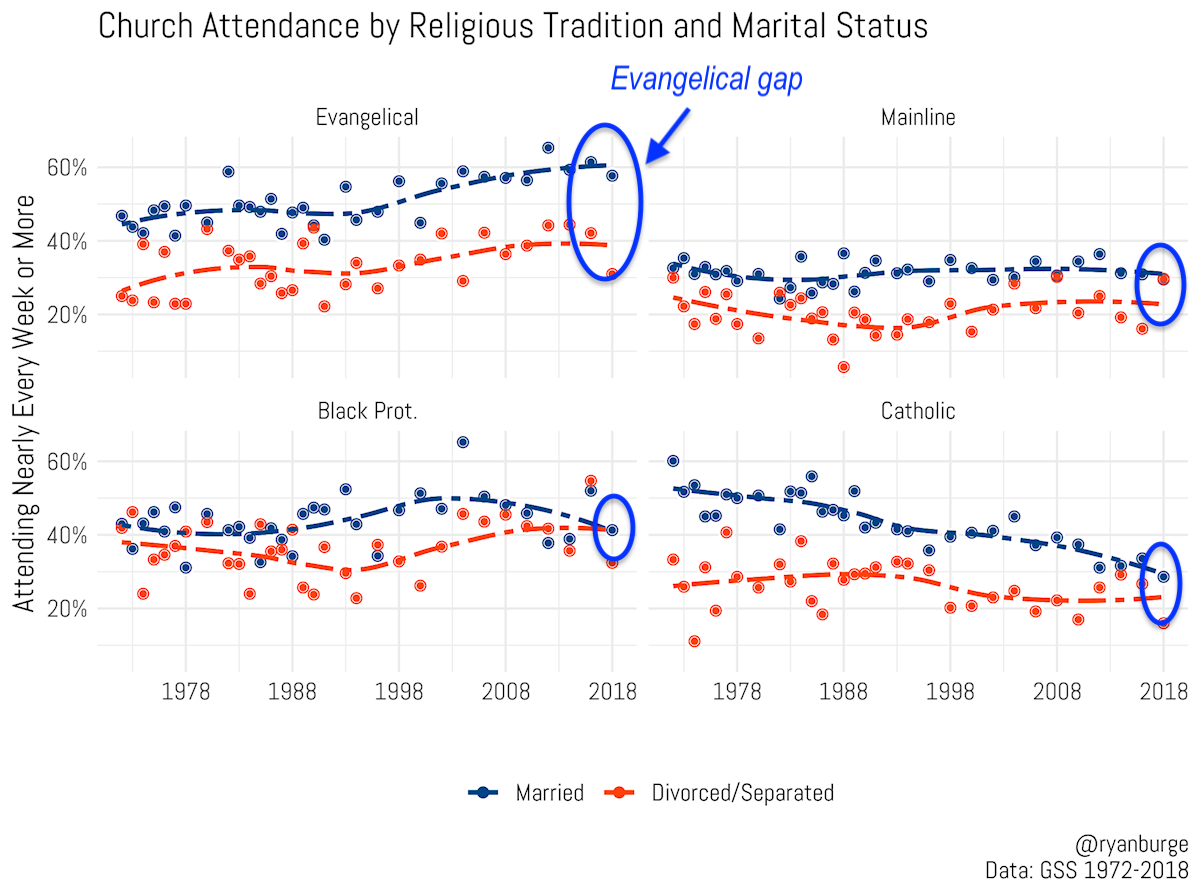
Dr. Ryan Burge’s data show that evangelical churches lose divorced believers from attendance at unusually high rates compared with other Christian traditions.
Why This Matters?
What makes this sobering is not that divorce affects church attendance. That happens almost everywhere.
What is unique is how pronounced the attendance gap is within evangelicalism.
These are not people abandoning faith. These are believers who once sat in the pew, served in ministries, raised their children in church—and are now absent.
After the split, some opt to switch churches, stop bringing the children to church, or no longer attend at all. — Dr. Burge
If we want to understand the attendance gap, we must ask why evangelical spaces, in particular, struggle to retain divorced Christians.
And that question leads us back to theology, tone, and pastoral practice.
We Need to Accept That Some Divorces Are Life-Saving
If evangelical churches are uniquely losing divorced believers, we have to ask why.
Part of the answer may be theological. In many evangelical spaces, divorce is treated as a profound sin. But Scripture itself distinguishes between covenant-keeping and covenant-breaking sin. Adultery, abuse, abandonment, and exploitation are not minor marital disappointments. They are serious violations.
About half of divorces in the United States involve patterns of adultery, domestic violence, severe emotional abuse, addiction, abandonment, or chronic neglect. These are not impulsive exits. They are often desperate attempts to survive.
When churches refuse to distinguish between a frivolous divorce and a life-saving divorce, innocent spouses can feel erased. Their suffering becomes secondary to preserving an institution. (For biblical grounds, see: Adultery, Abuse, Abandonment are Biblical Grounds for Divorce.)
Divorce Can Save Lives
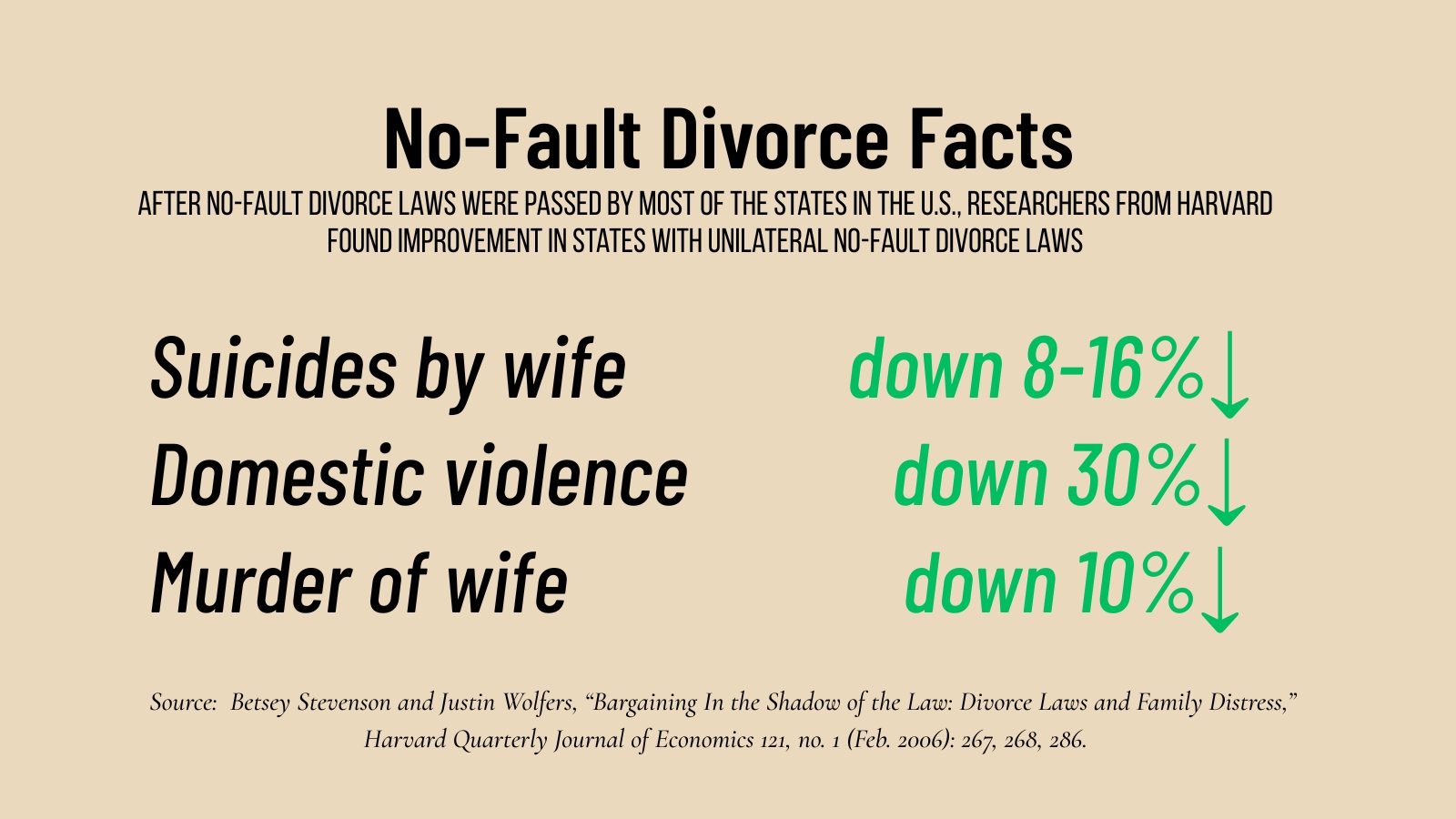
Research from Harvard economists Betsey Stevenson and Justin Wolfers examined what happened when unilateral no-fault divorce laws were passed state by state beginning in 1969. The results were striking.
After these laws were enacted:
-
Suicide rates for wives declined by up to 16% in some states.
-
Domestic violence rates dropped by about 30%.
-
The homicide rate of women murdered by intimate partners fell by roughly 10%.[1]
Those are not small numbers.
When safe exits from dangerous marriages became legally accessible, measurable harm decreased.
That does not mean divorce is ideal. It means that in some situations, it is protective.
If our church culture treats every divorce as rebellion, we may unintentionally trap victims in harm’s way. (See also: Safety-First vs. Marriage-First Counseling.)
The Harvest Is Still Here
These divorcees and their children are not enemies of the church.
They love the Lord. They want to worship. They want to belong. They want to serve.
The attendance gap is not a rejection of faith. It is often a response to feeling misunderstood, stigmatized, or unsafe.
Pastors, this is not about lowering the standard for marriage. It is about raising the standard for protecting the innocent.
If evangelical churches learn to clearly distinguish between frivolous divorce and life-saving divorce, we will not weaken our witness.
We will strengthen it.
The harvest is plentiful.
Many of these workers are simply waiting to see whether there is room for their story in our pews.
Footnote
[1] Betsey Stevenson and Justin Wolfers, “Bargaining in the Shadow of the Law: Divorce Laws and Family Distress,” The Quarterly Journal of Economics (Feb. 2006): 267, 286.
Recommended Reading
 :
:
 :
: Buy PDF