
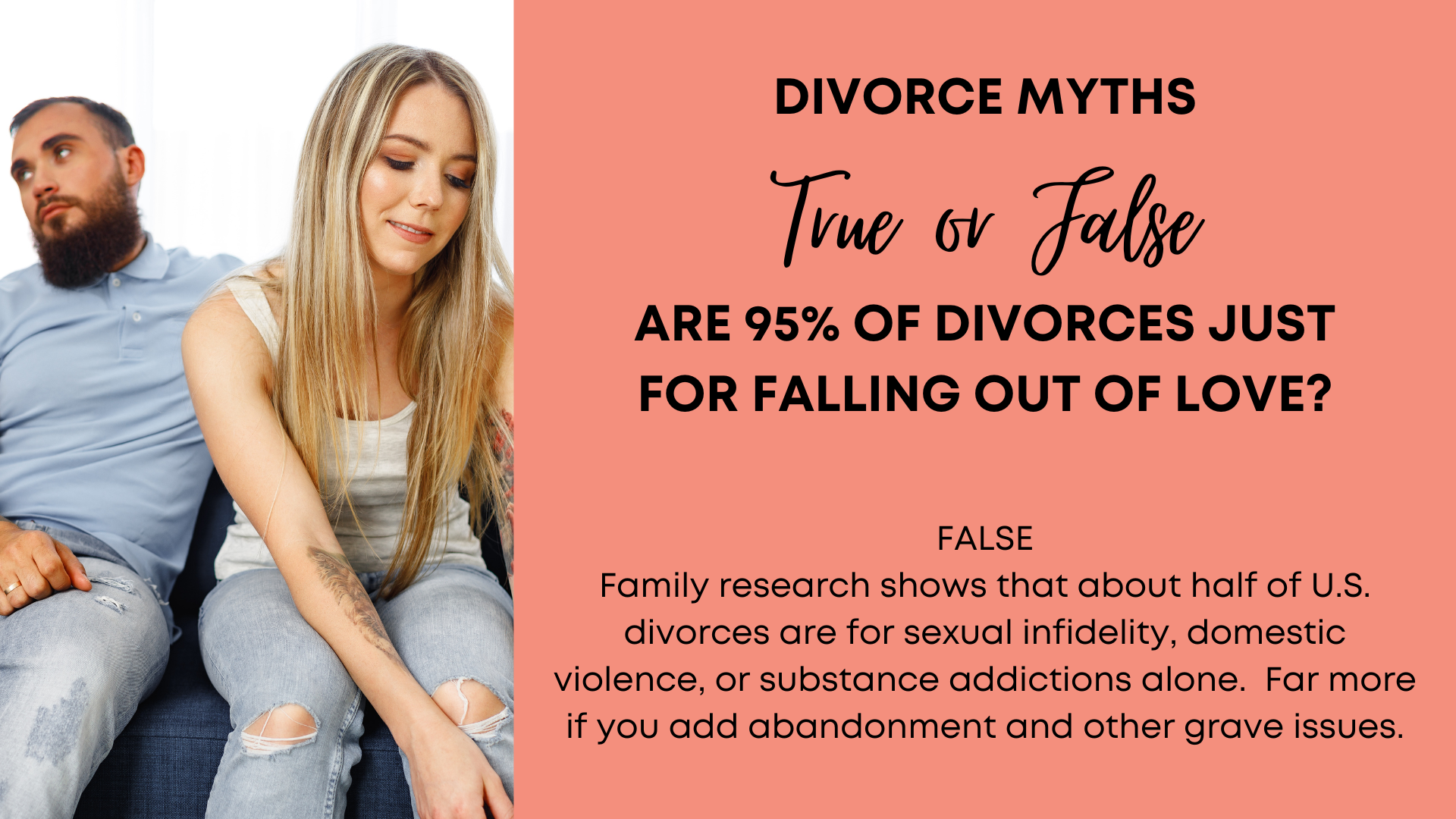
Divorce Myth #1: Most Divorces Are Not About “Falling Out of Love”
Why People Really Divorce: Abuse, Adultery, and Addiction Are Often the Final Straw
The Church Must Stop Repeating Myths That Silence Victims and Protect Destructive Behavior

In Survey #4: Nearly six in ten people said their final straw for divorce was infidelity, domestic violence, or substance abuse, according to a National Library of Medicine study (referred to as Study #4 below)
Destructive marriages are more common than we thought.
We weren’t alone. For decades family researchers have wondered the same thing. Why do people divorce? They’ve done a lot of surveys of divorced men and women who reported anonymously.
Here are the four significant surveys (with full citations at the bottom).
Survey 1 – In this first survey, the participants had divorced over age 40. Of these, 50% of divorcees mentioned the most significant reason was one of the serious reasons: adultery, sexual immorality, domestic violence, chronic emotional abuse, or abandonment (neglect of duty). [1]
Survey 2 – In this survey of participants age 20- 55, about 42% of divorcees mentioned at least one of the reasons above as the issue that caused the divorce. [2]
Survey 3 – In this study, divorcees could select more than one major contributor to their divorce: 58% of divorcees mentioned infidelity; 30% mentioned domestic violence. (They did not offer drug/alcohol abuse as a choice.) [3]
Survey 4 – In this study, too, participants could select more than one factor in their divorce. Infidelity was a major contributor in 59.6% of divorces, substance abuse in 34.6%, and domestic violence in 23.5%. When asked for the “final straw,” nearly 6 in 10 mentioned either infidelity, domestic violence, or substance abuse. [4]
About half of divorces are for life-saving reasons.
What this shows is that somewhere between 42% and 59% of divorces are for serious problems. So about half of divorces.
For a long time, we in the church have tended to think about divorce, and about people who have gotten divorced, as though only five percent of those divorces happened for good reason. As you can see from these studies, that’s not true.
There is a lot of bad behavior that makes marriages miserable: unfaithfulness, physical or mental abuse, drug or alcohol abuse, refusing to support the family, or simply walking out the door and never returning.
When the desperate spouse says, “I can’t take any more suffering and betrayal,” we call it a “life-saving” divorce. And only that desperate spouse knows how much they can take. No one else has skin in the game, not the pastor, not their parents, not their friends or people at church.
Those who taught us that 95% of divorces are “frivolous” are simply wrong.
Nearly half of divorces are life-saving divorces.
Footnotes:
[1] Xenia P. Montenegro, “The Divorce Experience: A Study of Divorce at Midlife and Beyond,” AARP the Magazine (May 2004), accessed 1/10/20, https://assets.aarp.org/rgcenter/general/divorce.pdf.
[2] Paul R. Amato and Denise Previti, “People’s Reasons for Divorcing,” Journal of Family Issues 24, no. 5 (July 2003): 602-626.
[3] C. Johnson, S. Stanley, and N. Glenn, et al., “Marriage in Oklahoma: 2001 Oklahoma Baseline Statewide Survey,” (2002): 15.
[4] Shelby B. Scott, Galena K. Rhoades, and Scott M. Stanley, et al., “Reasons for Divorce and Recollections of Premarital Intervention: Implications for Improving Relationship Education,” Couple and Family Psychology: Research and Practice 2, no. 2. (2003): 131-145.
 :
:
 :
: Buy PDF