
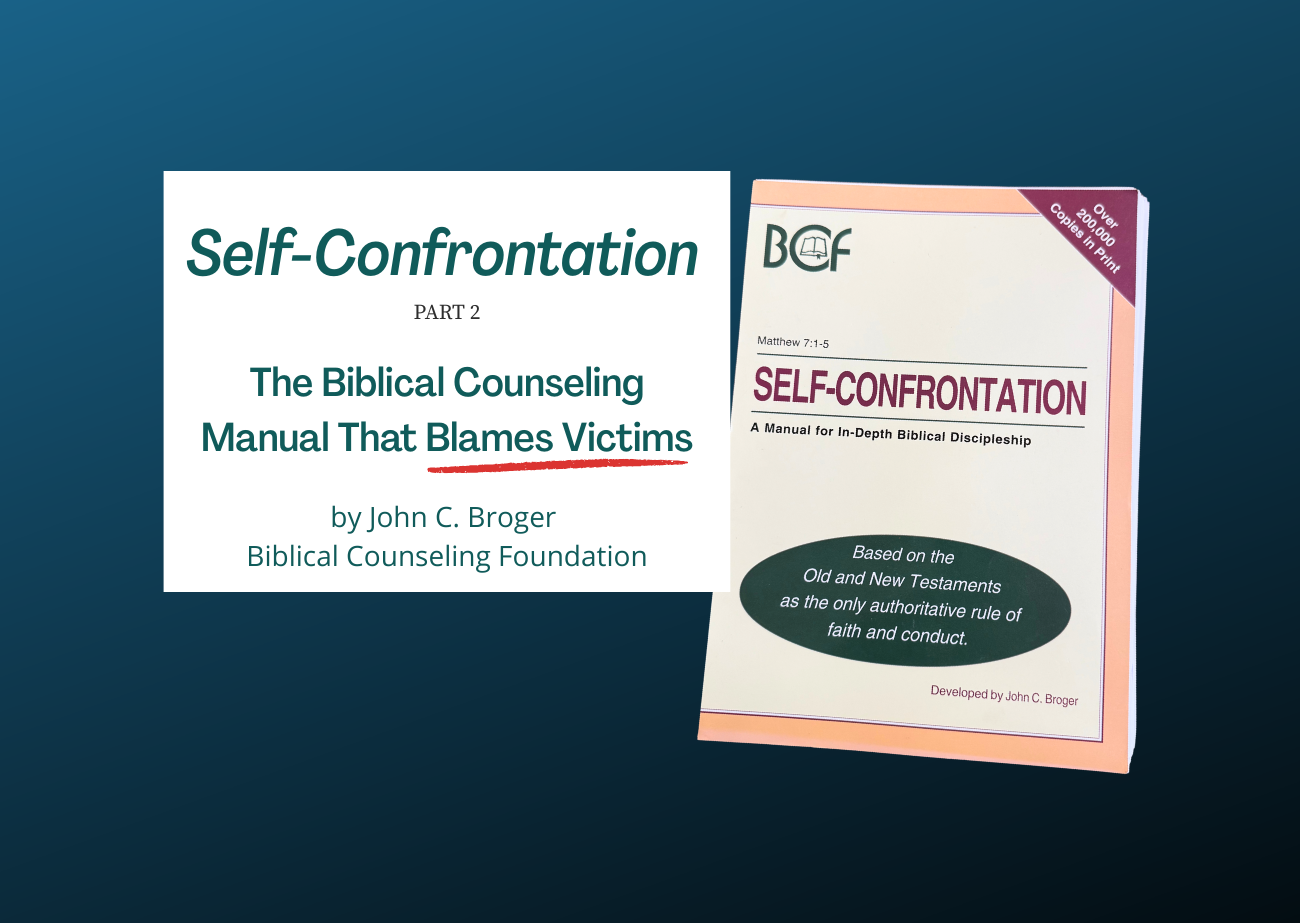
When “Biblical Counseling” Misreads Abuse: The Troubling Mary and Tom Story in the Self-Confrontation Manual
This is Part 2 of a multi-part series on John C. Broger’s Self-Confrontation and how the manual mishandles marital abuse, addiction, and victim-blaming.
Part 1 examines Broger’s background, the Biblical Counseling Foundation, and the system behind the manual.
Part 3 examines spiritual self-surveillance, scrupulosity, and how “self-confrontation” can become spiritual coercion and outward religious behavior control. Part 4 offers a practical list for detecting Self-Confrontation–style keywords and concepts in sermons.
One of the most revealing sections of John C. Broger’s Self-Confrontation manual is the extended case study commonly known as “Mary’s Husband Has Left Her.” Spread across multiple lessons, the story is designed to train readers in “biblical” counseling. But the case study exposes a serious pastoral danger: the method directs attention first to Mary’s alleged self-centeredness, even before the reader learns the extent of her husband’s destructive conduct. In doing so, it models a form of coercive spiritual authority that judges her for suffering, shifts the burden onto the already-burdened, and risks blaming victims in the name of biblical care.1
According to conservative Christian critics Martin and Deidre Bobgan, the “Mary” story is one of the clearest examples of Self-Confrontation’s weaknesses. It encourages judging before listening, excessive introspection, and the misdiagnosis of suffering people.2 Their critique becomes even more striking when compared with modern ethical standards for Christian counseling, trauma-informed care, and domestic abuse counseling, which is described at the end of this blog post.
The Story: Mary, the Mistreated Wife Becomes a Counseling Problem
In Lesson 9, we meet Mary, the central case-study figure in the entire manual. Mary has just described being abandoned by her husband: the kids are crying, the house is in chaos, and she is overwhelmed. She is a professing believer and the narrative presents her as a sincere, committed wife who cannot understand how things went so wrong.
Mary’s Distress Is Reframed as Spiritual Failure
Yet almost immediately, the manual begins treating Mary as a case study in spiritual failure, shifting the focus from her husband’s desertion to her “bitterness,” “self-focus,” and other supposed “heart problems.” What began as a plea for help from a mistreated wife has turned into a prolonged exercise in scrutinizing her reactions and criticizing her while her husband’s pattern of harm recedes into the background.
Broger’s framework repeatedly encourages readers to reinterpret Mary’s emotional pain through categories such as self-centeredness, bitterness, unbelief, improper focus, sinful reactions, and failure to trust God. This reflects a recurring theme throughout Self-Confrontation: suffering itself is often treated as evidence of personal spiritual disorder. Jesus’ pattern is the opposite: he sees the weary, the burdened, the dismissed, and the exploited. (See the comparison table at the end for detail on how Mary is treated in each lesson vs better Christian counseling.)
The Crucial Fact Is Withheld Until Lesson 21
As the manual unfolds, readers are repeatedly invited to scrutinize Mary: her reactions, her motives, her attitudes. Her story is recited in 9 different lessons and more than 50 pages. It is the only major case study in the manual. Only near the end of the manual, more than 250 pages later, in Lesson 21, p. 393, does the author reveal a crucial fact: Tom admits he has a “drinking problem” and says “most of our money has been going for liquor.” She has to beg him for money for food. No wonder she is so distressed.
That late disclosure changes everything.
Mary Has Already Been Cast as the Primary Problem
Instead of carefully weighing Tom’s behavior, possible addiction, irresponsibility, indifference, abuse, neglect of duty, coercion, instability, or safety concerns, the counseling process has already trained readers to see Mary as the primary spiritual problem. Her distress is treated less as evidence of serious harm and more as raw material for moral blame. In Lesson 13, the counselor tells Mary her “most serious problem” is not loving God.
Mary’s Reactions Become the Curriculum
Across this 477-page manual, Mary becomes the manual’s all-purpose counseling subject: marital conflict, bitterness, depression, communication failures, parenting failures, and wrong responses to suffering are repeatedly taught through her. Tom is not entirely let off the hook; he is eventually confronted and given his own change work. But structurally, Mary is the one readers are repeatedly invited to examine. Her reactions become the curriculum.
What trainees learn, implicitly, is that a woman should never show even one iota of frustration in front of a biblical counselor: her anger may become bitterness, her despair may become self-pity, her protest may become rebellion, and her exhaustion may become failure to serve. By the end, the case reads less like a study of a mistreated wife and more like a training exercise in victim blaming. The danger is not that Tom’s wrongdoing is never mentioned, but that Mary’s anger, despair, criticism, and fear are given far more attention than the betrayal, deception, and abandonment that produced them.
Why This Pattern Matters in Real Christian Counseling
For readers trying to understand how this dynamic plays out in real life, the Mary and Tom story resembles patterns often seen in victim-blaming Christian counseling and coercive-control marriages, where the suffering spouse becomes the focus of scrutiny while destructive behavior is minimized.
When “Heart Issue” Language Becomes Dangerous
In many Christian counseling settings, the phrase “heart issue” sounds harmless, even biblical. It usually means that outward behavior flows from inward desires, motives, beliefs, or spiritual commitments. But in systems like Self-Confrontation, “heart issue” language can become dangerous when counselors move from observing behavior to claiming with confidence they know a person’s hidden motives.
- A hurting wife’s fear is labeled “unbelief.”
- Her anger is labeled “bitterness.”
- Her exhaustion and illness is labeled “self-focus.”
- Any claim she makes about how hard she’s tried to make the marriage work is labeled “preoccupation with self.”
Scrutinizing the Victim Becomes the Counseling Method
Once that happens, the victim’s inner life becomes the counseling target, while the harmful behavior around her receives less scrutiny. And that is exactly how Biblical Counseling Foundation designed it. This manual disciples people into believing that scrutinizing a victim’s emotions is more “biblical” than caring for their safety and well-being. Scroll to the bottom to see how a better trained Christian counselor would handle this.
The Bobgans’ Critique: “Answering Before Hearing”
Martin and Deidre Bobgan sharply criticized the structure of the Mary case study. They argued that the story presents far too little information while simultaneously training readers to draw strong conclusions about Mary’s spiritual condition. They wrote that “the information about Mary is too brief to be comprehensible,” and warned that the manual encourages readers to “answereth a matter before he heareth it,” referencing Proverbs 18:13.3
They also argue that biblical care includes practical love, such as helping Mary clean her house or bringing tangible support like groceries, rather than only assigning her verses and homework.
That concern is magnified by the fact that crucial information about Tom’s behavior — including indications of alcohol abuse — appears much later in the story. In other words, the counseling structure initially trains readers to analyze Mary’s heart long before they possess enough information to understand the marriage itself.
Even after Tom admits, “Most of our money has been going for liquor,” Broger’s Self-Confrontation training material does not instruct trainees to reassess Mary’s earlier complaints as factually corroborated, to name Tom’s conduct as financial abuse, or to view Mary with more sympathy as someone responding to addiction-driven deprivation.
Broger withholds the crucial fact of Tom’s alcoholism and financial destruction, but the counselor is still directed to identify Mary’s self-centeredness. That is revealing. The method does not need the facts before it knows where to look for sin: in the distressed wife.
Double Standard of BCF’s Self-Confrontation Manual: Wife Scrutinized, Husband Coddled
The book has a strange double standard: it demands restitution, consequences, demonstrated long‑term change, and even legal action when men sin against employers, churches, or civil authorities, but when a husband persistently harms his wife, it largely turns the spotlight onto the wife’s “heart issues” while treating the husband’s pattern of harm as unimportant, his accountability as optional, and his restoration to leadership as a matter of saying the right words and minimum gestures of self‑evaluation.
| Situation | Victim’s response | How the manual treats the victim | What the man actually does / is required to do | How the manual treats the man |
|---|---|---|---|---|
| Husband sins against wife (Tom/Mary) Lessons 9–22 |
Mary describes neglect, financial deprivation, abandonment, parenting overload, and her emotional distress as a result of her husband’s drinking, selfish spending, abandonment, and withholding of funds, including grocery money. | Her reactions are dissected as “bitterness,” “self-centeredness,” “self-pity,” “fear,” and “keeping a record of wrongs”; she is repeatedly assigned self-confrontation homework. | Tom is said to have “listed specific sins” and “asked Mary to forgive him,” and later asks “the Lord and Mary” to forgive him for skipping a counseling session; the text does not quote any detailed apology to Mary for abandoning her, leaving her to face the bill collectors, drinking away most of their money, or neglecting the children. | His repentance is mostly summarized (“Tom needs help being specific”; “he asks her to forgive him”); once he verbalizes repentance and does some homework, he is quickly restored as spiritual “leader.” |
| Employee steals from company Lesson 12 |
Coworkers report the theft to the manager; the manager reports to supervisors and later considers further action. | The business is not called bitter or unforgiving; the witnesses who report are presented as wise, responsible, and necessary. | The employee must admit the theft, accept transfer and job restrictions, make restitution through a payment schedule, and may face termination and criminal charges if he steals again. | His sin is treated as serious and ongoing; confession alone is not enough—structural consequences, restitution, and legal involvement are all explicitly on the table. |
| A “brother” sins in church Lesson 12 |
Believers confront him, bring witnesses, and if he refuses to repent, involve the whole church. | Those who confront are not labeled bitter; they are obeying Scripture by pursuing discipline and, if needed, separation. | The man must repent and demonstrate change; if he persists, he can be removed from fellowship and treated as “not walking as a brother.” | The manual strongly emphasizes his responsibility and the church’s duty to protect the body; ongoing sin leads to exclusion, not quick reinstatement. |
| Man sins against civil order (e.g., criminal acts) Lesson 12 |
Victims, employers, or leaders report the offense to appropriate authorities. | They are never criticized for “not forgiving” or “remembering wrongs”; reporting is encouraged as part of faithfulness. | The offender is to be “dealt with by the authorities” (e.g., child abuse, robbery, assault); he must accept legal consequences in addition to any personal repentance. | Civil consequences are treated as appropriate and even necessary; there is no push to avoid the courts in the name of quick forgiveness. |
Mary’s Emotional Pain Is Called a Sin
One of the most troubling aspects of the story is the way ordinary responses to mistreatment become moralized. Mary’s fear, exhaustion, anger, emotional overwhelm, and distress are repeatedly filtered through a spiritual diagnostic framework.
She is mentioned on 52 pages of this manual. Yet instead of asking, “Is Mary emotionally safe?” “Is Tom manipulative?” “Is addiction destabilizing the home?” or “Is Mary carrying the entire emotional burden of the family?” readers are trained to ask, “Is Mary bitter?” “Is she self-focused?” “Is she trusting God?” and “Is she reacting biblically?”
This is one of the most common dangers in these counseling systems: legitimate suffering gets reinterpreted primarily as spiritual failure. It is also one reason many abuse victims need outside help, informed support, and a safety-first understanding of harmful marriages, rather than correction-heavy counseling. We have a God-given instinct for self-preservation for ourselves and our children. That should not be systematically erased.
It turns out, this refusal to ask about safety and whether someone else is behaving in unsafe ways, is deliberate in this counseling system.
It can be summed up as: “Your pain is not evidence that something is wrong; your pain is evidence that you are wrong.” That is the spiritual-abuse loop.
Pastoral Surveillance & Monitoring: Mary’s Week Becomes an Obedience Report
This dynamic becomes especially clear in a later session. The counselor greets Mary warmly—“Mary, it is good to see you again. We have been praying for you”—but immediately pivots to performance: “I understand that you have faced some challenges this week, but we want to hear how you did in responding in a manner that pleased the Lord.” (View p. 250)
The “but” is undercutting any sense of real care.
Mary’s circumstances are acknowledged only to shift attention back to Mary’s response. The counselors already know she has had a difficult week because the assistant counselor has spoken with her privately. They have also observed her at church, noting that she arrived late and left early without speaking to anyone. In other words, This lands more like spiritual monitoring than pastoral care.
Then, after prayer, the counselors ask to hear about her “progress” on homework. Mary blurts out what sounds like an exhausted cry for help: Tom remains physically present but takes care only of himself; she is left to manage teenagers, a three-year-old, the house, the food, and the emotional chaos alone. She says she feels like “a policeman and maid with no pay,” like “everyone’s victim,” and finally, “What’s the use? I feel like I’m a nothing.”
That should be a pastoral alarm bell. A woman saying “I feel like I’m a nothing” should first be met with reassurance of her value, compassion for her frustration, and careful questions about depression, despair, safety, practical support, and what Tom is doing to the household.
Instead, the manual immediately asks trainees: “What Scriptures would you use to help Mary see her sin of self-centeredness?” Her collapse becomes a lesson in her sin.
By this point, Mary has learned the rules of the room: if she reports fear, anger, exhaustion, or despair, those reactions may become the next counseling target. So the safest answer is not necessarily the honest one; it is the spiritually acceptable one. That is one of the most damaging effects of this model: it trains vulnerable people to narrate their pain in the language their counselors will approve.
This refusal to begin with safety, context, and causation is not accidental. It is built into the counseling system itself.
Readers Are Taught Not to Ask “Why?”
In Lesson 10, p. 13, under “Understand the problem,” the manual instructs trainees to “make biblical inquiry by asking what, who, when, where, and how questions, but… avoid why questions,” and then cites Proverbs 18:13, 18:17, and James 1:19 as if those verses support that rule. The Bobgans quote this line and point out that these passages simply urge careful listening and fact‑gathering; they say nothing about forbidding “why” questions, so the “no‑why” rule is being slipped in under biblical language rather than clearly taught from the text.
In practice, this no‑why rule means counselees are steered away from asking, “Why am I feeling this way?” or “Why am I so afraid and angry?” The cause is treated as unimportant; what matters is slotting their emotions into pre‑set sin categories such as “bitterness,” “self‑pity,” “fear of man,” or “self‑focus.” A wife who is terrified because of her husband’s drinking and financial deprivation isn’t invited to explore, “Why does living with him feel unsafe?” She is led instead to ask which heart sins her fear and resentment reveal. This structure doesn’t just limit data‑gathering; it narrows what kinds of thoughts and interpretations are even allowed on the table. The real‑world “why” (ongoing harm) is quietly pushed aside so that the only “why” left is, “Because my heart is wrong.”
You can see how dangerous this becomes when you’re dealing with real threats in life—addictions, coercive control, financial deprivation, or violence—because the system quietly redirects attention from actual danger to the victim’s “wrong” thoughts and feelings about that danger.The real‑world “why” (ongoing harm) is quietly pushed aside so that the only “why” left is, “Because my heart is wrong.”
It’s a cruel mind‑game to ignore danger and teach people they are sinning when they feel genuine fear.
Modern Christian Counseling Ethics Would Raise Serious Concerns
From the standpoint of modern ethical counseling principles, the Mary and Tom case study contains numerous red flags.
1. Premature Diagnosis
Ethical counseling requires gathering sufficient information before drawing conclusions. The Self-Confrontation manual doesn’t model listening skills. The Bobgans specifically criticized the manual for encouraging speculation based on sparse information. Modern counseling ethics emphasize avoiding harm, respecting client dignity, practicing within one’s competence, and using appropriate assessment rather than imposing predetermined conclusions.4
2. Victim-Blaming Dynamics
Modern abuse counseling warns against frameworks that subtly shift responsibility from harmful behavior onto the victim’s emotional reactions. In the Mary story, the counseling repeatedly redirects attention away from Tom’s behavior and back toward Mary’s attitudes and responses.
This resembles patterns abuse experts describe as DARVO — “Deny, Attack, Reverse Victim and Offender” — where responsibility subtly shifts away from harmful behavior and toward the victim’s reactions.5 While Self-Confrontation does not explicitly teach abuse tactics, its framework can unintentionally produce similar effects by pathologizing normal responses to mistreatment. For a survivor-focused explanation, see What Is DARVO? How Abuse Survivors Are Silenced.
3. Ignoring Power Imbalances
Healthy therapy recognizes that relationships are not always symmetrical. But Self-Confrontation often treats marital conflict primarily as a mutual spiritual problem rooted in sinful attitudes. This can dangerously flatten addiction, coercive control, emotional abuse, manipulation, intimidation, or chronic irresponsibility.
Self-Confrontation frequently engages in what abuse survivors sometimes call “sin-leveling”: the flattening of moral distinctions through generalized appeals to universal sinfulness. Instead of carefully distinguishing destructive behavior from understandable reactions to harm, the counseling process redirects both spouses into the same machinery of confession, self-examination, and “heart issue” correction.
Trauma-informed care emphasizes safety, trustworthiness, collaboration, empowerment, and awareness of cultural and historical factors.6 Those principles are hard to reconcile with counseling that reflexively moralizes a victim’s fear, anger, or exhaustion. This is one reason marriage counseling in abusive situations can be unethical.
4. Excessive Judgment of Emotion
Modern therapy distinguishes between feelings, behavior, trauma responses, attachment wounds, mental illness, and moral wrongdoing. But Self-Confrontation frequently collapses these categories together. Fear becomes unbelief. Anger becomes selfishness. Exhaustion becomes self-focus. Anxiety becomes failure to trust God.
For people vulnerable to anxiety, OCD, or religious scrupulosity, this can become spiritually devastating.7
5. Selective Bible Use Around Marriage Covenant-Breaking
For a manual that repeatedly insists the Bible is the only authoritative rule for life and counseling, Self-Confrontation is strikingly narrow in the marriage texts it applies to Mary and Tom. In Lesson 14, the manual leans heavily on passages about the permanence of marriage and tells the distressed spouse that even if the other spouse “never practices biblical love,” she can (should) still remain in the marriage, experience peace and joy, and “do [her] part to foster harmony.” But Mary is never given a comparably serious biblical framework for what it means when a spouse has already broken the covenant through abandonment, neglect, drunkenness, financial irresponsibility, or harm to the family. 1 Corinthians 5:11 might be a good passage to apply here because it mentions some of these behaviors and says and tells the reader not to associate with people who do these things, not even to eat with them.
That omission matters because Mary’s story is not a tidy case of ordinary marital unhappiness. Tom leaves her, withholds practical and financial support, spends “most” of their money on liquor, and leaves Mary overwhelmed with children and household survival. Yet the counseling pathway repeatedly turns Mary back toward self-examination, submission, forgiveness, reconciliation, and peacemaking. Those themes may be biblical in themselves, but in this case they are applied without equal attention to covenant accountability, protection, or the possibility that Tom’s behavior has already ruptured the marriage in ways Scripture takes seriously.
The result is not truly comprehensive “Bible-centered” counseling. It is selective Bible use. The manual preserves Mary’s marital status while failing to emphasize the biblical concern for the person the covenant was supposed to protect. It does not need to quote “God hates divorce” to produce the same practical effect: Mary is trained to keep asking how she can respond better, while the larger question—what justice, safety, provision, and covenant faithfulness require from Tom—is pushed to the margins.
A Better Christian Response
Comparing the Self-Confrontation Manual with Ethical, Safety-First Christian Counseling
Let’s look at the lessons that teach trainees how to counsel Mary. She is mentioned in Lessons 9, 10, 11, 12, 13, 14, 15, 18, 19, 21, and 22.
I’m contrasting the Self-Confrontation manual’s Mary case with the kind of Christian counseling that follows normal ethical and safety standards.
By “ethical and safety-first,” I mean counseling that seeks to avoid harm, protect dignity and autonomy, promote well-being, obey law and ethics, consult qualified professionals when needed, assess suicide risk when clinically indicated, and prioritize abuse safety planning over marital-preservation pressure.
For more on the difference between these approaches, see Safety-First vs. Marriage-First Counseling and Good vs Bad Pastoral Counselors: Marital Abuse.
In Lesson 10 — “Dealing with Self (Part Two)”
Self-Confrontation Manual
What the Self-Confrontation Manual Emphasizes
The manual’s Lesson 10 advice is to give Mary “scriptural hope,” use the four elements of biblical counseling—understanding the problem, hope, change, and practice—assign Scripture memory, and arrange a next-day session with childcare help. When explaining “Understand the problem,” the manual teaches readers to ask what, who, when, where, and how questions, but to “avoid why questions,”
Those are not necessarily wrong instincts. Hope, prayer, Scripture, and practical childcare may all be helpful. But they also help explain why the material never really addresses the elephant in the room. In this manual, Mary’s actual safety is not the priority of the counseling session; what matters is training her to catalog and correct her ‘wrong’ thoughts and feelings with no serious exploration of the context that produced them. It becomes more important to judge her reactions than to understand the harm she has lived through. This is exactly why so many so‑called biblical counseling situations leave victims feeling worse than before—more ashamed, less safe, and still unheard.”
Ethical Safety-First Counseling
What Ethical Christian Counseling Would Add
But a safety-first Christian counselor would not treat hope as a substitute for crisis assessment. Mary is distraught, abandoned, and dealing with children who witnessed escalating conflict.
A competent counselor would first assess immediate safety and risk:
- Does Mary feel safe?
- Is Tom returning?
- Has there been violence, coercion, threats, substance abuse, weapons access, stalking, financial control, or child endangerment?
Because the manual itself names possible suicide and murder as risks, the counselor should directly assess suicidal and homicidal ideation, plan, intent, means, and protective factors.
Spiritual hope should be combined with concrete stabilization: food, childcare, safe housing if needed, a trusted support person, medical care if she is not sleeping or eating, and clear explanation of confidentiality limits.
Prayer and Scripture can comfort Mary. But ethical Christian care would first communicate:
You are not alone. You are not disposable. Your safety and your children’s safety matter to God.
In Lesson 11 — “Anger and Bitterness”
Self-Confrontation Manual
What the Manual Emphasizes
Lesson 11 frames anger and bitterness as sins to be overcome. It asks the trainee to draw biblical counseling lessons from Mary’s situation.
The homework has students list angry or bitter responses and use a “Victory Over Failures” worksheet.
Ethical Safety-First Counseling
What Ethical Christian Counseling Would Add
A safety-first Christian counselor would slow this down.
Mary’s anger may contain sin, but it may also be a normal protective response to betrayal, abandonment, fear, exhaustion, or coercive mistreatment.
The counselor should distinguish between emotion, behavior, and danger.
Anger is not automatically moral failure. Threats to “get even” do require risk assessment.
- Does she mean angry words, legal action, revenge, self-harm, or violence?
- Does she have a plan or access to means?
The counselor should validate the grief underneath the anger while setting boundaries against harm:
Your rage makes sense as a signal that something serious happened. We still need to help you respond safely and faithfully.
Christian counseling could use lament psalms, confession, forgiveness theology, and peacemaking—but not to suppress disclosure or make Mary responsible for absorbing Tom’s abandonment.
Ethical care would also document risk, consult when needed, and involve emergency services if imminent harm is present.
For more on why forgiveness must not be rushed after betrayal or abuse, see Forgiveness Takes Time Where There’s Marital Abuse or Betrayal.
In Lesson 12 — “Interpersonal Problems (Part One)”
Self-Confrontation Manual
What the Manual Emphasizes
Lesson 12 has the counseling team take notes, review the four counseling elements, ask about Mary’s salvation, and make a list of Mary’s “unbiblical words and actions.”
Mary reports years without communication, companionship, or romance. She feels hopeless. She reports conflict over money, Tom spending on himself, and her needing to beg for grocery money.
Ethical Safety-First Counseling
What Ethical Christian Counseling Would Add
A safety-first Christian counselor would see several possible red flags here: financial control, emotional neglect, abandonment, spiritual isolation, and children exposed to chronic conflict.
Rather than immediately classify Mary’s narrative as “unbiblical words and actions,” the counselor would conduct a trauma-informed intake.
That means asking open, non-shaming questions:
- “Has Tom ever frightened you?”
- “Do you have access to money, transportation, documents, clothing, and food?”
- “Do the children feel safe?”
- “Has he threatened to take the children, cut off funds, harm himself, harm you, or punish you for seeking help?”
A Christian counselor can ask about faith, but should avoid making Mary’s salvation history the gateway to whether she is believed.
Her description deserves careful fact-finding, not premature moral labeling.
If financial deprivation is present, the counselor should help Mary access benevolence, legal information, advocacy, and practical support.
For a broader list of warning signs, see 130 Examples of Abuse: Physical, Emotional, Sexual, Spiritual, Financial and Neglect and But He Never Hit Me: Divorce for Neglect, Emotional, and Financial Abuse.
In Lesson 13 — “Interpersonal Problems (Part Two)”
Self-Confrontation Manual
What the Manual Emphasizes
Lesson 13 is the harshest example.
The counselor tells Mary her “most serious problem” is not loving God. He emphasizes her sins against 1 Corinthians 13, says not to “feel badly for Mary” or try to “remove her from her situation,” and says Tom’s behavior is his problem until he wants to change.
Ethical Safety-First Counseling
What Ethical Christian Counseling Would Add
A safety-first Christian counselor would reject that view as ethically dangerous if there is any possibility of abuse, coercion, child endangerment, financial deprivation, or abandonment trauma.
Compassion is not “getting between Mary and God.”
Compassion is part of Christian care.
“Removing her from her situation” may be exactly what is needed if the situation is unsafe.
A Christian counselor can still invite Mary to examine her own choices, but only after making clear that Tom’s sin is not hers to carry—and that self-examination must never be weaponized against the vulnerable.
Matthew 7 should not be used to silence legitimate reporting of harm.
Tom’s behavior may need to be addressed even if he does not “want to change,” through boundaries, church discipline, mandated reporting if applicable, legal protections, or referral to domestic violence specialists. The warnings in I Corinthians 5:11 appears in the the manual, but is never applied to this situation.
For more, see The Bible Teaches Us to Get Away from Abusers and Can I Divorce for Abuse? Can Christians Divorce for Abuse?.
In Lesson 14 — “The Marriage Relationship (Part One)”
Self-Confrontation Manual
What the Manual Emphasizes
Lesson 14 has Mary saying Tom remains at home but takes care only of himself. She is left with teenagers and a small child. She feels like “a policeman and maid with no pay,” is treated like a “doormat,” wants to “get away,” and feels like “a nothing.”
The manual asks what Scriptures would show Mary her “sin of self-centeredness.”
Ethical Safety-First Counseling
What Ethical Christian Counseling Would Add
A safety-first Christian counselor would hear Mary’s words as distress signals of exhaustion and a one-sided marriage, not merely self-pity.
“I feel like a nothing” should prompt the counselor to do an assessment for depression, shame, spiritual despair, and suicidal ideation.
“I need to get away” should be explored:
- Does she need rest?
- Respite?
- Separation?
- Shelter?
- Protection?
- Time alone?
The counselor should also look at workload, childcare, finances, sleep, social support, and whether Tom’s passivity is neglectful, coercive, or part of a broader pattern.
Christian care would affirm Mary’s worth as an image-bearer and sister in Christ before asking her to serve more.
It would also mobilize help: meals, childcare, house help, financial support, medical care, and a plan for household responsibilities.
A safe counselor would not spiritualize exhaustion into selfishness.
For related discussion, see Turning Point 3: Depression, Suicidal Thoughts and Medical Issues.
In Lesson 15 — “The Marriage Relationship (Part Two)”
Self-Confrontation Manual
What the Manual Emphasizes
Lesson 15 moves into joint marital work.
Tom attends after seeing Mary change. He professes conversion. The counselor sets up a “conference table” where Tom leads as “leader in the home” and Mary records.
When Mary responds sarcastically, the counselor corrects her for not being kind.
Ethical Safety-First Counseling
What Ethical Christian Counseling Would Add
A safety-first Christian counselor would not move quickly into joint reconciliation exercises without first understanding the full pattern of harm. They ask the why-questions. In Tom’s case, that means looking not only for violence or coercive control, but also for addiction-related deception, financial betrayal, neglect of family responsibilities, and the squandering of money needed for food, bills, and children.
When addiction is present or suspected, the counselor should meet separately with each spouse before joint sessions. Individual therapy comes before couples therapy. Mary needs space to speak honestly without managing Tom’s reaction, minimizing his behavior, or being pressured to appear “supportive.”
The ethical approach would be:
- Meet separately first.
- Ask about deception, hidden spending, secret accounts, alcohol or drug use, and unpaid bills.
- Assess whether family money has been squandered or withheld.
- Ask whether Mary and the children have enough food, clothing, transportation, medical care, and financial stability.
- Determine whether Tom has shown sustained accountability of his own initiative, not just apology, remorse, or religious language.
- Require concrete actions from Tom, such as financial transparency, addiction assessment, treatment, sobriety support, and restitution where possible.
If joint work is appropriate, the structure should not reinforce a power imbalance or reward Tom with leadership before he has become trustworthy. Making Tom the “leader” and Mary the “recorder” could be unsafe or silencing if he has used deception, money, spiritual language, or household authority to avoid responsibility.
A Christian counselor could teach mutual confession, truth-telling, repentance, restitution, gentleness, and rebuilding trust—but not as if both spouses created the same problem. Tom’s deception and addiction-related choices must remain Tom’s responsibility.
Mary should not be expected to trust faster than Tom becomes trustworthy. Real repentance would need to be observable over time: honesty, sobriety, financial transparency, consistent provision, accountability outside Mary, and no retaliation when she asks reasonable questions.
For more, see Marriage Counseling in Abusive Situations is Unethical.
In Lesson 18 — “Depression”
Self-Confrontation Manual
What the Manual Emphasizes
Lesson 18 has Mary arrive pale, slow, sleep-deprived, recovering from a high fever, overwhelmed by a disastrous house, and wanting to go back to bed.
The lesson’s depression training emphasizes confessing sinful thoughts, serving others, and speaking edifying words regardless of feelings.
Ethical Safety-First Counseling
What Ethical Christian Counseling Would Add
A safety-first Christian counselor would treat this as a medical, psychological, practical, and spiritual crisis—not just a discipleship lapse.
Fever, insomnia, exhaustion, inability to function, and withdrawal warrant medical screening. These physical symptoms are well documented in medical literature as possibly resulting from the type of tension Mary faces.
Depression screening and suicide assessment are appropriate, especially given Mary’s earlier hopeless language.
Christian counseling could encourage prayer, Scripture, and small acts of obedience. But it should also arrange tangible support:
- Someone to help clean.
- Meals.
- Childcare.
- Rest.
- Medical care.
- Possibly referral to a licensed mental health professional.
“Go serve others no matter how you feel” may sound biblical, but for an exhausted, medically ill person it can become harmful if it is not paired with rest, care, and protection.
In Lesson 19 — “Fear and Worry”
Self-Confrontation Manual
What the Manual Emphasizes
Lesson 19 presents Mary’s fear that Tom’s change may not last.
Tom has apologized for missing a session. Mary confirms some change, but she worries he may return to old ways and repeatedly confess without real change.
The manual asks how to show her the “self-focus” leading to fear.
Ethical Safety-First Counseling
What Ethical Christian Counseling Would Add
A safety-first Christian counselor would treat Mary’s fear as potentially wise information.
After abandonment, chronic irresponsibility, financial instability, and later alcohol disclosure, fear is not automatically sinful self-focus. It may be pattern recognition.
The counselor should say something like:
Your fear makes sense. Let’s test it with facts and build a plan.
That plan would include observable markers of repentance from Tom, of his own volition, not due to Mary’s reminders or following a checklist:
- Consistency over time.
- Financial transparency.
- Sobriety supports.
- Non-retaliation.
- Household responsibility.
- Respectful communication.
- Accountability outside Mary.
Faith should not require Mary to trust Tom faster than Tom has become trustworthy.
Christian hope can be in God while still setting boundaries with a person.
A safety-first counselor would help Mary distinguish anxiety spirals from legitimate risk, then create a contingency plan: who to call, where to go, what money and documents to have, and what church leaders or professionals will do if Tom relapses or becomes unsafe.
In Lesson 21 — “Life-Dominating Sins (Part Two)”
Self-Confrontation Manual
What the Manual Emphasizes
Lesson 21 reveals for the first time that Tom has a drinking problem and that “most” of the family’s money has been going to liquor.
The manual’s focus shifts to Tom’s life-dominating sin, while also saying each family member must keep concentrating on pleasing the Lord and not base peace and joy on Tom’s actions.
Ethical Safety-First Counseling
What Ethical Christian Counseling Would Add
A safety-first Christian counselor would treat Tom’s disclosure as a major safety, financial, medical, and family-system issue.
Alcohol misuse can increase risks of deceit, violence, neglect, unsafe driving, job loss, financial deprivation, and emotional volatility.
Tom needs more than a worksheet. He needs assessment by qualified addiction professionals, possible medical detox evaluation, relapse-prevention planning, accountability, and perhaps recovery groups or intensive treatment.
Mary needs separate support, not just exhortation to keep growing.
The counselor should ask whether Tom is intoxicated around the children, driving them, controlling money, becoming aggressive, or leaving the family without necessities.
If “most” of the money went to liquor, Mary may need immediate financial protection and benevolence.
Christian care can call Tom to repentance and sobriety, but ethical care also protects Mary and the children from the consequences of his addiction.
In Lesson 22 — “God’s Standards for Life”
Self-Confrontation Manual
What the Manual Emphasizes
Lesson 22 ends with Tom and Mary as a success story, based on homework completed, family devotions, Scripture memory, church involvement, and plans to serve.
But those are not the same as safety, sobriety, repair, or trust.
The counseling concludes, and the team offers monthly follow-up for the next year.
The homework says the case shows how establishing God’s standards solves problems and gives a foundation for life.
Ethical Safety-First Counseling
What Ethical Christian Counseling Would Add
A safety-first Christian counselor would be much more cautious about declaring success.
A few weeks or months of improved behavior, church attendance, devotions, and counseling participation do not by themselves prove safety, sobriety, repentance, or marital health.
The closing plan should include separate check-ins with Mary and the children, not only couple-based follow-up.
It should monitor Tom’s alcohol recovery, financial transparency, emotional regulation, household responsibilities, and whether Mary can disagree without punishment.
It should also include a written relapse and safety plan:
- What happens if Tom drinks?
- What happens if he disappears?
- What happens if he drains the bank account?
- What happens if he threatens Mary or the children?
- What happens if he returns to neglect?
Christian discipleship absolutely can include Scripture, worship, confession, service, and accountability.
But ethical counseling would avoid “problem solved” language that pressures Mary to maintain the appearance of victory.
Real follow-up should preserve Mary’s autonomy, protect the children, and keep Tom accountable over time.
For more on these dynamics, see What Is a Life-Saving Divorce? What Are the Reasons for Divorce? and Adultery, Abuse, Abandonment are Biblical Grounds for Divorce.
Healthy Christian care does involve self-reflection, repentance, forgiveness, and spiritual growth. But mature pastoral care must also recognize abuse, understand trauma, respect emotional reality, acknowledge power imbalances, protect vulnerable people, and distinguish suffering from sin.
A wife overwhelmed by a husband’s addiction, manipulation, abandonment, or financial neglect does not primarily need endless motive analysis. She needs safety, compassion, wisdom, practical support, honest assessment of reality, and permission to tell the truth about what is happening.
For readers facing these questions personally, see Adultery, Abuse, Abandonment are Biblical Grounds for Divorce, But He Never Hit Me, and 12 Ways to Help a Christian Who is Being Abused by Their Spouse.
The tragedy of the Mary and Tom story is not simply bad counseling technique. It is that a generation of church leaders may have been trained to mistake spiritual control for spiritual care.
Why This Matters Today
Many survivors of authoritarian church cultures describe exactly the emotional atmosphere reflected in the Mary story: constant self-monitoring, fear of hidden sin, pressure to reinterpret pain spiritually, distrust of personal instincts, and leaders continually diagnosing “heart issues.”
Women married to addicts, emotionally abusive husbands, or manipulative church leaders often report being told they are bitter, rebellious, unsubmissive, unforgiving, selfish, or “not trusting God enough.” Meanwhile the destructive behavior around them remains minimized, excused, or spiritually reframed.
That is why the Mary and Tom story matters. It is not merely a flawed fictional example. It models a counseling system that can unintentionally train churches to minimize abuse, over-spiritualize suffering, distrust emotional reality, and pressure hurting people into endless self-correction and self-blame.
If you are in marital crisis and your spouse continues a pattern of marriage-destroying sins, it normal to want to talk with the pastor. But if you notice the Self-Confrontation manual in your pastor or church leader’s office, you may want to protect yourself and choose someone with a healthier view of Christian care. There’s no point in leaving a counseling session more beaten up and demoralized than you went in. Abuse and betrayal victims need safety, not victim-blaming. Sometimes people have to walk away from a pastor who responds with this kind of cold‑heartedness. In the domestic violence and infidelity survivor community, sometimes I hear, “You may have to divorce your abusive spouse and your abusive church.” Part 4 offers a practical list for detecting Self-Confrontation–style keywords and concepts in sermons.
For more on how some churches mishandle destructive marriages, see these resources:
- Good vs. Bad Pastoral Counselors,
- Safety is Biblical
- 5 Ways Christian Marriage Advice Goes Wrong in Destructive Marriages,
- Churches That Block Abused Wives and Husbands From Divorcing.
- The Bible allows divorce for abuse, abandonment, adultery, and family-destroying addictions.
Endnotes
- John C. Broger, Self-Confrontation: A Manual for In-Depth Biblical Discipleship (Biblical Counseling Foundation), Internet Archive, https://archive.org/details/selfconfrontatio0000brog. ↩
- Martin and Deidre Bobgan, “Confronting the Biblical Counseling Foundation’s Self-Confrontation Manual,” PsychoHeresy Awareness Ministries, PDF. ↩
- Bobgan and Bobgan, critique of the “Mary’s Husband Has Left Her” case study, especially their concern that the manual encourages readers to answer before hearing enough facts. ↩
- American Counseling Association, ACA Code of Ethics (2014), https://www.counseling.org/resources/aca-code-of-ethics.pdf. ↩
- Jennifer J. Freyd, “What is DARVO?” University of Oregon, https://dynamic.uoregon.edu/jjf/defineDARVO.html. ↩
- Substance Abuse and Mental Health Services Administration, SAMHSA’s Concept of Trauma and Guidance for a Trauma-Informed Approach (2014), SAMHSA. ↩
- International OCD Foundation, “What Is Scrupulosity?” https://iocdf.org/faith-ocd/what-is-ocd-scrupulosity/. ↩
 :
:
 :
: Buy PDF