
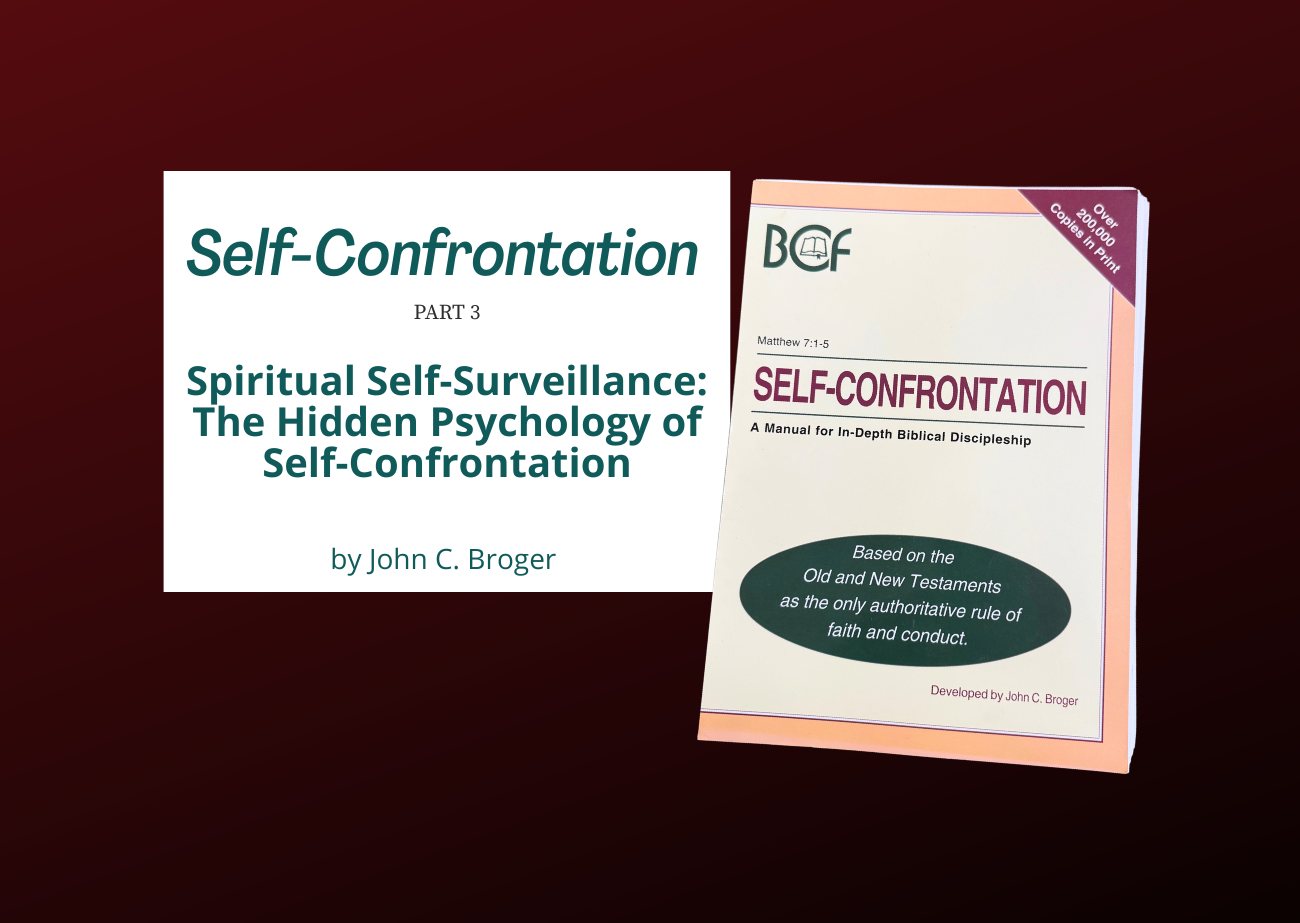
Spiritual Self-Surveillance: The Hidden Psychology of Self-Confrontation
This is Part 3 of a three-part critique on John C. Broger’s Self-Confrontation manual. Part 1 examined Broger’s career and background, the Biblical Counseling Foundation, and how the manual can function as a system of behavioral control. Part 2 examines the Mary and Tom case study — the main case study in the book — and how the manual mishandles marital abuse, addiction, and victim-blaming. Part 4 offers a practical list for detecting Self-Confrontation–style keywords and concepts in sermons.
Christianity has always included self-examination. Confession, repentance, humility, and moral reflection are part of ordinary Christian life.
But there is a difference between healthy conviction and chronic spiritual self-surveillance.
Healthy conviction leads a person toward God, truth, repair, and freedom. Spiritual self-surveillance keeps a person trapped inside their own inner life: inspecting motives, distrusting emotions, hunting for hidden sin, monitoring reactions, and wondering whether every thought reveals rebellion, pride, bitterness, or unbelief.
That is one of the deepest dangers of John C. Broger’s Self-Confrontation. The manual claims to lead people into biblical change, but its methods can train Christians to live under constant internal inspection.
When “Self-Confrontation” Becomes Self-Preoccupation
Many conservative Christians rightly warn about cults and authoritarian pastors who use the Bible to control people instead of shepherd them. The problem with systems like Self‑Confrontation is that they blur that line. One man’s application of Scripture is packaged as 105 “unalterable” principles and a fixed process every believer must follow. That doesn’t just teach the Bible; it quietly replaces personal discernment and the leading of the Holy Spirit with a man‑made grid. At that point we have moved from biblical authority into something much closer to spiritual manipulation.
The irony is hard to miss. Self-Confrontation repeatedly warns against self-focus, self-pity, self-centeredness, and self-protection. Yet the actual practice of the course can become intensely self-preoccupied.
Readers are trained to:
- examine their thoughts,
- analyze their motives,
- identify sinful “heart attitudes,”
- track patterns of failure,
- complete worksheets,
- memorize corrective verses,
- record progress,
- confess failures,
- and repeat the process continually.
The manual even tells students to plan on spending “a minimum of thirty minutes to an hour each day” doing homework designed to establish “biblical habit patterns” that will change their lives.1
Spiritual discipline is not the problem. The problem is the atmosphere created when discipline becomes constant self-monitoring and when every emotional struggle is routed through a system of moral diagnosis.
Martin and Deidre Bobgan, conservative Christian critics who were themselves strongly opposed to secular psychology, warned that “self-confrontation easily becomes self-preoccupation” and that “constant self-examination may lead to disguised self-improvement and self-righteousness.”2
That critique is devastating because it names the paradox: the system condemns self-focus while structurally producing obsessive self-focus.
The Workbook Becomes the Lens
Self-Confrontation is not simply a book to read. It is a training system.
The manual includes lessons, homework, Scripture memory, worksheets, “practical helps,” biblical counseling records, planning forms, scheduling tools, “Victory Over Failures” materials, “Think and Do” lists, and anxiety action plans.3 Assignments marked with an asterisk may be required for those who want to continue further biblical counseling training.4 It feels rigorous, militant, and elite—and that intensity attracts some people.
Over time, the workbook can become the lens through which a person interprets reality. (Introduction of book, Lesson 9)
A normal feeling becomes a diagnostic clue. (Lesson 6)
A painful response becomes a “heart issue.” (Lesson 6)
A protective boundary can be treated as sinful self-protection. (Lessons 4, 7)
Pushback or resistance can be framed as rebellion. (Lessons 7, 11)
Fear, anxiety, or trauma responses can be treated as unbelief or failure to trust God. (Lessons 9, 19)
Anger becomes bitterness. (Lesson 11)
Exhaustion and illness become sinful self-focus. (Lesson 18)
That is how spiritual self-surveillance works: a person learns to watch themselves as though every inner movement might expose a hidden spiritual defect.
For more on how this kind of interpretive framework can harm victims, see 27 Ways Churches Gaslight Abuse and Betrayal Victims and Am I the One Destroying the Relationship? Or Is This Abuse?
The Crushing Guilt of Never Being Done
People formed by these systems may begin monitoring their own thoughts, confessing constantly, correcting one another, fearing “rebellion,” and distrusting their own instincts.
Over time, this can create a state of constant, crushing guilt: never fully resting in grace, never sure whether one’s motives are pure, and always wondering what hidden sin still needs to be uncovered.
This is not the same as ordinary Christian repentance. Repentance has an endpoint: confession, mercy, repair, and renewed life. Spiritual self-surveillance often has no endpoint. There is always another motive to inspect, another worksheet to complete, another attitude to correct, another pattern to discover.
The manual repeatedly praises the practices that can produce it: lifelong self-confrontation, constant self-examination, suspicion of one’s motives, grief over one’s failures, and ongoing efforts to uncover what is still wrong inside.
The person may appear very “teachable” on the outside while becoming increasingly anxious, dependent, and spiritually exhausted on the inside.
That is one reason this framework can be especially harmful to people vulnerable to anxiety, OCD, religious scrupulosity, or moral injury.5 See also Quiz: Moral Injury & Christian Abuse Survivors Who Divorce.
Longtime evangelical senior pastor David Johnson describes this as the loss of blessing under religious performance (outward holiness). In spiritually abusive systems, people are pressured to perform religious behaviors while the system examines them instead of examining itself. The result is not freedom but exhaustion. People become tired, belittled, and uncertain whether they will ever be good enough.
Scrupulosity: When Faith Becomes Fear
Scrupulosity is not simply taking God seriously. It is not humility. It is not tenderness of conscience. Scrupulosity is commonly understood as a religious or moral subtype of obsessive-compulsive disorder, involving intrusive fears about sin, guilt, purity, blasphemy, moral failure, or offending God.6
The National Institute of Mental Health describes OCD as involving recurring, unwanted thoughts or obsessions, repetitive behaviors or mental acts, or both.7 In religious scrupulosity, the “checking” may not look like handwashing or lock-checking. It may look like repeated confession, compulsive prayer, rereading Scripture anxiously, replaying conversations, asking pastors for reassurance, mentally reviewing motives, or trying to feel certain that repentance was sincere enough.
That distinction matters enormously. A scrupulous person is often not careless about sin. They may be painfully over-concerned with sin. They may already feel guilty, condemned, and afraid. They may be trying desperately to obey God while trapped in a loop of intrusive thoughts and compulsive spiritual checking.
Systems like Self-Confrontation can become dangerous for such people because the system’s “medicine” may intensify the symptoms: more self-examination, more motive analysis, more confession, more checking, more fear of self-deception, more correction, more searching for hidden sin.
For someone with scrupulosity, that can become a spiritual treadmill. The person feels temporary relief after confessing, completing the worksheet, finding the right verse, or receiving reassurance from a counselor. But soon the doubt returns: Did I really repent? Was I honest enough? Am I resisting God? Am I bitter? Am I self-focused? Did I confess the right sin?
That cycle is one reason OCD specialists warn that reassurance-seeking and compulsive checking can keep OCD alive. The International OCD Foundation notes that religious faith and effective OCD treatment do not have to be enemies; good treatment can respect a person’s faith while helping them stop compulsive patterns.8
This is where poorly trained religious counseling can do real harm. If a counselor mistakes OCD-driven fear for conviction from the Holy Spirit, they may unintentionally feed the compulsion. If every anxious doubt is treated as a “heart issue,” the person may become more trapped, not more free.
That is why scrupulosity requires humility from pastors, lay counselors, and biblical counseling ministries. Not every fear of sin is spiritual conviction. Not every intrusive thought reveals the heart. Not every anxious confession is repentance. Sometimes the most faithful response is not more self-confrontation, but qualified mental health care, rest, wise pastoral boundaries, and freedom from compulsive religious checking.
Worksheets, Records, and the Problem of Exposure
The Bobgans raised another serious concern: privacy.
They warned that some homework required for continued BCF training could expose not only the student’s own sins, but also the sins of others. They specifically worried that instructors reading homework could begin viewing a student through the lens of a confessed private attitude, such as selfishness.8
This matters because spiritual formation becomes dangerous when private conscience material is gathered, evaluated, remembered, and potentially used to classify people.
In a healthy church, confession should be handled with humility, privacy, mercy, and restraint. In a controlling system, confession becomes data.
Once confession becomes data, leaders may begin to see people less as complex image-bearers and more as patterns:
- the bitter one,
- the rebellious one,
- the selfish one,
- the fearful one,
- the unsubmissive one,
- the one who resists counsel.
That kind of labeling can make people feel deeply “othered.” Once a counselor or leader has targeted you as the person who does not measure up, every fear, hesitation, question, or objection can be treated as further evidence of your spiritual problem.
You are no longer simply a Christian being helped. At best, you become “the struggling one.” If you offer even the slightest pushback or try to explain what you are going through, you may quickly become “the bitter one,” “the defensive one,” “the rebellious one,” or “the one who won’t receive correction.”
For more on similar dynamics in church settings, see Good vs. Bad Pastoral Counselors: Marital Abuse and Church Betrayal After Abuse.
Tracking Sin Can Become Its Own Trap
The Bobgans also criticized the manual’s “Discovering Problem Patterns Worksheet,” which asks people to observe and record patterns in their lives. They noted that students may be directed to write down instances of sinful behavior, such as all the times one is lazy during a week.9
That may sound practical. But spiritually and mentally, there is a difference between confessing sin and becoming a bookkeeper of one’s own failures.
The Bobgans warned that someone could complete such a worksheet faithfully and still never truly change. Worse, they argued, a person might “improve” outward behavior while becoming prideful — what they called improving the flesh rather than walking after the Spirit.10
That distinction matters.
- A person can become more disciplined while becoming less free.
- A person can become more compliant while becoming less honest.
- A person can become more externally “biblical” while becoming more anxious, fearful, and self-righteous.
- A person can learn the system without learning love.
When Accountability Becomes Surveillance
Healthy accountability is relational, humble, mutual, and bounded. It helps people tell the truth, receive support, repair harm, and grow in wisdom.
Unhealthy accountability becomes surveillance.
It asks too much, watches too closely, interprets too confidently, and keeps people spiritually dependent. It trains Christians to disclose, report, confess, submit, and self-correct — often without equal emphasis on safety, boundaries, conscience, and freedom.
In authoritarian churches, this can create an in-group/out-group dynamic:
- the “teachable” people who accept the system,
- the “rebellious” people who question it,
- the “mature” people who use its language,
- the “struggling” people who are always under evaluation.
That is not discipleship. That is social and spiritual control.
Many abuse survivors recognize this pattern immediately because similar dynamics show up in coercive relationships: your motives are interpreted for you, your reactions are used against you, and your pushback becomes evidence that you are the problem. See Abuse Isn’t “Subjective”: How Control Patterns Are Measurable and What Is DARVO?
The Illusion of Freedom
This is the paradox that makes systems like Self-Confrontation psychologically powerful:
The person believes they are becoming freer while simultaneously becoming more self-policing, more dependent on approved frameworks, more fearful of independent thought, and more vulnerable to spiritual authority.
- The system promises victory, but the path to victory is continual inspection.
- It promises freedom, but freedom becomes dependent on remaining inside the system.
- It promises biblical change, but change becomes measured by compliance with prescribed methods.
- It promises maturity, but maturity becomes confused with submission to spiritual diagnosis.
High‑control religious groups often promise freedom while training people to police their own thoughts and feelings on behalf of the system. Self‑Confrontation does something similar: the more “biblical” you become, the more you are expected to interpret your own conscience through its categories and distrust any perception that doesn’t fit them.
A Better Christian Way
Christian growth does not require people to live under constant internal surveillance.
Healthy discipleship should help people become more truthful, loving, wise, courageous, and free. It should strengthen conscience without crushing it. It should teach repentance without producing obsessive guilt. It should encourage humility without making people dependent on spiritual authorities to interpret their inner lives.
A better Christian approach would include:
- honest confession without compulsive confession,
- repentance without chronic shame,
- discernment without paranoia,
- accountability without surveillance,
- pastoral care without interrogation,
- Scripture without proof-texted control,
- and spiritual growth without authoritarian systems.
For those in destructive marriages or controlling churches, safety must come before correction-heavy “growth plans.” See Safety-First vs. Marriage-First Counseling, Safety Is Biblical, and How to Help a Friend in an Abusive or Destructive Marriage.
Conclusion: Not Every “Biblical” System Is Safe
Self-Confrontation may contain Scripture, doctrine, and sincere desire for holiness. But that does not make the system safe.
A manual can quote the Bible and still train people into fear.
A counseling system can reject secular psychology and still become psychologically coercive.
Bible‑believing Christians should be especially cautious here, because once a curriculum claims, “This is God’s view of your motives,” it becomes very difficult to question the system without feeling like you are questioning God Himself.
Paul insists that in many matters “each one should be fully convinced in his own mind” and that believers will not all see everything the same way (Romans 14). The Self‑Confrontation curriculum quietly reverses that: it presents Broger’s 105 “biblical principles” and his heart‑issue categories as if they were the way serious Christians must interpret their motives, emotions, and conflicts. In practice, the system does not just teach Scripture; it narrows Scripture down to Broger’s counseling lens and binds consciences where Paul leaves room for discernment and difference.
A church can speak constantly about grace while producing people who feel guilty, watched, corrected, and spiritually unsafe.
In the hands of an authoritarian pastor, Self-Confrontation can become especially dangerous because it gives spiritual language to control. The pastor can claim to be helping a person see “God’s view” of the problem while actually training them to distrust their own perception of reality. Fear can be labeled unbelief. Anger can be labeled bitterness. Exhaustion can be labeled self-focus. Pushback can be labeled rebellion. Once the pastor controls the categories, the church member’s own explanations become suspect before they are even heard.
A controlling pastor does not need to say, “I want power over you.” He only has to say, “I am helping you confront yourself biblically.” Then the counselee’s fear, exhaustion, confusion, and objections can all be folded back into the system as evidence that more self-confrontation is needed.
That is why Christians should be cautious with Self-Confrontation and similar systems. The problem is not repentance. The problem is a framework that can turn repentance into surveillance, conviction into chronic guilt, discipleship into interrogation, and Christian freedom into behavioral control.
The fruit of the Spirit is not obsessive self-monitoring. It is love, joy, peace, patience, kindness, goodness, faithfulness, gentleness, and self-control.
This also affects Christian witness. When churches use “biblical” systems that leave people feeling watched, shamed, and spiritually unsafe, outsiders do not see holiness; they see control. The church may think it is defending biblical authority, while the wounded and the watching see another reason to stay away.
Any system that produces fear, shame, suspicion, dependency, and spiritual exhaustion should be questioned — no matter how biblical it claims to be.
Endnotes
- John C. Broger, Self-Confrontation: A Manual for In-Depth Biblical Discipleship (Biblical Counseling Foundation), course introduction and homework instructions, Internet Archive, https://archive.org/details/selfconfrontatio0000brog. ↩
- Martin and Deidre Bobgan, “Confronting the Biblical Counseling Foundation’s Self-Confrontation Manual,” PsychoHeresy Awareness Ministries, critique of constant self-examination, self-preoccupation, works-oriented activity, and bondage, PDF. ↩
- Broger, Self-Confrontation, Supplements and Practical Helps section, including “Victory Over Failures Worksheet,” “Think and Do” List, Biblical Counseling Record, Summary and Planning, schedules, and anxiety action plan. ↩
- Broger, Self-Confrontation, homework instructions noting assignments marked with an asterisk and further biblical counseling training. ↩
- For a related discussion of moral injury among Christian abuse survivors, see Life-Saving Divorce, “Quiz: Moral Injury & Christian Abuse Survivors Who Divorce,” https://lifesavingdivorce.com/moralinjury/. ↩
- International OCD Foundation, “What Is Scrupulosity?” https://iocdf.org/faith-ocd/what-is-ocd-scrupulosity/. ↩
- Marissa Franks Burt (@mburtwrites), Threads post, Apr. 17, 2026, https://www.threads.com/@mburtwrites/post/DXPQRBoFLO3. Burt describes postpartum panic, compulsive Bible reading/prayer, evangelical moralism, and a culture where “extremism is faith.” ↩
- Bobgan and Bobgan, “Sharing Homework,” warning that required homework may expose the sins of others and shape how instructors view students. ↩
- Bobgan and Bobgan, critique of the “Discovering Problem Patterns Worksheet.” ↩
- Bobgan and Bobgan, critique of tracking sinful patterns, improving the flesh, and prideful self-improvement. ↩
 :
:
 :
: Buy PDF