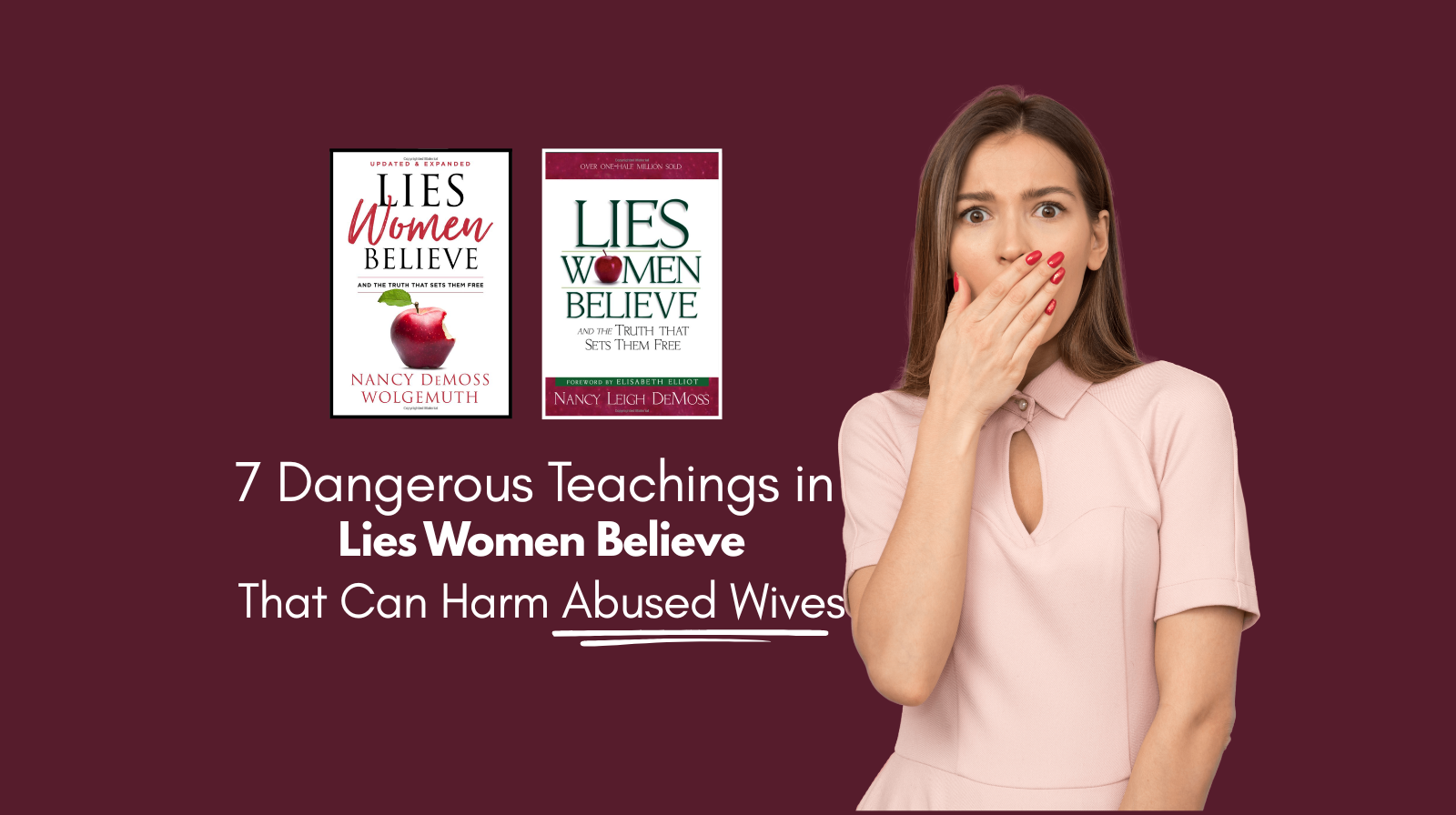
Seven of the Most Troubling Teachings in Lies Women Believe, by Nancy Leigh DeMoss Wolgemuth
The book Lies Women Believe is not dangerous because of one isolated sentence. It is dangerous because of the pattern. Again and again, women’s instincts for safety, autonomy, grief, anger, medical care, family planning, and divorce are framed as deception unless they fit Nancy DeMoss Wolgemuth’s narrow vision of “truth.” This may be the reason that nearly 500 people — apparently mainly Christian women — over the past two decades have given this book the lowest possible rating on GoodReads.
For readers who are new to my work, I am not talking about ordinary disappointment or two flawed people learning how to live together. As Christians, we take marriage seriously, and we oppose frivolous divorce. But where there is abuse, coercive control, sexual immorality, abandonment, addictions, neglect, criminality, or danger to children, divorce may be necessary, biblical, and life-saving.
1. “Sometimes divorce is a better option than staying in a bad marriage” is listed as a lie.
In the 2001 table of contents, that sentence appears as one of the “lies” women believe about marriage. (p. 9)
That statement matters. Before the reader even gets to the chapter on marriage, she has already been told what conclusion she is supposed to reach: that believing divorce may be better than remaining in a bad marriage is deception. Not discernment. Not protection. Not wisdom. Deception.
The phrase “bad marriage” doesn’t tell us what is going on behind closed doors. A bad marriage could mean ordinary disappointment. But it could also mean coercive control, sexual betrayal, emotional abuse, physical danger, financial abuse, abandonment, or a home that is harming children.
The Bureau of Justice Statistics reported that in 2021 there were an estimated 4,970 female murder victims in the United States. Of those, 34% were killed by an intimate partner.That made intimate partner homicide by a current or past spouse or romantic partner the single largest known category of female murder victim-offender relationship.
In other words, for a significant number of women, the most dangerous person in their lives was not a stranger in a dark alley. It was the man who had once promised to love them. One suspects these women would have preferred divorce over death.
Related Life-Saving Divorce resources:
- Can I Divorce for Abuse? Can Christians Divorce for Abuse?
- Abuse, Abandonment, and Adultery Are Biblical Grounds for Divorce
- Is it Always Best to “Stay for the Kids”? No, Not If the Home is Toxic
- Dr. Paul Amato’s research suggests that divorce can be a net benefit to children in some cases—roughly one-fourth to one-third—where the marriage is highly conflicted, because it removes children from a seriously discordant home.
Related review with screenshots
For readers who want to examine the original passages, see my earlier review with some screenshots from the book:
Lies Women Believe: Why This Christian Bestseller Endangers Abused Wives
.
2. The book frames a wife’s desire to leave as part of a deceptive “spiral.”
The divorce section includes the thought, “If my husband doesn’t love and respect me, I have the right to leave him,” followed by, “I’m better off getting a divorce than staying in a miserable marriage.” (p. 157-158)
DeMoss presents this as a progression into deception. That is pastorally dangerous because many abused women already doubt themselves. They have been told they are too sensitive, too emotional, too unforgiving, too unsubmissive, or too selfish. This teaching reinforces the abuser’s script.
Related Life-Saving Divorce resources:
3. The book says a woman who wants to “bail out” is elevating her happiness and well-being above God’s Word.
In the marriage chapter, the desire to leave is described as putting “personal happiness and well-being” above what God says about marriage vows. (p. 158)
That pairing is chilling. “Happiness” and “well-being” are not the same thing. Safety is not selfishness. Sanity is not rebellion. Protecting children is not worldliness. In abusive marriages, “well-being” can mean the difference between survival and destruction.
Related Life-Saving Divorce resources:
4. “If I submit to my husband, I’ll be miserable” is listed as a lie.
Submission is treated as God’s pathway to freedom and safety. (pp. 9, 162-163, and in the new edition pp 173-176)
For women married to safe, loving, non-abusive men, this may sound like ordinary complementarian teaching. But for a woman married to a controlling or abusive husband, “submission” is often the very language used to silence her. A wife’s fear of submission may not be rebellion. It may be evidence that submission has already been weaponized against her.
Related Life-Saving Divorce resources:
5. “When we resist authority, we become more vulnerable to Satan’s attacks and to sin.”
6. The depression teaching links many symptoms to spiritual failure.
The 2001 edition says many symptoms connected with depression may be rooted in issues such as ingratitude, bitterness, unforgiveness, unbelief, anger, claiming rights, and self-centeredness. (p. 203-205, 212, and in the newer edition pp. 242-243)
The 2018 edition is somewhat more careful, but the pattern remains troubling. For women in abusive or destructive marriages, depression may be the body and mind responding to prolonged trauma. It is cruel to tell a suffering woman, directly or indirectly, that her despair is probably rooted in her own sin.
Women need competent medical care, trauma-informed counseling, safety planning, and community support. They do not need a Bible study implying that their depression is probably a sin problem.
Related Life-Saving Divorce resources:
7. The book spiritualizes suffering in ways that can silence victims.
The book repeatedly teaches women to endure hardship by trusting God’s purposes, relinquishing control, and choosing holiness over temporal happiness. (p. 264-265, and in the newer edition pp. 263-264)
There is a Christian way to talk about suffering that comforts the afflicted. But there is also a way to talk about suffering that protects the oppressor. When a woman is being harmed, the first pastoral question should not be, “How can she endure this more faithfully?” It should be, “How do we help her get safe, tell the truth, and stop the wickedness?”
Related Life-Saving Divorce resources:
The danger of Lies Women Believe is not merely that Nancy DeMoss Wolgemuth values marriage, motherhood, submission, forgiveness, and endurance. The danger is that these ideals are often presented in ways that make women distrust their own need for safety.
When a woman is being abused, betrayed, abandoned, coerced, or endangered, the life-saving truth may be the very thing this book trains her to call a lie: sometimes divorce is better than staying in a bad marriage.
Finally, DeMoss’s traditional teaching on wifehood, motherhood, and homemaking deserves mention, though it is not the main point of this post. Many Christians value those roles deeply, and so do I. The concern is not honoring homemaking and motherhood. The concern is when women are taught that their highest holiness is domestic service and child raising, in ways that can make it harder for them to recognize danger, seek help, support themselves, or leave a destructive marriage.
 :
:
 :
: Buy PDF