
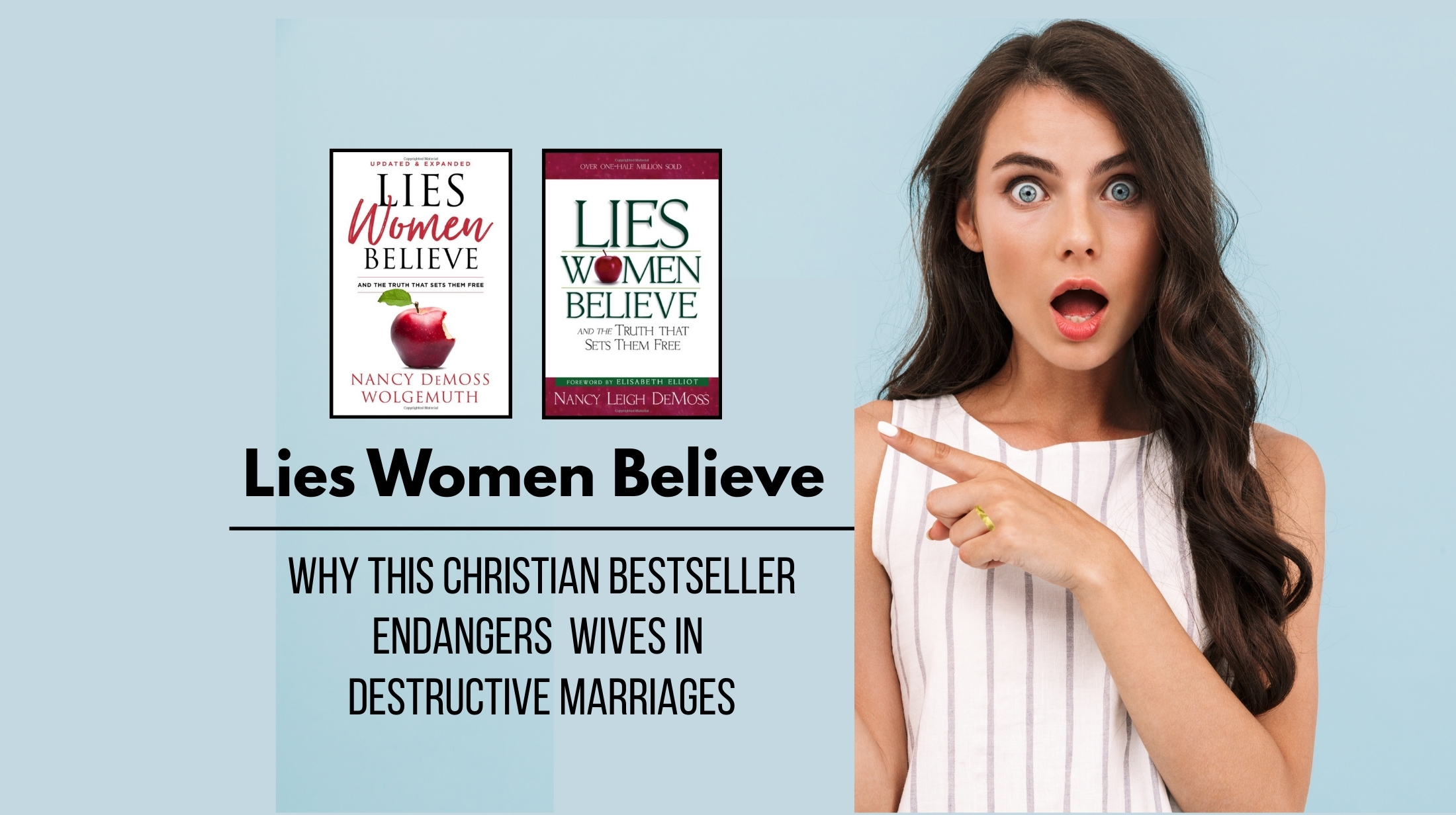
Review of Lies Women Believe by Nancy Leigh DeMoss Wolgemuth
Lies Women Believe has shaped Christian women’s Bible studies for more than two decades. It has been distributed at conferences, used in church small groups, and promoted as a trustworthy guide for spiritual growth. Because of its enormous reach, its most dangerous teachings deserve careful scrutiny. It’s also important to note that nearly 500 people — apparently mainly Christian women — over the past two decades have given this book the lowest possible rating on GoodReads, just one star.
This article focuses on one of the most damaging teachings in Lies Women Believe: the claim that “sometimes divorce is a better option than staying in a bad marriage” is a lie. For a broader overview, my other article looks at seven dangerous issues in the book.
The Teaching That Causes the Most Harm
The Book Frames Divorce as Deception Even When the Marriage is Dangerous
The 2001 Lies Women Believe table of contents explicitly lists “Sometimes divorce is a better option than staying in a bad marriage” as one of the “lies” about marriage. That statement matters. Before the reader even gets to the chapter on marriage, she has already been told what conclusion she is supposed to reach: that believing divorce may be better than remaining in a bad marriage is deception. Not discernment. Not protection. Not wisdom. Deception.
For a woman in an ordinary disappointing marriage, that framing is troubling enough. For a woman in a coercive, abusive, sexually unsafe, or chronically destructive marriage, it can be devastating. The implication is that staying in a bad marriage is more faithful, more God-honoring, and better for everyone involved—even when the “bad marriage” may include harm to the woman and her children. That is not wisdom. It is dangerous theology dressed up as truth. Fifty years of family research shows that adult and child wellbeing improves when they leave a high-conflict or destructive marriage.
The Chapter Does Not Soften the Setup
And the chapter does not soften that setup. DeMoss introduces this section by saying “the Enemy” leads women to believe there is no right way to deal with a seemingly hopeless situation, and that this “deception” has fostered “a culture of shattered marriages.” The burden is placed immediately on the woman’s thoughts, perceptions, and willingness to endure. Her impulse to leave is spiritually suspect before her circumstances are seriously examined.
The Phrase “Bad Marriage” Hides Too Much
This is exactly why these books are so dangerous in church women’s studies. The category “bad marriage” is doing an enormous amount of work. A “bad marriage” could mean ordinary disappointment, emotional neglect, coercive control, chronic porn use, financial abuse, sexual betrayal, intimidation, or physical danger. But the table of contents collapses all of that complexity into one sweeping “lie.” A woman in crisis sees herself on the page and is taught to distrust the very thought that leaving may be necessary.
When “Truth” Becomes a Trap
The later summary pages are just as stark: under “THE LIE,” the book repeats, “Sometimes divorce is a better option than staying in a bad marriage.” Under “THE TRUTH,” it answers with covenant permanence, “There is no marriage God cannot heal,” and “God’s grace is sufficient” to enable faithfulness, love, and forgiveness “without limit.” That is not a trauma-informed safety plan. That is a theological mousetrap.
The problem is not that Christian marriage vows should be treated lightly. The problem is that women have often been taught to treat their own harm lightly. When the “truth” offered to a suffering wife is essentially “stay, submit, forgive, wait, and believe God can change him,” the teaching can become a ready-made cage for the vulnerable.
Safety Is Recast as Spiritual Failure
In these passages, Nancy Leigh DeMoss Wolgemuth teaches that women who want to leave deeply destructive marriages are “hard-hearted,” spiritually deceived, and ensnared by Satan. Under this framework, a wife’s desire to escape ongoing harm is not wisdom, discernment, or self-preservation—but proof that she has believed lies.
No Meaningful Exceptions for Abuse or Danger
Crucially, the author offers no exceptions for physical violence, serial adultery, sexual abuse, or danger to children. The husband’s behavior fades into the background, while the wife becomes the moral problem for refusing to endure it forever. Marriage-destroying sin is minimized. A woman’s attempt to survive is pathologized. This is not biblical accountability. It is spiritual blame-shifting.
A sentence was added to the 2018 edition suggesting that an abused woman should “get to a safe place,” but it gives no indication that marital separation might be warranted (p. 177).
Scripture warns against “acquitting the guilty and condemning the innocent” (Proverbs 17:15). Yet this teaching does exactly that—placing the weight of a husband’s repeated sin onto the wife’s shoulders and calling her desire for safety evidence of deception.
Why This Theology Is Spiritually Dangerous
It Teaches Victims to Distrust Their Survival Instincts
This teaching has real-world consequences. Women absorb the belief that leaving danger equals betraying God. They learn to distrust their God-given instincts for survival. Many stay longer than they should—or never leave at all—because they fear spiritual condemnation more than continued harm.
It Protects Abusers From Accountability
Calling a battered woman “selfish” or “deceived” for wanting safety is not discipleship. It is spiritual gaslighting. It keeps victims trapped, protects abusers from accountability, and misrepresents the character of God. To borrow a phrase from a Christianity Today article, this kind of counsel can function as “a slow, sadistic death sentence.”
It Turns Human Pain Into Spiritual Failure
What makes Lies Women Believe so damaging is the way it recasts ordinary human pain as spiritual failure. By the end of the book, women have already been told that feeling God has not been good, feeling unloved, feeling worthless, feeling overwhelmed, wanting help, wanting their rights respected, struggling with disappointment, sexual pain, or unfulfilled longings are all signs of deception or wrong belief. The pattern is relentless: instead of meeting fear, loss, exhaustion, or grief with compassion, the book teaches women to suspect themselves. The question becomes not, “What happened to you?” but, “What lie are you believing?”
“But She Was Single When She Wrote It”
The 2018 Revision Did Not Fix the Core Problem
Some people felt that DeMoss Wolgemuth was unqualified because she wrote the first edition while single and lacked firsthand marital experience. That explanation does not hold up. The book was “updated and expanded” in 2018—after she married—and the core message remains unchanged.
She Knew Some Readers Were Objecting
By the time she revised Lies Women Believe in 2018, she was not writing in ignorance of criticism. In the updated preface, she says hundreds, perhaps thousands, of women had responded through conversations, letters, emails, and online reviews, and that some disagreed with particular points. In other words, the pain and pushback were not hidden from her.
That makes the 2018 revision more troubling, not less. She knew women were reacting. She knew some readers objected. She knew the book had generated enough criticism to require “clarifying” and “fine-tuning.” And yet the basic structure remained: women’s suffering is still repeatedly described as deception, self-focus, rights-claiming, bitterness, unbelief, and failure to accept biblical truth.
Softened Wording Is Not Safer Theology
Given the volume of public negative response—including hundreds of one-star Goodreads reviews, depending on edition aggregation—it is hard to argue that she simply did not know how the book was landing. The problem is not that no one told her. The problem is that, after hearing from women, she largely preserved the viewpoint that caused the harm.
Although some wording was softened, the underlying theology did not change. A woman who wants to leave a destructive marriage is still portrayed as spiritually compromised rather than morally justified. See image below. Apparently, marriage did not introduce empathy for victims. It did not add meaningful exceptions for danger. It did not correct the central error.
Why This Matters to Me Personally
This Teaching Is Not Theoretical to Me
My life-saving divorce saved my life, my sanity, and my children. For years, I stayed. I prayed. I tried harder. I hoped for change. When I finally chose safety, it was not because I had a hard heart—it was because I had clarity.
Leaving Did Not Destroy My Faith
Many survivors tell the same story. Leaving did not destroy their faith; it preserved it. What harmed them most was not divorce, but theology that demanded acceptance of ongoing harm and called it holiness.
The Church Must Name Dangerous Teaching Plainly
Today, even many conservative Christian organizations, such as Focus on the Family, openly advise abused wives to separate from their husbands. Lies Women Believe stands increasingly out of step—with Scripture, with pastoral wisdom, and with reality.
That is why this teaching must be named plainly: it is spiritually dangerous, morally inverted, and harmful to the very people Jesus consistently protected.
Video Discussion and Reader Response
🎥 Video discussion linked here for readers who want a quote-by-quote walkthrough of the book: https://youtu.be/yfunQZE7U6I?si=MTADj19y_qfbyoDk
This book has more than 500 1-star (very negative) reviews, going back nearly 20 years on Goodreads, many of them written by conservative Christians.
Images From the Earlier and Updated Editions
See image of a portion of page 159 below in the original version of Lies Women Believe.
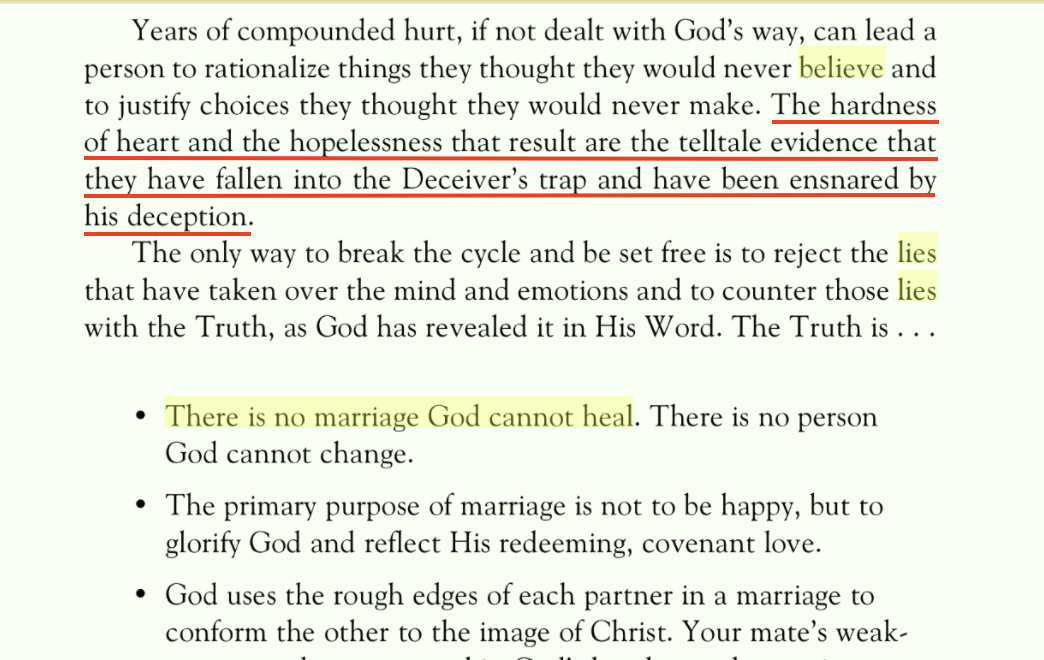
Caption: page 159 from the earlier edition — the author talking about abused and betrayed wives who want to get to safety and leave.
Here’s page 208 (Kindle) from the 2018 version of Lies Women Believe, which she updated after she married. It softens the wording slightly, but is still damaging. The same text is found on page 186 in the updated and expanded print edition.
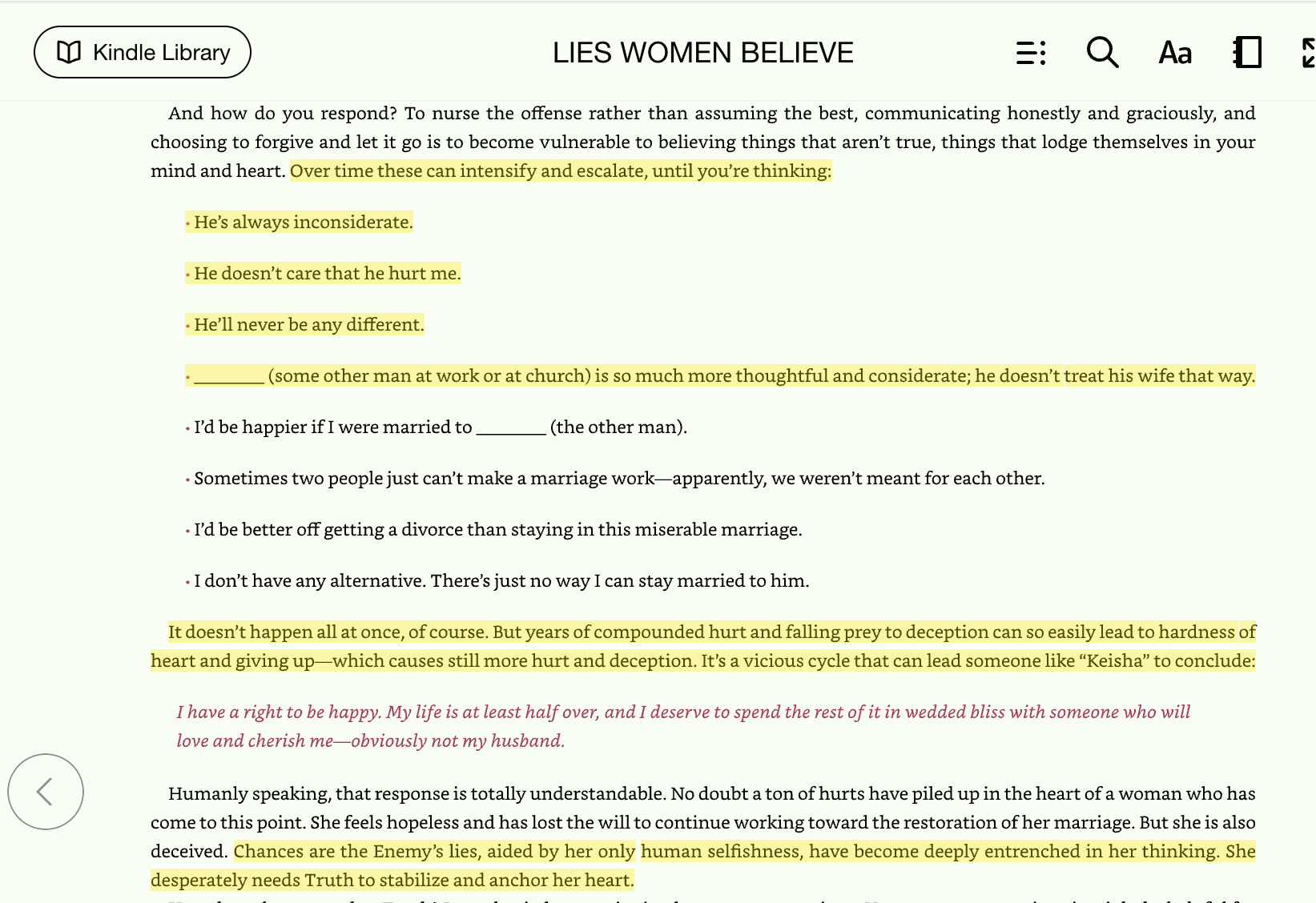
2018 edition of Lies Women Believe, p. 208 Kindle — or see p. 186 in the printed version.
Related Reading
- 7 Dangerous Teachings in Lies Women Believe
- Safety-First vs. Marriage-First Counseling
- But He Never Hit Me: Divorce for Neglect, Emotional, and Financial Abuse
- 12 Ways to Help a Christian Who is Being Abused by Their Spouse
- 27 Ways Churches Gaslight Abuse and Betrayal Victims (And the Biblical Truth)
- Unconditional Love in Marriage Does Not Mean Enduring Abuse
 :
:
 :
: Buy PDF