
Are Christian Donors Funding a System That Keeps Abuse Victims Married?
Focus on the Family receives desperate calls about abuse every week. What happens next?
Most Christians who give to Focus on the Family have good intentions.
They love healthy marriage.
They love strong families.
They want children to grow up in safe homes.
When Focus asks for donations to “save marriages,” many gladly give because they believe they’re helping hurting families heal.
I don’t question their motives.
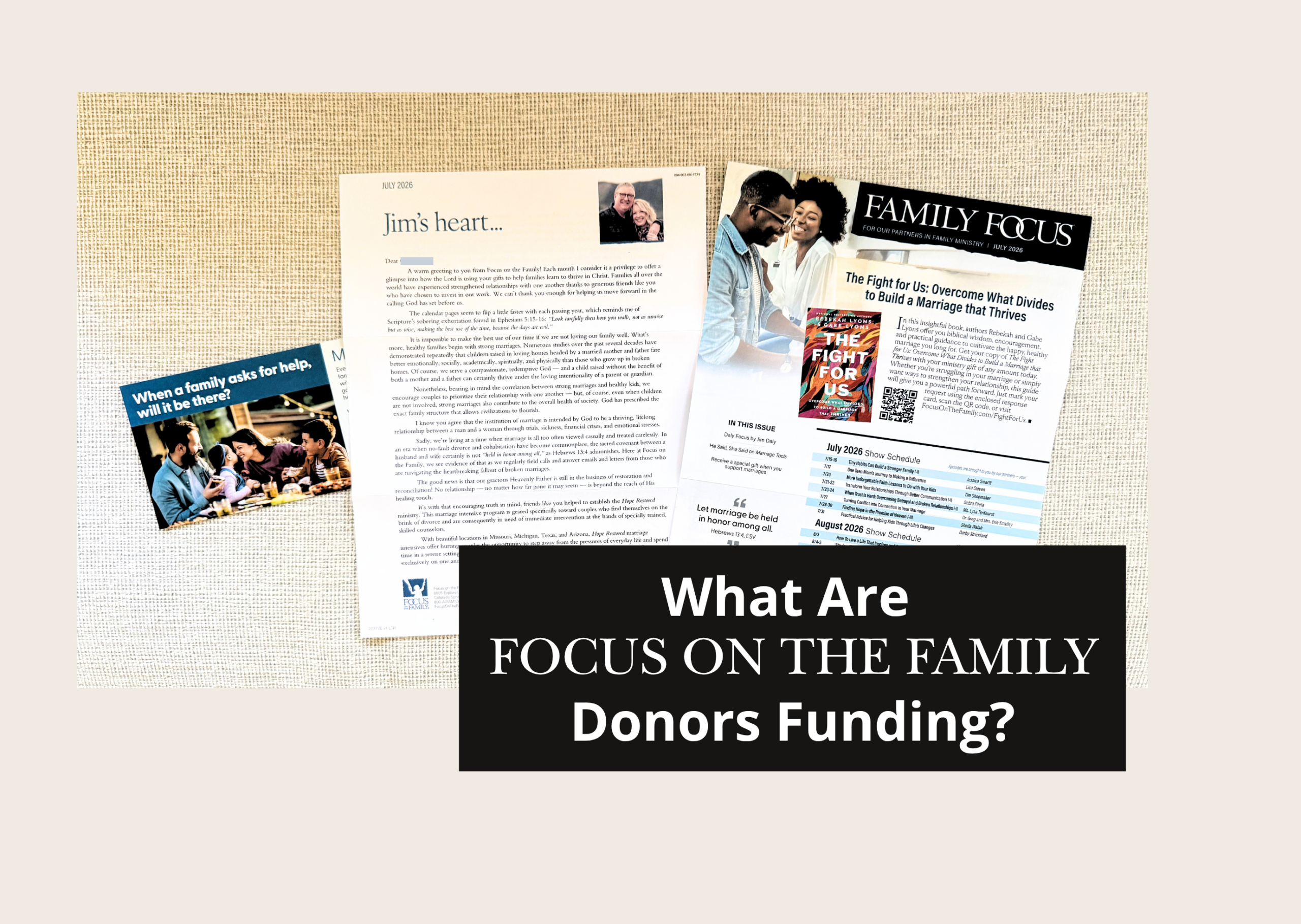
I question whether they know what they’re funding. (See a recent fundraising letter below.)
What Does Focus Offer?
Focus describes its counseling ministry as one complimentary, biblically grounded telephone consultation.
Notice what it does not describe.
It is not long-term therapy.
It is generally a one-time consultation.
After that consultation, callers may be referred to:
- an independent therapist screened through Focus’s Christian Counselors Network, or
- Focus on the Family’s own Hope Restored marriage-intensive program.
Hope Restored Is Not Free
Hope Restored is a multi-day marriage intensive.
Depending on the location and format, couples typically pay approximately $3,000 to $6,000 to attend.
That doesn’t make the program wrong.
But it does raise an important question.
What Happens When the Caller Is An Abused Wife?
This is where the documents begin fitting together.
Focus’s public divorce policy tells abuse victims to get to safety.
That’s good.
But when Focus explains the biblical grounds for divorce, abuse is missing.
Instead, it lists:
- sexual immorality
- abandonment by an unbelieving spouse
Abuse—even felony-level violence, coercive control, murder threats, emotional abuse, or child abuse—is not presented as biblical grounds for divorce.
Then consider the Hope Restored therapist manual, Restoring Hope.
It instructs therapists not to advise clients to divorce…ever.
If a spouse decides to pursue divorce rather than restoration, that couple leaves the program and is referred elsewhere.
In other words, the program’s mission is marriage restoration—not helping abused spouses discern whether ending the marriage is the safest and most faithful option.
Put These Pieces Together
Focus tells us:
- abuse calls are “not uncommon,”
- callers receive one free consultation,
- some callers may be referred to Hope Restored,
- Hope Restored is built around reconciliation,
- Hope Restored therapists are not supposed to recommend divorce under any circumstance.
- Focus’s public policy statement does not recognize abuse itself as biblical grounds for divorce.
Those aren’t my documents.
They’re Focus’s.
The Question Donors Should Ask
Here’s the question I would ask if I were giving money.
How many abuse victims are referred into Hope Restored?
Focus doesn’t say.
Another question:
How many are referred to domestic violence specialists instead?
Focus doesn’t say.
Another:
How many callers are clearly told that ongoing abuse itself may justify divorce?
Again—
Focus doesn’t say. But we know their official therapy manual says they do not “advise or encourage people to divorce” and they give no exceptions, not even for pedophilia.
The Missing Numbers
Focus reports millions of dollars spent on marriage ministry every year.
It reports thousands of counseling contacts.
It reports that abuse is not uncommon among those contacts.
Their Hope Restored program says couples involving domestic abuse or violence require additional screening to determine whether the program is an appropriate fit. That is important—but it still leaves major unanswered questions.
Focus does not publicly disclose:
- how many callers reporting abuse are screened for Hope Restored,
- how many are found unsuitable for the intensive,
- how many are referred to specialized domestic-violence services,
- how many are encouraged to continue pursuing reconciliation outside the intensive,
- how many are told that divorce may be the safest biblical response,
- or what ultimately happens to those victims.
Those omissions matter.
The Referral Pathway
This is what Focus publicly describes:
Abuse.
↓
One free telephone consultation.
↓
Referral to a Focus-approved counselor or a Hope Restored marriage intensive.
What Focus does not publicly explain is what guidance abuse victims receive during that process.
The Hard Question
In other words, the free counseling line may function partly as a feeder into an expensive, reconciliation-oriented program.
Focus does not disclose how many abuse victims are referred to Hope Restored, how many are referred to specialized domestic violence services, or whether any are clearly told that abuse itself may justify divorce.
That should concern every donor.
Because if abuse is “not uncommon,” then donor dollars are not simply funding communication coaching for unhappy couples.
They may also be supporting a system that encounters victims of coercive control, violence, and child abuse while operating within a theological framework that still refuses to recognize abuse itself as biblical grounds for divorce.
This Isn’t an Attack on Marriage
I believe in the sanctity of marriage.
I believe that God meant marriage to be loving, faithful, and holy. But what happens if it isn’t? What if it’s destructive?
Healthy marriages deserve every resource we can give them.
But a ministry that counsels people in situations involving abuse owes donors—and victims—transparency.
If your ministry receives calls about suicidal spouses, child abuse, coercive control, and domestic violence, donors deserve to know:
- What happens after the first phone call?
- How are abuse cases handled differently from ordinary marital conflict?
- How many victims are referred toward reconciliation?
- How many are referred toward safety, such as a therapeutic separation?
- What outcomes are you measuring? Do you measure what most professional counselors do, like depression?
- And do your counselors ever tell an abused spouse that divorce may be the most faithful response to a persistently hard-hearted abuser?
Those aren’t hostile questions.
They’re the questions any thoughtful donor should ask before writing the next check.
Read the Letter Yourself
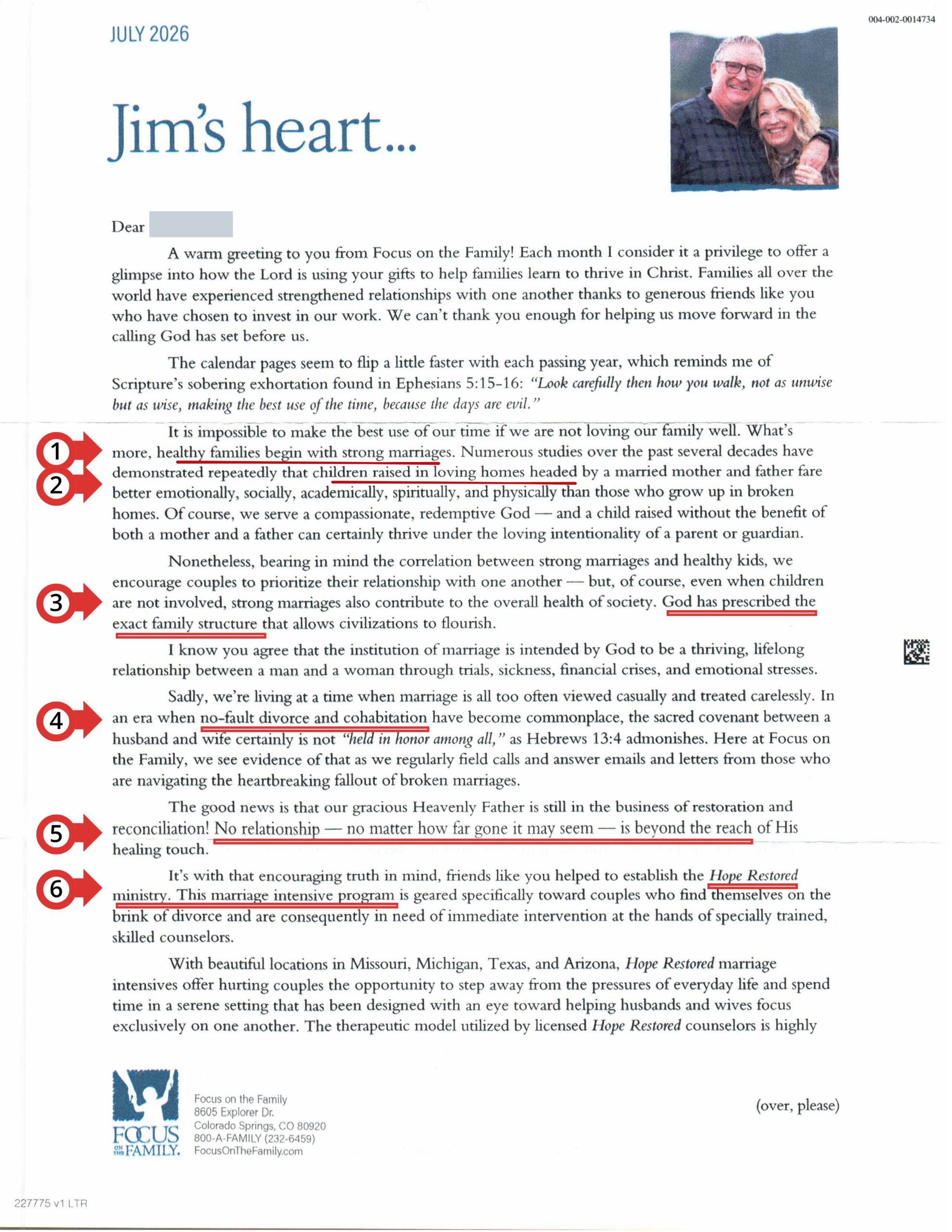
Before criticizing Focus on the Family’s fundraising, I want you to see the appeal exactly as it arrived in my mailbox. I’ve blacked out my personal information, but otherwise these are unedited images of the July 2026 fundraising letter.
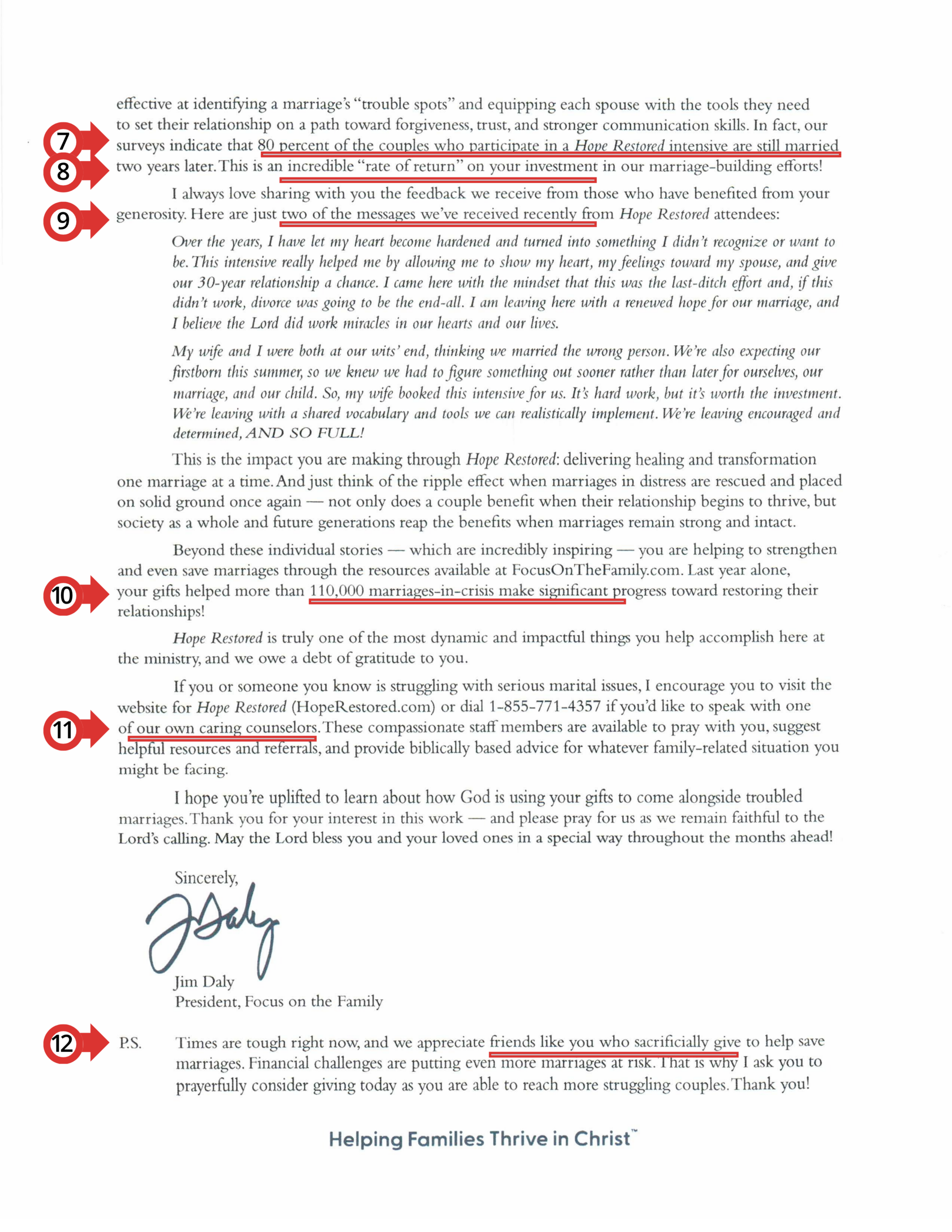
As you read, notice what is emphasized—and what is never mentioned. I’ve added red arrows and lines to make it clear, with an explanation of each below.
What I Notice About Page 1
1. “Healthy families begin with strong marriages.”
Marriage status is treated as the foundation of family health. No distinction is made between safe marriages and unsafe marriages characterized by abuse, coercive control, addiction, betrayal, or fear.
2. Children in married-parent homes “fare better.”
This is true, but only “on average.” It is not true in destructive two-parent intact homes. The letter does not acknowledge the research showing that children may fare better after divorce from violent or highly conflictual homes.
3. “God has prescribed the exact family structure that allows civilizations to flourish.”
The donor’s gift is framed as defending civilization itself. This raises the emotional stakes: divorce becomes not merely a family decision but a threat to God’s social order, even though Jesus himself acknowledged it was necessary due to the hardheartedness.
4. No-fault divorce and cohabitation have “complicated” marriage.
No-fault divorce is treated as an “easy out” for people who cannot go the distance in marriage. The letter never mentions the reductions in wife suicide, domestic violence, or wife homicide associated with easier access to unilateral divorce.
5. “No relationship—no matter how far gone it may seem—is beyond” restoration.
A universal restoration message leaves no visible exception for dangerous marriages. We read the headlines about murder-suicide tragedies destroying families. Some relationships should not be restored.
6. Hope Restored is for couples “on the brink of divorce.”
The precipitating reason for divorce is never discussed. “On the brink” may include ordinary distress—or violence, coercive control, sexual betrayal, husband’s pedophilia (yes, they admit they get calls about this), and child abuse.
Page 2: The sales pitch and missing evidence
Page 2: The sales pitch and missing evidence
7. “80 percent … are still married two years later.”
Sadly, there is no scientifically valid evidence for this old 2011 claim. But it’s still being reused in their marketing. Not only that, but The letter does not report safety, wellbeing, recurrence of abuse, participant satisfaction, or results based on everyone originally recruited.
8. “Rate of return on your investment.”
The donor is invited to view continued marriage as a measurable return. But remaining married does not prove that a relationship became safe or healthy.
9. Two enthusiastic testimonials.
Exit enthusiasm is not long-term success. About half of participants leave hopeful, but that hope often fades according to an independent survey. The letter gives only glowing testimonials that appear to be collected immediately at the end of the program, not representative two-year outcomes. In fact, the 2-year outcome claims are based on a 2011 survey of past participants and only 8 in 100 responded at the two-year mark.
10. “110,000 marriages-in-crisis” made “significant progress.”
What counts as “significant progress”? This very large claim includes unspecified online resources and is not the same as 110,000 marriages saved.
11. Call “one of our own caring counselors.”
The free consultation may lead into Focus’s referral system. Focus on the Family’s public tax disclosure says callers may be referred to its $3,000-$6,000 marriage-intensive program or to counselors screened for its Christian Counselors Network.
12. “Sacrificially give to help save marriages.”
The closing appeal defines the desired outcome before the problem is assessed. The donor is asked to save marriages—not first to determine whether preserving a particular marriage would protect or endanger the children.
What the letter never tells the donor:
Focus acknowledges in its tax disclosures that spousal and child abuse are “not uncommon” among the people contacting its ministry. Its free counseling service generally consists of a one-time consultation, after which callers may be referred to its Christian Counselors Network or to Hope Restored—a reconciliation-oriented intensive costing approximately $3,000–$6,000. Focus does not disclose how many abuse victims are referred to Hope Restored, how many are connected with specialized domestic-violence services, or whether any are clearly told that abuse itself may justify divorce.
Focus Is Still Paying to Advertise This Claim
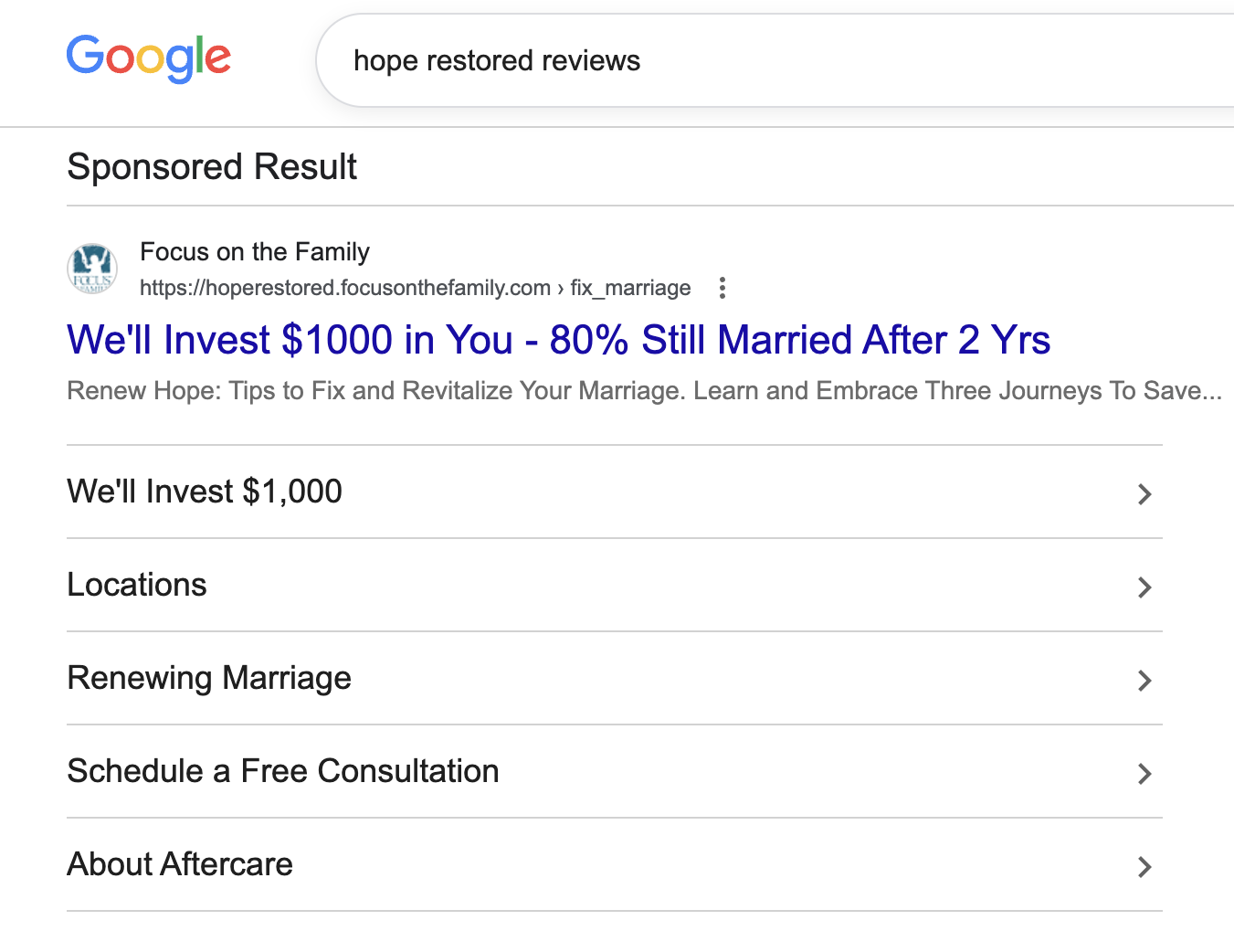
This figure is not merely sitting in an old study or being recycled in a fundraising letter. As of July 2026, Focus on the Family is paying Google to place it in front of people searching for “Hope Restored reviews.” The sponsored result announces: “80% Still Married After 2 Yrs.”
What the ad does not disclose is that only 84 of the 1,043 couples answered the two-year survey. Of those 84 responding couples, 71 said they were still married. There was no two-year outcome data for the other 959 couples. Read more about the the Hope Restored study.
 :
:
 :
: Buy PDF
