
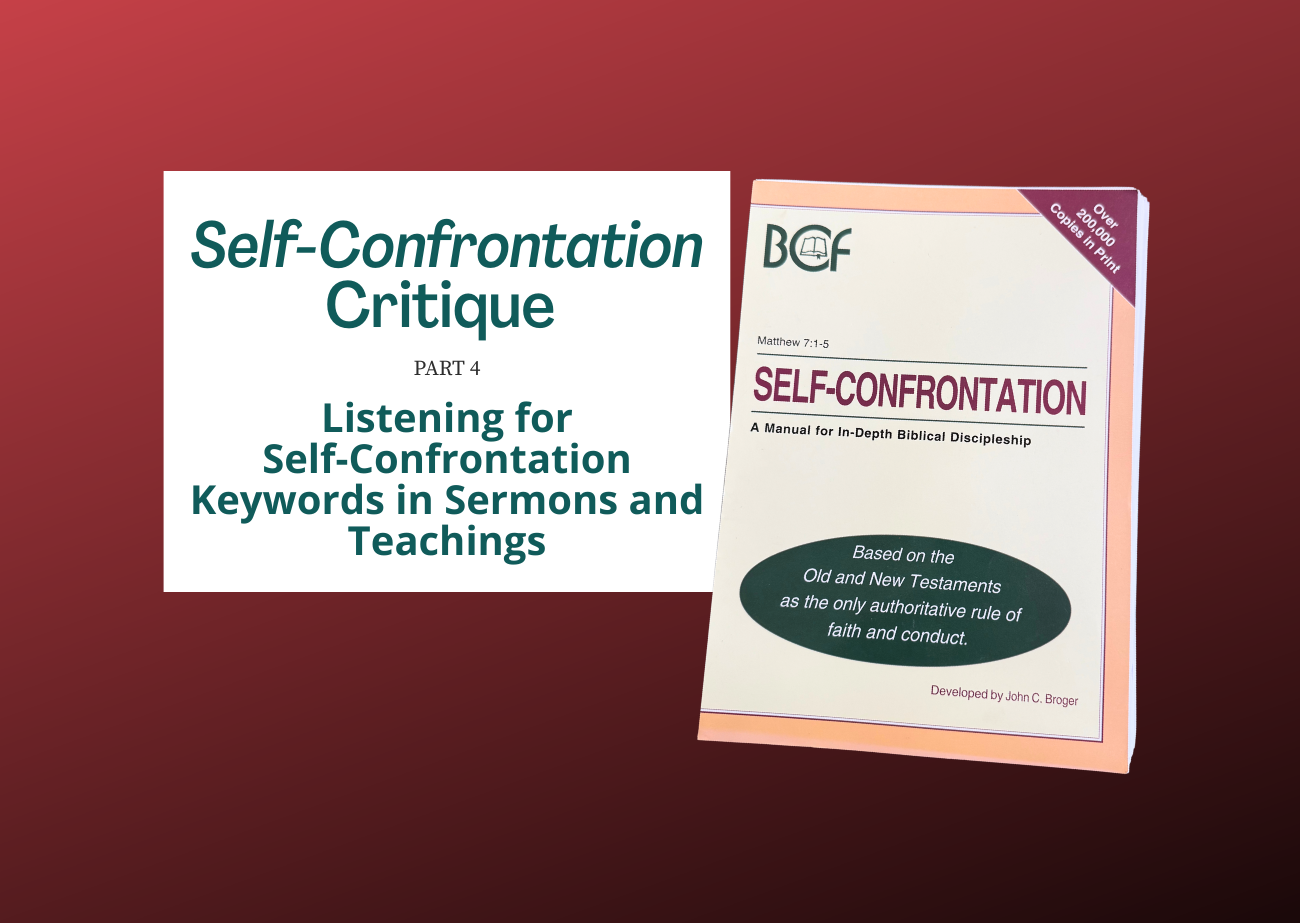
Listening for Self‑Confrontation Keywords in Sermons and Teachings
This article is part of a critique of Biblical Counseling Foundation’s Self‑Confrontation manual. Though presented as a Christian discipleship tool, it trains readers to scrutinize every emotion and to relabel many natural responses—such as fear, anger, or sorrow—as sins, even when those emotions arise in genuinely dangerous situations where the most urgent need is to act, seek help, and get to safety. It may not mean to teach Christians to be passive, obsessively blame themselves, and ignore danger, but that’s the effect of the training.
When you listen to sermons, conferences, or online counseling content, you can often spot Self‑Confrontation–style teaching by its vocabulary and patterns. Here are some cues to listen for. (Real life examples at the bottom of this article.)
1. “Dealing with self” and “preoccupation with self”
Watch for repeated emphasis on:
-
“Dealing with self,” “dying to self,” or “overcoming a preoccupation with self” (“Dying to self” is biblical language; what’s at issue is how it’s being used.)
-
Lists of “self‑sins”: self‑pity, self‑belittlement, self‑exaltation, self‑love, self‑focus, self‑gratification
-
Claims that most problems stem from “self at the center,” rather than from external harm or injustice
These phrases are central in Lessons 9–10 of Self‑Confrontation and signal that the speaker likely sees almost all negative emotions as “self‑preoccupation” that must be confessed and eliminated.
2. “Victory over failures” and “biblical plans”
The manual uses very specific language about “victory” and “plans”:
-
“Victory over failures” worksheets
-
“Basic plan” and “contingency plan” for your own thoughts, words, and actions
-
Promises of “lasting victory” or “permanent change” in “any and every area of life” through Scripture memory and self‑confrontation
If a speaker talks about “developing a biblical plan” to address “patterns of failure” and frames nearly every struggle as a failure of personal obedience rather than as a mix of sin and suffering, that’s a strong echo of John C. Broger’s method, encapsulated in Self-Confrontation.
3. Four “essential elements” of counseling
Lesson 10 drills four elements:
-
“Understand the problem”
-
“There is hope”
-
“You must learn how to change”
-
“You must practice being a doer of the Word”
Listen for this sequence used almost as a fixed template for every counseling situation, especially when “understanding the problem” is reduced to cataloguing the counselee’s sinful thoughts and emotions, with little attention to safety, context, or external wrongdoing.
4. Banning “why” questions
A distinctive hallmark is suspicion of “why”:
-
Explicit statements like, “We don’t ask ‘why’ questions, only what, who, when, where, and how”
-
Accusations that “why” questions are just excuses, rationalizations, or subjectivity
-
Heavy emphasis on “getting the facts” while framing causes and motives as unimportant
When a speaker proudly says they avoid “why” questions and instead focus on “what are you doing?” that’s very close to the Self‑Confrontation approach.
5. Reframing pain and harm as “self‑pity” or “self-focus”
Self‑Confrontation repeatedly treats intense distress as evidence of “self” sins. Listen for:
-
Grief, fear, anger, and exhaustion quickly relabeled as “self‑pity,” “self‑focus,” “bitterness,” “envy,” or “fear of man”
-
Little or no curiosity about what the person has suffered
-
Statements like, “Your real problem isn’t what your spouse did; your real problem is your heart response”
That pattern—minimizing harm while magnifying the victim’s “self” problem—is a key diagnostic marker.
6. Distrust of “self‑esteem,” “self‑worth,” and “feelings”
The manual sharply attacks many common counseling words. Watch for:
-
Blanket rejection of “self‑esteem,” “self‑worth,” and “forgiving yourself” as unbiblical
-
Claims that you must not pay much attention to your feelings; that “feelings lie” and obedience must override emotion
-
Repeated contrasts between “man’s wisdom” about the self and “God’s wisdom” about dying to self
If sermons consistently frame any concern for emotional health as worldly psychology, and insist that feeling small, ashamed, or afraid is mainly a sign of sin, you are likely hearing that same stream of teaching.
A practical way to use this guide: when you hear two or three of these elements in the same sermon or counseling talk—especially the four‑step counseling pattern plus “self‑preoccupation” language and suspicion of “why”—you can reasonably suspect that the speaker has been shaped by Self‑Confrontation or closely related material.
Real Life Examples
In my 6,000-member private online group for divorced conservative Christians, I hear real stories every day mentioning victim-blaming in sermons and church counseling sessions. Many of them use the same wording found in the BCF Self-Confrontation manual. Here are some examples of real-life stories from the article “Good vs Bad Pastoral Counselors: Marital Abuse.” Several of these anecdotes show the same phrases and patterns as Self‑Confrontation–style teaching, especially around mutualizing sin, focusing on the victim’s “heart,” and ignoring genuine danger. Here are some examples.
A. Mutualizing and sin‑leveling
-
The DivorceCare leader who “kept trying to get me to make a list of things I did to contribute to the abuse” is using a classic sin‑leveling move: insisting “we all do things to push each other’s buttons,” even when the wife describes walking on eggshells to prevent the children from being hurt. That matches the Self‑Confrontation pattern of demanding the counselee catalog their own “failures” (self‑pity, self‑focus, provoking, not trusting enough) rather than treating the abuse as one‑sided wrongdoing.
-
The pastor who told the woman, “You need to submit to him as you do to God,” and the leaders who say she must admit “my sins too” before talking about abuse show the same instinct: you can’t name evil unless you first turn the spotlight back on yourself. That reflects the manual’s insistence on constant self‑confrontation and focusing on “preoccupation with self” in every problem.
B. Blaming the victim’s responses
-
The pastor who told the husband of an unfaithful, manipulative wife, “She’s the queen, so no matter what, you need to make her feel loved,” and left him depressed and suicidal, mirrors the teaching that one spouse’s self‑denial and “dying to self” can carry the whole marriage. His pain and depression are treated as failures of love and perseverance, not as evidence that the situation is unsafe and unsustainable.
-
The woman whose pastoral counselors excused her husband’s alcoholism, told her she “absolutely must trust him 100% (or I’m not acting like Jesus),” and blamed her for his choices is being pushed into the same pattern Self‑Confrontation promotes: interpret distrust, fear, and boundaries as sinful “self‑focus” or lack of faith, instead of as wise responses to chronic sin. We find hints of this in the teachings of Gary Chapman and Focus on the Family.
C. Ignoring evidence and danger
-
Pastors who refuse to listen to recorded abuse (“They refused to listen to the recording”) and who remove the victim from ministry while believing the abuser’s talk of reconciliation show the same structural issue as Lesson 10’s Mary case: the system is more interested in its own process and image than in danger, evidence, or safety.
-
Leaders who say it is “good for my character to suffer” and talk about “gospel courage” while a husband “beat my kids” are reinterpreting serious harm as an opportunity for sanctification, which is exactly how Broger’s material reframes suffering in terms of “dealing with self” and “preoccupation with self” rather than confronting the abuser.
So even when the exact phrases “self‑confrontation” or “preoccupation with self” don’t appear, many of these stories clearly reflect the same doctrinal DNA: mutualized blame, relentless self‑evaluation for the victim, suspicion of their emotions, and a willingness to sacrifice safety on the altar of “character,” “submission,” or “trust.”
Self-Confrontation Critique Series
- Part 1: Self-Confrontation: When Biblical Counseling Becomes Behavioral Control
Examines John C. Broger’s background, the Biblical Counseling Foundation, and how the Self-Confrontation manual can turn ordinary Christian self-examination into behavioral control, self-surveillance, and spiritual dependency. - Part 2: The Mary and Tom Story: How Self-Confrontation Blames Victims
Looks at the manual’s central Mary and Tom case study and shows how Mary’s distress is scrutinized and judged while Tom’s abandonment, addiction, and harmful behavior are minimized. - Part 3: Spiritual Self-Surveillance and Scrupulosity in the BCF’s Self-Confrontation
Explains how constant motive-checking, worksheets, “heart issue” language, and suspicion of emotions can create chronic guilt, scrupulosity, and spiritual self-policing. - Part 4: Listening for Self-Confrontation Keywords in Sermons and Teachings
Gives readers practical warning signs to listen for in sermons, conferences, and counseling content, including “self-sins,” “heart issues,” avoiding “why” questions, and reframing pain as sin.
 :
:
 :
: Buy PDF