
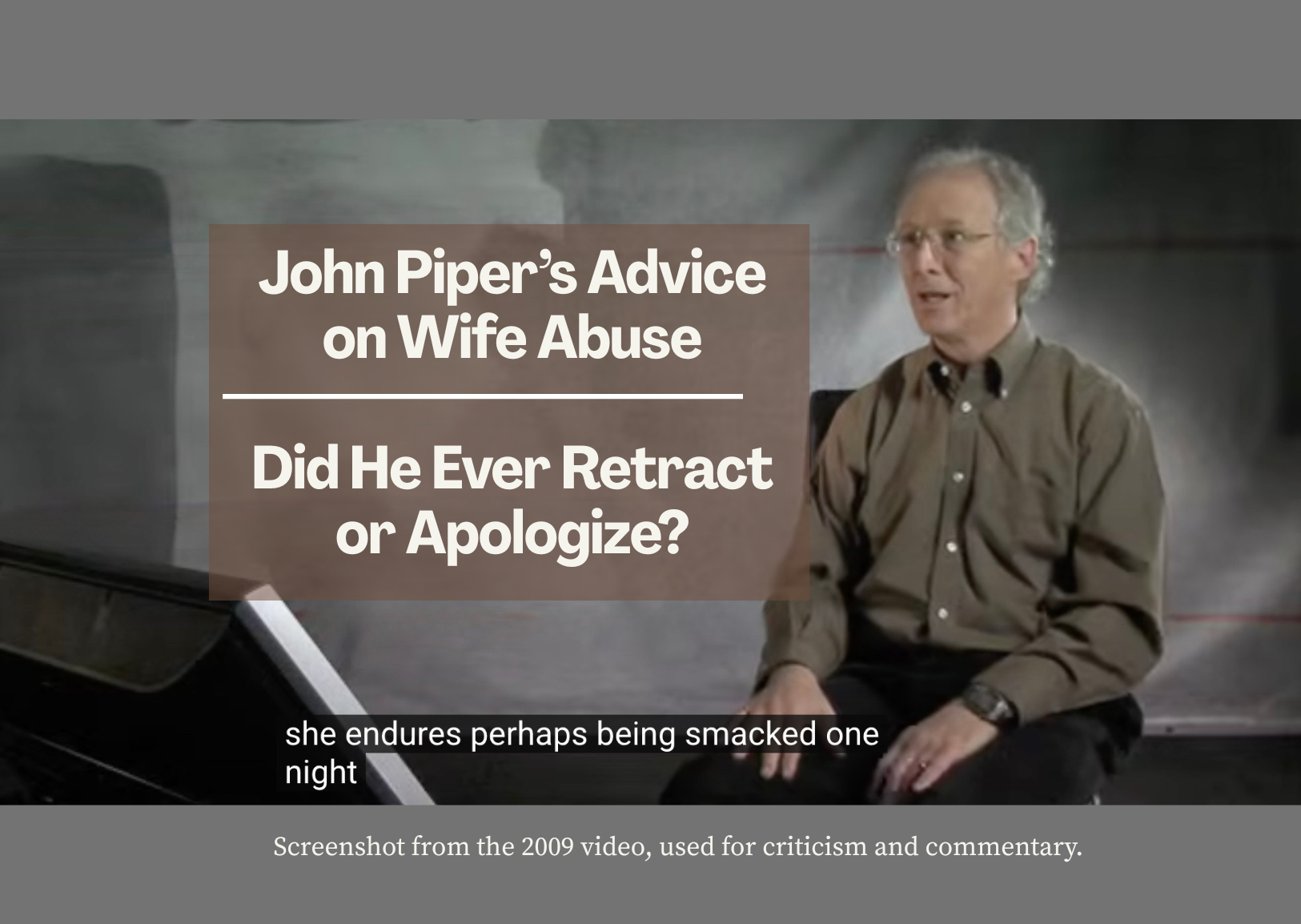
John Piper on Wife Abuse: Did He Retract His “Smacked One Night” Advice?
A firestorm broke out when John Piper’s video mentioning a wife “being smacked one night” was released. Many people have heard John Piper’s notorious advice that an abused wife might endure verbal abuse “for a season” and perhaps be “smacked” before seeking help.
What they may not realize is that Piper gave this advice in 2009—the same year Crossway published his marriage book, This Momentary Marriage. That timing matters. It shows what can happen when preserving the marriage covenant becomes the controlling priority over the safety and wellbeing of the person inside the marriage, and especially the wife.
The timing becomes even more striking. In March 2010, less than a year after the video and the publication of This Momentary Marriage, Piper announced an eight-month leave from public ministry. He wrote that his “soul, marriage, family, and ministry-pattern” needed a reality check and acknowledged that pride had taken a toll on his relationship with Noël. In his report after the leave, he identified longstanding patterns of “selfishness, self-pity, anger, blaming, and sullenness” and said that he and Noël had received formal counseling. This does not prove that his 2009 advice arose from problems in his own marriage, and I would not make that claim. But it is relevant context when evaluating the marriage teachings of a public figure who admitted that his own ministry patterns and behavior had harmed his closest relationships. Read Piper’s original announcement of his 2010 leave of absence.
August 2009: The Original Wife-Abuse Video
Piper was asked, “What should a wife’s submission to her husband look like if he’s an abuser?” He opened with a wry laugh and “Oh my,” then asked whether her life was in danger or whether the abuse was “verbal unkindness.”
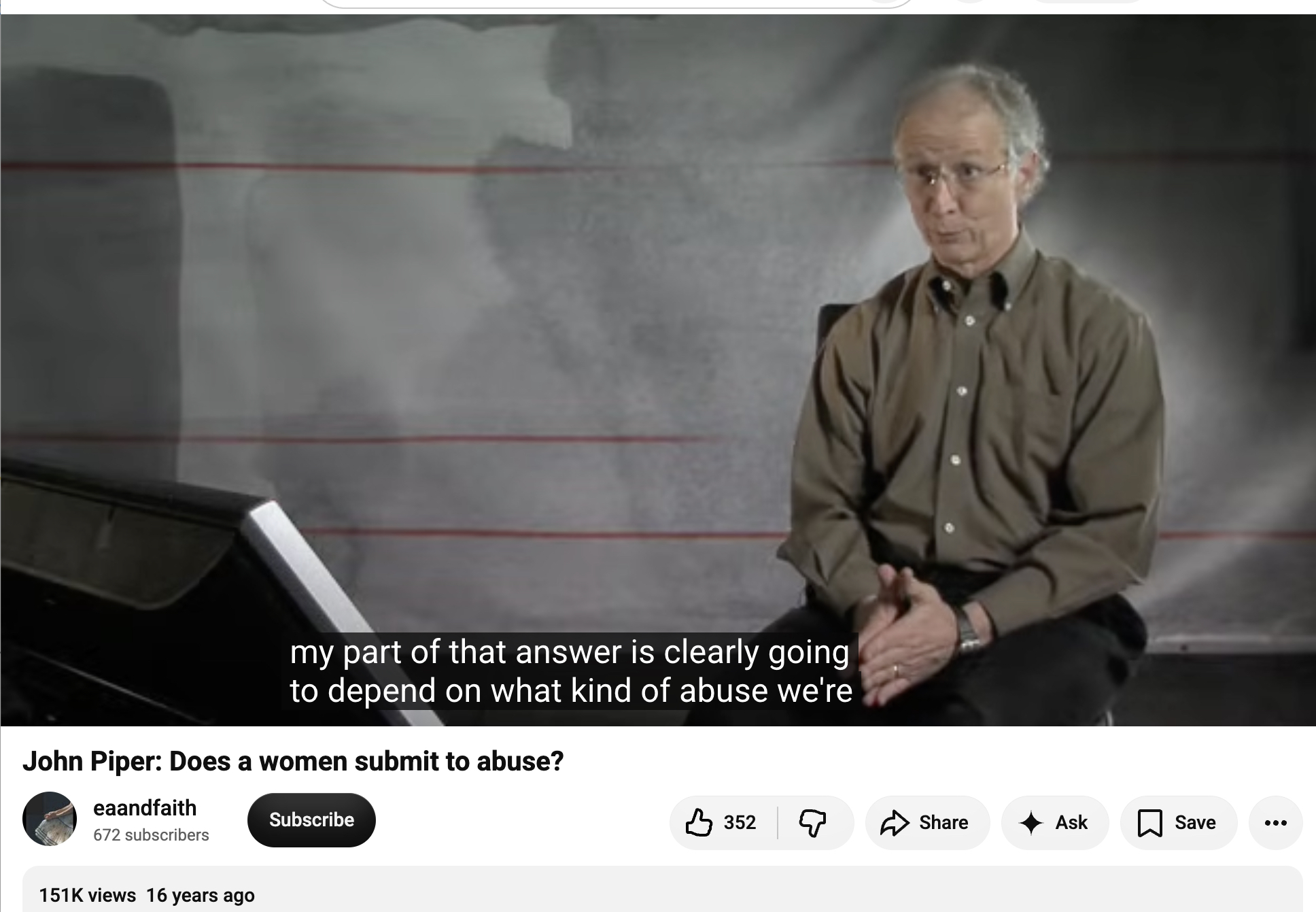
He soon shifted from the harmed wife to whether the husband was requiring her to sin or “simply hurting her.” Piper said:
“If it’s not requiring her to sin but simply hurting her, then I think she endures verbal abuse for a season, and she endures perhaps being smacked one night, and then she seeks help from the church.”
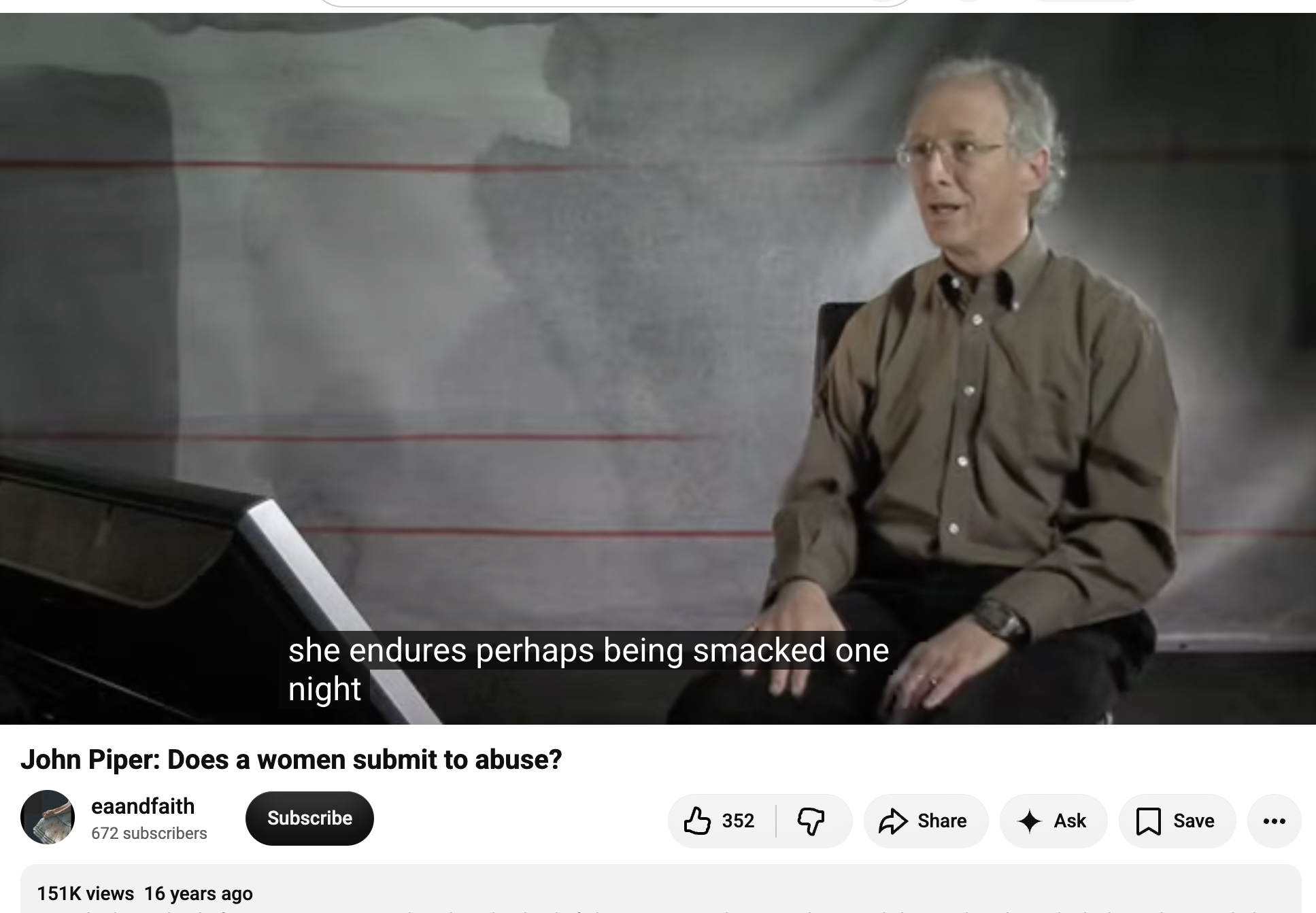
A transcript cannot convey Piper’s tone, so it’s important to watch. Laughing, chuckling, and saying, “Oh my” at the beginning of a serious question about wife abuse, combined with phrases such as “simply hurting her,” enduring abuse “for a season,” and being “smacked one night,” can sound minimizing, dismissive, or even mocking—whether or not that was his intention. Several listeners noticed his laughter, casualness, and lack of visible empathy. To my ear, he places unusually forceful emphasis on the word smacked. We cannot know his intention, but the delivery makes an already disturbing sentence land even more harshly.
What More Than 800 YouTube Comments Reveal
I exported and reviewed more than 800 public comments and replies appearing under this video. They are not a scientific survey, and some people commented repeatedly, but several themes were unmistakable:
- The dominant response was negative. Commenters repeatedly called the advice dangerous because it told a wife to endure harm before seeking help.
- Many distrusted the church-centered solution. Survivors described churches that minimized abuse, blamed wives, demanded more submission, or protected the husband.
- Commenters distinguished church discipline from criminal justice. As one person put it, “The church can minister to her while the law deals with the man.”
- Defenders added safeguards Piper never stated. They assumed he meant leave, call the police, or involve authorities—even though he did not say those things.
- Survivors described real consequences. Some said similar teachings had kept them or their mothers in dangerous homes.
- Reputational damage occurred. Christians described losing trust in Piper, complementarian teaching, or churches that treated submission as more important than safety.
A note about reporting abuse: State laws vary. Clergy may have mandatory-reporting duties when they suspect child abuse or neglect, and some states impose duties involving older or otherwise vulnerable adults. Religious-confidentiality exceptions also vary. Possible crimes and child-safety concerns cannot always be treated as internal church matters.
December 2012: The “Clarification”
More than three years later, Piper finally published “Clarifying Words on Wife Abuse.” By this time, DesiringGod.org had already removed the video. He acknowledged that his original answer had omitted law enforcement—but he did not say:
- “I was wrong.”
- “I retract my advice.”
- “No one should endure being hit for one night.”
- “I apologize to anyone endangered by my words.”
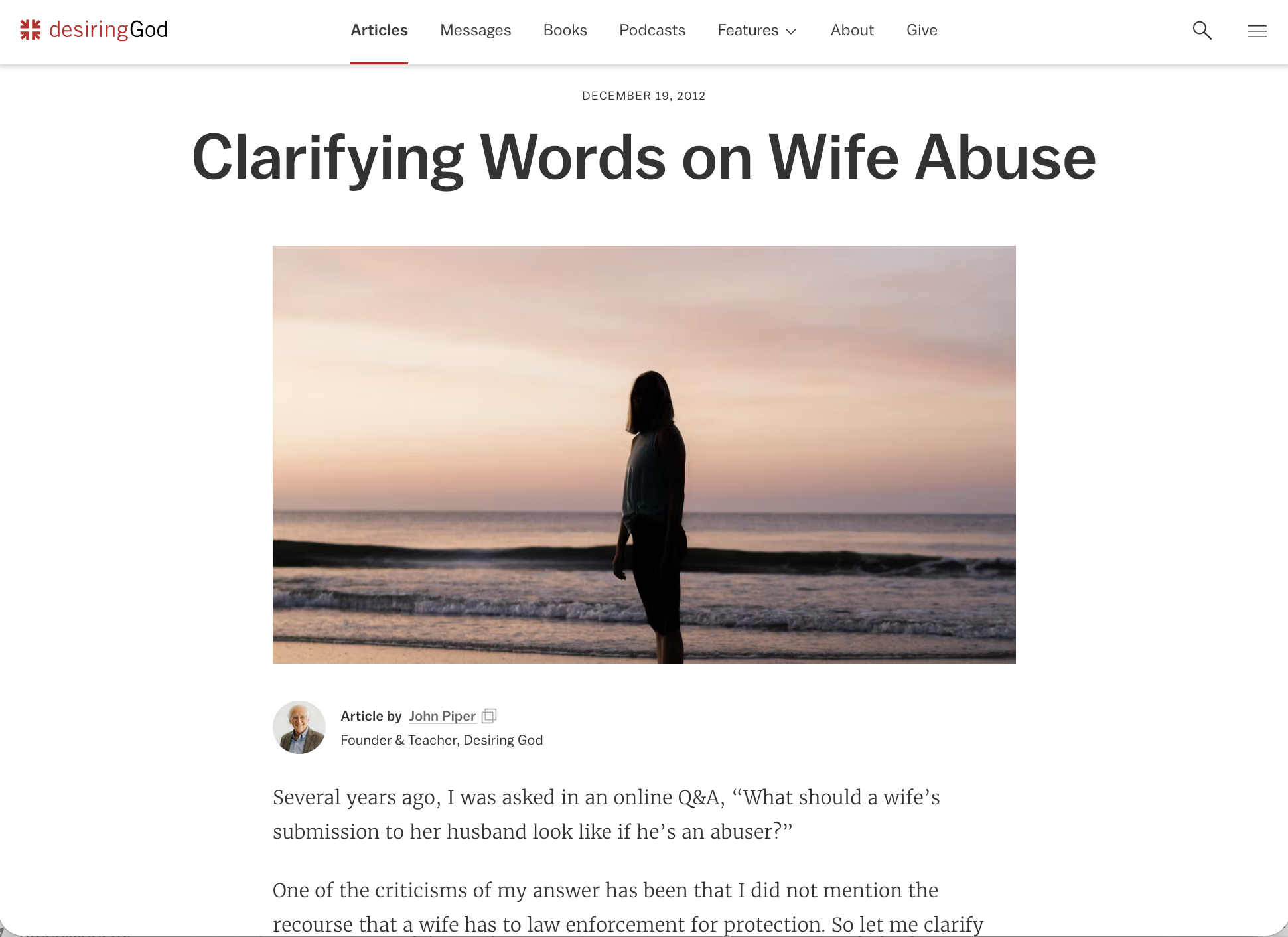
Instead, Piper wrote that civil recourse “may be the right thing.” He said it could be pursued with a “heavy and humble heart” that retained love and submission while longing for the restoration of the husband’s “nurturing leadership.”
More Comments, More Concerns About the “Clarification”
Critics commenting at numerous Christian websites, including Crying Out for Justice, The Wartburg Watch, and Spiritual Sounding Board, raised recurring objections:
- It was not a retraction, correction, or apology.
- The word may still made police protection sound optional.
- The church remained a gatekeeper between the victim and civil authorities.
- The husband’s authority appeared to survive his abuse.
- The wife’s humility, love, and attitude remained under scrutiny.
- Restoring the husband’s leadership remained a goal, even when nurturing leadership may never have existed.
- Immediate safety, children, coercive control, and long-term escape were not made the controlling priorities.
The central criticism was simple: Piper added law enforcement to his framework, but he did not make the abused wife’s immediate safety the center of the framework.
Did Piper’s Advice Later Improve?
Yes, in some respects. Eleven years later, in 2020, Piper said that a wife being “brutalized” was “obliged—rightly and legally—to go to the police.” That was much stronger than saying police involvement merely “may” be appropriate.
But a later, stronger statement is not the same as retracting the earlier one. I have found no explicit withdrawal of “smacked one night,” no apology, and no direct response to the second wave of criticism.
Let’s be blunt: Piper may allow an abused wife to flee, call the police, and live apart, but he still does not permit her to divorce because of abuse. He admits that he holds an unusually restrictive position on divorce and remarriage. I examine that position in my review of his book This Momentary Marriage, which acknowledges the husband’s duties to his wife, but explains how (in his view) 15 priorities come first, and that the measure of success is simply staying married.
Safety Rating for Piper’s Public Messages About the Wife-Abuse Video
Overall rating: 1 out of 10—dangerously unsafe as a complete system of pastoral guidance.
This rating evaluates the likely effect of Piper’s teaching on an abuse victim, not his intentions or his entire ministry. His later statements contain some improvements, but they remain embedded in a theology that treats marriage as effectively permanent even after serious abuse. A victim may be allowed to flee, call police, or live separately—but is still told that abuse does not free them to divorce and remarry.
| Message | Rating | Safety Assessment |
|---|---|---|
| 2009 original answer | 0/10 | Dangerously unsafe. Piper tells a wife to endure verbal abuse “for a season” and perhaps be “smacked one night” before seeking church help. He gives no clear direction to get to safety, contact police, obtain medical care, or consult a domestic-violence specialist. He never explicitly retracted this advice. |
| 2012 clarification | 1/10 | It mentions civil authorities, but still says police involvement “may” be appropriate and keeps the wife’s submission, humility, love, and hope for her husband’s restored leadership at the center. It does not apologize, retract the original wording, or make immediate safety the controlling priority. |
| 2017 verbal-abuse answer | 2/10 | Piper recognizes coercion, degradation, and fear as serious, but the response remains heavily centered on friends, elders, confrontation, and church discipline. He does not provide a clear path to separation, safety planning, independent domestic-violence expertise, divorce, or remarriage. |
| 2020 police statement | 3/10 | Saying that a wife being physically “brutalized” should go to police is an improvement. But “short of that,” Piper again directs her primarily toward elders. He still does not recognize physical or emotional abuse as grounds for divorce and remarriage, leaving the victim permanently bound to the abuser under his theology. |
A Biblical Marriage Must Protect the People Inside It
Scripture does not give a husband permission to neglect his wife in the name of ministry. In 1 Corinthians 7:3–5, Paul describes mutual marital obligations. Later, he explains that singleness allows more undivided attention to ministry, while a married person must also care about serving and pleasing their spouse (1 Corinthians 7:32–35). If a man wants complete freedom for ministry, Paul presents singleness—not neglecting a wife—as the appropriate option.
Ephesians 5 commands a husband to love his wife sacrificially, nourish and cherish her, and seek her good as he would his own body. A wife is not an expendable support system behind a man’s public calling.
This Momentary Marriage asks readers to see marriage as a picture of Christ and the church. But Christ does not terrorize, degrade, coerce, strike, or chronically neglect his bride. Any Christian vision of marriage must begin there. And pastors shouldn’t laugh when asked about abusive husbands.
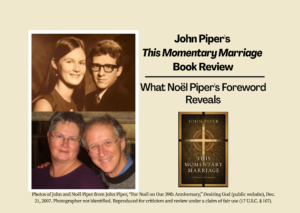
Click image to see full book review
Recommended Reading
This article is part of my series examining John Piper’s teachings about marriage, divorce, submission, and abuse.
- Piper Part 1: Does Divorce Destroy the Image of Christ and the Church?
Piper warns that divorce can “shatter” the picture of Christ and the church. I examine whether Scripture places that burden on an injured spouse—and why ongoing cruelty and covenant-breaking behavior are the real distortion of Christ’s love. - Piper Part 2: This Momentary Marriage—When Staying Married Becomes the Goal
My review looks at Piper’s unusually strict position on divorce and remarriage, the book’s emphasis on permanence, and Noël Piper’s candid description of profound conflict and unhappiness in their own marriage. - Piper Part 3: Did He Retract His “Smacked One Night” Advice?
This article traces Piper’s wife-abuse statements from 2009 through 2020 and asks whether his later comments amounted to a genuine retraction, correction, or apology.
Related Biblical Resources
- 1 Corinthians 7:10 Explained: Separation and Remarriage
A closer look at Paul’s instructions to married Christians, including what the passage does—and does not—say about separation, abandonment, and remarriage. - Marriage Is a Conditional Covenant, Not an Unbreakable Promise
Biblical covenants contain responsibilities. A marriage certificate records promises, but it does not prove that both spouses have faithfully kept them. - Wayne Grudem Supports Divorce and Remarriage After Abuse
Grudem explains why serious abuse can function like abandonment and why the innocent spouse may be free to divorce and remarry. - The Bible Teaches Us to Get Away from Abusers
Scripture repeatedly shows faithful people escaping violent, deceptive, and destructive individuals rather than remaining available for further harm. - Safety-First vs. Marriage-First Counseling
Marriage-first counseling asks how to preserve the relationship. Safety-first counseling begins by asking whether the spouse and children are safe.
 :
:
 :
: Buy PDF