
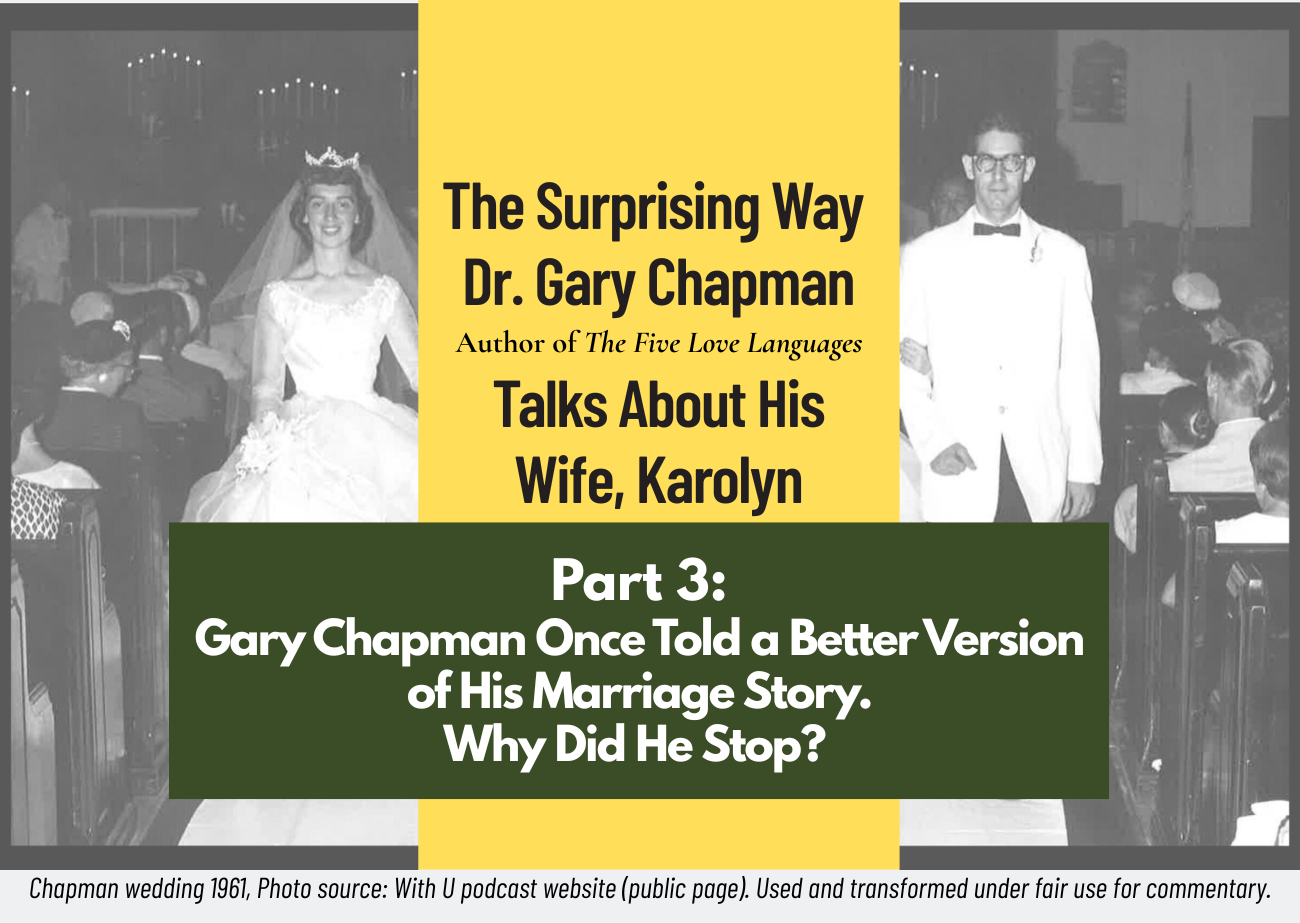
Gary Chapman Once Told a Better Version of His Marriage Story. Why Did He Stop?
For decades, Dr. Gary Chapman, author of The Five Love Languages, has been treated as one of the most trusted Christian marriage teachers in America. His books, broadcasts, and interviews have shaped how millions of Christians think about love, apology, forgiveness, leadership, submission, conflict, separation, and reconciliation.
That is why his own marriage story matters.
This series began with a question I did not expect to ask: Over the past thirty years — and especially in the past few years — why does Gary Chapman so often describe his wife, Karolyn, in ways that make her sound less capable, less spiritual, less organized, less mature, or less suitable than the public record and people in her church fellowship show her to be?
Chapman is not a young man casually telling newlywed stories. He is an elderly, retired pastor and bestselling author reflecting on his life, still giving interviews, and reportedly working on a memoir. That makes these retellings significant. At this stage, a person is not merely remembering; he is curating a legacy. So when Chapman continues to tell stories that cast Karolyn as lesser while saying less about the harm his own behavior caused, readers are right to ask: Why this version? Why now?
In the first post, I looked at decades of public interviews where Gary talks about Karolyn and their marriage, noting how his descriptions of her have become more diminishing over time. In the second post, I answered common objections from his supporters: “He’s just being honest,” “That’s just how Southern Baptist leaders talk,” “Her love language isn’t words,” “He’s not gushy,” and “The 50-year church tribute proves he honors her.”
But the pattern did not disappear. In fact, the more sources I reviewed, the clearer the problem became.
One recent 2026 interview captured the problem in miniature. At the end of the interview, the host actually had to stop and ask Gary:
“Dr. Gary, what’s your wife’s name?”
Gary answered:
“Carolyn, but she spells it with a K.”
The host then thanked God for Karolyn and said he could only imagine “the incredible woman” she is. Gary responded that she edits his books, encourages him, prays for him, and is “absolutely incredible.”
I am glad he said something kind. But the moment was unintentionally revealing.
When Karolyn is the problem, Gary jumps in with details. When Karolyn is to be praised, the interviewer has to help him get started.
That reminded me of the 2021 church celebration of Chapman’s decades of ministry, where Gary gave warm, heartfelt praise to others, but gave Karolyn only a brief sentence. That is not what many longtime Southern Baptist leaders typically do when receiving a major honor. It was strange then. It is still strange now.
The Strange Thing Is This: Gary Once Told the Story Better
One reason this story matters is that Gary Chapman has not always told his early marriage story in the same way. (See the chart comparing Gary’s story: then and now.)
In recent interviews, especially over the past few years, he often tells the story in ways that place a lot of attention on Karolyn’s differences, habits, family background, and supposed deficiencies. He talks about her loading the dishwasher differently, losing keys, coming from a less structured home, not listening to him, and his mother warning him about her. In one interview, he even says that “everything” his mother said about Karolyn (60 years ago) turned out to be true.
But in his book Things I Wish I’d Known Before We Got Married, Chapman tells a noticeably better version of the same early marriage story.
- Not perfect.
- Not full.
- Not as honest as Karolyn’s own 1976 testimony.
- But better.
In that book, Gary is more willing to place himself inside the problem.
He says he and Karolyn entered marriage deeply “in love,” but soon found themselves in repeated arguments. He writes that their marriage became “an ongoing series of verbal explosions.” He says he thought he had married the wrong person. And then he gives a revealing contrast: he could not imagine how “illogical” Karolyn could be, while she could not imagine how “harsh and demanding” he could be. He adds, “It was not that I wanted to be harsh; it’s just that I knew that my idea was the best idea.”
That is a very different story from the one where Karolyn is the odd, disorganized, spiritually questionable wife who had to be corrected by a patient husband.
Here, Gary gives us the better insight:
He thought his way was best.
That is not a small admission.
A man who believes his way is best can call it leadership. He can call it logic. He can call it spiritual maturity. He can call it “helping” his wife.
But in a marriage, that attitude can quickly become pressure, correction, contempt, and control.
Gary Admits He Was Harsh
The strongest part of Things I Wish I’d Known Before We Got Married comes in the chapter on apology.
Gary describes his father as a man who sometimes lost his temper and spoke harshly to his wife and children, but who did not apologize. Gary says he absorbed that model. Then he says he carried it into marriage.
This is important. Gary insists his father was not abusive, but the pattern he describes is serious: harshness toward a wife and children, anger, no repair, and no apology. Chapman’s failure to identify that pattern accurately is part of the problem. He can describe harmful behavior while refusing the category that would help wounded people name it.
Then Gary remembers saying to Karolyn in a loud, harsh voice:
“Karolyn, think. This is simply not logical.”
That is not merely “communication difficulty.”
That is a husband speaking down to his wife.
It is contempt wrapped in logic.
And Gary knew enough, at least in this book, to admit that he was harsh.
He also admits that after his harsh words, he did not know how to apologize. He says learning to apologize earlier would have saved him “many days of silent suffering, hoping in vain that Karolyn would forget my harsh words.”
That is better than many of his later interviews because he admits he caused a breach. He admits his words were harsh. He admits he failed to repair.
But even here, the focus is still revealing. He says apology would have saved him days of silent suffering.
The same pattern appears in a 2026 Focus on the Family interview. When Gary explains the turning point in his marriage, he does not say that Karolyn’s distress finally broke through to him or that he became convicted by the harm he was causing her. He says:
“There’s no way I can ever stand in front of people and preach if I’m this miserable in my marriage.”
His concern is expressed first in terms of his calling, his conscience, and whether he could become a pastor while his marriage was failing. That may have led to genuine change, but it is still striking that Karolyn’s pain is not what he names as the catalyst.
He still does not linger over what his harsh words did to Karolyn.
The Rain Story Is Better in the Book Too
Another important passage appears in his story about Karolyn walking out into the rain.
In Things I Wish I’d Known Before We Got Married, Gary says that about six weeks after their wedding, he and Karolyn were in a serious argument. Karolyn put on her raincoat, slammed the front door, and walked out into the pouring rain. She tells her version of the story in Part 1.
Gary says his first thought was:
“Why doesn’t she stay and fight like a man?”
That sentence alone tells us a great deal.
He interpreted her leaving not as fear, overwhelm, or self-protection, but as failure to fight the way he expected. He wanted her to stay in the argument. He wanted her to keep engaging. He measured her by a masculine conflict style and found her wanting.
But Karolyn’s own explanation points in a very different direction. When she came back, she said she was sorry for walking out, but she could not take it anymore. She hated arguing. When he yelled at her, she knew she had to get out or it would get worse.
And there is another important detail: in his telling, Karolyn had already been thinking that she needed to leave — but where would she go?
That is not a casual thought.
That is not merely a “we were young and different” moment.
That is a young wife, six weeks into marriage, internally asking whether she needed to get away.
That is one of the clearest windows we have into Karolyn’s experience.
- She could not take it anymore.
- She hated arguing.
- He yelled.
- She felt she had to get out before things got worse.
- She had already wondered whether she needed to leave, but did not know where she would go.
That is not a cute newlywed misunderstanding. That is a young wife overwhelmed by escalating conflict and weighing escape.
And Gary admits that even after apologizing for raising his voice, he still blamed her in his heart for the whole argument.
This is why Things I Wish I’d Known matters. In this version, Gary is not simply the wise marriage expert looking back on his difficult wife. He is the young husband yelling, arguing, demanding, blaming, and wondering why his wife will not “stay and fight like a man.” Karolyn, meanwhile, is the young wife trying to survive an argument that felt like it was getting worse.
That is the better story because it exposes his own sin more clearly.
But Even the Better Story Leaves Something Out
Here is the limit of Gary’s better version.
- He admits conflict.
- He admits arguing.
- He admits harshness.
- He admits yelling.
- He admits blaming Karolyn.
- He admits he did not know how to apologize.
Those admissions matter.
But across the sources I reviewed, I do not see him plainly saying:
“I hurt Karolyn.”
“My behavior caused her suffering.”
“My yelling frightened or overwhelmed her.”
“She became physically ill from the stress of our first year.”
“I contributed to the conditions that gave her ulcers.”
That absence matters because Karolyn herself told a much more serious version years earlier.
Karolyn’s 1976 Testimony Changes the Story
In 1976, Karolyn Chapman was profiled in Worldwide Challenge, a Campus Crusade publication. In that testimony, she said:
“During our first year of marriage I had ulcers because our problems were more than I could handle.”
That sentence should change how we hear Gary’s marriage stories.
- This was not merely a funny “opposites attract” situation.
- This was not merely that she was a night person and he was a morning person.
- This was not merely that she loaded the dishwasher differently.
- This was not merely that her love language was acts of service and his was words of affirmation.
Karolyn said the problems were more than she could handle — and she developed ulcers.
That is a serious statement.
It means the early marriage conflict affected her body. It means the stress was not theoretical. It means the story cannot honestly be told only as “we were different” or “we needed to learn each other’s love language.”
When Gary tells the rain story in his book, Karolyn says she had to get out because he yelled and she feared it would get worse. When Karolyn tells her own story in 1976, she says the problems were more than she could handle and she developed ulcers.
Those two accounts belong together.
Gary’s account tells us some of what he did.
Karolyn’s account tells us something of what it cost her.
Karolyn Was Not the Helpless Woman in the Later Stories
This matters even more because the public record does not support the image of Karolyn as a weak, confused, unspiritual, or incapable woman.
Before marriage, Karolyn was an honors student, a basketball standout, a majorette, active in church life, a Bible Club leader, and a talented singer. Later, she was involved in ministry, teaching, speaking, singing, seminar leadership, editing, and even her own television work.
In other words, Karolyn Chapman was not a blank slate waiting for Gary Chapman to shape her into usefulness.
She was already capable.
She was already gifted.
She was already spiritually active.
She was already respected.
That is why Gary’s later storytelling is so troubling. When he repeatedly highlights her quirks, her background, her supposed resistance, her family’s lack of a car, her father’s lack of church attendance, her dishwasher habits, her lost keys, or his mother’s doubts, he is not merely telling “honest” stories. He is shaping how audiences remember Karolyn.
And the pattern makes her smaller.
In 2026, He Is Still Telling the Acts-of-Service Story
In one of the newer interviews, Gary again tells the familiar story about Karolyn saying, “If you love me, why don’t you help me?” He explains that he had been giving her words of affirmation, telling her how nice she looked, how much he appreciated her, and how glad he was that he married her. But Karolyn asked why he did not help with dishes, vacuuming, or cleaning the toilet. Gary says he did not say it out loud, but he thought, “My mother did those things.”
This story is useful in one sense. It shows that Gary learned something important: Karolyn experienced love through acts of service.
But it also reveals how he continues to frame the story.
The point becomes: Gary learned Karolyn’s love language.
That is true as far as it goes.
But it is not the whole story.
The deeper issue was not merely that Gary did not understand acts of service. The deeper issue was that he entered marriage with assumptions about what women did, what wives did, and what his mother had modeled for him. Karolyn had to challenge him directly before he saw that he expected her to do the domestic work.
So even here, the better reading is not merely:
“Learn your spouse’s love language.”
It is:
“A husband may spiritualize romance while still expecting his wife to carry the work.”
That is a much more important lesson.
He Can Praise Karolyn — But Often Only When Prompted
One of the strangest recent moments came in a Pure Desire interview. Gary did not spontaneously launch into warm admiration for Karolyn. The host had to ask about her and then praise her. Only then did Gary agree that Karolyn was “absolutely incredible.” He then explained that she edits his books, encourages him, and prays for him.
I am glad he said something kind.
But the moment is unintentionally revealing.
Across these interviews, Gary can be very specific when describing Karolyn’s supposed weaknesses, habits, background, or resistance. Yet when he praises her, the praise is often brief, prompted, and tied to how she supports his work.
That imbalance is the issue.
When he criticizes or explains Karolyn, he has details.
When he praises her, he often has to be led there — and the praise tends to be functional.
- She edits his books.
- She encourages him.
- She prays for him.
Those are good things. But where is the equally specific admiration for her courage, intelligence, resilience, leadership, musical gifts, discernment, humor, ministry, or endurance?
Why is Karolyn most visible when she is useful to Gary’s story?
Gary’s Later Interviews vs. His Better Book Version
The contrast becomes clearer when we put Gary’s later interview claims beside the version he tells in Things I Wish I’d Known Before We Got Married. The book is not perfect, but it is less demeaning toward Karolyn and more self-implicating. In the interviews, Karolyn increasingly becomes the problem. In the book, Gary more often admits he was part of the problem.
Perhaps the book is better because books have editors — and Gary has often said Karolyn helps edit his. When the story is written, revised, and possibly seen by Karolyn, it becomes more honest and confessional. But in podcasts and interviews, the guardrails seem to come off. What emerges is not only a version of Gary as the wise spiritual leader, but a failure to center the wounded spouse’s pain, a failure to place responsibility squarely on the offender, and a framework that can pressure wives to forgive so their husbands can supposedly stop sinning. That is not safety. That is spiritual burden-shifting.
| Topic | Later interview version | Things I Wish I’d Known 2010 book version | Why it matters |
|---|---|---|---|
| Romantic beginning | In the 2024 With U interview, Gary says he dated Karolyn’s best friend for three years and only noticed Karolyn after that girlfriend broke up with him. The story frames Karolyn as a second-choice romantic option, especially compared with the woman he says he loved euphorically.
Source: WU24, podcast transcript/video. |
In Things I Wish I’d Known, I did not find this “Karolyn as second choice” framing. He says that before marriage he loved Karolyn and intended to make her happy.
Book page: p. 52. |
The book is not gushy, but it is kinder. It does not publicly downgrade Karolyn by comparing her to a former girlfriend who rejected him. |
| Who was the problem? | Later interviews often emphasize Karolyn’s background, dishwashing habits, family poverty, supposed disorganization, or resistance to Gary’s leadership. Gary increasingly explains marital conflict through Karolyn’s deficiencies.
Sources: WSJ2006, WU24, BG24, FL25. |
In the book, Gary admits he was harsh, demanding, and convinced his ideas were best. He says Karolyn thought he was “harsh and demanding,” and he admits, “I knew that my idea was the best idea.”
Book pages: pp. 41–42. |
The book gives us repentance material. The later interviews often give us hierarchy: Gary as wiser, Karolyn as needing correction. |
| Harsh words | In later interviews, the emphasis often falls on Karolyn not listening, not understanding, or not doing things Gary’s way.
Sources: WU24, BG24, FL25. |
In the book, Gary admits he spoke in a “loud, harsh voice,” telling Karolyn, “Think. This is simply not logical.” He says his words would spark a sharp response and send them into a “downward spiral.”
Book page: p. 52. |
This is one of the strongest contrasts. The book exposes Gary’s contemptuous tone; the interviews often soften that harm by making Karolyn sound unreasonable. |
| Gary’s father and harshness | Later interviews often elevate Gary’s structured Christian upbringing compared with Karolyn’s background. That framing makes his home sound spiritually superior to hers.
Sources: WSJ2006, WU24, BG24, FL25. |
In the book, Gary says his father was “not an abuser” and “not even an angry man,” but then describes him as a man who sometimes lost his temper, spoke harshly to his wife and children, and never apologized. Gary says he followed that model into marriage.
Book pages: pp. 51–53. |
This undercuts the moral-superiority frame. Gary’s own “structured” background included harsh, unapologized treatment of a wife and children. His failure to identify that pattern as abusive is part of the problem. |
| The rain story | In some later retellings, the rain story can sound like another example of Karolyn’s emotional reaction or their early incompatibility. In the 2024 With U interview, Karolyn adds the striking detail that she probably would have gone home to her mother “to escape all this,” but they were 1,200 miles away and there was “no getting out of it.”
Source: WU24, podcast transcript/video. |
In the book, Karolyn’s explanation is clearer: she walked out because she could not take the arguing anymore, hated arguing, and knew she had to get out when he yelled or “it would get worse.” Gary admits that even after apologizing, he still blamed her in his heart.
Book pages: pp. 66–68. |
The book preserves Karolyn’s pain more clearly. The 2024 version adds that she was not merely taking a dramatic walk; she was thinking about escape and had nowhere to go. |
| Domestic work | In interviews, the acts-of-service story often becomes a tidy love-language lesson: Karolyn needed help, Gary learned to help.
Sources: WU24, Marriage on the Daily 2026, other love-language interviews. |
In the book’s toilet-cleaning story, Gary admits he assumed Karolyn would clean the toilet and did not know how to clean it himself. Karolyn calmly offers to teach him.
Book pages: pp. 75–76. |
The book shows Karolyn as competent and Gary as the one needing instruction. That is very different from later stories where she is often the one portrayed as lacking. |
| Apology | In interviews, Gary often teaches apology as a general marriage principle.
Sources: Multiple Chapman marriage interviews and broadcasts. |
In the book, he admits he personally needed to learn apology and says it would have saved him “many days of silent suffering, hoping in vain that Karolyn would forget my harsh words.”
Book page: p. 61. |
This is better because he applies the lesson to himself. But even here, he focuses more on his suffering than on what his harshness cost Karolyn. |
| Karolyn’s competence | Later interviews repeatedly highlight quirks: dishwasher habits, keys, family background, “less structured” upbringing, and his mother’s doubts.
Sources: WSJ2006, WU24, BG24, FL25. |
In the book, Karolyn is often more capable: she challenges his assumptions, teaches him practical household skills, and explains her experience of conflict.
Book pages: pp. 66–68, 75–76. |
The later version shrinks her. The book, even unintentionally, shows a woman with agency, clarity, and practical competence. |
| The emotional cost to Karolyn | Later interviews often use the early marriage story as a teaching illustration without discussing Karolyn’s pain and suffering from his treatment.
Sources: WU24, BG24, FL25, 2026 love-language interviews. |
The book admits his harshness, yelling, blaming, and conflict, but still does not appear to say plainly, “I hurt Karolyn,” or connect his behavior to her distress or physical suffering.
Book pages: pp. 51–53, 61, 66–68. |
Even the better book stops short. It gives enough evidence to see harm, but not a full reckoning with what that harm did to her. |
| Karolyn’s own testimony | Gary’s later versions often sound like ordinary incompatibility, love-language mismatch, or a difficult wife slowly learning.
Sources: WU24, BG24, FL25. |
Karolyn’s 1976 testimony says, “During our first year of marriage I had ulcers because our problems were more than I could handle.”
Source/page: Worldwide Challenge, Sept. 1976, p. 22. |
Karolyn’s own words make the story much more serious. This was not just “opposites attract.” The conflict affected her body. |
This is why Chapman’s book Things I Wish I’d Known is so important. It shows that Gary Chapman knows how to tell a more honest version of the story. He knows how to admit harshness. He knows how to admit blame-shifting. He knows how to show Karolyn pushing back with clarity. But in many later interviews, that better version fades, and Karolyn increasingly becomes the foil for Gary’s wisdom.
The book says, “I was harsh.” The later interviews often say, “Karolyn was difficult.” That is the drift.
He Has Better Language for Empathy — But Does He Apply It to Karolyn?
In newer interviews, Gary often teaches empathy well — in theory.
In one interview, he says empathy means asking questions and trying to see the world through the other person’s eyes, not your own. He says a spouse should listen, ask follow-up questions, and say, “If I were in your shoes, I’d probably feel the same way.”
In another, he says empathy is a choice to understand what your spouse is saying, thinking, and feeling. He says men often try to fix their wives instead of listening to them.
That is good advice.
But this raises an uncomfortable question:
Where is that empathy when Gary tells Karolyn’s story?
Where does he say:
“If I had been in Karolyn’s shoes, I would have felt overwhelmed too”?
“I can understand why my yelling made her feel she had to leave”?
“I can understand why our first year was more than she could handle”?
“I had been trained to see my own harshness as normal, and she bore the cost”?
This is why the issue is not that Gary Chapman has no useful concepts. He does.
The issue is that his best concepts often do not seem to govern the way he talks about his own wife.
He Knows Harsh Words Hurt
This is another reason the Karolyn story matters.
In a February 2026 interview, Gary explains that if words of affirmation are someone’s love language, then harsh, critical, or angry words can feel like “putting a hole in the side of the love tank.” He says negative input can quickly drain a person’s love tank.
That is true.
But again, it raises the question:
If Gary knows harsh words hurt, why does he not more plainly connect that truth to Karolyn?
In Things I Wish I’d Known, he admits he spoke to her in a loud, harsh voice. He admits he demanded that she “think.” He admits he called her position illogical. He admits she walked out in the rain because she could not take the arguing and yelling anymore.
And Karolyn later said she had ulcers during their first year because their problems were more than she could handle.
So Gary’s own teaching gives us the categories:
- Harsh words hurt.
- Harsh words drain.
- Harsh words create barriers.
- Harsh words require apology.
But the missing sentence remains:
“My harsh words hurt Karolyn.”
Moody’s “Healthy Family” Sermon Shows the Same Mixture
The newer Moody Radio sermon, “The Five Traits of a Healthy Family,” is one of Gary’s better-sounding talks. He says husbands should be loving leaders, not generals. He says the model is Christ, who gave himself for the church. He says a husband should view his wife as an equal partner, seek her input, communicate with her, put her at the top of his earthly priorities, and model moral consistency.
Those are good things.
But even there, the old problem appears.
Gary says:
“No woman’s going to walk away from a man that’s willing to die for her.”
That sounds inspiring in a sermon. But it is not true.
A woman may absolutely walk away from a man who says he would die for her while refusing to repent in daily life. Some men love dramatic sacrifice language. They may say they would take a bullet for their wife, die for their wife, or protect their wife from outsiders.
- But will they stop yelling?
- Will they stop belittling?
- Will they stop cheating?
- Will they stop intimidating?
- Will they stop lying?
- Will they stop using Scripture as a weapon?
- Will they stop making their wife carry the entire emotional burden of the marriage?
A man’s willingness to die in theory does not prove he is safe in practice.
And sometimes, a woman walks away not because she was insufficiently loved, but because the man who claimed to love her was destroying her.
The Better Story Is Still Available
That is what makes this so frustrating.
Gary Chapman does not need to invent a new marriage story.
He already told a better one.
He could say:
“In our early marriage, I was harsh and demanding.”
“I assumed my ideas were best.”
“I yelled.”
“Karolyn walked out into the rain because she could not take the arguing anymore.”
“Even when I apologized, I still blamed her.”
“Karolyn later said the problems were more than she could handle, and she developed ulcers. Looking back, I see that my behavior contributed to her suffering.”
That would be a better legacy.
That would be a more honest ministry lesson.
That would help husbands recognize themselves.
That would help wives name what they endured.
That would help churches stop minimizing harshness, yelling, contempt, and blame-shifting as “normal newlywed conflict.”
Why This Matters Beyond Gary and Karolyn
This is not about prying into an elderly couple’s private life.
Gary Chapman made his marriage story public. He has used it for decades to teach Christians about marriage, love, service, apology, reconciliation, and leadership.
That means the story has consequences.
When Gary tells the better version, he gives husbands a warning:
- A husband can be wrong.
- A husband can be harsh.
- A husband can think his way is best.
- A husband can blame his wife for his own outbursts.
- A husband can spiritualize selfishness.
- A husband can need repentance.
But when Gary tells the worse version, he gives audiences a different lesson:
- A wife’s background is suspect.
- A wife’s habits are funny and worth mocking in public.
- A wife’s resistance proves she needs correction.
- A wife’s pain becomes the backdrop for the husband’s growth.
- A wife’s gifts can remain mostly unnamed.
- A wife’s good character can be overlooked.
That is why this matters.
Gary’s marriage story is not just biography. It is instruction.
The Church Needs the Better Story
Gary Chapman once told a better version of his marriage story.
He should return to it.
He should stop telling stories that make Karolyn sound lesser while leaving his own harm underdeveloped. He should stop validating his mother’s criticisms of her from sixty years ago. He should stop using her quirks as teaching material while failing to name her gifts with equal specificity.
If he continues to tell their early marriage story in podcasts and video interviews, he should tell the part that matters most — much of it already present in his 2010 book:
- He was harsh.
- He was demanding.
- He yelled.
- He blamed.
- Karolyn was overwhelmed.
- Karolyn became physically ill.
And whatever healing happened later, the harm should not be softened.
The church does not need another story about a difficult wife rescued by a patient marriage expert.
The church needs the truth.
Karolyn Chapman was not a weak, confused, disorganized woman who needed to be shaped into usefulness by Gary Chapman’s leadership.
She was bright, capable, talented, spiritually active, artistically and musically gifted, socially respected, and resilient long before she married him.
And Gary’s own book gives us enough evidence to say this:
Karolyn was not the problem to be solved. Gary’s harshness was.
That is the story worth telling.
Recommended Reading: Gary Chapman and Christian Marriage Advice
- The Surprising Way Dr. Gary Chapman Talks About His Wife, Karolyn — And Why It Matters
- Critics Push Back: Answering Objections to How Gary Chapman Talks About His Wife, Karolyn
- Dr. Gary Chapman’s Double-Speak Blame Decoder
- Is Gary Chapman’s Marriage Advice Safe for Abuse Victims?
- More articles in the Gary Chapman series
Recommended Reading: Recognizing Abuse and Coercive Control
Recommended Reading: Biblical Grounds for Life-Saving Divorce
- Can I Divorce for Abuse? Can Christians Divorce for Abuse?
- Abuse, Abandonment, and Adultery Are Biblical Grounds for Divorce
- Divorce Is Good Sometimes: Biblical Covenants, Bondage, and Deliverance
- Does God Hate Divorce? What Malachi 2:16 Really Means
- Myth 18: Divorce Is the Unpardonable Sin and “God Hates Divorce”
Source legend for table:
TIWIK = Gary Chapman, Things I Wish I’d Known Before We Got Married, 2010.
WC76 = Karolyn Chapman profile/testimony, Worldwide Challenge, September 1976.
WSJ2006 = Gary and Karolyn Chapman interview, Winston-Salem Journal, 2006.
WU24 = Gary Chapman interview on With U, 2024.
BG24 = Gary Chapman personal-story interview, Billy Graham / BGEA-related video, June 2024.
FL25 = Gary Chapman interview, FamilyLife, “I Thought I Married the Wrong Person…,” July 2025.
PD26 = Gary Chapman interview on the Pure Desire Podcast, “The Love Language That Matters Most.” The transcript I reviewed was uploaded July 8, 2026; the original episode date was not visible in the transcript.
MOD26 = Gary Chapman interview on Marriage on the Daily, “Speaking Your Spouse’s Love Language,” posted February 10, 2026.
Moody26 = Gary Chapman, Building Relationships with Dr. Gary Chapman / Moody Radio, “The Five Traits of a Healthy Family,” 2026.
AW26 = Gary Chapman interview with Alli Worthington, “The Secret to Happier Marriages with Dr. Gary Chapman,” posted February 9, 2026.
 :
:
 :
: Buy PDF