
🚨 Why Epstein Found James Dobson Useful — and Why Focus on the Family Still Does
The Epstein files contained a detail that should stop Christians cold.
For audio narration in multiple languages
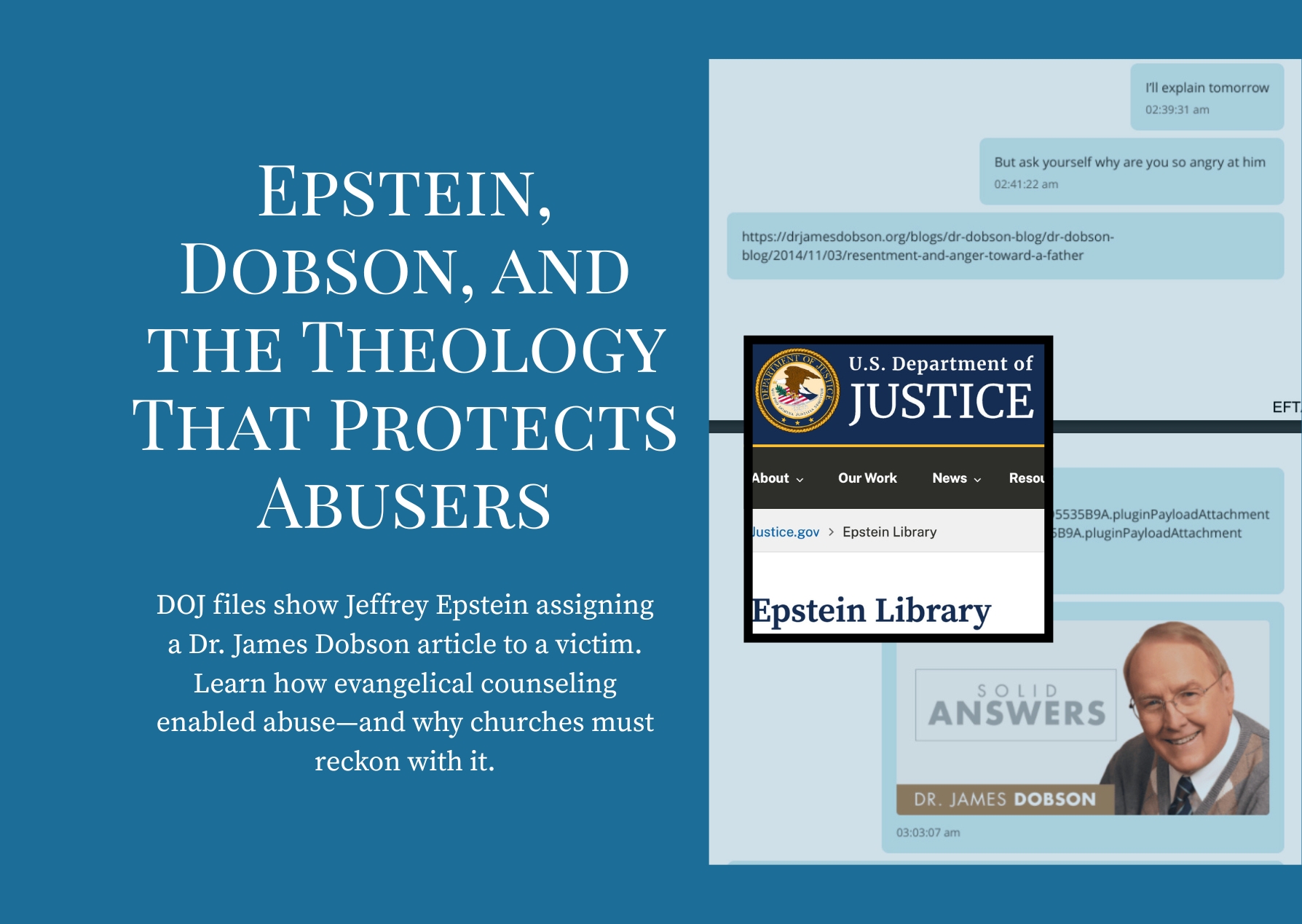
In a May 2019 iMessage exchange (released by the U.S. Department of Justice), Jeffrey Epstein chastises a victim, challenges her for being angry at her father, and then assigns a corrective reading assignment to her: a James Dobson article titled “Resentment and Anger Toward a Father.”
This is not secondhand reporting or inference. It is a direct link sent by Epstein to a victim, in the context of moral correction and control.
That matters. Not because Epstein “twisted” Dobson—but because he recognized advice that already worked in an abuser’s favor.
📂 Epstein Assigned a Dobson Article to a Victim to Correct Her
Predators don’t need a Bible verse that says, “Go abuse.” They need a trusted voice that effectively helps them get away with it by doing the cleanup work for them: neutralize a victim’s anger, recast offender’s cruelty as “brokenness,” and make self-protection feel immoral. That’s exactly what happens in this DOJ exchange.
What the DOJ document shows, step by step:
-
Epstein chastises the victim for being angry at her father.
-
He tells her she knew she was hurting him, reframing her anger as a moral failure.
-
He instructs her to “ask yourself why are you so angry at him.”
-
He immediately follows this with a direct link to James Dobson’s article, “Resentment and Anger Toward a Father.”
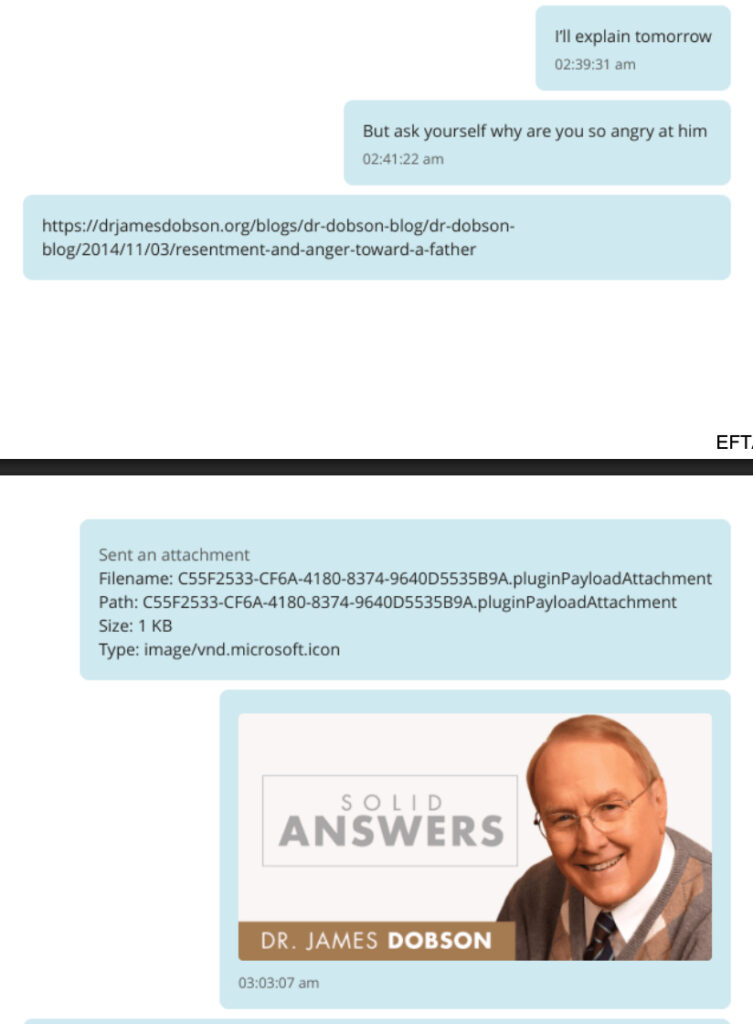
In a May 2019 iMessage exchange released by the U.S. Department of Justice, Jeffrey Epstein directs a victim to read a James Dobson article as moral correction, reframing her anger toward an abusive father.
🧠 Dobson Didn’t Warn Her About Cruel Fathers. He Reframed the Abuse.
The article Epstein assigned was not neutral advice.
Dobson’s article addresses a woman whose father was neglectful and cruel—including skipping the funeral of her infant child.
Instead of naming abuse or danger, Dobson:
-
Reframes cruelty as emotional blindness or a permanent “handicap.”
-
Removes moral agency from the father (“he can’t help it”).
-
Shifts responsibility away from the perpetrator.
-
Places the emotional labor on the victim.
-
Treats her anger as the central problem to be solved.
That move shifts the entire moral center of the story.
Responsibility slides off the perpetrator and lands on the victim, who is now tasked with empathy, restraint, and emotional adaptation. Her anger becomes the problem to solve—not his behavior.
That is precisely why predators find this framing useful.
In this DOJ exchange, Epstein is not merely recommending inspirational reading—he is actively redirecting a victim’s moral compass away from self-protection and toward empathy for male wrongdoing.
Dobson’s Advice Follows a Classic DARVO Pattern
What makes Dobson’s response so useful to Epstein—and to abusers more broadly—is not just its emphasis on empathy, but the structure of the advice itself. It quietly follows a well-documented abuse pattern known as DARVO: Deny, Attack, Reverse Victim and Offender. This pattern excuses the offender and makes the victim the problem.
D — Deny / Minimize
Dobson never names the father’s behavior as abuse.
Instead, he reframes cruelty as:
-
“emotional peculiarities”
-
“unpleasant incidents and disagreements”
-
a “permanent handicap” or emotional blindness
These phrases soften what sounds like ongoing rejection and emotional abuse. The father’s behavior is treated not as a series of accountable choices, but as an unfortunate condition.
A — Attack (Redirect the Problem)
Dobson subtly redirects the problem onto Martha’s needs and expectations:
-
“you are still hoping”
-
“you will be less vulnerable”
-
“it hurts less to expect nothing”
The implied critique is that her longing is the real issue. Her desire for love—not her father’s cruelty—is framed as the source of ongoing pain.
RVO — Reverse Victim and Offender
Finally, Dobson casts the father as the one who deserves sympathy:
-
His behavior was “probably caused when he was vulnerable”
-
He is described as emotionally “blind”
-
His wounds are placed in the foreground
Martha—the injured daughter—is repositioned as the one who must change, lower expectations, manage exposure, and “shield” herself, as if she is responsible for managing his harm.
By the end of the article, the father’s cruelty is contextualized, excused, and empathized with—while the daughter is tasked with emotional labor, restraint, and self-management.
That is DARVO.
And it is exactly the psychological maneuver Epstein exploits.
⚠️ Abusers Don’t Need to Twist This Teaching
Epstein didn’t misuse Dobson’s advice. He weaponized it exactly as written.
Abusers routinely do this:
-
Redefine harm as misunderstanding
-
Recast cruelty as brokenness, easily dismissed
-
Describe danger as dysfunction in the relationship between them
Once the abuser is framed as fragile or impaired, the victim is pressured to be understanding, spiritual, and quiet.
This is not biblical discernment.
It is flipping morality on its head.
Jesus consistently does the opposite…
🧨 Why This Teaching Is So Useful to Predators
This framework accomplishes several things abusers rely on:
- It trains victims to doubt their instincts.
- It elevates empathy for offenders over self-protection.
- It reframes harm as misunderstanding or dysfunction.
- It spiritualizes endurance and discourages escape.
Abusers do not need to distort this theology.
It already functions as a control mechanism.
⏳ This Isn’t Just “Old Dobson”
Some will argue this is ancient history. It isn’t.
The same themes show up today at Focus on the Family under Jim Daly—especially when the rubber meets the road in real abuse cases. Ed Chinn’s article is a perfect example.
Consider Focus on the Family’s article responding to a wife whose husband had molested a child.
While the piece offers a few obvious first steps (protect the child, seek medical care, involve authorities), it quickly pivots to familiar ground:
- “God hates divorce” is emphasized, even in the context of child sexual abuse.
- Pedophilia is softened with therapeutic language rather than named as predatory evil.
- The wife is encouraged toward confrontation and counseling—approaches widely recognized as unsafe with sex offenders.
- The burden subtly shifts toward preserving the marriage rather than eliminating the danger.
Notably absent are:
- Jesus’ fiercest warnings about those who harm children.
- His clear permission to sever relationships marked by sexual immorality.
- Any recognition that some marriages are already destroyed by predatory sin.
🧠 This Is How Theology Becomes Useful to Predators
When religious teaching prioritizes empathy for offenders, views divorce as sinful, and elevates reconciliation over safety, it creates ideal cover for abuse.
Victims are taught to doubt their instincts.
Communities are trained to protect institutions.
Abusers are given language that explains away their behavior without stopping them.
This is why Epstein found Dobson helpful.
And this is why Christians must stop dismissing these concerns as misunderstandings or exaggerations. The fruit is visible. Survivors have been saying it for decades.
If one of the world’s most prolific abusers recognized evangelical counsel as a tool of control, the proper response is not defensiveness.
It’s repentance.
We need to stop teaching victims to reinterpret danger—and start teaching them how to get free.
✝️ What Jesus Actually Did
Jesus never spiritualized danger or reframed cruelty as a tragic limitation.
He named evil plainly and drew hard lines to protect the vulnerable. He warned that those who harm children face severe judgment, using language so strong it shocks modern readers. He also explicitly permitted divorce for sexual immorality, recognizing that some violations destroy the covenant itself.
In Scripture:
- Escape is not a failure of faith.
- People flee kings, abusers, and violent authorities to preserve life.
- Protection comes before reconciliation.
- Repentance is required of the offender—not endurance from the victim.
🏛️ Why This Still Matters for Churches Today
When churches echo Focus on the Family’s framework—minimizing abuse, prohibiting divorce, urging confrontation or counseling with predators—they unintentionally train congregations to side with danger.
Survivors learn that clarity will be punished, anger spiritualized away, and safety treated as secondary to appearances.
This is not neutral theology.
It produces predictable harm.
📣 A Call to Church Leaders
If your counseling advice would sound reasonable coming from Jeffrey Epstein, something is deeply wrong.
- Stop centering empathy for abusers.
- Stop invoking “God hates divorce” in situations involving violence or sexual exploitation.
- Stop asking victims to carry the moral weight of crimes committed against them.
Start preaching the full counsel of Scripture about domestic violence.
Name abuse as abuse.
Prioritize safety.
Tell the truth about when marriage is already destroyed.
Jesus did.
Related Articles
Terrible Forgiveness Articles That Blame Victims and Excuse Predators
How We Learned of Epstein’s Use of Dobson’s article.
Focus on the Family’s victim-blaming, father-excusing article.
A Better Article on Forgiving Bad Fathers (Gospel Coalition)
Focus on the Family’s guidance on pedophilia
Focus on the Family’s victim-blaming guidance to wives of alcoholics, batterers, and unfaithful husbands.
Hat tip to BareMarriage.com (via D.L. Mayfield) for first drawing my attention to this Epstein–Dobson connection.
 :
:
 :
: Buy PDF