
Book Review: Lies Girls Believe
Lies Girls Believe by Dannah Gresh (part of the Lies Women Believe series by Nancy Leigh DeMoss Wolgemuth) contains some genuinely helpful Christian ideas—God loves you, sin matters, feelings are not infallible, and friendship can be difficult. But those ideas are packaged inside a framework that may train girls to distrust themselves before they learn how to evaluate whether other people are behaving safely or justly.
This review gives 10 main problems. The central problem is not that the book teaches girls to examine their thoughts. Self-examination can be healthy. The problem is that the examination is asymmetrical: the girl repeatedly scrutinizes her attitudes, feelings, desires, and perceptions, while parents, friends, and authorities receive far less scrutiny.
Over time, that imbalance can create a spiritual habit of constant self-accusation: I must be wrong. I must be selfish. I must repent more. I must distrust my own reactions. A girl may begin to confuse guilt, shame, and relentless self-criticism with humility and godliness.
That pattern can lead in two very different directions. One is a joyless, despair-filled faith in which she never feels good enough, safe enough, or spiritually perfect enough. The other is spiritual pride: she may begin to measure maturity by how thoroughly she suppresses her own needs and emotions, and then judge others who do not do the same.
Neither outcome is healthy Christian formation. Humility is not self-hatred, and godliness is not the habit of beating yourself up.
A note on healthier books: This review focuses on the 10 biggest problems in Lies Girls Believe, but I’ve included recommendations near the end of this post for readers looking for healthier alternatives.
In everyday life, this can produce false guilt, anxiety, self-silencing, and faking it. A girl may learn to assume that:
- discomfort means she is ungrateful;
- anger means she is rebellious;
- resistance means she is believing a lie;
- sadness means she is being dramatic;
- being a “good girl” means feeling loved, calm, grateful, happy, content with her appearance, open to others’ opinions, glad to be a girl, and uninterested in boys—even when those feelings are not genuine.
The “Girl Drama Quiz” on pages 15–16 is one example. I want to say this clearly: a child’s sadness and stress are not mere drama to be criticized. It is a real human emotion that deserves compassion, curiosity, and care.
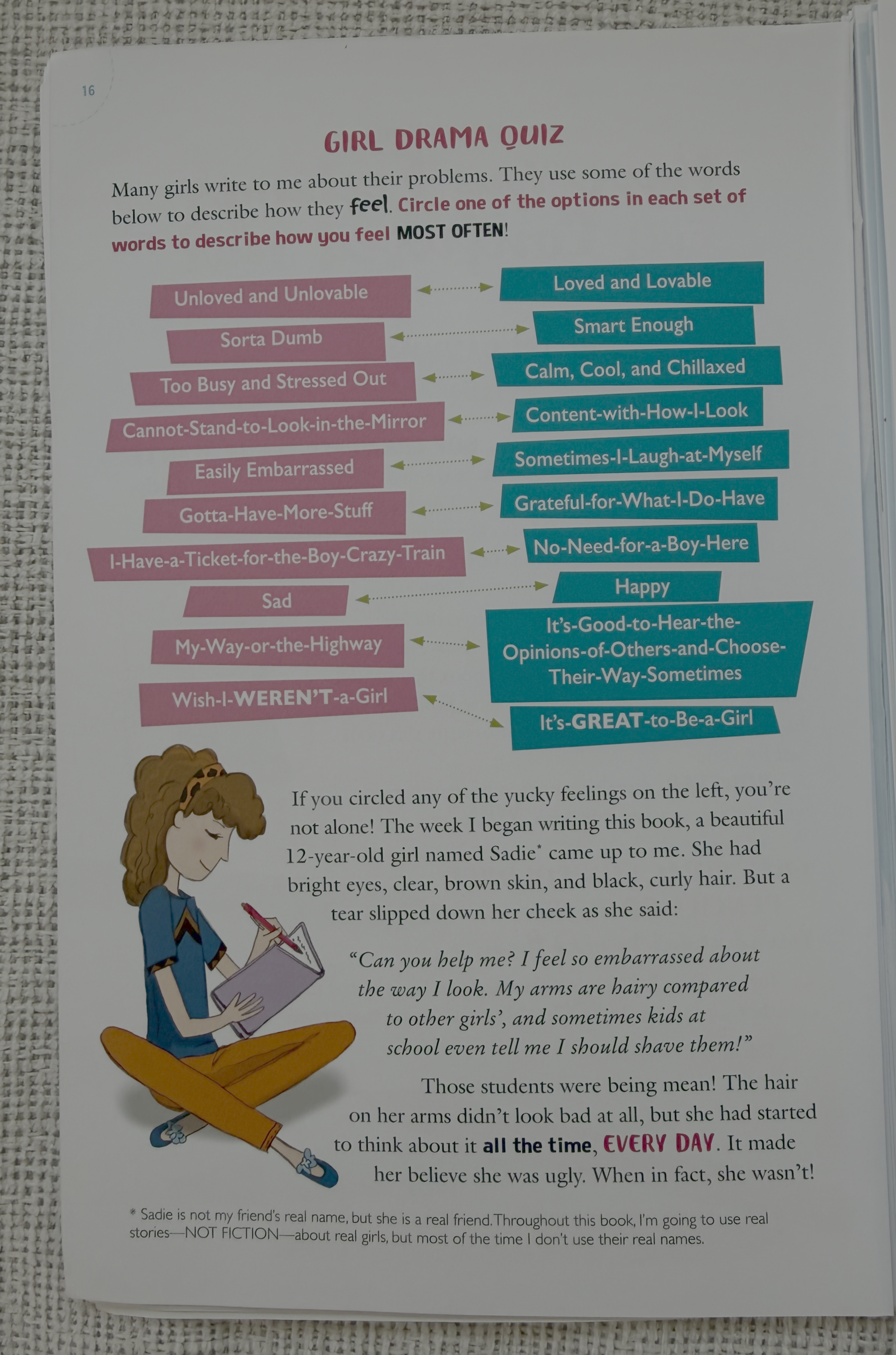
Click to enlarge: The “Girl Drama Quiz” on page 16 of Lies Girls Believe asks readers to compare discouraging self-beliefs with “healthier” feelings about identity, appearance, relationships, and contentment.
1. Lies Girls Believe treats ordinary developmental needs as possible spiritual deception
Among the book’s identified “lies” are ideas such as:
- “I need more freedom.”
- “My parents just don’t get me.”
- “My family is too broken for me to ever be happy.”
- “I don’t need to tell anyone about my sin.”
- “I don’t need to talk to my mom about boys.”
A child can certainly be mistaken about these things. But she can also be right.
She may need more age-appropriate autonomy. Her parents may genuinely misunderstand her. Her family may be deeply dysfunctional. Her mother may not be a safe person with whom to discuss boys. The difficulty is that the book classifies these statements as lies before teaching girls how to assess the behavior of the adults around them.
So my question would be:
Why are we teaching a girl to suspect her perception before teaching her how to recognize coercion, manipulation, humiliation, emotional abuse, or unsafe authority? Isn’t that a set up for marrying an abusive person?
That is the wrong order.
A safer approach would be: “Your perception may be incomplete, so let’s investigate it.” That is very different from: “This thought belongs in the category of lies.”
An Example
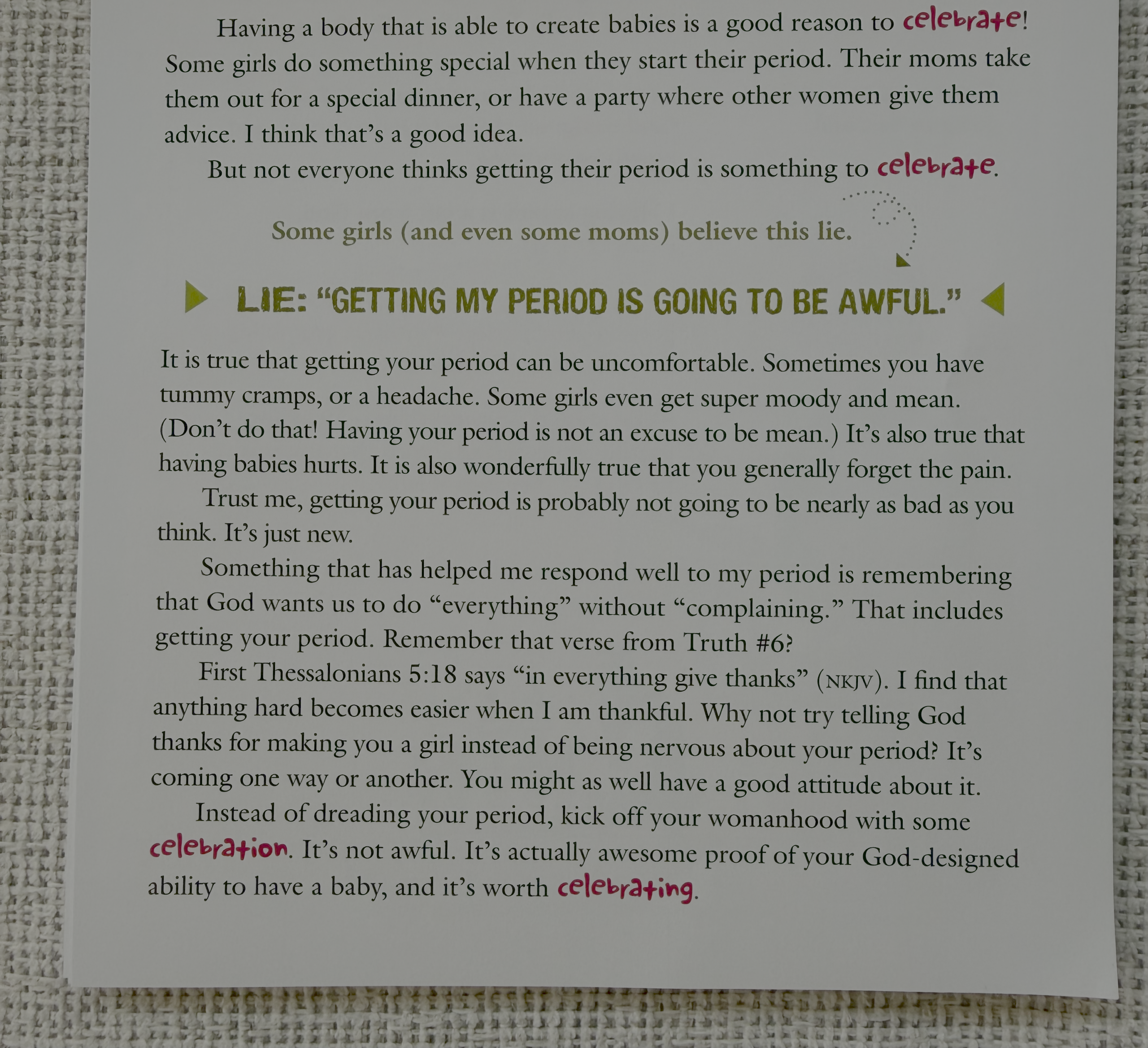
Click to enlarge: A page from Lies Girls Believe & the Truth That Sets Them Free presents the fear that menstruation will be awful as a “lie” and encourages girls to respond with gratitude and celebration.
“Getting my period is going to be awful.” This statement is listed as “a lie.”
Before going on, I want to say clearly that menstrual pain, mood changes, fear, or distress are not signs of a bad attitude or spiritual failure—and girls deserve accurate information, compassionate care, and permission to speak honestly about what they are experiencing.
The book admits that periods can involve cramps, headaches, and discomfort. But then it says girls should do everything, including having their period, without complaining, and with thanksgiving. It concludes that a period is “not awful” but “awesome proof” of a girl’s ability to have a baby.
That is troubling for several reasons.
Some girls have severe cramps, migraines, vomiting, fainting, heavy bleeding, endometriosis, or other medical problems. For them, “this is awful” may be an accurate report—not a lie, bad attitude, or failure of gratitude.
The passage also turns a bodily symptom into a moral test:
pain → complaining → wrong attitude → be thankful instead
That can teach girls to minimize pain instead of reporting it. It may also make them feel guilty for not experiencing menstruation as a celebration of future motherhood.
And the line that “it’s probably not going to be nearly as bad as you think” is exactly the kind of reassurance that can become dismissal.
A better message would be:
Periods vary. Some are mild and some are very painful. You do not have to pretend pain is pleasant or feel guilty for disliking it. Tell a safe adult and seek medical care if the pain or bleeding is severe.
This fits the larger pattern perfectly:
The girl reports physical discomfort; the book corrects her attitude before taking the discomfort seriously.
The advice has the emotional quality of a parent snapping, “Suck it up.” The book softens the command with pastel graphics and spiritual language, but the message is the same: endure the pain quietly, stop complaining, and prove your maturity by having a better attitude.
And the larger point:
A girl who says, “This hurts,” needs care and information before she needs correction. When a book treats pain as whining, it teaches her that reporting distress may itself be a moral failure.
2. Lies Girls Believe risks confusing emotional health with thought-control
The book’s model tends to move like this:
- Identify an upsetting thought (fear, pain, disappointment)
- Label it a lie.
- Distrust the feelings connected with it.
- replace it with the approved “truth.”
- Treat agreement as spiritual freedom.
That can become a system of regulating a child’s perception rather than helping her develop discernment.
It’s not that feelings are always accurate. It’s that feelings are information.
Fear may be telling a girl that someone is unsafe.
Anger may signal that a boundary has been crossed.
Sadness may reveal loss.
Discomfort may tell her that she needs to slow down and investigate.
A severely painful period may mean she needs medical attention.
3. It may train girls to do things that abusive people exploit
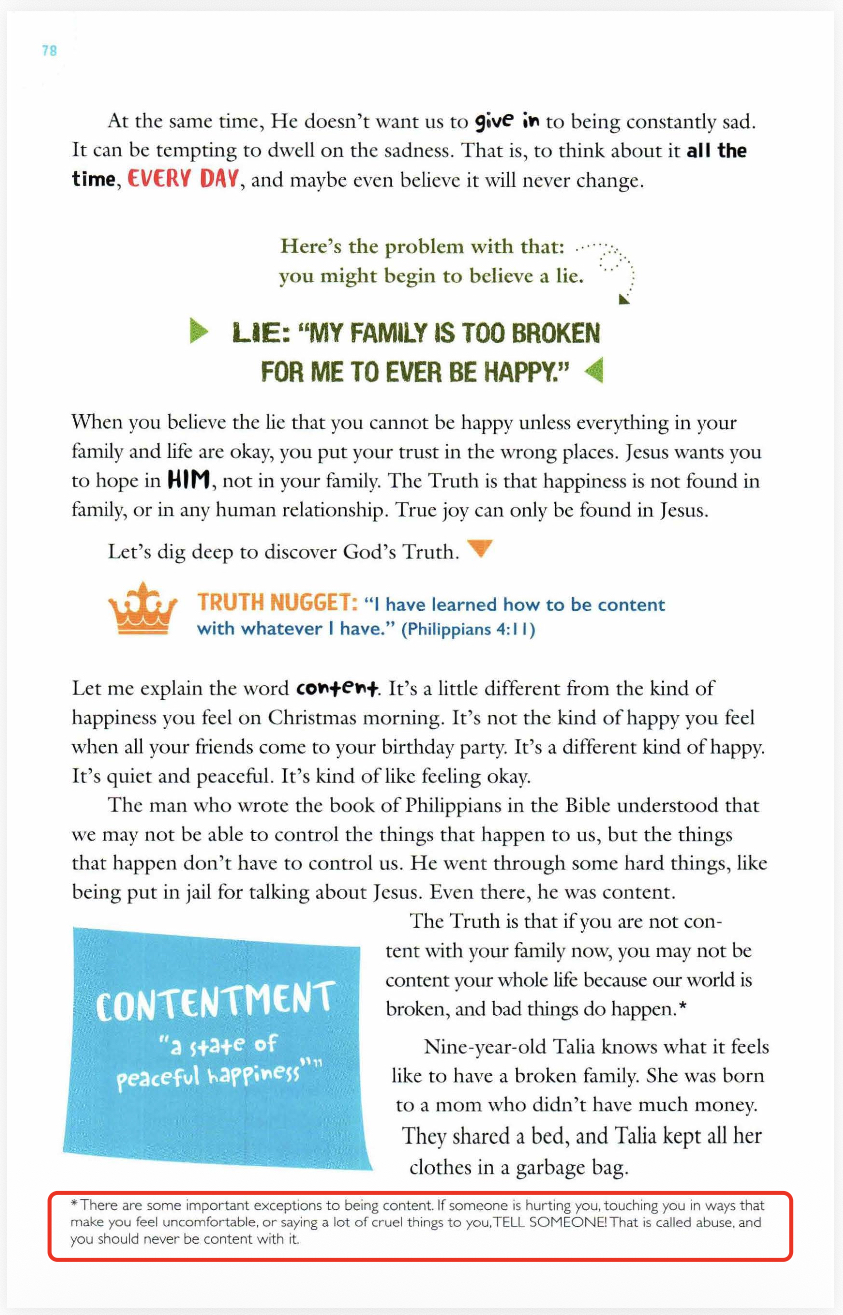
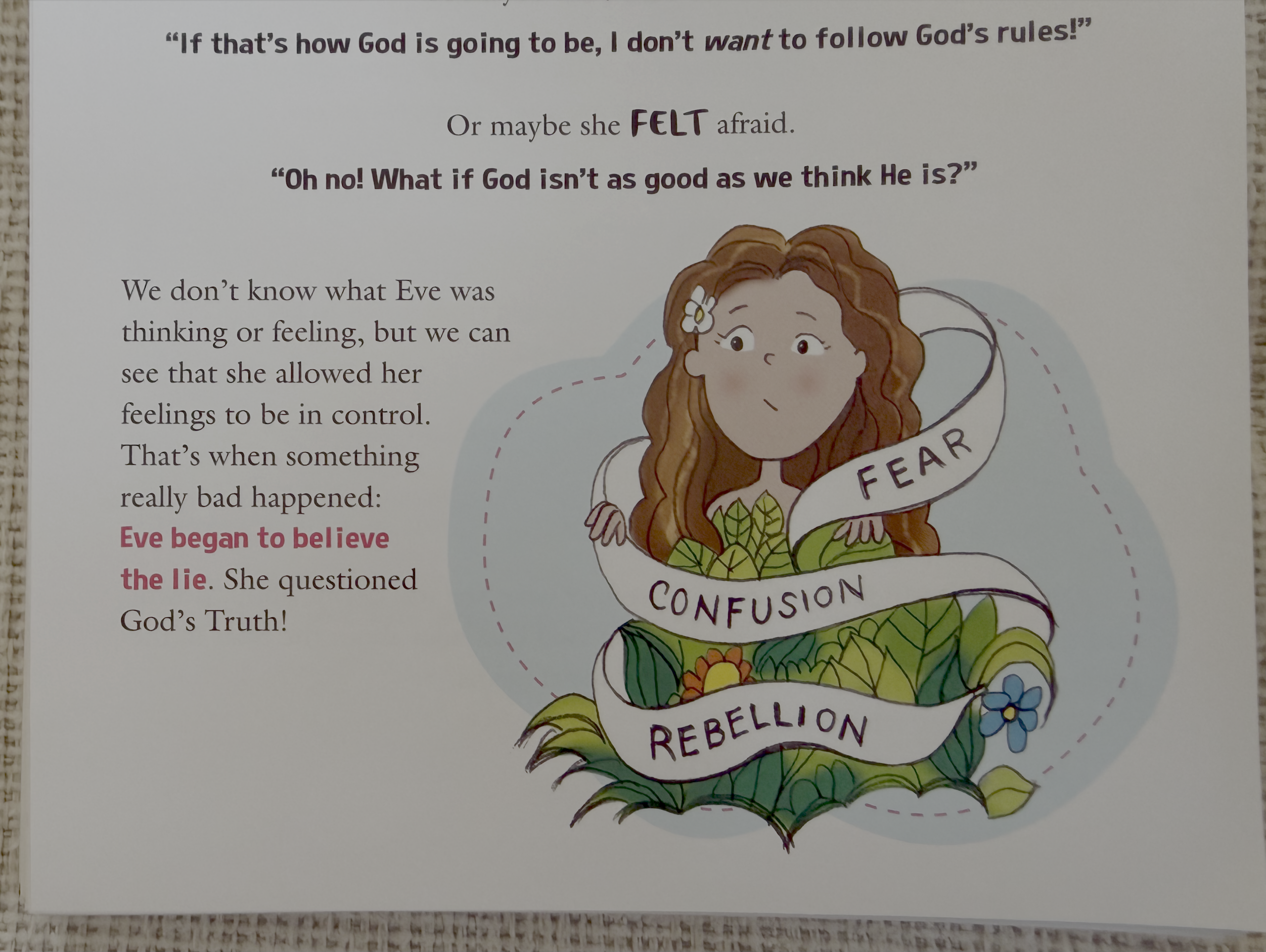
Click to enlarge: Page 78 of Lies Girls Believe includes an small footnote: contentment does not mean tolerating abuse, cruelty, or unwanted touching.
The book does include one small-print footnote on page 78 telling a child to speak up if someone is hurting her, touching her in ways that make her uncomfortable, or repeatedly saying cruel things to her. That warning matters. But one brief abuse warning cannot counteract the book’s much larger pattern of teaching girls to critique herself whenever something feels wrong.
Again and again, the girl is encouraged to:
- question herself when she thinks others might disapprove of her;
- confess troubling thoughts;
- honor authority without being equally taught how to evaluate whether that authority is safe;
- “correct” her attitude before examining another person’s behavior;
- practice contentment even in difficult circumstances, without asking how those circumstances arose, who may be responsible for them, or whether anything needs to change;
- disclose her inner life to adults;
- express disagreement politely, but ultimately accept and obey authority’s decision without being taught when continued protest may be necessary;
A girl may learn that when she feels uneasy, angry, pressured, or misunderstood, her first responsibility is to investigate herself for any sign of sin.
Instead of asking whether another person is being controlling, unfair, manipulative, or unsafe, she may search her own heart for pride, rebellion, discontentment, or unbelief. That habit can produce false guilt, anxiety, pretending, and self-silencing—especially when she has not also been taught how to evaluate authority, name wrongdoing, or persist when something is wrong. Those habits are not abuse in themselves. But developing those thought processes are extremely useful to controlling people.
This same imbalance appears in the “Mary’s Husband Has Left Her” case study examined in the nouthetic counseling manual Self-Confrontation by John C. Broger: The Biblical Counseling Manual That Blames Victims, which trains readers to treat Mary’s anger and distress over her alcoholic husband’s betrayals and abuse as sins she must confront only in herself.
An unsafe person (adult, school bully, predator) benefits when a child has learned to think:
Maybe I am overreacting.
Maybe the problem is my attitude.
Maybe wanting privacy means I am hiding sin.
Maybe I should obey even when I disagree.
Maybe my fear is evidence that I am believing something untrue, like “God’s isn’t good.”
The issue is not merely, “Does this book tell girls to report obvious abuse?”
It is, “Does this book strengthen or weaken the abilities girls need to recognize abusive or deceptive behaviors and attitudes before they becomes dangerous?”
4. Lies Girls Believe blurs the difference between privacy and secrecy
Children should never be told to keep dangerous secrets. But privacy is not the same as secrecy.
A girl has a legitimate inner life. She may have doubts, crushes, resentment, imaginary conversations, dreams or goals, theological questions, passing thoughts, or fears that she is not yet ready to discuss. These do not automatically belong to her parents, pastor, teacher, youth leader, or counselor.
A healthy parent wants communication, but does not demand total access to the child’s mind.
Sheila would likely say that a book for girls should explicitly distinguish:
- Dangerous secrecy: concealing abuse, threats, sexual pressure, self-harm, exploitation, or serious danger.
- Healthy privacy: having thoughts, feelings, questions, relationships, and personal space that are not automatically open for inspection.
When a book strongly emphasizes confession and disclosure without equally teaching privacy and safe-adult discernment, it may teach girls that spiritual maturity means making themselves transparent to authority.
That is dangerous in unhealthy families and churches.
5. Lies Girls Believe risks confusing humility with chronic self-doubt
The book looks cheerful and child-friendly, but its organizing assumption is that the main battlefield is inside the girl: her feelings, attitudes, desires, perceptions, and resistance.
The emphasis becomes a focus on:
“What false thought — of the 20 lies in this book — is hiding inside me?”
Girls do need humility. But humility is not chronic self-doubt. Christian maturity should make a girl more capable of recognizing truth, confronting wrongdoing, and protecting the vulnerable—not more likely to assume she is the problem.
6. It emphasizes obedience without asking whether authority is acting rightly
A major weakness in this genre is that authority is often treated as a stable source of wisdom, while the girl’s resistance is treated as morally suspect.
But authority is not automatically good because it is authority.
Parents can be loving, wise, and safe. They can also be emotionally immature, controlling, neglectful, sexually inappropriate, violent, addicted, or manipulative. Church leaders can protect children—or pressure them to tolerate unsafe people for the sake of “grace.”
The footnoted warning on page 78 is important and well placed in the home-and-family section. But not all abuse fits into neat categories like hitting, sexual touching, or overt cruelty.
Some abuse is coercive, manipulative, shaming, isolating, or spiritual. A girl may sense that something is wrong long before she can name it. The warning therefore needs to be repeated and expanded in the book’s sections on authority, obedience, privacy, friendship, boys, and emotions. Girls need explicit permission to question unsafe behavior, leave, seek another adult, and keep telling until someone listens.
Obedience cannot require surrendering safety.
Note: Nancy Leigh DeMoss Wolgemuth’s theological basis for mistrusting feeling is the story of Adam and Eve. In the biblical story, Eve is deceived by the serpent’s lie—not by the mere existence of emotion. In Genesis, Adam acts knowingly and Scripture identifies him as the representative through whom sin entered the world—so other people’s deliberate choices should be weighed at least as carefully as a woman or girl’s feelings.
7. The book needs a much stronger doctrine of boundaries
A book for girls should not merely tell them what not to believe. It should teach them what they are allowed to do.
A girl should know:
- She may say no.
- She may leave an uncomfortable interaction.
- She does not owe politeness to someone violating her boundaries.
- She may seek another adult when the first adult dismisses her.
- She may stay away from a friend who lies without being cruel.
- She may recognize that a parent is wrong.
- She may keep appropriate matters private.
- She may ask difficult questions.
- She may report misconduct even when the offender is respected.
- She does not have to prove that someone intended harm before protecting herself.
As good protective parents, we want girls to practice boundaries before a crisis, not receive reluctant permission to become forceful only when danger is unmistakable.
8. It treats healthy self-regard and dignity with suspicion
Some Christian resources treat self-esteem as competition with dependence on Jesus—as though girls must choose between thinking well of themselves and worshiping God.
A girl can know she is loved by God and also believe:
- My thoughts matter.
- My body belongs to me.
- My boundaries matter.
- I am allowed to speak.
- I can recognize mistreatment.
- I do not need to become small so that others feel powerful.
Positive self-esteem functions as a protective factor for Christian girls. According to researcher and author Sheila Gregoire, women who had stronger self-esteem in high school reported better outcomes in areas including marital satisfaction, ability to raise difficult issues, sexual well-being, and freedom from abusive dynamics.
So the question is not, “Does the book say girls have value?”
Many evangelical resources say girls are precious while simultaneously teaching them to distrust their judgment, police their bodies, defer to authority, and question their anger.
The relevant question is:
Does the book treat the girl as a morally responsible person with agency, or primarily as a bundle of dangerous thoughts requiring adult correction?
9. It warns against “boy craziness” without teaching girls how to assess boys
The book does not explicitly tell girls that they are responsible for boys’ lust or behavior. Its message is subtler: girls are taught to monitor their own interest in boys, resist “boy craziness,” and avoid awakening romantic love until they are ready for lifelong commitment.
There is wisdom in telling young girls that they do not need to rush into romantic relationships. But the chapter treats attraction primarily as something the girl must regulate. It says that liking boys can lead to dating and marriage, warns that feelings can overpower good choices, and directs girls to check those feelings against the book’s prescribed truth.
What is largely missing is practical teaching about boys themselves:
- How does a respectful boy behave?
- What should a girl do if a boy pressures, embarrasses, manipulates, or frightens her?
- How can she recognize entitlement or controlling behavior?
- Does she have permission to dislike a boy who likes her?
- Can she say no without explaining or apologizing?
- What makes a boy trustworthy?
The chapter asks girls to govern their own feelings, but gives them little help evaluating boys’ conduct. That continues the book’s larger pattern: the girl’s inner life receives close scrutiny, while the behavior of people around her receives much less.
A healthy chapter about boys would do more than warn girls against being “boy crazy.” It would teach that attraction is normal, boys are responsible for their own choices, and a girl’s task is not merely to restrain herself but to recognize character, insist on respect, and leave when someone ignores her boundaries.
10. It narrows Christian girlhood too much
Many evangelical resources for girls are disproportionately preoccupied with:
- boys;
- dating;
- sex;
- virginity;
- clothing;
- temptation;
- purity;
- marriage preparation.
Meanwhile, major New Testament themes—such as the kingdom of God, the Holy Spirit, resurrection, justice, generosity, courage, and care for the poor—receive much less emphasis.
In the book She Deserves Better, the authors’ word analysis found that books for Christian teen girls emphasized sex, modesty, lust, virginity, and temptation far more heavily than the New Testament does, while giving comparatively less emphasis to the Holy Spirit, the kingdom of God, the gospel, resurrection, and money.
They would ask:
Why are we teaching girls that the main drama of their Christian life is controlling themselves around boys?
A girl’s calling is much larger than becoming sexually unproblematic, relationally agreeable, and prepared for marriage.
To illustrate how different this message is from the past, let look at the change in girls’ Christian books over the decades. This shows what Christian publishers thought would sell.
Messages in Christian Girls’ Books Over Time
For parents who grew up on Christian adventure stories, missionary biographies, mysteries, historical novels, and books about young people facing danger with courage, the contrast can be startling.
1970s Christian Girls and Teen Books
In the 1970s, church and family bookshelves often held The Chronicles of Narnia, Treasures of the Snow, God’s Smuggler, The Hiding Place, Joni, and the Danny Orlis adventures. These books gave children wardrobes, mountains, border guards, concentration camps, overcoming tragedy, forests, boats, mysteries, betrayal, and rescue. They were often preachy, and the older books had serious problems of their own such as racism and paternalism. But they usually gave young readers a world outside themselves. They were allowed to call a spade a spade: evil characters, dangerous situations, acts of bravery.
1980s Christian Girls and Teen Books
In the 1980s, girls read Janette Oke’s frontier stories, the Mandie mysteries, Frank Peretti’s Cooper Kids adventures, Catherine Marshall’s Christy, and missionary biographies like YWAM’s Christian Heroes. I’m not saying they were 100% good books. The tone remained problematic in some places, but the child still followed a protagonist through a plot. The question was: The world is difficult. Life hands you serious problems. How will you act within it?
1990s Christian Girls and Teen Books
In the 1990s, Christian girlhood became a market. Brio magazine, the Christy Miller and Sierra Jensen series, Left Behind, Lady in Waiting, and I Kissed Dating Goodbye shifted attention toward identity, romance, purity, and God’s plan. Adventure did not disappear, but the focus narrowed. Girls were increasingly taught to guard their hearts, regulate desire, prepare for future marriage, and treat ordinary romantic feelings and crushes as spiritually dangerous.
2000s Christian Girls and Teen Books
By the 2000s, the girl’s interior life had become the battlefield. Every Young Woman’s Battle, For Young Women Only, Dateable, and Lies Young Women Believe invited girls to monitor their clothing, bodies, fantasies, emotional attachments, media, friendships, sexual thoughts, and private desires.
The older books often taught girls faith, courage, adventure, and confidence. The newer books began teaching girls how to distrust themselves in the name of faith.
Lies Girls Believe brings that method to preteens. It teaches a girl to ask whether her loneliness, fear, anger, dissatisfaction, desire for privacy, or resistance to authority reveals a lie she has believed.
That can create self-scrupulosity and fuel OCD: relentless monitoring of one’s thoughts, motives, feelings, and reactions for hidden sin. Instead of learning to talk about emotions and feelings and asking what they mean, a girl learns intense self-criticism. Sadness may become self-pity. Anger may become rebellion. Dissatisfaction may become ingratitude. Fear may become weak faith. A boundary may become bitterness. Wanting distance may become unforgiveness.
The result can be anxiety and guilt disguised as discipleship.
Bottom line
I would not call every page harmful or accuse the Dannah Gresh (or Nancy DeMoss Wolgemuth, the series’ founder) of intending to endanger girls.
But we don’t just books by good intentions. We judge them by fruit.
The book’s deepest mistake is locating danger primarily inside the girl—inside her feelings, desires, perceptions, resistance, and wish for autonomy—rather than giving equal attention to dangers outside her, including controlling adults, unsafe families, manipulative theology, peer coercion, predatory boys, and abusive authority.
A healthier book would teach:
Your feelings are not always correct, but they are worth listening to.
Your parents may be wise, but they are not infallible.
You should confess wrongdoing, but you are not responsible for everyone else’s behavior.
You need community, but you are entitled to privacy.
You should practice humility, but humility does not mean distrusting yourself.
You should honor others, but you may still confront, refuse, leave, and seek help.
Jesus does not free girls by teaching them to become less visible, less discerning, or less powerful.
Comparison with a healthier books on raising girls
Books for Teens and Adults on Christian Sexual Morality, But Without the Toxic Messages
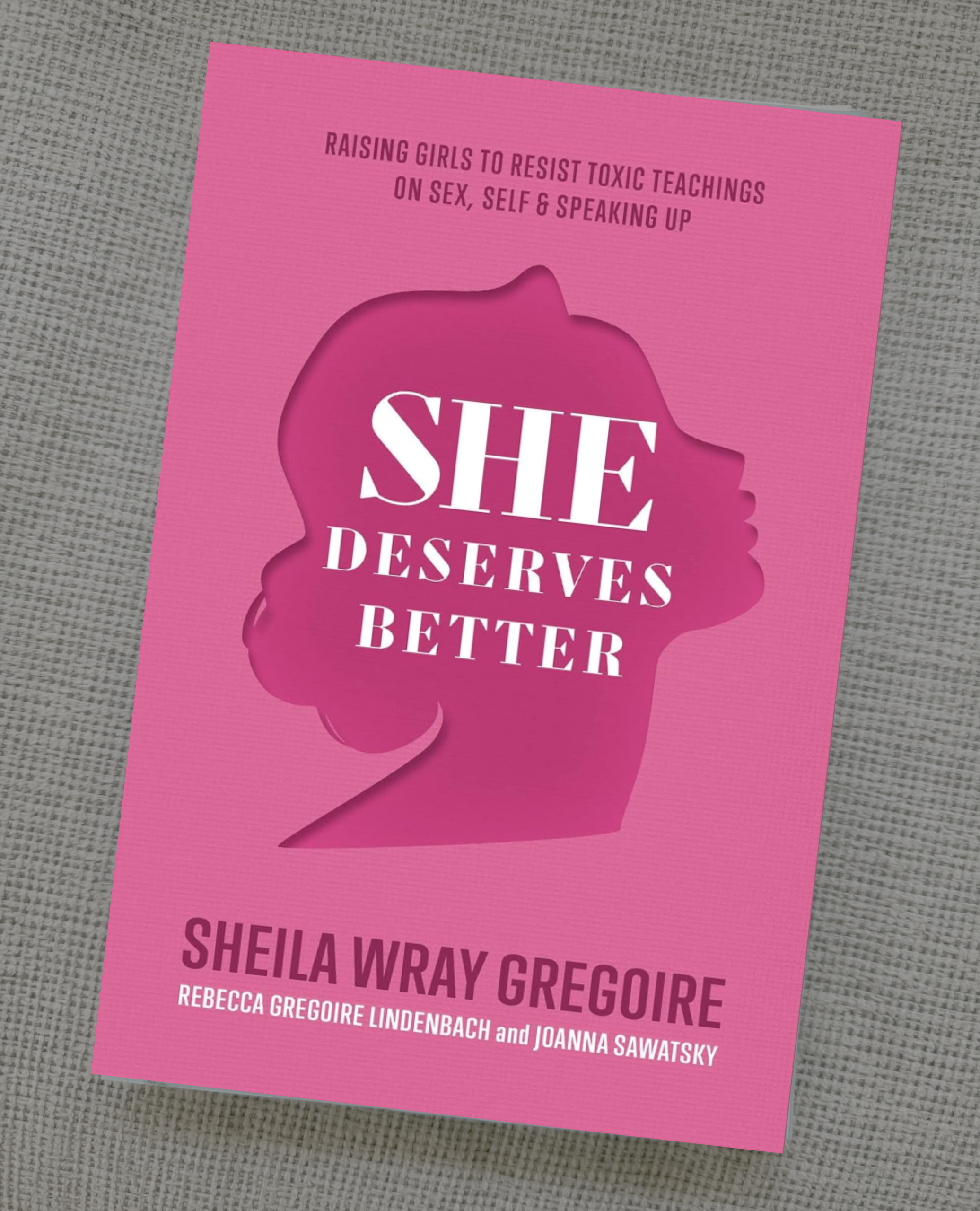
This book helps parents bring up daughters who are grounded in their faith and care about morality, but are resilient against toxic messages that tell them they are “worth less.” Based on a study of 28,000 women, this book gives evidence-based advice on how to raise good daughters.
| Area | Lies Girls Believe — Dannah Gresh 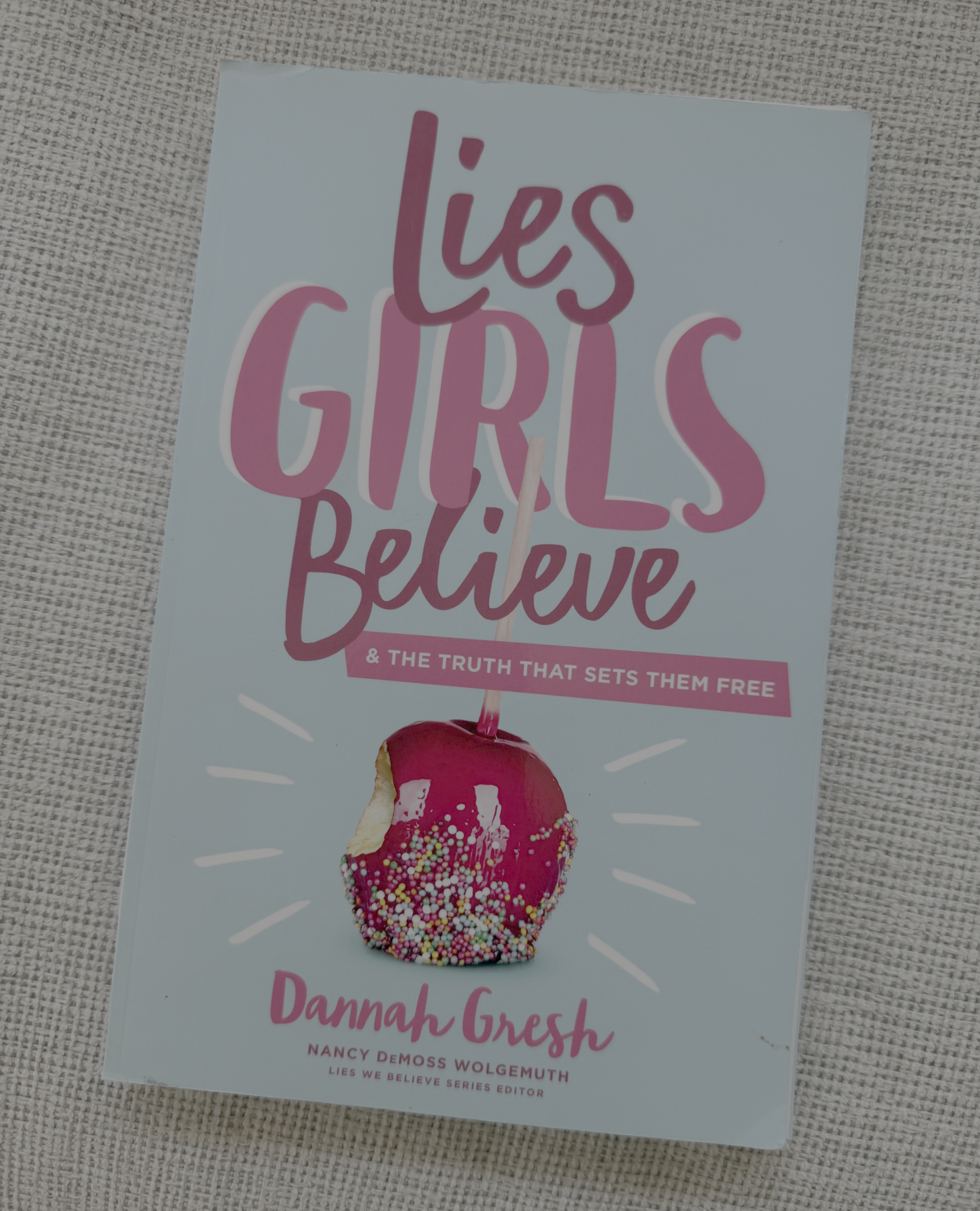 |
She Deserves Better — Sheila Wray Gregoire, Rebecca Gregoire Lindenbach, and Joanna Sawatsky
|
|---|---|---|
| Intended audience | Written directly to girls ages 8–12, with a companion guide for mothers. | Written primarily to mothers and caregivers, with mother-daughter exercises and discussion sections. |
| Primary goal | Help girls identify “lies” about God, themselves, family, sin, gender, boys, friendship, and emotions, then replace those lies with biblical “truth.” | Help parents raise girls who can resist harmful Christian teachings about sex, self-worth, emotional health, boundaries, consent, relationships, and speaking up. |
| Basic framework | The main problem is false belief inside the girl. Her task is to identify wrong thoughts, submit them to Christ, and replace them with approved truths. | The main problem may be inside the girl, in her environment, or in the teaching she has received. Her task is to discern truth by Scripture, evidence, fruit, emotional health, and the conduct of others. |
| View of feelings | Feelings can become “sticky” and confusing; thoughts should govern feelings, and Christ should govern thoughts. | Feelings are not automatically authoritative, but they are meaningful information. Fear, anger, sadness, and discomfort may reveal violated boundaries, danger, grief, or injustice. |
| View of self-examination | Strong emphasis on examining one’s own thoughts, attitudes, desires, complaints, sin, and media choices. | Balances self-examination with examination of authority figures, systems, teachings, relationships, and power differences. |
| Self-esteem | Rejects the belief that a girl is “not good enough” and says inner beauty matters more than physical beauty. | Treats healthy self-esteem as an important protective factor linked with stronger boundaries, healthier relationships, and greater ability to address difficult issues. |
| Beauty and appearance | Challenges comparison culture and the belief that pretty girls are worth more. Physical beauty fades; inner beauty matters most. | Agrees that appearance does not determine worth, but also critiques teachings that make girls’ bodies spiritually dangerous or responsible for boys’ thoughts. |
| Freedom and autonomy | Labels “I need more freedom” as a lie and redirects girls toward responsibility, obedience, and proving readiness. | Treats growing autonomy as a normal developmental need. Encourages responsibility while also teaching girls that they may have privacy, boundaries, personal judgment, and a voice. |
| Parents and authority | Teaches that girls can find joy by honoring parents and treats “My parents just don’t get me” as a lie. It encourages girls to seek parental wisdom. | Encourages connection with parents but does not assume parents are always wise or safe. Teaches girls to recognize controlling, manipulative, abusive, or emotionally immature authority. |
| Privacy and disclosure | Treats “I don’t need to tell anyone about my sin” as a lie and emphasizes confession and disclosure. | Distinguishes dangerous secrecy from healthy privacy. A girl should disclose abuse or danger, but adults are not automatically entitled to every thought, feeling, crush, doubt, or private matter. |
| Family dysfunction | Teaches that a girl can still be happy in a broken family and that family differences can be good. | Would affirm hope in difficult families but places greater emphasis on naming dysfunction accurately, recognizing harm, and seeking protection or outside support. |
| Sin | Sin is a central organizing category. Girls are taught that sin separates them from God, hiding it leads to failure, and media should be filtered through moral standards. | Takes sin seriously but also asks whether Christian teaching has misidentified normal development, female assertiveness, anger, questions, or boundaries as sin. |
| Grace and belonging | Emphasizes salvation through Jesus and God’s constant love, but much of the practical structure focuses on identifying and correcting wrong belief. | Explicitly argues for the order “belong, then believe, then behave,” warning that behavior-first Christianity may produce performance rather than genuine faith. |
| Faith formation | Christian maturity is strongly associated with believing correct propositions, resisting lies, controlling thoughts, obeying Scripture, and seeking wisdom. | Christian maturity is associated with Christlike fruit, courage, justice, emotional wholeness, discernment, healthy relationships, boundaries, and the ability to recognize harmful teachings. |
| Use of Scripture | Uses short “Truth Nuggets” to answer specific beliefs and behaviors. | Uses Scripture alongside research, survey data, psychology, abuse dynamics, and examination of outcomes or “fruit.” |
| Use of evidence | Includes a survey of 1,531 churched girls ages 7–12 and some secondary sources, but the book is mainly devotional and prescriptive. | Built around survey research, statistical models, focus groups, published research, analysis of Christian books, and comparisons between teachings and later outcomes. |
| Gender differences | Teaches that God created two distinct genders and that boys’ and girls’ bodies, brains, and strengths are generally different, while allowing girls to have atypical interests. | Challenges broad gender stereotypes when they restrict girls, excuse boys, or create hierarchy. Focuses more on individual character and capability than predetermined gender roles. |
| Girls’ future role | Celebrates female biology and the ability to create life. | Affirms motherhood but resists defining a girl primarily through marriage, maternity, sexual purity, or service to men. Girls are encouraged to become full participants in church and society. |
| Boys and attraction | Teaches girls not to be “boy crazy,” not to awaken love too early, and to seek their mothers’ advice about boys. | Treats attraction as normal and emphasizes discernment, mutuality, red flags, consent, compatibility, and the girl’s freedom to make relational decisions. |
| Dating | The book for younger girls emphasizes avoiding premature romantic fixation and talking with a wise adult. | Rejects rigid one-size-fits-all dating formulas. Teaches girls how to evaluate character, power, safety, coercion, and relationship health. |
| Consent | Consent is not one of the book’s main organizing themes. | Consent is central. Girls are taught that they may give a direct no, leave, make noise, seek help, and prioritize safety over politeness. |
| Boundaries | Boundaries appear indirectly through resisting peer pressure, unhealthy friendships, media, and “boy craziness.” | Boundaries are explicit and foundational. Girls need practice saying no, recognizing manipulation, protecting bodily autonomy, and refusing access to unsafe people. |
| Politeness versus safety | Tone generally favors respectful, obedient, relationally agreeable responses. | Warns that Christian girls are often trained to be polite when they need to be firm. A clear no is preferable to a humorous or apologetic refusal in unsafe situations. |
| Abuse prevention | Encourages girls to speak to trusted adults but does not build the book around recognizing coercive systems or unsafe authority. | Gives substantial attention to grooming, toxic people, abuse dynamics, institutional failure, unsafe leaders, date rape, and the protective value of assertiveness. |
| Responsibility for boys’ behavior | In this book, the emphasis is more on controlling a girl’s own romantic attention than on managing boys’ sexuality. | Directly rejects messages that make girls responsible for boys’ lust, sexual escalation, or lack of self-control. |
| Modesty | Inner beauty is emphasized, and the author’s wider ministry has historically included modesty teaching. | Critiques modesty teaching when it treats girls’ bodies as temptations or transfers responsibility for male behavior onto girls. |
| Sex education | Limited because the book targets ages 8–12; discusses puberty, periods, and male-female difference. | Argues that girls deserve accurate, age-appropriate knowledge about anatomy, sex, consent, assault, bodily responses, and reproductive health. It reports that more frequent church attendance correlated with lower sex-education knowledge in the survey. |
| Sexual purity | Avoiding premature romantic and sexual focus is presented as part of godly living. | Supports wise sexual choices but rejects virginity as the primary measure of a girl’s faith, worth, or future marital health. |
| Marriage emphasis | Girls are warned not to awaken love before they can make a lifelong commitment. | Warns that Christian resources often make boys, virginity, and future marriage the central plotline of girls’ lives instead of the kingdom of God, vocation, courage, justice, and spiritual gifts. |
| View of cultural messages | Culture, social media, peer influence, and deceptive feelings are major sources of lies. | Culture can harm girls, but so can churches, Christian books, parents, youth leaders, purity culture, hierarchy, and distorted biblical interpretations. |
| View of church teaching | The book largely presents evangelical teaching as the corrective to cultural lies. | Treats evangelical teaching itself as something that must be tested. Christian language can produce either good or harmful fruit. |
| Definition of discernment | Discernment means recognizing thoughts that conflict with Scripture and replacing them with biblical truth. | Discernment means evaluating beliefs, people, institutions, behavior, power, evidence, outcomes, Scripture, and emotional signals together. |
| Typical question asked of the girl | “What lie are you believing, and what truth should replace it?” | “What happened? What are you feeling? Is this safe? Is this teaching true? Who holds responsibility? What boundary or action is needed?” |
| Potential strength | Accessible, warm, visually engaging, age-appropriate in tone, Christ-centered, and helpful in challenging appearance-based worth, social comparison, hidden sin, and destructive media habits. | Strong on evidence, safety, agency, consent, emotional health, boundaries, critical thinking, and exposing teachings that may make girls vulnerable. |
| Potential weakness | May encourage girls to classify normal feelings, autonomy, doubts, or accurate criticism of adults as “lies” before sufficiently evaluating whether their environment is unhealthy. | Written mainly for adults rather than younger girls; its critique of evangelical teaching may feel destabilizing to parents who want a simpler devotional framework. |
| Overall picture of a faithful girl | A girl who trusts God’s truth, resists deceptive thoughts, honors parents, controls her attention, confesses sin, seeks advice, and develops inner beauty. | A girl who loves Jesus, knows her worth, understands her body, recognizes danger, uses her voice, draws boundaries, evaluates teaching, and refuses to become smaller for the comfort of others. |
One final note: The book also introduces a troubling stereotype about children of divorce. In a friendship story on page 120, Katrina’s parents divorce, the girls’ mothers grow apart, and Katrina “started to be a real bully.” Laura responds compassionately because Katrina is “going through a hard time,” confronts her behavior, and the friendship is restored. The book does not say that all children of divorce become bullies, but the narrative sequence invites readers to connect divorce with a girl becoming mean. Research does not support divorce itself as a typical or sufficient cause of bullying; most children whose parents divorce do not become bullies.
 :
:
 :
: Buy PDF