
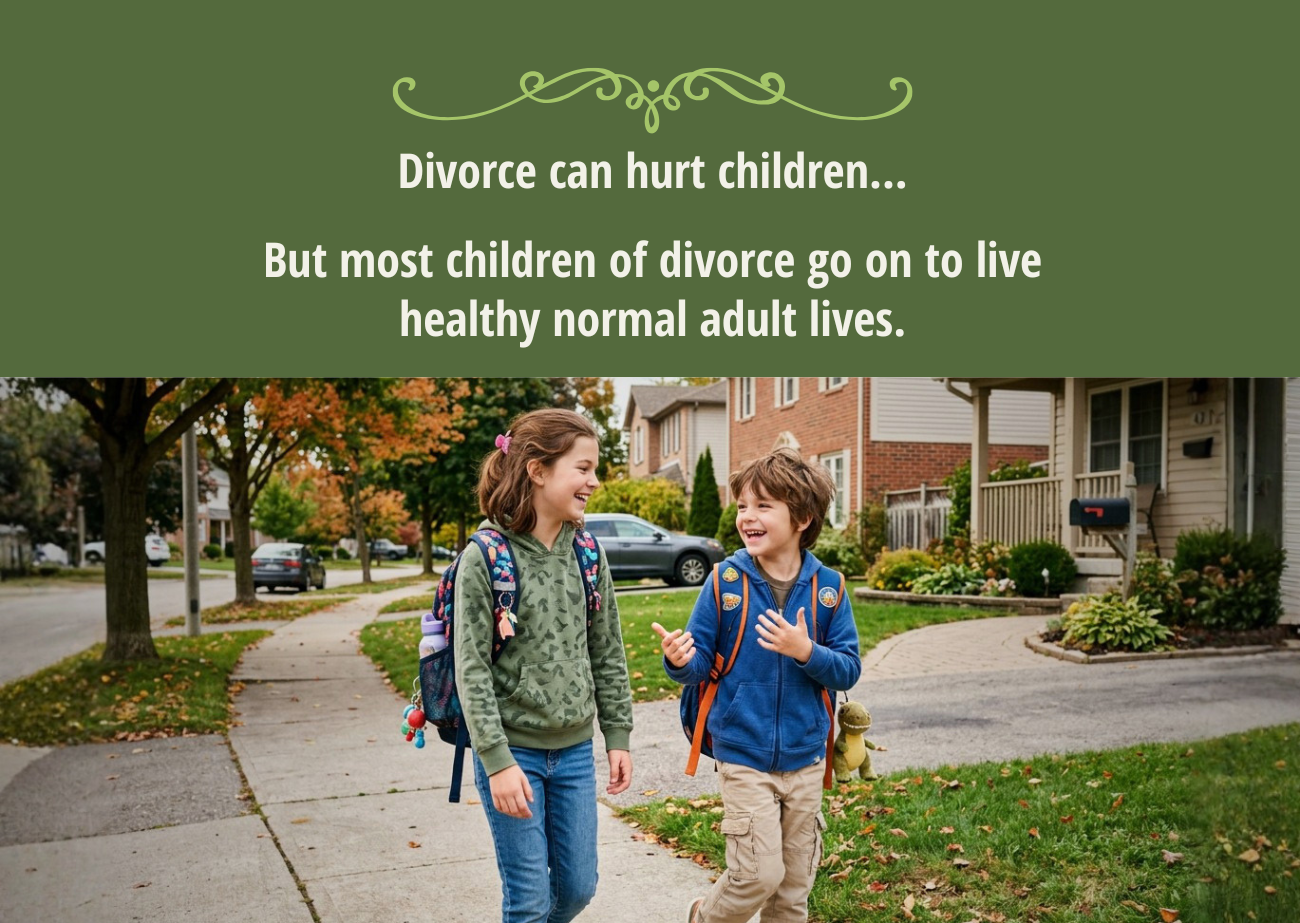
“Kids Are Resilient” Does Not Mean “Divorce Doesn’t Matter”
Anti-divorce groups love a sneering line:
“They say kids are resilient. Ha ha.”
Notice the trick. “They” is left vague on purpose. It can mean therapists, selfish divorcees, feminists, lawyers, researchers, or whoever the audience already distrusts. The vagueness does the work. It turns a research concept into a punchline.
But resilience is not a slogan invented by people who do not care about children. It is a serious finding in child-development research.
And the research does not say what marriage-at-any-cost groups claim. Children are not universally destroyed by divorce.
What the Research Actually Says
Nobody serious claims divorce is painless. Nobody serious claims kids are unaffected. Nobody serious claims children magically “bounce back” with no support.
What the research actually says is more honest:
- Divorce can raise risks for children.
- High-conflict divorce can hurt them badly, especially when children are exposed to ongoing parental warfare and instability.
- Most children of divorce are not doomed. In fact, most children of divorce grow into functioning adults without severe long-term problems.
- Many adjust, recover, grow, marry, parent, work, and live ordinary, healthy adult lives.
That is resilience.
Not denial. Not fantasy. Resilience.
The Trick: Turning “Resilient” Into “Unaffected”
The common tactic is to twist the word resilience until it means something no one meant.
What Researchers Say
Many children adapt over time, especially with safe, stable, supportive parenting.
What Anti-Divorce Advocates Pretend They Heard
Divorce has no effect and children feel nothing.
Then they attack that weaker claim.
That is a straw man.
A resilient child may still cry. A resilient child may still need therapy. A resilient child may still remember the divorce as painful.
Resilience does not mean untouched. It means the child is not ruined.
Personal Pain Is Real. It Is Not the Whole Dataset.
Some writers tell painful stories about growing up in high-conflict divorce. Those stories deserve compassion. Children should never be trapped in abusive, chaotic, or emotionally destructive homes.
But one person’s pain does not prove that most children of divorce are permanently damaged.
Both of These Can Be True
“My parents’ divorce hurt me deeply.”
That does not prove:
“Divorce destroys children.”
Those are different claims.
The best research follows thousands, sometimes millions, of children. It looks at averages, risks, protective factors, and mechanisms.
The pattern is clear: divorce raises some risks, but it does not doom most children.
The New Johnston Study Does Not Say What the Scare Headlines Claim
Marriage-at-any-cost groups have been waving around the 2025 Johnston, Jones, and Pope Census study as if it proves divorce wrecks children.
It does not.
The study is important. It followed more than 5 million children using linked tax and Census records. It found that children exposed to divorce had higher risks of several negative adult outcomes, including teen birth, incarceration, lower earnings, and early mortality.
But look at the actual numbers.
The absolute risks remain low.
What the Numbers Actually Show
According to the summary from Table 1:
- Teen birth rose from about 0.6 per 100 daughters to about 1.5 per 100.
- Incarceration rose from about 0.15 per 100 children to about 0.46 per 100.
- Early mortality rose from about 0.83 per 100 children to about 1.2 per 100.
Yes, those increases matter. Researchers are right to study them.
But they do not mean most children of divorce become teen parents, go to prison, or die young.
They mean almost all do not.
That is the part the scare headlines leave out.
Relative Risk Can Be Used to Frighten People
If a risk goes from 1 in 100 to 2 in 100, someone can shout:
“The risk doubled!”
That sounds terrifying.
But another accurate way to say it is:
“98 out of 100 children did not experience that outcome.”
Both statements can be mathematically true. Only one tells parents the whole story.
So when advocacy groups trumpet “60% increase!” or “45% increase!” without explaining the baseline risk, they are not educating people. They are frightening them with statistics presented without context, similar to other common myths about divorce and children.
And fear is not the same as truth.
The Study Also Points to Mechanisms, Not Doom
The Johnston study does not simply say “divorce happens, children fail.”
It points to pathways.
What Can Make Life Harder After Divorce
- Household income drops.
- Families move more.
- Neighborhoods may get worse.
- Parents may live farther apart.
- Children may lose time with a parent.
That matters.
Because if the problem is income loss, instability, unsafe neighborhoods, and reduced parent contact, then the answer is not “shame divorced parents forever.”
What Actually Helps Children
- Reduce conflict.
- Protect children financially.
- Keep them connected to safe, emotionally available parents whenever possible.
- Support stable housing.
- Strengthen schools.
What Adults Must Stop Doing
- Stop using children as weapons in parental conflict.
- Stop making children carry adult emotions.
- Stop forcing children to choose sides.
- Stop pretending marriage is safe just because it is intact.
That is a very different message.
Modern Research Supports the Same Point
A 2020 meta-analysis by van Dijk and colleagues reviewed 115 samples and more than 24,000 divorced families. It found that post-divorce child adjustment is linked to interparental conflict and parenting quality.
The effects were mostly small but significant, and parenting partly explained the link between conflict and children’s internalizing and externalizing problems.
That is not a “divorce always destroys kids” finding.
It is a “family processes matter” finding.
What Hurts Children Most
The same meta-analysis found that children are especially harmed when parents:
- Keep fighting after divorce.
- Dump adult problems on children.
- Make children take sides.
- Use harsh or hostile parenting.
- Create role confusion or triangulation.
That is exactly why the “just stay married” message is too crude.
A hostile home is not magically healthy because two married adults still share an address.
Staying Married Is Not Always Protection
Children need safety, stability, love, structure, and sane adults.
Sometimes an intact marriage gives them that.
Sometimes it does not.
When “Staying Together” May Not Protect Children
If the home is filled with serious harm, then staying married may not protect the kids at all.
- Abuse or coercion
- Addiction or chronic betrayal
- Screaming fights
- Manipulation or emotional neglect
- Ongoing fear and chaos
It may just keep them trapped inside the blast zone.
That does not mean divorce is always good. It means marriage is not automatically safe simply because it remains intact.
What Resilience Really Means
Resilience is not pretending nothing happened.
Resilience is what happens when children have enough support to keep growing after something painful happens.
Children Are More Likely to Do Well When They Have Safety
- At least one steady, loving parent
- Low exposure to adult conflict
- Predictable routines
- Permission to love both safe parents
Children Are More Likely to Do Well When They Have Support
- Financial and housing stability
- Emotional honesty
- Adults who listen
- Adults who do not make the child carry the divorce, manage adult emotions, or absorb ongoing conflict.
That is not magic.
That is support.
The Honest Message
Here is the truth without the scare tactics:
Divorce can hurt children. High-conflict divorce can hurt them a lot. Some children carry pain for years.
But divorce does not doom most children.
The research does not support that level of panic.
Most Children of Divorce Are Not Doomed
- Most do not go to prison.
- Most do not become teen parents.
- Most do not die young.
- Most are not permanently broken.
So the next time someone sneers, “Kids are resilient? Ha ha,” the answer is:
Yes. Many are.
And they are even more resilient when adults stop using fear, shame, and half-truths — start giving children the stability, protection, and love they actually need—especially in homes affected by abuse, chronic conflict, or emotional manipulation.
 :
:
 :
: Buy PDF