
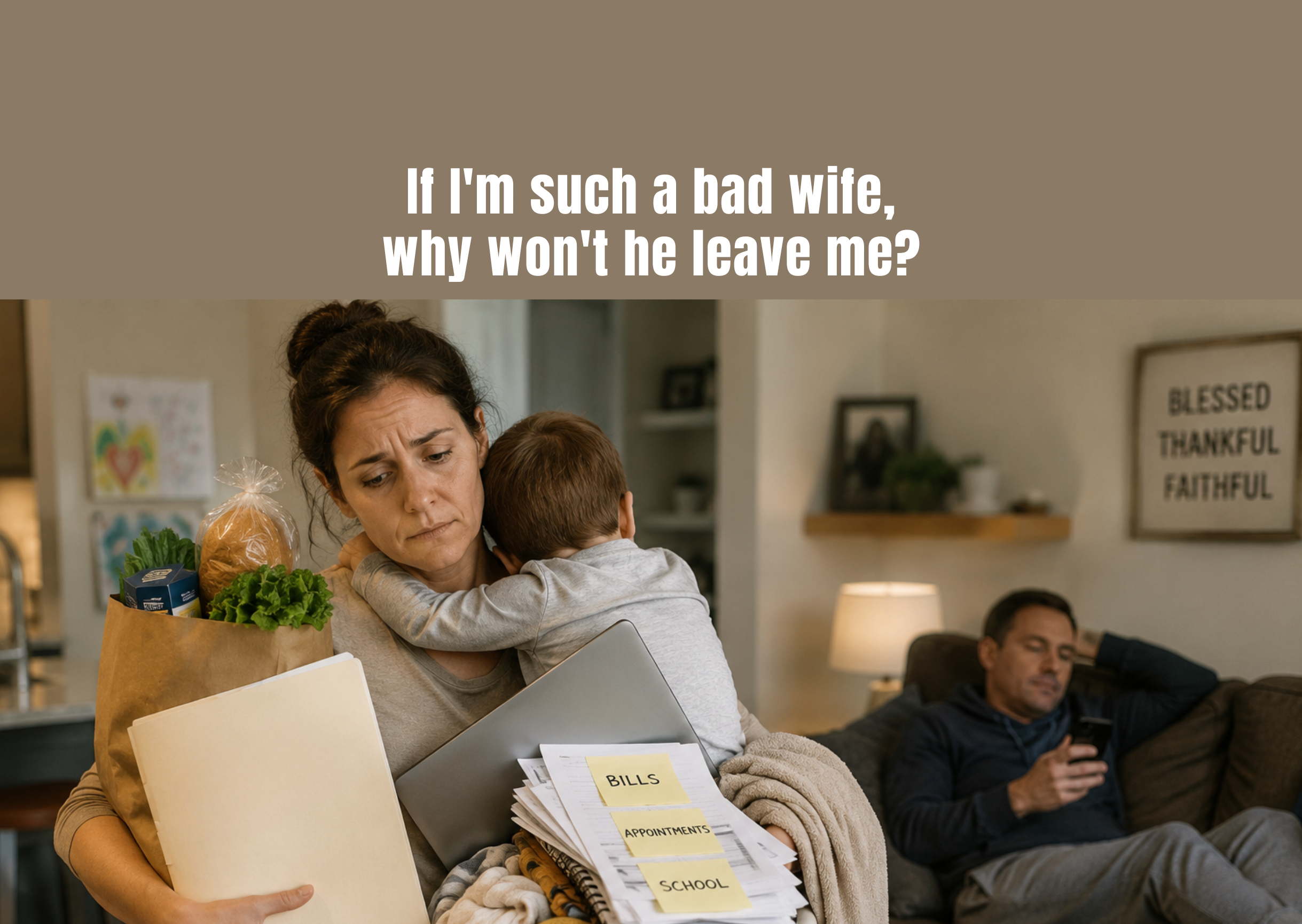
Why Does My Husband Stay Married If He’s Always Criticizing Me?
From time to time, confused wives say something like this to me:
“He says I’m selfish, lazy, disrespectful, overweight, and a loser. He criticizes how I parent, how I spend money, how I dress, and even how I load the dishwasher. But when I talk about separating, he becomes furious. If I’m really as terrible as he says I am, why is he so determined to stay married to me?”
I have heard themes like this repeatedly from Christian divorce survivors for nearly 30 years.
Note: Of course, sometimes the roles are reversed. A wife may be the chronically critical, controlling, or abusive spouse, while her husband is the one walking on eggshells and trying to keep the peace. In this article, I’m using the husband-as-aggressor pattern because it is the one I hear most often from the Christian women who contact me, but the underlying dynamic can occur in either direction. I believe men who tell me their stories.
And it raises an important question:
If a husband finds so much fault with his wife, why does he fight so hard to keep the marriage?
The answer may be that his constant criticism is not evidence that the marriage gives him nothing.
The marriage may be deeply painful for her while still giving him exactly what he wants.
The marriage may be working for him
Later, as survivors look at how hard they worked to please their spouse, I hear a new insight:
“He told everyone I was a terrible wife. But I cooked, cleaned, raised the children, worked outside the home, managed the bills, and protected his reputation. He enjoyed all the benefits of marriage while telling me I was the problem.”
That contradiction is more common than many people realize.
A chronically critical spouse may still receive:
- domestic labor
- childcare
- income
- sex
- emotional attention
- social respectability
- a stable public image
- someone else to blame
The marriage may be painful for the criticized spouse while remaining highly beneficial to the spouse doing the criticizing.
That is why the criticism itself can be misleading.
He may not be saying, “This marriage gives me nothing.”
He may be saying, “I want you to do everything I expect, without arguing, objecting, or having any expectations of your own. And I will punish you until you comply.”
Those are very different complaints.
Criticism can keep someone striving
Persistent fault-finding can create a powerful cycle.
The wife thinks:
Maybe if I try harder, he’ll be kinder.
Maybe if I become more patient, organized, attractive, submissive, cheerful, or sexually available, he’ll finally be satisfied.
But the standard keeps moving.
Recommended reading
The Bible Teaches Us to Get Away from Abusers Many Christians have been taught to endure abuse rather than escape it. Here’s what Scripture actually says about getting away from dangerous people.
Typical survivors put it this way:
“Every time I fixed one thing, he found another problem. I spent years trying to become the wife he said he wanted. Eventually I realized there was no finish line.”
That endless striving can keep a person off balance. Instead of evaluating whether the relationship is safe or mutual, she spends her energy proving that she is not the failure he says she is.
The criticism may therefore serve a purpose.
It can keep her apologizing, serving, doubting herself, and trying harder.
Eventually, she may reach a painful conclusion:
“If I don’t file for divorce, no one will.”
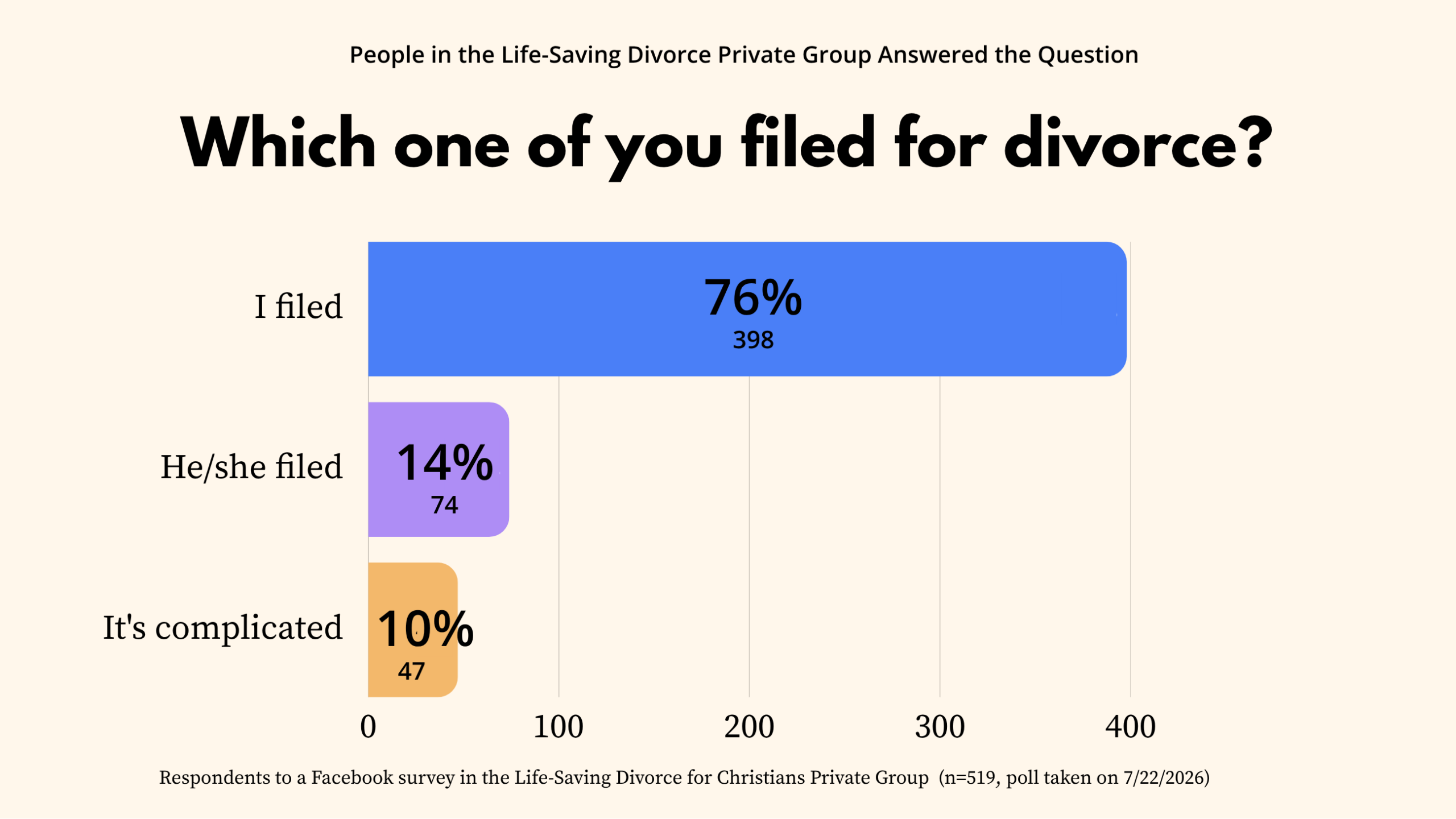
This pattern is so common that I recently asked members of my private Life-Saving Divorce Facebook group a simple question: Which spouse filed for divorce? (For those new to my site, my group is made up mostly of conservative Christian women and men who identify as abuse or infidelity victims.)
Recommended reading
What Is a Life-Saving Divorce? Filing for divorce is not always what destroys a marriage. Sometimes it simply acknowledges that one spouse has already destroyed it through abuse, adultery, abandonment, or chronic betrayal.
This is not a scientific survey. My group consists largely of Christian divorce survivors, many of whom were the faithful spouses in abusive or chronically destructive marriages. But the result illustrates what I have heard for decades: the destructive spouse may have no intention of ending an arrangement that continues to benefit them.
The faithful spouse may finally file—not because they wanted the marriage to end, but because the other spouse refused to change or acknowledge that the marriage was already being destroyed.
Why doesn’t he leave?
Because he likes the arrangement. He gets much of what he wants with minimal effort.
He is not seeking fairness, integrity, or a loving partnership. He feels entitled to have his own way. Normal relationship values—listening, caring, compromising, and giving weight to the other person’s wishes—require more effort than he wants to give.
Abuse is fast and easy. It is the mindset of an immature bully.
Listening, caring, finding solutions that consider both people, and making sacrifices require maturity. They also require the belief that both people matter—not just him.
A destructive spouse may resist separation because separation threatens access, convenience, control, finances, childcare, domestic labor, sex, or public image.
He may also fear exposure. As long as the marriage continues, he can preserve the appearance of a respectable Christian family.
This is why setting boundaries does not always cause an abusive or controlling spouse to walk away, as some Christian authors suggest.
Sometimes the opposite happens.
The spouse who has spent years demeaning the marriage may suddenly fight fiercely to preserve it—not because the relationship has become loving, but because the arrangement is no longer guaranteed. The services provided may disappear.
Sidebar: Finding humor in the hypocrisy
What I would say if I had no filter:
- Funny how “nothing you do is good enough” can coexist with “don’t you dare leave.”
- Apparently she’s unbearable—but also indispensable.
- If she’s so impossible, why are you working overtime to keep her and spending thousands of dollars to block the divorce?
- If the marriage is such misery, why are you fighting so hard to preserve your meal ticket, your nanny, your emotional regulator, your social camouflage, and your unpaid household staff?
- He doesn’t want a partner. He wants an appliance that folds laundry, pays bills, raises children, supplies validation, absorbs criticism, and never develops inconvenient needs of her own.
- Do more. Need less. Ask fewer questions. Stop noticing the double standard. And when she finally says, “No,” suddenly she’s the one destroying the marriage.
“Will the abuser eventually commit adultery so I can divorce him?”
Here is another dangerous misconception: that an abuser will eventually have an affair, and the affair will finally give the victim acceptable “grounds” to leave.
Maybe he will. Maybe he won’t.
Some self-righteous, religious abusers weaponize the Bible, marriage vows, submission, forgiveness, and the threat of public shame. Coercive control is the name of the game. They may never commit adultery.
For victims in churches that recognize adultery—but not abuse—as grounds for divorce, this distinction matters enormously. “Divorce is a sin” can become another instrument of power and control, trapping a victim while the abuser enjoys the moral cover of appearing faithful.
Some Christian communities have historically treated adultery and abandonment as the only biblical grounds for divorce. But many theologians, pastors, and advocates recognize that abuse is itself a profound violation of the marriage covenant.
A victim should not have to wait for an affair, a broken bone, or a pastor’s permission before recognizing that the relationship is unacceptable.
Abuse is grounds enough to seek safety.
You do not need sexual betrayal.
Recommended reading
Adultery, Abuse, and Abandonment Are Biblical Grounds for Divorce You do not have to wait for adultery before recognizing that a marriage covenant has been profoundly violated.
Ask a different question
Many Christian communities ask:
“Why would this committed Christian wife file for divorce?”
But sometimes a better question is:
“Why was he so determined to keep a wife he claimed was so terrible?”
If your spouse constantly belittles you, then stonewalls until you calm down, give up, and come home, do not mistake his refusal to change for commitment to the marriage.
He may simply be waiting for the boundary to pass so the old arrangement can resume.
Sometimes endless fault-finding is not evidence that he wants out.
Sometimes it is one of the tools used to keep you in.
 :
:
 :
: Buy PDF