
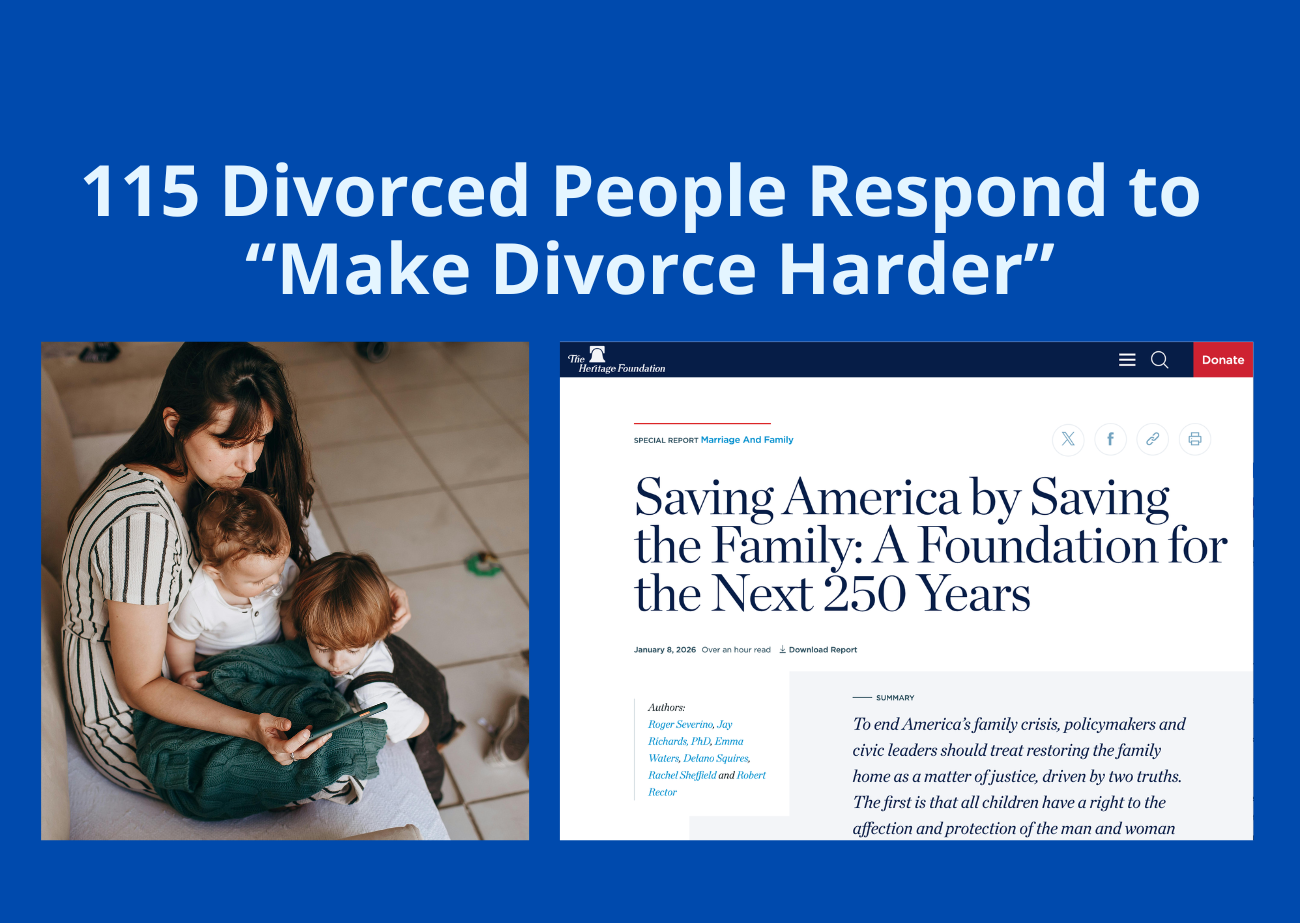
Heritage Foundation’s Plan to Make Divorce Harder: A Critique
The Heritage Foundation says America can be “saved” by strengthening marriage and family. In practice, some of its proposals would reward certain married couples financially and encourage states to make divorce harder to exit or restructure divorce outcomes in ways that could trap vulnerable spouses longer. On my Facebook page, I took a poll and more than 115 people in the comments spoke out against their plan.
What Was Heritage Foundation Proposing?
Here are a few specific proposals stood out in Heritage’s report:
- New FAM tax credit for married parents of young children (pp. 120–121)
- Up to $2,000 more per child for home childcare in married-couple families (pp. 122–123)
- Use tax policy to give unmarried parents an incentive to marry (pp. 122–123)
- Expand covenant marriage and other harder-to-exit marriage structures (p. 48)
- Promote default 50/50 custody after divorce (pp. 48–49). See also: The Hidden Danger of Requiring Equal 50/50 Child Custody: What People Don’t See.
- Reduce alimony to remove what they call the “financial incentive to leave” (p. 49)
Related policy analysis: For more background on why “make divorce harder” proposals can harm families in destructive marriages, see The “Easy Divorce” Myth: For Many Christian Survivors, Divorce Took Years, The Top 10 No-Fault Divorce Myths and How to Refute Them, and The Hidden Danger of Requiring Equal 50/50 Child Custody.
Six Questions for Divorced People
On Facebook, I asked six simple questions to divorced people:
- Would receiving a $4,000 annual tax credit for staying married have saved your marriage?
- Would making divorce harder to get have improved your marriage, or only prolonged the pain?
- Did your marriage end because divorce was too easy—or because the marriage was already over?
- Would you rather have had cash to stay married or cash to leave safely?
- What would have helped more: support to fix the marriage, or support to leave it?
- If the people making these policies had lived in your house for a week, would they still think divorce was too easy?
Hundreds of people responded, most with anger over the tone-deafness of the proposals.
Many of them took a survey: https://forms.gle/s4vtqaqBtkUqrDy78. See the results below. (See the funniest responses here: https://lifesavingdivorce.com/the-funniest-and-fiercest-responses-to-the-heritage-foundations-push-to-make-divorce-harder/)
What 115 Survey Responses Said
—In 115 responses, every single respondent said a $4,000 annual tax credit would not have saved the marriage.
—Every single respondent said making divorce harder would have prolonged the pain.
—Every single respondent said the marriage ended because it was already over, not because divorce was “too easy.”
—Every single respondent said they would rather have had cash to leave safely than cash to stay married.
On the question of what would have helped more, 112 said support to leave and only 3 said support to fix the marriage.
—And when asked whether policymakers would still think divorce was too easy if they had lived in the home for a week, 106 said no and 9 said yes—but several of those “yes” answers came with an important warning: many abusers are so covert and image-conscious that outsiders still might not see the truth.
Related: These responses fit what I found in another survey of Christian divorce survivors: divorce was not quick or casual for most of them. See The “Easy Divorce” Myth: For Many Christian Survivors, Divorce Took Years.
That Should Stop Us Cold
These are not the responses of people looking for an easy exit. These are the responses of people who already stayed too long.
They describe marriages marked by abuse, coercive control, sexual betrayal, addiction, financial entrapment, terror, homelessness, suicidal despair, church pressure, and years—sometimes decades—of trying to make the marriage work. Again and again, the story was not, “Divorce was easy.” The story was, “Leaving was almost impossible.”
Why These Proposals Are So Dangerous
That is why these proposals are so naïve—and so dangerous.
A tax credit does not make an abuser safe.
A waiting period does not create repentance.
Making divorce harder does not heal a destructive marriage. It hands more power to the spouse who is already using money, fear, manipulation, religion, children, or the legal system as weapons.
Many respondents said exactly that. Some said the money would simply have been taken or controlled by the abusive spouse. Some said making divorce harder might have gotten them killed. Some said they stayed years longer than they should have because they had no money, no support, and nowhere to go. Some said the only reason they survived was that divorce was still possible.
Related: Heritage is not the only influential organization promoting marriage policy while giving too little attention to abuse. I address this broader pattern in When Pro-Marriage Organizations Ignore Abuse in Christian Homes, naming Focus on the Family, the Institute for Family Studies (and Brad Wilcox), Heritage Foundation, Family Research Council, and AEI.
What Policymakers Miss
This is what policymakers miss when they speak in abstractions about “saving marriage.”
They imagine ordinary marital dissatisfaction. They imagine impulsive people walking away too quickly. They imagine marriage as a neutral institution that only needs more incentives and more barriers.
But destructive marriages are not saved by entrapment. Nearly 6 in 10 divorces in the “Reasons for Divorce and Recollections of Premarital Intervention” study cited adultery, substance abuse, or domestic violence as the “final straw.”
For more on what makes a divorce life-saving, see Can I Divorce for Abuse? Can Christians Divorce for Abuse?, 130 Examples of Abuse: Physical, Emotional, Sexual, Spiritual, Financial and Neglect, and “Why Didn’t You Just Leave?” 50 Abused Wives & Husbands Explain.
More on the research: The public-policy debate often assumes that most divorces are casual or unnecessary. For a closer look at that claim, see There Is No Divorce Crisis. We Have a Sin Crisis. and Myth: 95% of Divorces Are for Falling Out of Love.
What Would Actually Have Helped?
Not a government coupon for staying married.
- They needed safety.
- They needed money for legal fees and housing.
- They needed support systems that understood abuse.
- They needed churches and counselors who cared about safety first, and could tell the difference between a difficult marriage and a destructive one.
- They needed permission to stop carrying the entire burden of “saving” a marriage the other spouse was busy destroying.
For practical help, see Escape Plan: 50-Item Checklist, 12 Ways to Document and Protect Yourself & Kids in a Divorce, and Divorce vs. Legal Separation for Abuse Victims: What Christians Need to Know.
The Real Problem Is Not “Easy Divorce”
If we care about families, then we need to tell the truth: not every marriage crisis is the same. Some marriages can be repaired. Some should be fought for. But some are already dead in every way that matters long before the divorce papers are filed.
The problem is not that divorce is too easy.
The problem is that far too many people are trapped in marriages that are already unsafe, unfixable, or both—and influential people still call that “saving marriage.”
That is not wisdom. It is blindness.
For a lighter companion piece featuring some of the sharpest, funniest, and most revealing public replies, read The Funniest and Fiercest Responses to the Heritage Foundation’s Push to Make Divorce Harder.
Real Responses From Real People
1. Money Would Not Fix Abuse
- “All the money in the world wouldn’t have made him a better person.”
- “No amount of money could have stopped the abuse, addiction, and adultery.”
- “Money cannot fix emotional abuse, alcohol addiction, porn use, or rebuild trust.”
- “There is no amount of money worth my life, health, dignity, and safety.”
- “How does $4,000 stop verbal and financial abuse?”
2. Tax Credits Could Empower Abusers
- “It would have just given him one more thing to take from me.”
- “He was financially abusive, so extra money would have only made the abuse worse.”
- “I wouldn’t have seen a dime of that $4,000.”
- “He would have used the money to buy more guns.”
- “My abuser controlled all financial income. He even took my birthday checks.”
3. Divorce Was Already Hard Enough
- “Divorce is not easy. The decision to divorce is not easy.”
- “Trying to get a divorce the past four years has been hell.”
- “Making it harder gives an abuser more opportunity to harm.”
- “Divorce was hard enough and his behaviors nearly got our case thrown out of court twice.”
- “It already took me 20 years to work up the courage to leave, then over two years to finalize.”
4. The Marriage Was Already Over
- “The divorce was just the legal paperwork showing that the marriage was already over.”
- “Divorce is a legalizing of what has happened.”
- “My marriage was dead for 15 years before I finally admitted it.”
- “The covenant was broken years before it was ever filed onto paper.”
- “When one party repeatedly breaks the vows, the marriage is over.”
5. Cash to Leave Safely Would Have Helped
- “Financial insecurity keeps women in abusive marriages.”
- “I could have left sooner if I knew I had cash to get my children and myself to safety.”
- “I had nowhere to go because of financial abuse.”
- “A good lawyer costs about $10,000 to retain.”
- “Having access to money to start the process and get safe would have been amazing.”
6. Support to Leave Was Needed
- “There are plenty of resources to help fix a marriage, but next to none for those who need to leave.”
- “It was never a marriage problem. It was an addiction and abuse problem.”
- “One woman cannot fix an abusive man.”
- “I needed support to tell me it was okay to leave and to help me navigate how to do that safely.”
- “People don’t leave because it’s easy. It’s terrifying. People leave when the fear of staying becomes greater than the fear of leaving.”
Conclusion
And if the hundreds of comments on my Facebook post and these 115 anonymous survey responses tell us anything, it is this: people who have actually lived through destructive marriages know the difference. Policymakers should listen before they make survival harder and call it virtue.
-
More public-policy articles:
The “Easy Divorce” Myth: For Many Christian Survivors, Divorce Took Years
A survey-based response to the idea that divorce is quick, casual, or easy for Christian survivors leaving destructive marriages.When Pro-Marriage Organizations Ignore Abuse in Christian Homes
A broader critique of Focus on the Family, the Institute for Family Studies, Heritage Foundation, Family Research Council, and AEI when marriage-policy messaging overlooks abuse and child safety.The Hidden Danger of Requiring Equal 50/50 Child Custody
Why presumed 50/50 custody can be dangerous when abuse, coercive control, addiction, neglect, or child safety concerns are present.The Top 10 No-Fault Divorce Myths and How to Refute Them
A policy-focused response to common claims about no-fault divorce and family breakdown.
Sample Letter to Adapt for your Lawmaker
If you want to send an email, letter, or voice message to your lawmakers about these Heritage Foundation ideas, here’s a sample you can modify:
SUBJECT: Please oppose efforts to make divorce harder
Dear [Lawmaker Name],
I am writing as a concerned constituent to urge you to oppose proposals such as those promoted in the Heritage Foundation’s recent family policy report that would make divorce harder, reduce support for spouses who leave, push default 50/50 custody without regard to abuse, or pressure people to stay in unsafe marriages.
These ideas may sound pro-family, but in real life they can trap vulnerable spouses and children longer in dangerous, coercive, or already-dead marriages. A tax credit does not make an abuser safe. A waiting period does not create repentance. Harder divorce does not heal a destructive marriage.
If you want to strengthen families, please support policies that actually help: enforce child support, fund safe housing and legal aid, improve family court responses to abuse, and protect children’s safety.
Please put the well-being of real families above simplistic policy slogans.
Sincerely,
[Your Name]
[City, State]
[Email or Phone]
Citation: Shelby B. Scott, Galena K. Rhoades, Scott M. Stanley, et al., “Reasons for Divorce and Recollections of Premarital Intervention: Implications for Improving Relationship Education,” Couple and Family Psychology: Research and Practice 2, no. 2 (2013): 131–145.
 :
:
 :
: Buy PDF