
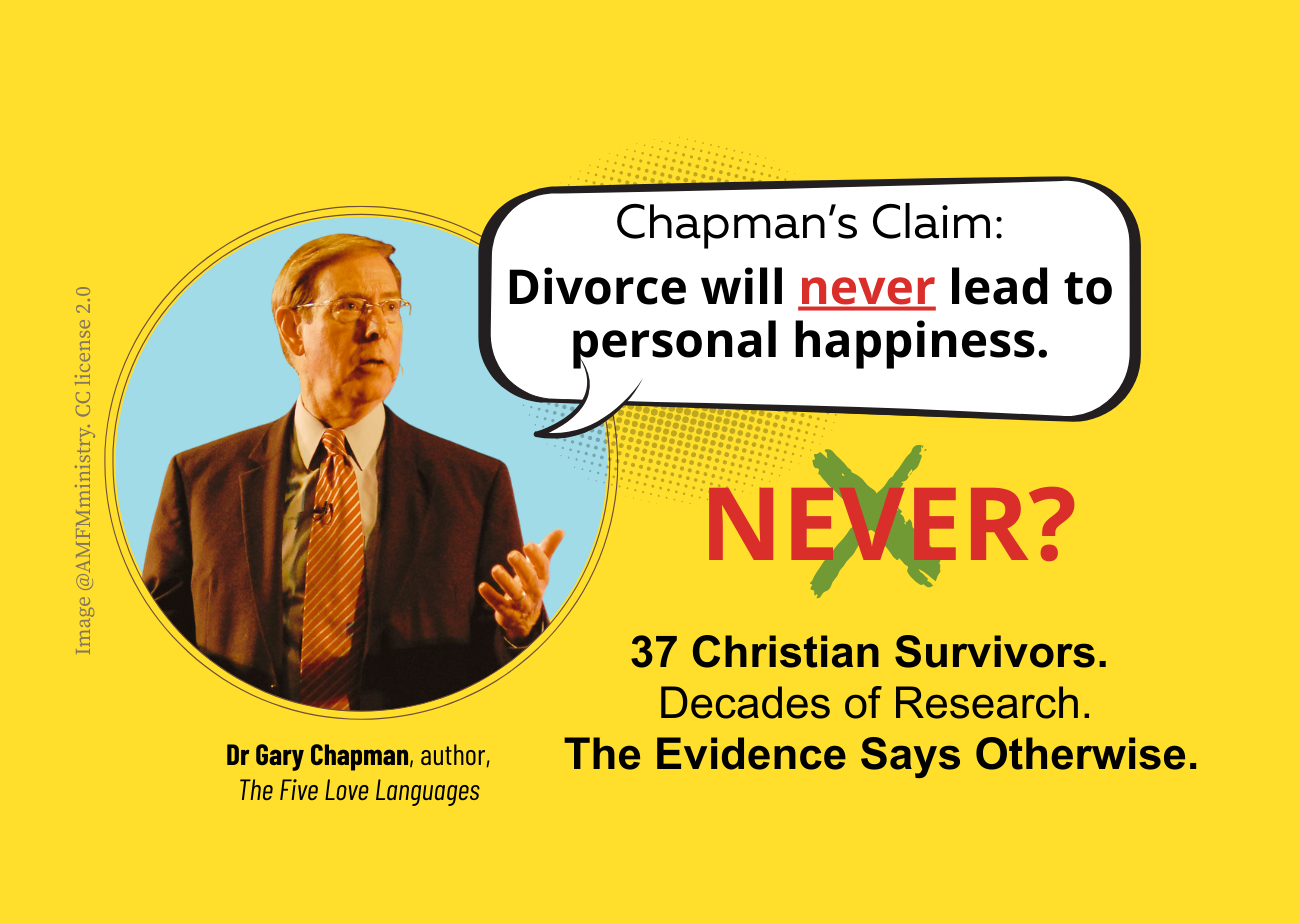
Yes, Dr. Gary Chapman, Divorce CAN Lead to Personal Happiness
Dr. Gary Chapman, author of The Five Love Languages says:
“Understand That Divorce Will Never Lead To Personal Happiness.”
—Gary Chapman’s Claim
Before we evaluate that claim, let’s hear from Christians who honor the sanctity of marriage, prayed and tried for years, but ultimately needed life-saving divorces to escape destructive, unsafe realities.
Christians Respond to Gary Chapman
I asked divorced Christians in my Life-Saving Divorce community:
“Do You Agree with Gary Chapman?”
Here’s what they said:
1. Gary is Wrong: “I’m Happy. I’m Free. I’m Safe.”
- -“I am happy. I believe that God can and does “fix” some marriages. I also firmly believe that God told me I had permission to leave.”
- -“I’m against frivolous divorces, but in my case, I was cheated on for five years and emotionally abused for longer than that. This is the best I’ve felt in close to a decade. For those in abusive or adulterous marriages, divorce can heal us and make us happy.”
- -I’m incredibly happy since my divorce. I feel like I’m who I used to be before my light was darkened. Those who knew me before my ex say my sparkle is back.
- -“Nope. I’m pretty happy. Much happier than when I was married.”
- -“Do not agree. I’m gloriously happy!”
- -“I’m pretty happy as a divorced woman. Much happier, in fact, than I ever was while married [to an abuser].”
- -“If I’d have known how happy divorce would make me, I’d have done it sooner.”
- -“My divorce definitely led to my happiness.”
- -“Ha! I’m SO much happier after my divorce. In fact, the only unhappiness I experience now occurs when my ex pops back up again, and every time, I am reminded of just how sick he is.”
- -“The day my divorce was finalized, I was euphoric. Life has not been easy, and I’ll never have the lifestyle I once had; but freedom is the sweetest thing ever.”
Editor’s Note: If you’ve been told divorce will ruin you forever, take a moment to scroll to the bottom of this post—there you’ll find encouraging, research-based facts that may surprise you.
2. Happiness Wasn’t the Goal. Survival Was.
- -“For most of us, personal happiness wasn’t the goal. Personal safety was.”
- -“How I could NOT be happy? I’m no longer married to a sexually destructive man who was mixed up with all kinds of abusive behavior.”
- -“Divorce delivers you from devastation to freedom. You can’t even begin to understand it if you have not experienced that.”
- -“Getting a life-saving divorce is the best thing I have ever done.”
- -“I would be dead today if I did not leave my ex. I remarried 13 years ago and have not once, regretted my decision to save my life.”
- “After 35 years of stress, my health was failing. My doctor told me that I was dying from a broken heart, anemia, and an 85 percent chance of congestive heart failure.”
3. Blanket Statements Like “Never” Are Dangerous
- -“Voices like Gary’s always suggest that we got a ‘grass is greener’ divorce or a ‘Hollywood’ divorce. But we got out to save our lives, praying for God’s help and leaping out into the darkness, never believing we would ever be happy again. But we were, and that surprised us.”
- -“Actually, in a sense Gary’s statement is true. Just as marriage can never lead to happiness, neither does divorce. What divorce will lead to is PEACE. Peace from abuse, oppression, domination, ridicule, degradation, manipulation, control, and a myriad of other toxic forms of neglect!”
- -“Obviously he hasn’t talked abuse victims who divorced. I’m incredibly happy. Other people might look at what I supposedly lost (my beautiful home) but I see only gain as I settle into this tiny apartment. Freedom. Peace. Safety. Can’t put a price on those.”
- -“Never” is such a strong word. Guess I should have stayed married to a child molester.
4. Some People Are Laughing… Because It’s So Out of Touch
- -“So, Gary believes we are all much happier to be abused, cheated on, and destroyed, than to be free of that? He’s obviously never *listened* to a divorced domestic violence survivor!”
- -“I’m laughing out loud at Gary’s advice.”
- -“Apparently he wasn’t married to my ex-husband.”
5. Men Spoke Up Too
- -“As a man who was married to a habitually unfaithful wife, I can say I did the right thing: divorced and happily remarried for nearly 20 years.”
6. The Real Harm: Theology That Keeps People Trapped
- -“Happiness isn’t everything, but I will say I am exponentially happier since my life-saving divorce! Blanket statements like this one from Gary Chapman are incredibly naive.”
- -“[Chapman’s] article’s advice is the same mentality and theology that kept me an abusive marriage for so long.”
- -“I think he would have a different opinion [if the roles were reversed and he was married to a wife who trampled all over him and cheated.]”
- -“Poppycock like this makes people stay in abusive marriages far longer than they should. From the article: “It’s important that a spouse considering separation understand that he or she has a great deal of power to change the marriage.” I used to believe that. It’s that type of thinking that keeps people trapped in abusive marriages. It’s nonsense.”
- -“Yes, there are many people who embrace the “no divorce” ideology, and I’m convinced they mean well, but they don’t realize that science shows that divorce saves lives. They were never open-minded enough to ask why so many divorcees and their kids are happy and doing better.”
- -“This is not a fluke, it’s common in his writings. In Chapman’s book, The Marriage You’ve Always Wanted, he brings up the word “divorce” a whopping 14 times, and in every anecdote he gives, divorce is portrayed as an act exclusive to vindictive, malicious women. From my perspective, it seems that either Chapman has never bothered to engage with a victim of abuse, or worse yet, he simply couldn’t care less about their well-being or safety. It’s abundantly clear that the prospect of you or your children suffering a prolonged, agonizing demise at the hands of an abuser holds little significance to him.”
7. The Cost of Staying Nearly Destroyed Them
- -“I adored my husband, and he hated me with his behavior. Even though I prayed him out of the house, I cried myself to sleep after for days. He was the father of my kids! I have NO REGRETS for divorcing him, because a guy who abuses you may stop at nothing to destroy you. Hey, Gary, have you ever even talked to an abused spouse? I can definitely tell he is not a genuine licensed counselor.”
- -“I stayed in my abusive marriage for over a decade after I started wanting to get out…mostly because of teaching from groups like Focus on the Family. I got more and more depressed. Something people don’t often talk about with depression is that it often leads to anger. I was a very angry person…which meant I yelled at my kids a lot. I didn’t have energy to be the joyful mom I wanted to be. That damaged my kids. The change in me after my husband moved out 3 years ago was so dramatic. I laugh, and dance around in the kitchen. I take my kids to the library, and to minigolf, and do crafts with them. I very rarely yell anymore. I’m so much happier now. I can be a much better mom now.”
- -“I am much happier than when I was married to a sexually destructive man.”
8. Christians Redefining Divorce and Misused Scripture
- -From the article: “True love involves looking out for the best interests of the other person. It’s not natural to want to serve another; it’s natural to love and be kind to the people who love and are kind to us. But Dr. Chapman believes that, with God’s love, couples can do the hard work during separation that leads to an ability to show unconditional love to a spouse.” I believe this is implying that we should love and stay with those who are mistreating us? Again, this is why people (especially Christians) get trapped in abusive marriages. Also, they tell you stories of “impossible” marriages where they were able to be “fixed”. So, if one couple can do it, all marriages can be saved? So much is being misconstrued here! But, to actually answer the question. No, I don’t agree with the assertion that divorce will never lead to personal happiness at all. I’m so much happier since my divorce. I am myself again. My closest friends and family will tell you that. I’m me again. It’s a good feeling. Freeing.
- -“I also think that Christians tend to mis-define the term “divorce” as something that happens when either party files papers with the court. Actually, most of us in this online group lived divorced for decades before any papers were filed. Clergy likes to quote Malachi 2:16 where God says “I hate divorce”, but if you read the preceding verses (something I didn’t do until after 20+ years of abusive marriage), you’ll see that God was referencing behavior that had already occurred: the men of Judah had been unfaithful to their wives, and God stated very clearly that He hated that behavior because it caused divorce (or in the KJV, the “putting away”). Filing papers hopefully brings legal and financial redress from our civil authorities.”
Christians Respond: Public Comments (Anonymized & Documented)
After publishing my article, dozens more Christians responded publicly. These are not private messages. These are real names, real accounts, publicly posted. I am summarizing and lightly anonymizing to protect privacy while preserving meaning.
Here is what Christian survivors said:
-
A woman reported her doctor told her: “This is the healthiest you’ve been in six years.” The only life change? She left her abusive marriage.
-
One woman shared that chronic migraines she endured for years disappeared entirely after leaving.
-
Another described her antidepressant dosage dropping to one-third of what it had been during her marriage.
-
A mother said: “I’m not happy because I’m divorced. I’m happy because my nervous system is finally at peace.”
-
A survivor of 36 years of deception and abuse said she no longer fears STDs, manipulation, or walking on eggshells — and that two pastors supported her decision.
-
A father wrote that divorce did not give him luxury. It gave him safety and freedom from oppression.
-
Multiple women described improved sleep, lower stress, better finances, higher credit scores, and restored church community.
-
One woman summed it up simply:
“Nothing tastes as good as freedom.”
These are not “I miss the party life” divorces.
These are trauma recoveries.
What the Research Actually Shows: Most People Do Regain Happiness After Divorce
Gary Chapman claims that divorce will “never” lead to personal happiness. But decades of family research have found the opposite: most people recover, and many report improved well-being—especially after leaving chronically destructive marriages.
Churches often repeat frightening claims: You’ll never be happy again. Your kids will be ruined forever. Your next marriage will fail. Divorce destroys lives.
That is not what the evidence shows.
Bradford Wilcox of the pro-family think tank Institute for Family Studies reported that within two years of divorce:
- about 50% of parents are doing fine, and
- about 20% are much happier afterward.¹
Likewise, the Baylor Religion Survey found that about 7 in 10 divorced Christians describe themselves as happy or somewhat happy after divorce.²
And one of the leading divorce researchers, Dr. Mavis Hetherington, observed that even the “left” spouses—those abandoned unwillingly—often experience an upsurge in emotional well-being by the second year as they adapt to their new life situation.³
Research also shows that staying in long-term, low-quality marriages can be more damaging than divorce. Hawkins and Booth concluded that people in chronically unhappy marriages often improve their well-being by dissolving those unions, with no evidence that they are better off staying.⁴
And despite the fear-messaging about children, large-scale outcome studies consistently find that most children—nearly 8 in 10—show no serious long-term impairment after divorce, especially when divorce ends exposure to chronic conflict or abuse.⁵
Divorce is not a magic wand. Recovery takes time. But the blanket claim that divorce never brings personal happiness is simply not supported by the research—or by the lived experience of thousands of Christians who found peace on the other side of life-saving divorce.
(For footnotes, see below. For graphs, citations, and research summaries, see this article: Researchers Say Most Parents and Children Have Higher Wellbeing After Leaving A Destructive Marriage)
Before We Accept His Claim, Let’s Examine Gary Chapman’s Credentials
Gary Chapman is widely platformed as a marriage expert. But what are his actual qualifications?
Chapman is not a licensed counselor. He does not hold a master’s or doctorate in counseling, psychology, marriage and family therapy, sociology, or social work. His degrees are in anthropology and religious education.
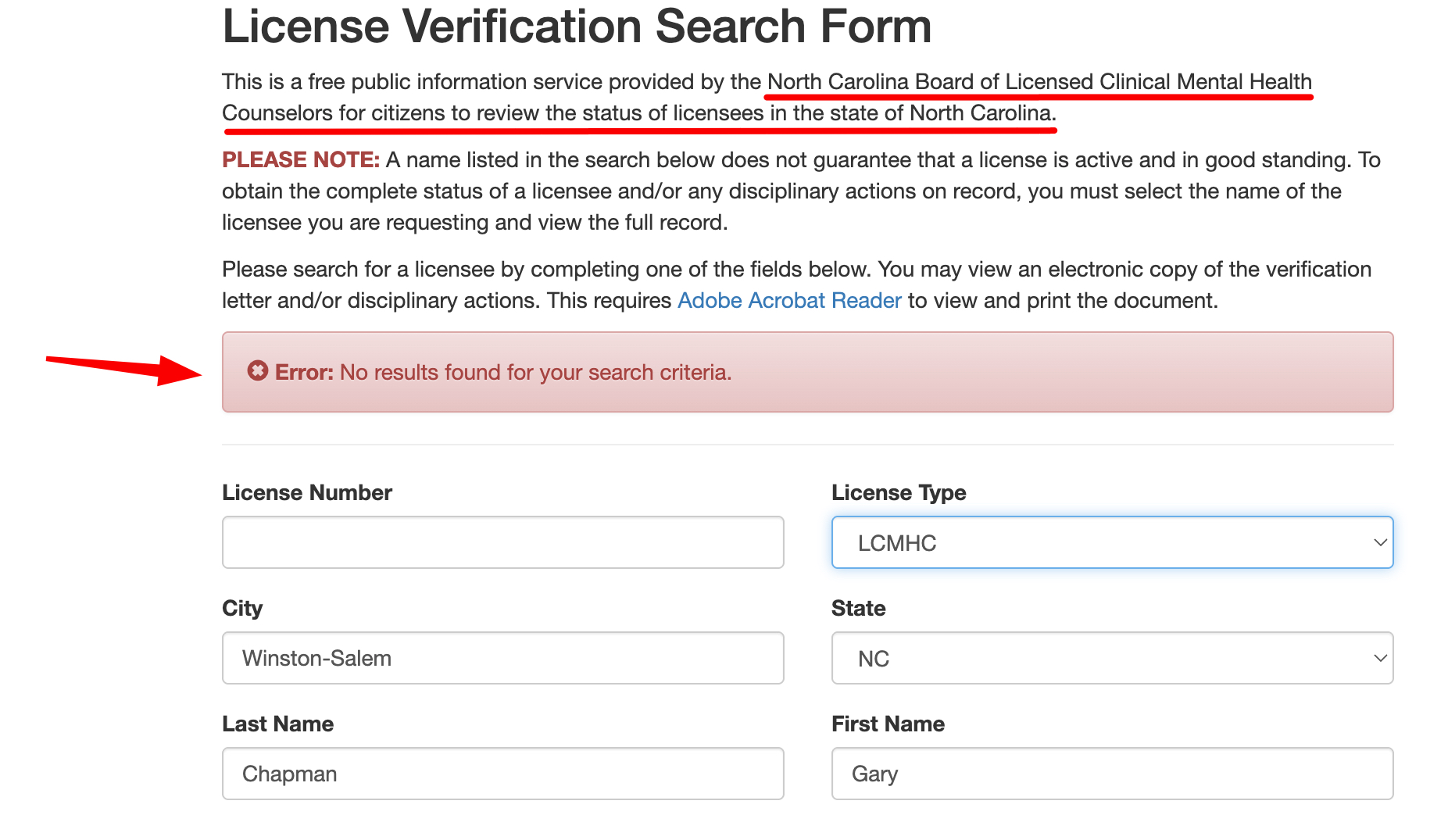
He does not appear in the State of North Carolina’s public licensing database as a Licensed Clinical Mental Health Counselor or Marriage and Family Therapist.
Yet he frequently speaks and writes as if he were functioning in that professional role.
The American Association of Christian Counselors’ ethics code states that professionals should not use titles in a way that implies credentials in a field where they do not hold them. That matters. Words like counselor and doctor carry weight, especially for vulnerable people seeking guidance.
When someone makes an absolute claim about divorce and happiness, credentials matter.
His opinion is not automatically invalid. But neither is it automatically authoritative.
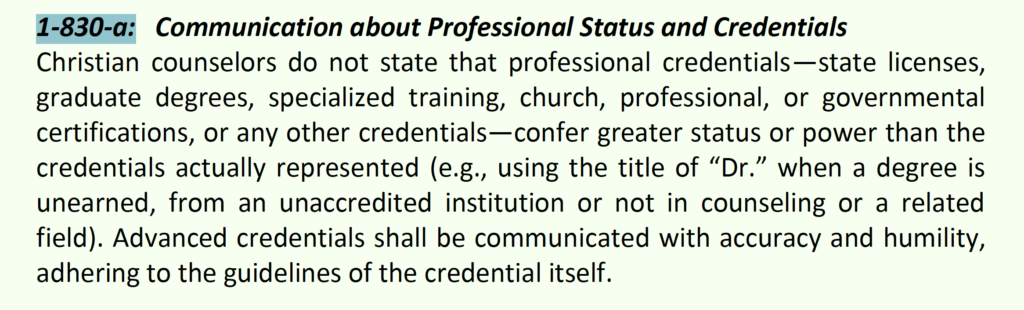
Paragraph 1-830-a of the American Association of Christian Counselors Ethics Code
🎓 Gary’s Credentials Keep Changing
Then there’s Chapman’s shifting résumé. Focus on the Family inflated Gary Chapman’s bio between 2023 and 2025. Suddenly in 2025 he’s a marriage-and-family counselor, even though he has no related degree or licensing.

Click to enlarge. Image of Gary Chapman’s bio on the Focus on the Family website in 2023

Click to enlarge. Image of Gary Chapman’s bio on the Focus on the Family website in 2025
Chapman isn’t a licensed counselor
Gary Chapman does not appear on the State of North Carolina’s public licensing database as a Licensed Clinical Mental Health Counselor or Marriage and Family Therapist. He holds degrees in anthropology and religious education, not counseling or therapy, marriage and family, sociology, or any other related field. It appears he’s just a pastor and author with opinions.
Click to enlarge. No listing for any Gary Chapman in North Carolina as a licensed clinical mental health counselor
A Quick Fact Check on Gary Chapman’s Use of Judith Wallerstein
Chapman claims that divorce “never” leads to personal happiness and cites Judith Wallerstein’s book Second Chances to support that statement.
But Wallerstein did not make that claim. Here are four quotes from Second Chances.
By 1989, Wallerstein was already saying that divorce was a rational solution to a bad marriage. And notice that she doesn’t limit it to physical abuse.
Although our overall findings are troubling and serious, we should not point the finger of blame at divorce per se. Indeed divorce is often the only rational solution to a bad marriage. When people ask if they should stay for the sake of the children, I have to say, “Of course not.” All our evidence shows that children turn out less well-adjusted when exposed to open conflict, where parents terrorize or strike one another, than do children from divorced families.” —Dr. Judith Wallerstein, Second Chances: Men, Women and Children, A Decade after Divorce, p. 322 (Originally published 1989. Referenced Kindle edition, 2018)
Wallerstein told people “Don’t stay ‘for the sake of the children.’” Wallerstein didn’t want people to stay in a cruel, demeaning, or intensely lonely marriage “just for the kids”:
“But for many other people, divorce is the best solution, and staying married “for the sake of the children” (as it is so often stated) is not the wiser path. When a marriage is cruel, demeaning, or intensely lonely, divorce opens new opportunities to build a better life. The details of such unhappy marriages are often shocking. I met one couple who had not talked to each other in three years; they just passed notes back and forth. One man went to bed fully clothed every night for years, sending a not so subtle message to his wife beside him in the bed. Others brought lovers into the home when the spouse was away. In some marriages, in-laws invaded the home at all hours, leading one man to say, “She was never mine!” —Dr. Judith Wallerstein, Second Chances: Men, Women and Children, A Decade after Divorce, p. xxxiv (Originally published 1989. Referenced Kindle edition, 2018)
Wallerstein was realistic about how bad marriages harm society, and says people in these bad marriages don’t consider it a mistake to divorce, even 10 years after the fact.
“Divorce is a useful and necessary social remedy…. And the fact is that most divorces with children are not impulsive. People may be wretched and lonely for years before summoning up the courage to separate, and most worry about the effects of divorce on their children. There is considerable evidence that a conflict-ridden marriage is not in the best interests of the children. There is evidence, too, that children benefit from dissolution of such marriages. Nor do most people consider that their divorce was a mistake a decade after the fact.” —Judith Wallerstein, Second Chances: Men, Women and Children, A Decade after Divorce, p. 16 (Originally published 1989. Referenced Kindle edition, 2018)
In 1989, Wallerstein mentioned the lack of comparison studies between unhappy families and divorced families. She felt divorce was better for kids in these cases.
“And while we lack systematic studies comparing unhappily married families and divorced families, I do know that it is not useful to provide children with a model of adult behavior that avoids problem solving and that stresses martyrdom, violence, or apathy. A divorce undertaken thoughtfully and realistically can teach children how to confront serious life problems with compassion, wisdom, and appropriate action.” —Dr. Judith Wallerstein, Second Chances: Men, Women and Children, A Decade after Divorce, p. 322 (Originally published 1989. Referenced Kindle edition, 2018)
By the mid-1990s, studies had been conducted comparing unhappy-but-married families vs. divorced families and the outcomes of children’s wellbeing in each. Dr. Paul Amato found that in highly troubled families, divorce was the better option—as much as 10 times better.
Wallerstein also explicitly states that for many people—especially those in cruel, demeaning, or intensely lonely marriages—divorce can be the best solution and can open opportunities to build a better life. In her 1995 book, The Good Marriage, she studied 50 happy couples, including 18 remarriages after divorce. She said:
“For all of these people, divorce was a gift, even a blessing.” The Good Marriage, p. 284.
That is not “never.”
That is a nuanced research conclusion about risk factors and varied outcomes.
Turning a complex, longitudinal study into a blanket moral statement distorts the source. Wallerstein described patterns. She did not declare that divorce can never bring personal happiness.
When someone uses the word never, it is wise to read the original material.
A Pattern of Minimizing Women’s Pain
Across decades of teaching, Gary Chapman shows a consistent reluctance to center the lived experience of abused spouses—especially women.
Even in describing conflict within his own marriage, his reflections tend to focus on his internal spiritual growth rather than naming the specific impact of his behavior on his wife. In public interviews and writings about marital hardship, he frequently speaks about empathy in principle. Yet empathy requires clearly identifying the other person’s suffering and validating it in concrete terms.
That pattern carries over into his broader teaching.
When discussing destructive marriages, Chapman often emphasizes what the faithful spouse can do differently—pray harder, love more unconditionally, try new approaches—rather than clearly acknowledging the reality of coercive control, chronic betrayal, addiction, intimidation, or violence.
This framing subtly shifts responsibility back onto the harmed spouse. It suggests that if the marriage does not improve, the faithful partner may not have done enough.
For survivors of abuse, that message is not neutral. It reinforces the very theology that kept many of them trapped.
The issue is not whether Chapman believes in marriage. Many of us do. The issue is whether his framework adequately accounts for marriages marked by cruelty, domination, and danger.
When religious leaders minimize the severity of abuse—or present divorce as categorically incompatible with happiness—they risk keeping vulnerable women and men in harm’s way.
Jesus confronted religious systems that placed burdens on the suffering while protecting rigid ideology. He freed people from bondage.
Christian teaching about marriage should do the same.
Rescuing God’s precious children is what Jesus does.
And it’s what Jesus wants from all of us,
including Dr. Gary Chapman
More on Gary Chapman’s Marriage Advice
- The Surprising Way Dr. Gary Chapman Talks About His Wife, Karolyn — And Why It Matters
What Chapman consistently avoids naming, even in his own marriage story, reveals a lot.
https://lifesavingdivorce.com/gary-chapman-marriage-critique/ - Critics Push Back: Answering 7 Objections to How Gary Chapman Talks About His Wife, Karolyn
A response to readers who challenged my analysis—and why Chapman’s framing still matters.
https://lifesavingdivorce.com/gary-chapman-wife-language-response/ - Is Gary Chapman’s Marriage Advice Safe for Abuse Victims?
A critical look at Focus on the Family’s claims, Chapman’s credentials, and the danger of “try harder” theology.
https://lifesavingdivorce.com/chapman2/ - HUMOR: Dr. Gary Chapman’s Double-Speak Blame Decoder
A plain-language guide to the subtle ways blame gets shifted onto abused spouses.
https://lifesavingdivorce.com/chapman3/ - How Gary Chapman’s New Book (Unintentionally) Teaches Abusers How to Get Away with It
https://lifesavingdivorce.com/fotfvideo/
Sources for footnotes
-
-
- Wilcox, W. B. (Institute for Family Studies). Summary of post-divorce adjustment findings cited in The Divorce Experience Study (2004).
- Baylor Religion Survey (Wave data reported by Ryan Burge). Post-divorce happiness among Christians (approximately 70% “happy” or “somewhat happy”).
- Hetherington, E. M., & Kelly, J. (2002). For Better or For Worse: Divorce Reconsidered. New York: W.W. Norton, pp. 150–151.
- Hawkins, D. N., & Booth, A. (2005). “Unhappily Ever After: Effects of Long-Term, Low-Quality Marriages on Well-Being.” Social Forces, 84(1), 451–471.
- Amato, P. R. (2010). “Research on Divorce: Continuing Trends and New Developments.” Journal of Marriage and Family, 72(3), 650–666. (Summarizes the majority of children showing resilience and no severe long-term dysfunction.)
- Blog image of Gary Chapman, https://www.flickr.com/photos/52938430@N04/4886191652 Used under CC license 2.0
-
 :
:
 :
: Buy PDF