
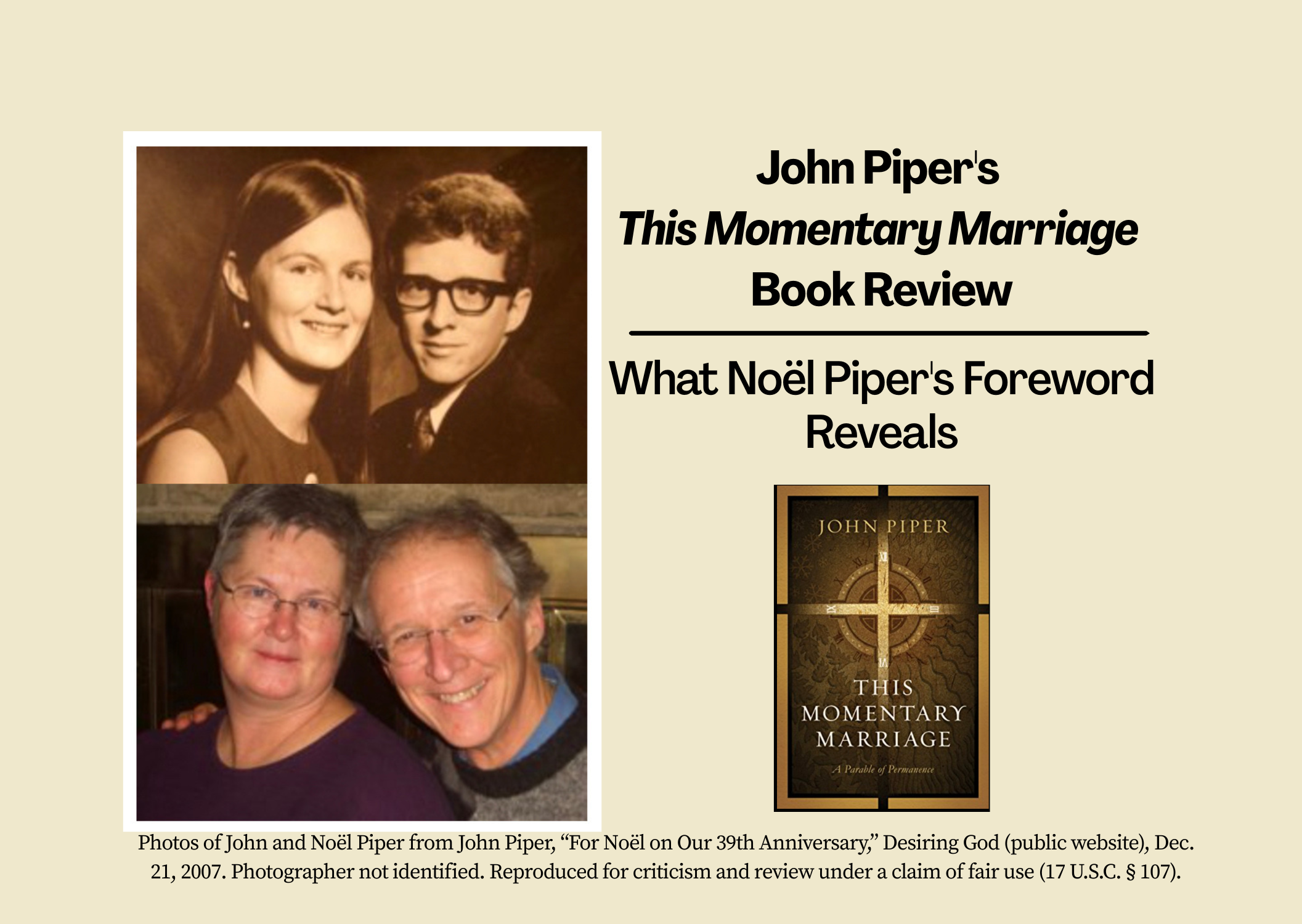
This Momentary Marriage: When Merely “Staying Married” Becomes the Measure of Faithfulness
This Momentary Marriage was written and first published in 2009—the same year Piper said a wife might endure verbal abuse “for a season” and perhaps be “smacked one night” before seeking help from the church. The following year, he took an eight-month leave from ministry to address character flaws that he said had affected his marriage, family, and ministry.
The book reveals more than Piper’s theology. Through Noël Piper’s own words, it also reveals a marriage marked by profound unhappiness and emotional strain.
Jump down to read about Noël Piper’s foreword and her description of their marriage.
John Piper’s Unique Interpretation
About Marriage
John Piper presents This Momentary Marriage as a biblical guide built on several controlling ideas:
- Marriage is temporary and belongs only to this life. Piper calls it a “momentary gift” and says romance, sex, and childbearing are temporary gifts that will not continue in the next life (pp. 16–17).
- Marriage’s highest purpose is to display Christ’s covenant with the church. He says marriage exists “ultimately to display the covenant-keeping love between Christ and his church” (pp. 42–43).
- The central measure of faithfulness is preserving the covenant, not staying in love or feeling warmth and affection. Piper writes, “Marriage is not mainly about being or staying in love,” but about portraying the gospel through one’s life (pp. 25–26).
- Ministry and eternal priorities take precedence over ordinary marital expectations.
- Piper opens with three stories of married Christian couples who died while carrying out their callings. He then quotes 1 Corinthians 7:29 about living “as though” one had no wife, along with passages about leaving family for the kingdom, costly obedience, and expected suffering (pp. 13–17).
- Within that framework, romance, emotional satisfaction, sexual intimacy, and children are temporary gifts that must be held loosely. Piper tells readers to live “as though” they were not holding them and warns that marriage may include “bitter providences” and “swamps with choking vapors” (pp. 16–17).
- The practical implication is deeply troubling: a disappointed, unhappy, neglected, or overwhelmed wife may be encouraged to lower her expectations and endure rather than treat her distress as evidence that something is seriously wrong. This is an inference from Piper’s priorities, not his exact wording, but it follows from his repeated elevation of covenant permanence, suffering, ministry, and eternal purpose over romance and present marital flourishing (pp. 16–17, 25–26, 42–43).
That is why Noël Piper’s foreword (discussed below) should not be brushed aside as a few unfortunate marital moments. It reads as an account of real unhappiness, conflict, concealed distress, thoughts of escape, and emotional strain.
About Divorce
Readers should know that Piper’s teaching on divorce and remarriage is unusually strict, even among conservative Christians. Piper admits that his position is “very much in the minority” even among Bible-believing scholars and pastors. He also says that his interpretation of Jesus’ exception for sexual immorality “is not widely held” (pp. 173, 175).
Piper’s Divorce and Remarriage Position in a Nutshell in This Book
- Piper permits a “redemptive separation” for serious wrongdoing such as assault, child abuse, adultery, or drunken rage (p. 53).
- He also says that a believer may peacefully accept a civil divorce when an unbelieving spouse insists on leaving (pp. 172–173).
- However, he maintains that death is the only final end of marriage and that remarriage while a former spouse is alive is an act of unfaithfulness to the original covenant (pp. 169–170, 173).
- Piper believes that divorce does not free either former spouse to remarry as long as both are still alive.
But Christians do not have to accept that view in order to take the Bible seriously. Many conservative Christians believe Jesus allows divorce in cases of sexual immorality and that Paul allows it when one spouse abandons the marriage.
Related reading on the biblical texts:
Other Christian Leaders in Piper’s World Hold Different Positions
Dr. Wayne Grudem changed his position on divorce and remarriage and argued that serious abuse can be a biblical ground for divorce and can free the innocent spouse to remarry.
He gives several reasons: abuse can force a spouse out of the home just as effectively as desertion; Paul’s phrase “in such cases” in 1 Corinthians 7:15 may include other situations that similarly destroy a marriage; ongoing abuse is a form of enslavement rather than the peace to which God calls believers; and repeated cruelty or violence can damage a marriage even more deeply than abandonment.
He also includes severe verbal cruelty, credible threats, destructive addictions, and other patterns of substantial harm.
For his full argument, see Wayne Grudem, Grounds for Divorce: Why I Now Believe There Are More Than Two. The link is in my summary.
That matters because This Momentary Marriage is the result of Piper’s unusually rigid interpretation of well-known biblical passages. Readers should ask not only whether his arguments sound biblical, but whether his teaching helps create marriages that are safe, honest, loving, and good.
Related reading on covenant, divorce, and remarriage:
A Glimpse into John and Noël Piper’s Marriage
John Piper’s This Momentary Marriage is not merely troubling because of its theology. The book contains startling admissions about Piper’s own marriage—admissions that make his counsel to other struggling spouses even harder to accept.
In the foreword, Noël Piper says she and John are nearly opposite in personality and do not live together “with hardly any conflict” (p. 9). During difficult periods, she asks how they became so unhappy (p. 10).
She asks:
“How in the world did we get into such a mess?”
“What happened to make us feel this kind of disagreement and
unhappiness?”
She is asking the right questions, but the book never gives answers.
Her account of their twenty-fifth anniversary is worse. While guests congratulated them, their smiles were a “veneer we were all too used to.”
Noël privately imagined choosing an alias and “bolting for miles.” She stayed after an older woman assured her that the first twenty-five years were the hardest (p. 10).
That is not ordinary marital frustration. Women in healthy marriages may argue with their husbands, endure difficult seasons, and sometimes feel deeply disappointed. But they do not ordinarily describe anniversary smiles as a habitual façade, fantasize about disappearing under another name, or explain staying by saying they were told the first twenty-five years were the hardest.
Noël does call John an “amazing husband,” says he knows and loves her, and refers to him as her “favorite preacher.” But she offers almost no concrete examples of the kindness, tenderness, sacrificial care, or pursuit of her good that would explain what makes him an amazing husband. Her distress is described in detail; his virtues are largely vague.
Edition reviewed: John Piper, This Momentary Marriage (2009, first edition). All quotations and page references are from the first edition. Noël’s foreword in the latest edition is still the same.
The Closest She Comes
- She calls him an “amazing husband.”
- She says he is “the one who knew me, yet loved me still.”
- She says she sometimes wonders why he paid attention to her and asked
her to marry him. - She recalls one especially happy vacation when they enjoyed reading,
talking, walking, worshiping, playing Scrabble, and simply being
together.
But Notice What Is Missing
In the book, she never says things like:
- “John patiently listened to me.”
- “He sacrificed for me.”
- “He protected me.”
- “He pursued reconciliation.”
- “He comforted me.”
- “He apologized.”
- “He made me feel cherished.”
- “He consistently put my needs before his own.”
She does not describe him with specific qualities Scripture especially associates with a godly husband, such as:
- loving her sacrificially;
- nourishing and cherishing her;
- showing her honor;
- living with her in an understanding way;
- being gentle and not harsh;
- being patient and kind;
- protecting and caring for her;
- seeking her good;
- laying down his own interests for her; and
- being concerned with how to please her.
Those are the kinds of concrete examples readers often expect after hearing someone called an “amazing husband.”
Then John provides his own clues. He calls their marriage a journey through “wonders and wounds” and admits it has “not been trouble-free.”
His imagined picture of success is remarkably modest: reaching old age, sitting across from Noël at Old Country Buffet, and saying, “We made it” (p. 17).
Survival becomes the measure of success.
Elsewhere, the Pipers compare marital offenses to piles of manure that spouses should shovel aside instead of camping beside (pp. 59–60). John also acknowledges periods of serious strain and thanks friends who supported them through their hardest seasons (pp. 179–180).
Taken together, these passages portray a marriage marked by recurring pain, concealed unhappiness, support from trusted friends during difficult seasons, and endurance.
None of this proves that either Piper was abusive. But it does reveal a marriage with substantial conflict and pain. Piper acknowledges serious pain and sin in the marriage, but the book contains no clear personal confession such as, “I hurt Noël,” “I was wrong,” or “I apologized and made amends.” The injuries remain unnamed and responsibility remains shared or abstract.
Piper’s Theology Leads to Survival Instead of Mutual Care
His sexual teaching adds another danger. When a wife does not want sex, Piper tells her to “give it anyway” unless extraordinary circumstances exist.
The double standard is difficult to ignore. In the book, Piper’s own marriage is presented as complex enough to require concealment, loyal friends, endurance, and generous interpretation. His readers’ marriages can become occasions for a cavalry charge of doctrinal pressure.
In contrast, 1 Corinthians 7 cuts against any view of marriage that reduces it to bare endurance. The apostle Paul says that a married man should be concerned with “how to please his wife,” and a married woman with “how to please her husband” (1 Corinthians 7:33–34).
Marriage, in 1 Corinthians 7, creates real obligations of care, attention, and mutual concern. If a person is unwilling to seek the good of a spouse, then marriage is not a calling he should undertake. A theology that praises lifelong permanence while neglecting whether spouses are loved, protected, and pleased has missed something essential in Paul’s teaching.
Related reading on abuse and safety:
John Piper’s Emphasis on (Literal) Martyrdom Over Love in Marriage
This Momentary Marriage begins not with biblical companionship, mutual care, or a husband’s duty to nourish and cherish his wife, but with martyrdom. In the intro, Piper tells the stories of three Christian ministry couples who died while carrying out their callings—though, in a broader sense, every faithful Christian eventually dies while living out their calling. He then invokes texts about living as though one had no wife, leaving family for the kingdom, costly obedience, expected suffering, and enemies within one’s own household. The opening on pages 13-16 conditions readers to interpret marriage primarily through sacrifice and endurance before helping them distinguish ordinary hardship from suffering caused by cruelty, domination, or abuse.
Piper quotes, “Let those who have wives live as though they had none” (1 Cor. 7:29), but the apostle Paul is not endorsing neglect. The surrounding passage teaches that the present age is temporary: mourners, buyers, and those engaged with the world should all live as though these things are not ultimate. Yet in the same chapter, Paul says married people must be concerned with how to please their spouses. Marriage creates real obligations of attention and care. That is precisely why Paul presents singleness as preferable for those seeking undivided freedom for ministry.
The apostle Paul’s point is not, “Marry, then act as though your wife does not matter.” It is that marriage is temporary, but while it lasts, spouses owe one another genuine concern. Piper emphasizes the verse that limits marriage’s ultimate significance while underplaying the same chapter’s demand for practical marital care.
These verses can also be used very easily to teach wives that they should expect little from marriage so their husbands can devote themselves to ministry. “Live as though you had no wife,” combined with texts about leaving family, costly obedience, suffering, and household enemies, can be heard as: Your needs are secondary. Do not interfere with his calling. Expect sacrifice, not attention. If you feel neglected, that may simply be the cost of serving God.
What is solidly documented from Piper’s own material:
- In 2007, he wrote that holding hands with Noël “often it is a sign of truce.”
- In 2010, he took an eight-month leave because of concerns involving his “soul, marriage, family, and ministry.” He also said the marriage was “rock solid” in commitment but admitted that this was not necessarily an “emotionally satisfying” description. Desiring God later described that leave as a “soul check” involving marriage, fathering, worship, and public life.
As I read This Momentary Marriage,
each chapter seemed to answer the same question:
What should a husband do that’s more important than making his wife happy?
The answer is: almost everything.
That is not to say a husband should pursue happiness at the expense of holiness. Scripture gives a richer vision. Paul tells husbands to love, nourish, and cherish their wives (Ephesians 5:25–29) and to be concerned with how to please them (1 Corinthians 7:33). Those are practical, relational commands. Yet throughout This Momentary Marriage, they are repeatedly overshadowed by other priorities—displaying the gospel, preserving the covenant, enduring suffering, and remaining married until death—because this is a “momentary marriage.” Though, in one sense, every marriage is momentary.
Introduction: Martyrdom and costly discipleship.
Chapter 1: God’s glory, not staying in love.
Chapter 2: Displaying Christ, not marital delight.
Chapter 3: Covenant symbolism over companionship.
Chapter 4: Forgiveness over relational repair.
Chapter 5: Personal holiness over mutual flourishing.
Chapter 6: Male headship.
Chapter 7: Male leadership.
Chapter 8: Fearless submission.
Chapter 9: Spiritual identity in Christ over marital fulfillment.
Chapter 10: Hospitality and ministry.
Chapter 11: Sexual purity.
Chapter 12: Making disciples.
Chapter 13: Spiritual fatherhood.
Chapter 14: Covenant permanence.
Chapter 15: No remarriage while a spouse lives.
Conclusion: Endure until you can say, “We made it.”
Contrary to this line of thinking, the biblical vision is not merely to stay married. It is to love, nourish, cherish, and seek to please your wife. A marriage that prizes permanence while neglecting those commands has captured only part of the Lord’s vision.
15 Ways to Call Wife-Neglect “Faithfulness”
Piper may not intend to excuse neglect, but when nearly every chapter gives husbands something more important to pursue than their wives’ happiness, tenderness, and flourishing, one question becomes unavoidable: What woman would want to sign up for this?
What Is the Fruit of This Book’s Teachings?
Perhaps the clearest fruit of Piper’s teaching is marriage permanence. After forty years, Noël does not say that the marriage became happy or healthy. She says that they “feel like celebrating” reaching year forty, admits that “the pendulum still swings,” and expresses hope that they will reach their golden anniversary.
The outcome presented is endurance—not flourishing.
But where is the fuller vision of Ephesians 5? Where is the husband who consistently loves his wife as Christ loved the church—not merely by remaining in the marriage, but through sacrificial care, kindness, tenderness, protection, cherishing, nourishing, and the daily pursuit of her good? And where is Paul’s concern that married people seek to please one another?
Piper affirms some of these duties, but they are not the controlling emphasis of the book. Covenant permanence receives far more attention than the practical cultivation of mutual care, emotional safety, delight, and relational health.
If the highest aspiration after forty years is simply, “We made it,” then the biblical vision of marriage has been reduced from Christlike love and mutual flourishing to survival.
Before marrying someone who embraces Piper’s vision of marriage, ask yourself: Would I flourish in this marriage? Not merely, Would we still be married in fifty years? but, Would I be deeply loved, cherished, protected, understood, delighted in, and sacrificially cared for? Would this man lay down his life for my good—or only for his ministry? Those are biblical questions too.
Recommended Reading
To explore these issues further, the following resources examine the biblical texts, theological arguments, and practical concerns raised by This Momentary Marriage:
- Piper Part 1: Does Divorce Destroy the Image of Christ and the Church?
Piper warns that divorce can “shatter” the picture of Christ and the church. I examine whether Scripture places that burden on an injured spouse—and why ongoing cruelty and covenant-breaking behavior are the real distortion of Christ’s love. - Piper Part 2: This Momentary Marriage—When Staying Married Becomes the Goal
My review looks at Piper’s unusually strict position on divorce and remarriage, the book’s emphasis on permanence, and Noël Piper’s candid description of profound conflict and unhappiness in their own marriage. - Piper Part 3: Did He Retract His “Smacked One Night” Advice?
This article traces Piper’s wife-abuse statements from 2009 through 2020 and asks whether his later comments amounted to a genuine retraction, correction, or apology.
Related Biblical Resources
- 1 Corinthians 7:10 Explained: What Paul Meant About Separation and Remarriage
A closer look at Paul’s instructions to married Christians, including what the passage does—and does not—say about separation, abandonment, and remarriage. - Romans 7 Does Not Teach “Marriage Ends Only at Death”
- Can the Innocent Spouse Remarry? Biblical Scholar Dr. David Instone-Brewer Says Yes
- Marriage Is a Conditional Covenant, Not an Unbreakable Promise
Biblical covenants contain responsibilities. A marriage certificate records promises, but it does not prove that both spouses have faithfully kept them. - Wayne Grudem Supports Divorce and Remarriage After Abuse, Adultery, and Abandonment
Grudem explains why serious abuse can function like abandonment and why the innocent spouse may be free to divorce and remarry. - Can Christians Divorce for Abuse?
- The Bible Teaches Us to Get Away from Abusers
Scripture repeatedly shows faithful people escaping violent, deceptive, and destructive individuals rather than remaining available for further harm. - Safety-First vs. Marriage-First Counseling
Marriage-first counseling asks how to preserve the relationship. Safety-first counseling begins by asking whether the spouse and children are safe.
 :
:
 :
: Buy PDF