
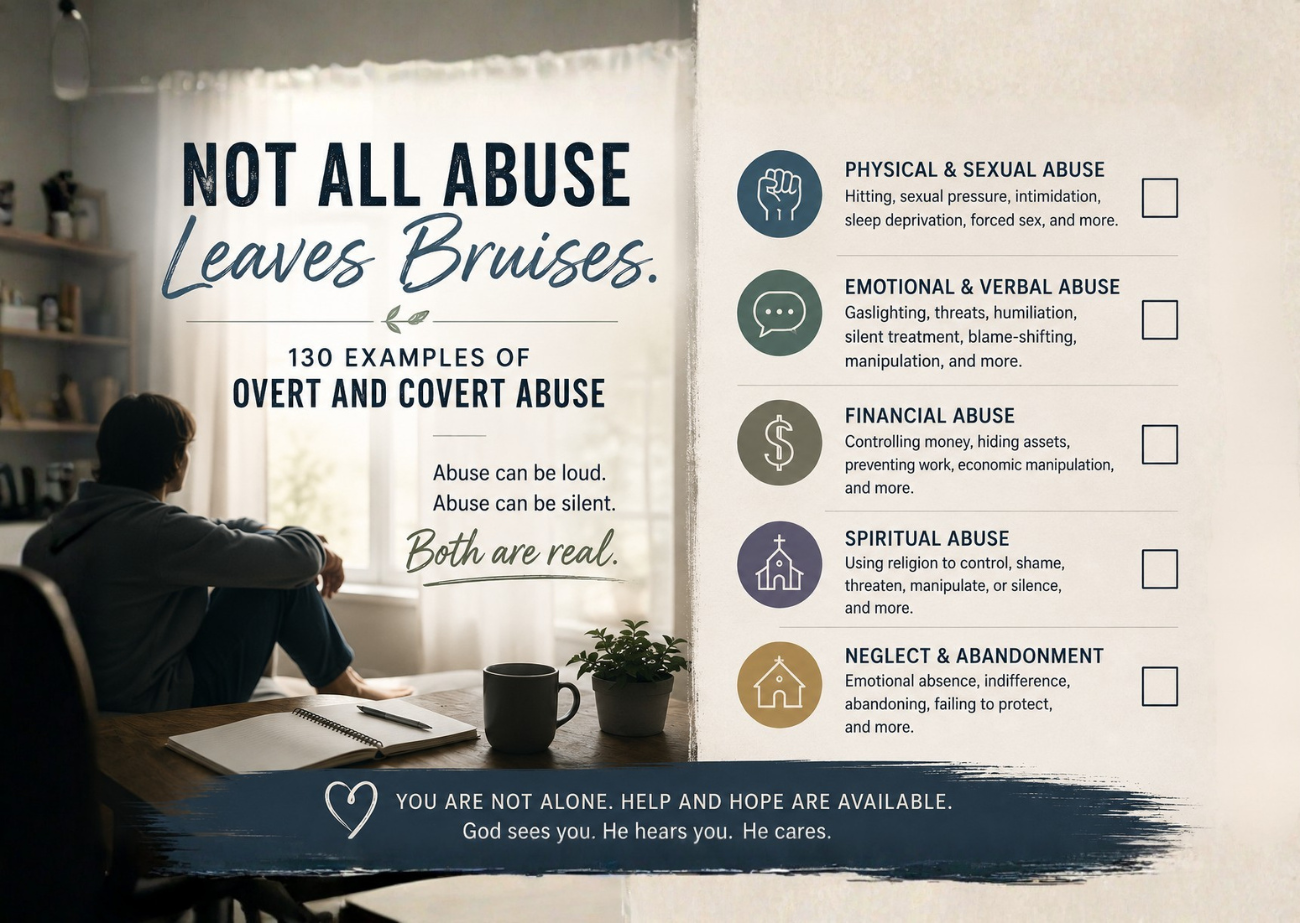
Is This Abuse? 130 Overt and Covert Warning Signs
Not all abuse is physical. Not all abuse is loud. Some abuse slowly wears you down until you barely recognize yourself. This list compares obvious abuse with more disguised abuse.
If you are struggling to determine whether your marriage is unhealthy, coercive, emotionally destructive, or abusive, this checklist may help you recognize patterns that are often minimized or overlooked—especially in Christian or highly religious marriages.
When Abuse Does Not Look Like Abuse
Many people do not recognize abuse in their marriage because they are looking for the obvious signs: hitting, bruises, screaming, threats, or police calls. And yes, those things are abuse. They are serious. They should never be minimized.
But many destructive marriages are quieter than that.
Sometimes abuse looks like chronic indifference, stonewalling, financial secrecy, sexual pressure, spiritual manipulation, emotional abandonment, public kindness, private contempt, or a spouse who makes you feel like you exist only as an accessory to their life.
This is especially confusing for Christians. In many churches, people are taught to forgive quickly, submit more, pray harder, communicate better, and avoid divorce at almost any cost. Those teachings can make a victim minimize abuse that is covert, deniable, or wrapped in spiritual language.
You may have read other abuse lists and thought, That is not what I am experiencing, so maybe this is just a difficult marriage. But a marriage can be destructive even when no one has hit you. Covert abuse can slowly erode your health, confidence, faith, friendships, finances, and ability to think clearly.
In a loving marriage, both spouses matter. In an abusive marriage, one spouse’s feelings, demands, image, ministry, comfort, or goals dominate the home. The other spouse becomes the fixer, appeaser, scapegoat, emotional shock absorber, or the one who quietly disappears.
You do not have to call it abuse before you are ready. You can start with something simpler:
- This is not okay.
- I feel controlled, pressured, or worn down.
- I am walking on eggshells.
- I am disappearing in this marriage.
- This relationship does not feel safe.
That matters. God sees what is hidden. Psalm 10 says God sees “the trouble of the afflicted” and listens to their cry. If you are confused, exhausted, or afraid to tell the truth about your marriage, you are not invisible to God.
“But you, God, see the trouble of the afflicted; you consider their grief and take it in hand… You, LORD, hear the desire of the afflicted; you encourage them, and you listen to their cry…”
—Psalm 10:14, 17 (NIV)
Overt Abuse and Covert Abuse
Overt abuse is easier for outsiders to recognize. It may include hitting, threats, sexual assault, screaming, intimidation, weapons, stalking, stealing, public humiliation, or open cruelty.
Covert or disguised abuse is harder to name. It may include gaslighting, silent treatment, chronic neglect, sleep deprivation, spiritual pressure, financial secrecy, sabotage, blame-shifting, emotional abandonment, or making you doubt your own judgment.
Both overt and covert abuse can be physical, sexual, emotional, financial, spiritual, or neglectful. Both can damage your body, mind, faith, children, finances, and future. The difference is not whether one “counts.” The difference is how easily people recognize it.
If your marriage has not been physically violent, you may also want to read But He Never Hit Me: Divorce for Neglect, Emotional, and Financial Abuse and Can I Divorce for Abuse? Can Christians Divorce for Abuse?.
How to Use This Checklist
This list is divided into More Overt / Easier to Recognize and More Covert / Often Minimized. This is not a scientific ranking, and covert abuse is not “less serious.” In fact, covert abuse can be especially confusing because it may be hidden behind charm, apologies, Bible verses, tears, public respectability, or claims of good intentions.
You do not need every item on this list for a marriage to be destructive. One repeated pattern can do tremendous damage.
- Note: For more on this, see “Emotional Abuse IS Physical Abuse” Chronic emotional abuse, coercive control, fear, and prolonged stress can profoundly affect the brain, body, nervous system, and long-term physical health—even when there are no visible bruises.
For a broader categorized abuse reference list, see 130 Examples of Abuse: Physical, Emotional, Sexual, Spiritual, Financial and Neglect.
If you are in immediate danger, call emergency services. For planning and documentation, see 12 Ways to Document and Protect Yourself & Kids in a Divorce and Escape Plan: 50-Item Checklist.
130 Examples of Abusive Behaviors
Physical and Sexual Abuse and Neglect
More Overt / Easier to Recognize as Abuse
- Smashing things, punching walls, damaging property, or destroying sentimental items to frighten you, punish you, or show power.
- Hurting, threatening, neglecting, or using pets to strike fear in you, punish you, or force your compliance.
- Throwing knives, stones, or other objects at you or near you. Spitting at you.
- Slapping, hitting, kicking, punching, burning, dragging, shaking, choking, shoving, or “accidentally” knocking into you. Breaking bones or twisting joints.
- Stalking, repeatedly following you, or harassing you in a way that would make you fear injury.
- Waving a gun or displaying a weapon such as a knife or baseball bat.
- Holding you down, tying you up, locking you in, kidnapping you, or restraining you against your will.
- Threatening to hurt you, your children, your pets, or your possessions.
- Frightening you with dangerous behavior: reckless driving, road rage, speeding, swerving, tailgating, running lights, aggressive passing, brake-checking, or threatening to crash the car while you or the children are inside.
- Withholding food, water, clothing, or other basic necessities.
- Giving you drugs or medicine without consent.
- Trying to impregnate you against your will or expose you to disease.
- Sex without your consent.
- Refusing to accept your no.
- Unwanted sexual contact, molestation, fondling, or brushing up against you without consent.
- Marital rape.
- Leaving you stranded somewhere and driving away.
- Neglect during surgery, childbirth, or other medical crises.
- Failing to help when you cannot manage basic life functions.
- “Wife spanking” or Christian Domestic Discipline used to establish control.
- Forced labor.
- Exhibitionism or voyeurism.
- Exposing you to pornography against your will.
- For children: exposing them to pornography or sexualized situations.
- For children: incest, attempted sexual contact, or sexual exploitation.
More Covert / Harder to Recognize or Often Rationalized
- Towering over you, pinning you against a wall, blocking your way, or invading your space.
- Hiding, removing, or tampering with contraceptives.
- Using sex or withholding agreed-upon intimacy to control reproduction while refusing mutual decision-making.
- Sleep deprivation.
- Frequently waking you up in the middle of the night to criticize you, pressure you, or demand sex.
- Abandonment, whether temporary or long-term: leaving you stranded, storming off and disappearing for hours or days, refusing to answer calls or messages, withholding their whereabouts, vanishing during conflict or crisis, or leaving you to manage the home, children, finances, or emergencies alone while they make themselves unreachable.
- Leaving for weeks or months with little communication while expecting you to hold everything together.
Verbal, Emotional, and Mental Abuse
More Overt / Easier to Recognize as Abuse
- Belittling your appearance, mannerisms, values, or abilities.
- Lecturing, condescending, or treating you as beneath them.
- Predicting you will fail at anything you try on your own.
- Treating you like a child through threats or bribes.
- Claiming everyone knows you are the problem.
- Saying you are nothing without them.
- Saying your opinions are stupid or worthless.
- Demanding proof of your love or loyalty.
- Using social media to bully, stalk, threaten, or intimidate you.
- Threatening divorce, abandonment, suicide, affairs, or punishment to control you.
- Calling you crazy, stupid, selfish, dramatic, unstable, unlovable, or mentally ill.
- Explosive screaming, cursing, raging, or verbal intimidation.
- Public humiliation or mockery.
- Humiliating you in front of children, friends, church members, or relatives.
- False accusations.
- Interrogating you aggressively.
- Threatening to take the children away.
- Threatening to ruin your reputation.
- Threatening false police reports or legal action.
- Destroying your confidence through repeated attacks on your character.
- Intimidating facial expressions, clenched fists, glaring, or aggressive body language.
- Monitoring your movements obsessively.
- Isolating you from family, friends, church, work, or support systems.
- Demanding access to your phone, accounts, journals, or private communications.
- Repeatedly accusing you of cheating without cause.
- Using children against you.
- Turning others against you with lies or smear campaigns.
More Covert / Harder to Recognize or Often Spiritualized/Minimized
- Chronic indifference to your wellbeing: ignoring your pain, illness, exhaustion, pregnancy, recovery, fear, or basic need for care and support.
- Using gifts, apologies, tears, promises, or public niceness to pressure you to stay silent, drop boundaries, or pretend the abuse did not happen.
- Muttering under their breath to show contempt.
- Sighing, smirking, or using contemptuous tones to belittle you.
- Acting smug or superior.
- Showing indifference toward your wellbeing.
- Refusing to listen to your goals, hopes, or desires.
- Acting helpless or incapable to avoid responsibilities.
- Excusing seductive behavior as “boys will be boys” or similar.
- Excusing porn use by blaming you.
- Professing love while actions never match words.
- Refusing to be pleased by your efforts.
- Minimizing bad behavior: “You’re overreacting.”
- Using “always” and “never” to exaggerate your faults.
- Crossing your boundaries while calling you crazy, sensitive, or unstable.
- Backing out of commitments at the last minute.
- Stonewalling important discussions or decisions.
- Silent treatment.
- Sulking and forcing you to guess what is wrong.
- Changing the rules so they apply only to you.
- Walking out of serious discussions repeatedly.
- Making major life decisions unilaterally.
- Using gifts to force forgiveness while making no real amends.
- Interrupting your work, rest, sleep, bathing, prayer, or important events for non-emergencies.
- Seducing you and then rejecting you.
- Blaming others for flirtation while claiming innocence.
- Emotional withholding.
- Acting affectionate publicly but cold privately.
- Making you feel invisible or emotionally alone.
- Expecting you to carry all emotional labor in the relationship.
- Requiring constant accommodation while offering little reciprocity.
- Creating confusion so you constantly second-guess yourself.
- Gaslighting.
- Acting wounded whenever you bring up concerns.
- Weaponized incompetence.
- Using pity, illness, childhood trauma, or tears to avoid accountability.
- Keeping you emotionally exhausted and off balance.
- Making you responsible for their moods or stability.
- Training you to walk on eggshells.
- Making the marriage revolve around their image, desires, comfort, or goals.
- Treating you more like an accessory, servant, audience, or emotional regulator than an equal spouse.
- Withholding affection as control—making you feel terrible for going against their wishes, then giving brief special attention so you feel grateful for crumbs of affection.
Financial Abuse
More Overt / Easier to Recognize as Abuse
- Stealing money or property.
- Hiding assets or income.
- Preventing you from working.
- Sabotaging your employment.
- Running up debt in your name.
- Refusing access to money for necessities.
- Taking your paycheck.
- Forcing financial dependence.
- Threatening financial ruin.
- Refusing to pay agreed household expenses while spending freely on themselves.
- Deliberately under-earning or refusing suitable work while leaving the family’s basic needs unmet.
More Covert / Harder to Recognize or Often Rationalized
- Making you justify every purchase.
- Giving you an “allowance” while maintaining unequal power.
- Slowly creating dependency over time.
- Keeping all financial information secret.
- Using money to reward or punish emotionally.
- Financial irresponsibility that keeps the family unstable.
- Refusing long-term planning while expecting you to absorb the consequences.
- Expecting you to carry all household management while they avoid responsibility.
- Making you feel guilty for basic needs.
- Controlling finances under the guise of “leadership,” “wisdom,” or “protecting the family.”
Spiritual Abuse
More Overt / Easier to Recognize as Abuse
- Using Bible verses to demand silence, submission, or staying in danger.
- Threatening church discipline if you leave.
- Telling a victim to pray “as though God has already healed” the abuser, while ignoring ongoing abuse/addiction cause trouble in real life.
- Blaming the victim for the abuser’s choices.
- Saying the victim is “not a real Christian.”
- Public spiritual humiliation.
- Telling others you are ungodly, rebellious, bitter, or unforgiving.
- Using prayer, sermons, or counseling sessions to shame or control you.
- Declaring that God is always on their side against you.
More Covert / Harder to Recognize or Often Praised as “Godly”
- Using forgiveness language to bypass accountability. Demanding instant forgiveness on the abuser or leader’s time table.
- Pressuring you to endure suffering indefinitely.
- Framing boundaries as selfishness or rebellion.
- Weaponizing “grace.”
- Selective repentance without real change.
- Performing godliness publicly while behaving differently privately.
- Spiritual bypassing: using “focus on Jesus” or “God will fix it” to avoid confronting danger.
 :
:
 :
: Buy PDF