
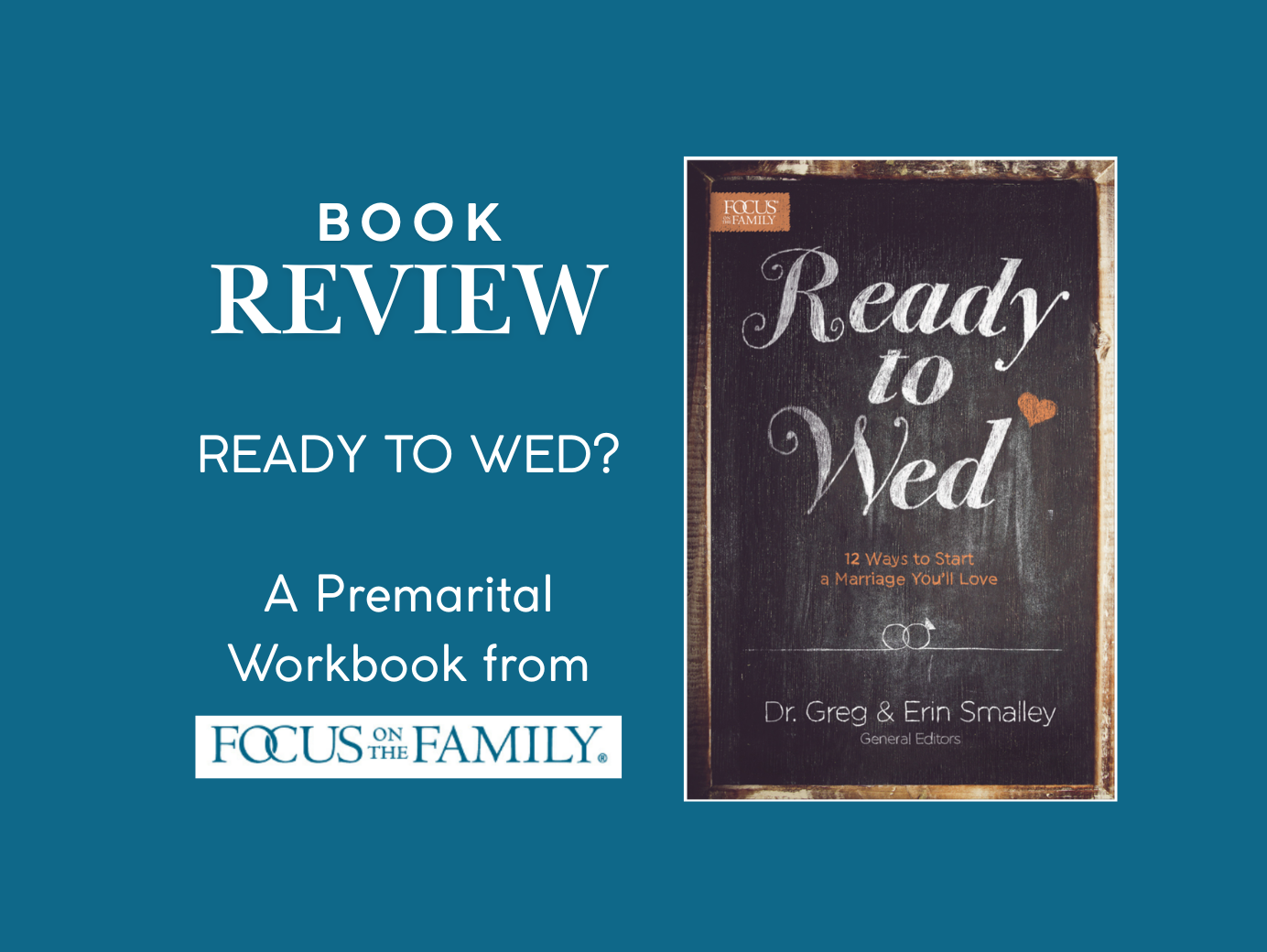
Ready to Wed? Premarital Curriculum from Focus on the Family
5 Pros and 9 Cons for Pastors and Small Group Leaders
Ready to Wed? is a structured, church-friendly premarital curriculum with real strengths in communication, expectations, and relationship habits. But its framework is far stronger for helping basically functional couples prepare for marriage than for helping pastors or engaged couples identify coercive control, chronic deception, addiction, pornography secrecy, intimidation, or other high-risk patterns.
The book offers external links to the structured PREPARE/ENRICH Couple Checkup assessment ($35) and LOGB discussion tools, but they are not a meaningful abuse-specific or danger-specific screening process. The ‘LOGB Personal Strengths Survey’ is a repackaging of John Trent’s familiar Lion–Otter–Golden Retriever–Beaver personality typology under the more professional-sounding title.
In other words, it helps couples communicate and plan—but it does not adequately help couples (or churches) discern whether they are truly ready for marriage, or whether serious red flags make the relationship unsafe or unwise to enter. (See readers’ comments about the pornography section on page 99 at the bottom of this article.)
Overall, the workbook reflects a marriage-education framework that prioritizes conflict management and “teamwork” language more than abuse-aware discernment.
PROS
- Strong emphasis on communication skills. It offers structured prompts and exercises that help couples talk about expectations, conflict, and habits.
- Encourages growth and intentional habits. The book pushes couples to plan, reflect, and build patterns that support long-term connection.
- Promotes shared responsibility and teamwork. Couples are encouraged to cooperate, pursue unity, and problem-solve together.
- Draws from Christian research and pastoral experience. Leaders will recognize the “church-friendly” tone and accessible application.
- Frames hardship as an opportunity for maturity. The authors emphasize that marriage will involve trials and that character growth matters.
9 CONCERNS
1. Very Limited Treatment of Abuse and Coercive Control
The book gives extensive attention to communication, expectations, stress, sexuality, and couple habits, but it offers very limited guidance on serious issues that can make a marriage unsafe or deeply unwise to enter.
The following behaviors are not meaningfully addressed within a clear premarital safety framework:
• Physical violence (hitting, pushing, restraining)
• Threats or intimidation
• Fear or safety planning
• Explosive anger or volatile temper
• Emotional abuse or gaslighting
• Coercion or control (financial, social, sexual)
• Pornography secrecy or sexual deception
• Infidelity, adultery, chronic deception (beyond a brief admonition such as “don’t cheat”)
• Addiction (substances, gambling, sex)
• Jealousy and possessiveness
• Contempt, humiliation, verbal degradation
• Monitoring devices, phone checking, surveillance
• Unequal power dynamics
• Patterns or “cycles” of harm
• Criteria for genuine repentance and measurable change
• When to postpone or cancel a wedding
The book does address sexual temptation and pornography prior to marriage. However, it does not meaningfully examine marital infidelity, betrayal trauma, or patterns of deception after the wedding. Nor does it equip couples or pastors to discern whether a fiancé(e)’s secrecy, minimization, or addiction history may signal deeper character concerns.
For a premarital curriculum, these are not fringe scenarios. They are foreseeable risks.
2. No Clear Identification of Disqualifying Behavior
Although the book prepares couples for ordinary conflict, it does not equip leaders or couples to identify potentially disqualifying behavior before marriage in a clear, abuse-informed way. And that matters because a sizable minority of divorced Christians say they were never taught about red flags.
If we hope to reduce the number of failed marriages, we must teach couples how to recognize red flags before vows are exchanged—not assume they already know them or will seek counseling on their own. A premarital curriculum should offer a straightforward screening framework and guidance for leaders on what requires a serious pause, professional help, and time.
Instead, Ready to Wed? largely assumes that many problems can be handled through communication, coaching, or counseling without offering clear criteria for when a wedding should be delayed or canceled due to ongoing deception, coercion, addiction, or abusive dynamics. Individuals who cancel a wedding, even after the invitations have gone out, need to be supported.
Premarital preparation should include screening, not just communication skill-building.
3. Their Own Research Suggests a Need for More Nuance
Focus on the Family has sponsored research indicating that:
• 44% of divorced Christians wished their church had offered more practical, hands-on help (p. 30)
• 41% wished their church had taught more about healthy marriage (p. 29)
If those findings are taken seriously, we would expect premarital curricula to place greater emphasis on:
• Recognizing destructive patterns early
• Teaching about emotional and spiritual abuse
• Identifying coercive control and betrayal
• Supporting the breaking of an engagement where there are serious issues
• Publicly acknowledging that some divorces are protective
Instead, Ready to Wed? continues to focus primarily on marriage preparation and conflict management, without adequately equipping couples to discern when a relationship may be unsafe or unwise to enter.
4. Theological Language That Can Shift Blame to the Harmed Spouse
5. Divorce Condemned Before Safety Is Discussed
Within the opening pages, divorce is condemned multiple times—anchored to “I hate divorce” (Malachi 2:16) and reinforced as a spiritual tragedy. Readers are urged to guard against the “violent dismembering” of one flesh and warned about hardened hearts as the cause of marital collapse.
What is striking is the sequencing.
Before any meaningful discussion of abuse, coercion, betrayal, intimidation, or safety, divorce is framed as spiritually catastrophic. The institution is defended before harm within the institution is examined.
This order matters. When marriage is elevated as sacred without equally naming behaviors that violate its covenantal core, the implicit message can become: protect the marriage at almost any cost.
Biblically, however, marriage exists to protect people—not the other way around. Covenant language in Scripture consistently confronts injustice, hardness of heart, and oppression. When divorce is condemned without simultaneously condemning covenant-breaking harm, the moral emphasis can tilt toward preserving the institution rather than safeguarding the vulnerable.
For pastors and leaders using this curriculum, that imbalance deserves careful reflection. Notably, when divorce affected the Smalleys’ extended family, their public response demonstrated more nuance than the book’s description of divorce, which can read as uniformly catastrophic.
6. Pornography Framed as a “Couple Problem” Even Prior to the Wedding
In Juli Slattery’s chapter on sexual intimacy, the book acknowledges that porn is common and spiritually dangerous, and it rightly notes that sexual sin affects both partners. However, at one point (see exact quote at the bottom of this post) it instructs engaged couples to begin seeing porn struggles as “your problem as a couple,” while also saying they should not take responsibility for the fiancé(e)’s purity. It’s double-speak.
That combination creates a predictable risk: the betrayed or concerned partner may feel pressure to manage someone else’s ongoing behavior—monitoring, soothing, minimizing, “being understanding,” or treating repeated deception as a shared burden rather than a serious integrity issue that may require postponing the wedding.
What is missing is the sentence engaged couples and church leaders need in plain language:
If pornography use is ongoing, hidden, minimized, or compulsive, postpone the wedding until there is verified, sustained change and full honesty.
7. Emphasis on “Leave and Cleave” Could Be Overapplied
Ready to Wed? mentions “leave and cleave” more than a dozen times and frames it as a core marker of marital loyalty, often contrasting spouse-first with parents or other family influence.
Ready to Wed? book, Greg & Erin Smalley, general editors; chapter by Ted Cunningham, pp. 21, 25–26, 30–31
- “The focus of this text is relational and emotional leaving.”
- “To leave Mom and Dad means to forsake, depart from, leave behind, and abandon your family of origin.”
- “Leaving your parents relationally and emotionally means you leave and abandon their expectations for your life.”
- “Your spouse-to-be needs to be the first go-to person for all decision making, parenting plans, personal struggles, and conflict resolution.”
- “When in conflict, don’t seek your parents as allies.”
- “Think about all of your most important relationships, and find pictures representing those relationships. Plan a time where you and your fiance(e) can discuss taking a leave of absence. Discuss what this will look like practically. How will you communicate to your parents, siblings, and friends that you need time to cleave to your spouse? How long will your leave of absence be? What boundaries will need to be placed?”
8. The Authors’ Wider Writings Suggest Destructive Marriages are More Common Than This Book Shows
Ready to Wed? presents marriage and divorce in strongly cautionary, high-commitment terms. Yet in the broader Christian counseling and ministry world—including later public commentary from the Smalleys and other ministry leaders—difficult marital situations such as betrayal, abuse, and family crisis are often handled with more nuance than this curriculum makes explicit.
That matters because pastors and small group leaders may assume the book reflects the fullest range of practical counsel available from the authors’ wider ministry. In practice, however, the curriculum reads more categorical than many later pastoral discussions about when protection, delay, separation, or other serious responses may be warranted.
9. A Missing Safeguard Even Christian Researchers Recommend
What’s missing is a key safeguard that even Christian family researchers say premarital curriculum should include: the willingness to stop an unhealthy marriage before it begins.
One of the contributors to Ready to Wed?, Dr. Scott Stanley (Chapter 3), is a family researcher who has studied the effectiveness of Christian premarital classes delivered through churches. Here’s what his research team concluded:
“We believe premarital education should serve as a prevention effort to help healthy and happy couples stay that way and that keeping distressed, abusive, or otherwise unhealthy couples together would not be a positive outcome.”
They also raise the question of “how and when these programs should advise individuals to leave damaging relationships.”
In other words, even Christian relationship scholars acknowledge that some weddings should be delayed—or not happen at all. That safeguard is not clearly built into Ready to Wed? as a practical premarital screening principle.
Bottom Line for Pastors and Small Group Leaders
Ready to Wed? can be a helpful tool for communication, expectations, and habit-building. But if you use it, you will need to supplement it with clear teaching on abuse, coercive control, addiction, chronic deception, pornography secrecy, infidelity, and safety.
Premarital preparation should not only help couples communicate better—it should also help them discern wisely. That includes giving pastors and leaders practical guidance for when a wedding may need to be slowed down, postponed, or reconsidered because serious patterns have not been resolved.
When a premarital book fails to address these realities, the responsibility for screening and safety education falls almost entirely on the pastor or small group leader.
For a list of Christian church curriculum and resources on abuse, coercive control, and safety, scroll down to TOPIC 22 on the Recommended Resources list.
Concerns Raised by Thoughtful Readers
Many readers objected to the troubling discussion of pornography on page 99, written by Juli Slattery. See a summary of their comments below.
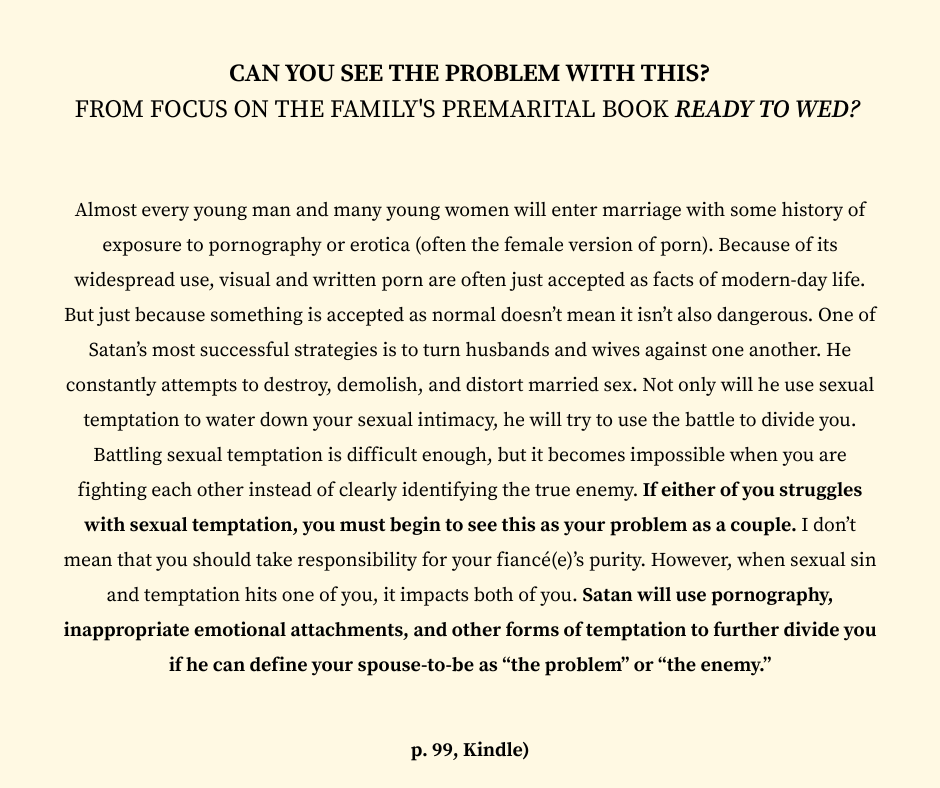
Actual quote shows how pornography is described in the Focus on the Family premarital book READY TO WED? page 99, Kindle
Themes from readers’ comments and reviews:
- Mixed message / doublespeak: “It’s your problem as a couple” immediately followed by “I don’t mean you’re responsible” reads contradictory and confusing, especially for anxious or socialized-to-caretake partners.
- Mutualizing individual sin: Porn use is framed as shared rather than the user’s moral/character issue (repentance, honesty, treatment, accountability). People objected that this blurs responsibility.
- Pre-marriage “exit ramp” removed: The wording discourages postponing/calling off the wedding and implies it’s already too late—setting people up to stay.
- Codependency/enmeshment risk: “Couple problem” language can pull the other partner into monitoring, soothing, managing triggers, and “being the accountability system.”
- Gendered burden: Many see it as shifting emotional labor onto women in a purity-culture ecosystem (“men lead—until they sin, then she’s blamed”).
- Minimizing betrayal trauma: It treats porn primarily as temptation or spiritual warfare rather than deception or a relational rupture that can require separation, time, and trauma-informed support.
- Too little guidance toward real help: Commenters wanted explicit referrals to qualified professionals (e.g., CSAT/APSATS), disclosure processes, and time-bound recovery markers before marriage.
- Sin-leveling / false equivalence: Calling erotica “the female version of porn” drew pushback (exploitation/relaying; not identical harms).
- Over-spiritualizing blame: Some objected to making “Satan” the central actor, which can reduce agency and accountability for choices.
- Spiritual pressure to marry: When pornography is framed as “Satan trying to divide you,” the partner who wants to delay or end the relationship can appear spiritually suspect or feel guilty—creating pressure to move forward despite unresolved integrity or safety concerns.
- Power-imbalance concern with couples therapy: A few argued that defaulting to “couples counseling” can reinforce existing inequities and pressure the betrayed partner to “work on the relationship” while the user keeps control.
FREE DOWNLOAD: Pastor 12-Question Checklist for Evaluating Christian Premarital Books and Workbooks.
 :
:
 :
: Buy PDF